

Kirjahaku
Etsi kirjoja tekijän nimen, kirjan nimen tai ISBN:n perusteella.
1000 tulosta hakusanalla Paul Ashbee


The Poems And Miscellaneous Compositions Of Paul Whitehead
Paul Whitehead; Edward Thompson
KESSINGER PUBLISHING, LLC
2009
pokkari


PAUL TWITCHELL'S SECRET AGENT MAN, was not known to this world until recently. The Real Universal Guides have kept him a secret, until Now. It is time for their NUPresentation, THE NUWAVIS THE ROD OF POWER. What is already taking place on many of the inner levels of Life, is an exposure of those who have perpetuated a fraud to the unaware humans of the earth. From religion and politics, to the so-called 'spititual paths' that have been around, and who look to personalities and worshiping authoritative deities. Young Duane, Rebazar Tarzs and Paul Twitchell's, Secret Agent Man, is reporting The Real News Now, and it does show up in people's DreamVisions. For those who test The NU-U Sessions, they will make contact with Rebazar and Paul, then be shown what is taking place Now with The TruReality, THE ALLIS. www.DuaneTheGreatWriter.Info

Paul as an Administrator of God in 1 Corinthians
John Goodrich
Cambridge University Press
2012
sidottu
This book looks in detail at Paul's description of apostles in 1 Corinthians 4 and 9 as divinely appointed administrators (oikonomoi) and considers what this tells us about the nature of his own apostolic authority. John Goodrich investigates the origin of this metaphor in light of ancient regal, municipal and private administration, initially examining the numerous domains in which oikonomoi were appointed in the Graeco-Roman world, before situating the image in the private commercial context of Roman Corinth. Examining the social and structural connotations attached to private commercial administration, Goodrich contemplates what Paul's metaphor indicates about apostleship in general terms as well as how he uses the image to defend his apostolic rights. He also analyses the purpose and limits of Paul's authority - how it is constructed, asserted and contested - by examining when and how Paul uses and refuses to exercise the rights inherent in his position.

Paul Samuelson on the History of Economic Analysis
Cambridge University Press
2014
sidottu
As one of the most famous economists of the twentieth century, Paul Anthony Samuelson revolutionized many branches of economic theory. As a diligent student of his predecessors, he reconstructed their economic analyses in the mathematical idiom he pioneered. Out of Samuelson's more than eighty articles, essays, and memoirs, the editors of this collection have selected seventeen. Twelve are mathematical reconstructions of some of the most famous work in the history of economic thought - work by David Hume, François Quesnay, Adam Smith, Karl Marx, and others. One is a methodological essay defending the Whig history that he was sometimes accused of promulgating; two deal with the achievements of Joseph Schumpeter and Denis Robertson; and two review theoretical developments of his own time: Keynesian economics and monopolistic competition. The collection provides readers with a sense of the depth and breadth of Samuelson's contributions to the study of the history of economics.
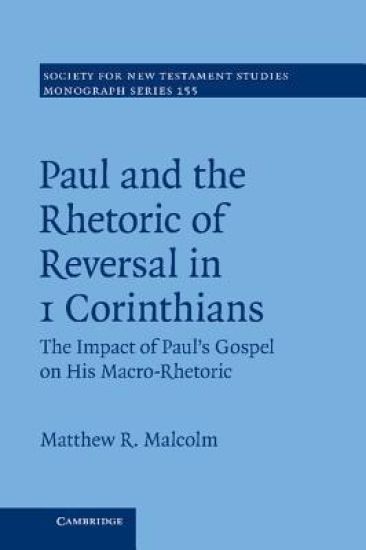
Paul and the Rhetoric of Reversal in 1 Corinthians
Matthew R. Malcolm
Cambridge University Press
2013
sidottu
The first letter to the Corinthians is one of the most discussed biblical books in New Testament scholarship today. Despite this, there has been no consensus on its arrangement and central theme, in particular why the topic of the resurrection was left until the end of the letter, and what its theological significance would have been to the Corinthian church. Matthew R. Malcolm analyses this rhetoric of 'reversal', examines the unity of the epistle, and addresses key problems behind particular chapters. He argues that while Jewish and Greco-Roman resources contribute significantly to the overall arrangement of the letter, Paul writes as one whose identity and rhetorical resources of structure and imagery have been transformed by his preaching, or kerygma, of Christ. The study will be of interest to students of New Testament studies, Pauline theology and early Christianity.

Paul and Ancient Rhetoric
Cambridge University Press
2016
sidottu
The Apostle Paul lived and breathed in a Hellenistic culture that placed high value on the art of rhetoric, and recent advances in rhetorical criticism of the New Testament have resulted in a new emphasis on the rhetorical aspect of his letters. As many scholars have pointed out, however, it is not clear to what extent ancient rhetoric actually influenced Paul and his writing or how important rhetoric is for interpreting the Pauline corpus. This volume, containing contributions from major figures in the field, provides a nuanced examination of how ancient rhetoric should inform our understanding of Paul and his letters. The essays discuss Paul's historical context, present innovative advances in and trenchant critiques of rhetorical theory, and offer fresh readings of key Pauline texts. Outlining the strengths and weaknesses of a widely used approach, Paul and Ancient Rhetoric will be a valuable resource for New Testament and Classics scholars.

Paul's Political Strategy in 1 Corinthians 1–4
Bradley J. Bitner
Cambridge University Press
2015
sidottu
This volume examines 1 Corinthians 1-4 within first-century politics, demonstrating the significance of Corinth's constitution to the interpretation of Paul's letter. Bradley J. Bitner shows that Paul carefully considered the Roman colonial context of Corinth, which underlay numerous ecclesial conflicts. Roman politics, however, cannot account for the entire shape of Paul's response. Bridging the Hellenism-Judaism divide that has characterised much of Pauline scholarship, Bitner argues that Paul also appropriated Jewish-biblical notions of covenant. Epigraphical and papyrological evidence indicates that his chosen content and manner are best understood with reference to an ecclesial politeia informed by a distinctively Christ-centred political theology. This emerges as a 'politics of thanksgiving' in 1 Corinthians 1:4-9 and as a 'politics of construction' in 3:5-4:5, where Paul redirects gratitude and glory to God in Christ. This innovative account of Paul's political theology offers fresh insight into his pastoral strategy among nascent Gentile-Jewish assemblies.

Paul, the Corinthians and the Birth of Christian Hermeneutics
Margaret M. Mitchell
Cambridge University Press
2012
pokkari
In a series of exchanges with the Corinthians in the mid-50s AD, Paul continually sought to define the meaning of his message, his body and his letters, at times insisting upon a literal understanding, at others urging the reader to move beyond the words to a deeper sense within. Proposing a fresh approach to early Christian exegesis, Margaret M. Mitchell shows how in the Corinthian letters Paul was fashioning the very principles that later authors would use to interpret all scripture. Originally delivered as The Speaker's Lectures in Biblical Studies at Oxford University, this volume recreates the dynamism of the Pauline letters in their immediate historical context and beyond it in their later use by patristic exegetes. An engagingly written, insightful demonstration of the hermeneutical impact of Paul's Corinthian correspondence on early Christian exegetes, it also illustrates a new way to think about the history of reception of biblical texts.

This is the first ever edition of the early version of Sons and Lovers, D. H. Lawrence's highly popular autobiographical novel. Amongst all the surviving early drafts of Lawrence's works this is the most different from the final version; as he rewrote, Lawrence discarded many episodes, some of them stories from his childhood not recorded anywhere else. It is less polished than Sons and Lovers, but it is full of powerful, spontaneous, dramatic writing: there is more humour and charm, more raw violence and nervous energy. This volume also contains remarkable documents written by Lawrence's girlfriend Jessie Chambers, the model for Miriam in Paul Morel and in Sons and Lovers, in which she gives Lawrence some hostile criticisms and writes out for him her own versions of some of his episodes. In addition there is a fragment of a novel about his mother's childhood, facsimiles of manuscript pages, maps, and scholarly notes and apparatus.

Paul's Political Strategy in 1 Corinthians 1–4
Bradley J. Bitner
Cambridge University Press
2025
pokkari
This volume examines 1 Corinthians 1-4 within first-century politics, demonstrating the significance of Corinth's constitution to the interpretation of Paul's letter. Bradley J. Bitner shows that Paul carefully considered the Roman colonial context of Corinth, which underlay numerous ecclesial conflicts. Roman politics, however, cannot account for the entire shape of Paul's response. Bridging the Hellenism-Judaism divide that has characterised much of Pauline scholarship, Bitner argues that Paul also appropriated Jewish-biblical notions of covenant. Epigraphical and papyrological evidence indicates that his chosen content and manner are best understood with reference to an ecclesial politeia informed by a distinctively Christ-centred political theology. This emerges as a 'politics of thanksgiving' in 1 Corinthians 1:4-9 and as a 'politics of construction' in 3:5-4:5, where Paul redirects gratitude and glory to God in Christ. This innovative account of Paul's political theology offers fresh insight into his pastoral strategy among nascent Gentile-Jewish assemblies.

Paul as an Administrator of God in 1 Corinthians
Goodrich John
Cambridge University Press
2014
pokkari
This book looks in detail at Paul's description of apostles in 1 Corinthians 4 and 9 as divinely appointed administrators (oikonomoi) and considers what this tells us about the nature of his own apostolic authority. John Goodrich investigates the origin of this metaphor in light of ancient regal, municipal and private administration, initially examining the numerous domains in which oikonomoi were appointed in the Graeco-Roman world, before situating the image in the private commercial context of Roman Corinth. Examining the social and structural connotations attached to private commercial administration, Goodrich contemplates what Paul's metaphor indicates about apostleship in general terms as well as how he uses the image to defend his apostolic rights. He also analyses the purpose and limits of Paul's authority - how it is constructed, asserted and contested - by examining when and how Paul uses and refuses to exercise the rights inherent in his position.

Paul and Religion demonstrates the continuing and contemporary relevance of the most important, and most controversial, figure of early Christianity. Paul Gooch interrogates the Pauline writings for their meaning as well as implications for religion as an entire form of life, a stance on the world expressed in distinctive practices. Bringing a philosophical approach to this topic, he connects Paul's ideas to lived experience. In a conversational style, Gooch explores Paul's experience of grace and his dismissal of distinctive markers of religious identity in favour of love as binding together a community. Contrary to common expectations, he finds within Paul's letters material for conversations about issues in our day, such as gender and sexuality. From his close reading of the Letters, Gooch argues that the Pauline religious form of life is not identical with institutional Christianity. Indeed, his conclusions may be welcome to those who belong to other faiths.