Kirjojen hintavertailu. Mukana 12 363 183 kirjaa ja 12 kauppaa.

Kirjahaku

Etsi kirjoja tekijän nimen, kirjan nimen tai ISBN:n perusteella.

1000 tulosta hakusanalla Phillip Good

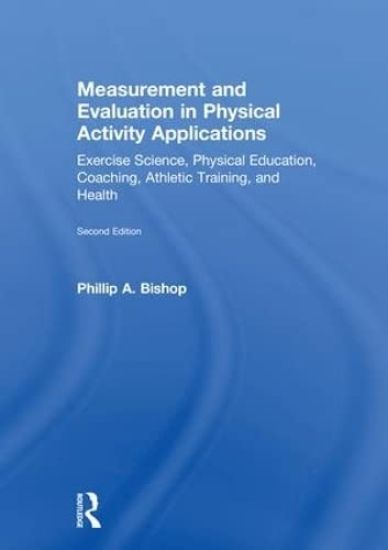
Measurement and Evaluation in Physical Activity Applications
Measurement and Evaluation in Physical Activity Applications offers the most accessible, student-friendly introduction to the principles and practice of measurement in physical activity available. Fully revised and updated, the second edition provides students with a clear guide to the obstacles to good measurement, and how to apply the principles of good measurement to a range of physical activity disciplines.Spanning applications in exercise science, sports performance, physical education, sports coaching, athletic training, and physical activity and health, the book also includes chapters on the key principles underlying good measurement practice—validity, reliability, and objectivity—as well as an introduction to using statistics and qualitative measurement.Structured to reflect single-semester classes, and involving students at every stage through its rich pedagogy and accessibility, this is a crucial resource for introducing students to the principles of best practice in measurement and evaluation. It is the ideal learning aid for any students studying measurement, evaluation, or assessment in kinesiology, exercise science, sports coaching, physical education, athletic training, and health and fitness.
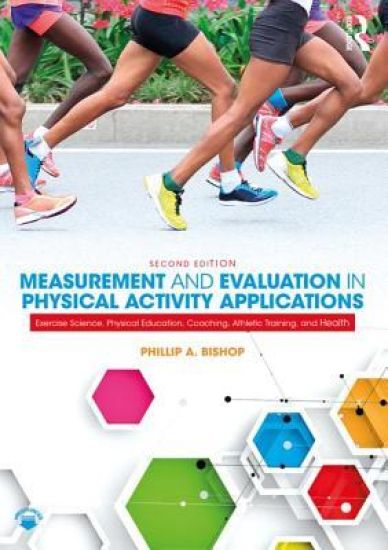
Measurement and Evaluation in Physical Activity Applications
Measurement and Evaluation in Physical Activity Applications offers the most accessible, student-friendly introduction to the principles and practice of measurement in physical activity available. Fully revised and updated, the second edition provides students with a clear guide to the obstacles to good measurement, and how to apply the principles of good measurement to a range of physical activity disciplines.Spanning applications in exercise science, sports performance, physical education, sports coaching, athletic training, and physical activity and health, the book also includes chapters on the key principles underlying good measurement practice—validity, reliability, and objectivity—as well as an introduction to using statistics and qualitative measurement.Structured to reflect single-semester classes, and involving students at every stage through its rich pedagogy and accessibility, this is a crucial resource for introducing students to the principles of best practice in measurement and evaluation. It is the ideal learning aid for any students studying measurement, evaluation, or assessment in kinesiology, exercise science, sports coaching, physical education, athletic training, and health and fitness.
Engineering Procedures Handbook

Engineering Procedures Handbook

Phillip A. Cloud

William Andrew Publishing
1998
sidottu
This handbook is a new systematic approach to engineering documentation, therefore, it will simplify the end users ability to set up or enhance their engineering documentation requirements. Companies with small manual systems to large-scale mass production facilities can use this handbook to tailor their engineering documentation requirements. If an individual or company wishes to create or improve an engineering documentation system, there is no need to start from scratch. Instead, use this new handbook, complete with 47 specially designed forms and with procedures that cover every major aspect of a comprehensive engineering documentation system. Another book published by Noyes, Engineering Documentation Control Handbook can be very helpful if used in conjunction with this handbook.This book contains 62 engineering procedures and 27 forms. Most of these engineering procedures are influenced by the author's background in aircraft, aerospace, and the computer industry. The manufacture of Printed Circuit Boards was used as an example throughout the book. However, the principles are applicable to all engineering and operational disciplines.
Developing and Managing Engineering Procedures

Developing and Managing Engineering Procedures

Phillip A. Cloud

William Andrew Publishing
2001
sidottu
This book provides hands-on techniques for writing engineering procedures to achieve ISO 9000 compliance. It is designed for individuals responsible for writing these procedures in any industry. Readers will find actual examples of clearly written, compliant engineering procedures, ready to adapt to your own industry and your own particular needs and use immediately. It answers virtually all your procedure writing questions. Procedure writers will gain a general understanding of engineering documentation principles and how to apply them to their own situations. Simple diagrams and other graphics illustrate key ideas, giving a bird's-eye view of what is coming next. The intent of the book is to familiarize the reader with the essential elements and concepts of engineering procedure development and management and show how to apply these concepts to their own specific applications. The author emphasizes engineering principles and tools that are common to all engineering disciplines, with examples for their use.Step-by-step procedures shown for each document format enable readers to apply each format to their own engineering documentation programs quickly and easily. The book provides a fingertip reference that covers the entire engineering procedure process, using the latest technology for engineering documentation systems.
Forever Wild

Forever Wild

Phillip G Terrie

Syracuse University Press
1994
nidottu
In this work Terrie offers an assessment of the roles that the Adirondacks have played in American history. He brings to life the scientists and scholars, the travellers and sportsmen, the publicists and bureaucrats, who together have contributed to the wilderness aesthetic.
Contested Terrain

Contested Terrain

Phillip G Terrie

Syracuse University Press
2008
nidottu
Contested Terrain explores the competing understandings of how best to manage this spectacular natural resource. Terrie introduces the key players and events that have shaped the region and its use, from early settlers and loggers to preservationists, year-round residents, and developers. This new edition includes a comprehensive account of the Pataki years, an era of stunning conservation triumphs combined with unprecedented pressures on the region's ecological integrity.
Expressing New Mexico

Expressing New Mexico

Phillip B. Gonzales

University of Arizona Press
2007
nidottu
The culture of the Nuevomexicanos, forged by Spanish-speaking residents of New Mexico over the course of many centuries, is known for its richness and diversity. Expressing New Mexico contributes to a present-day renaissance of research on Nuevomexicano culture by assembling eleven original and noteworthy essays. They are grouped under two broad headings: expressing culture and expressing place.? Expressing culture derives from the notion of expressive culture,? referring to fine art? productions, such as music, painting, sculpture, drawing, dance, drama, and film, but it is expanded here to include folklore, religious ritual, community commemoration, ethnopolitical identity, and the pragmatics of ritualized response to the difficult problems of everyday life. Intertwined with the concept of expressive culture is that of place? in relation to New Mexico itself. Place is addressed directly by four of the authors in this anthology and is present in some way and in varying degrees among the rest. Place figures prominently in Nuevomexicano ?character,? contributors argue. They assert that Nuevomexicanos and Nuevomexicanas construct and develop a sense of self that is shaped by the geography and culture of the state as well as by their heritage. Many of the articles deal with recent events or with recent reverberations of important historical events, which imbues the collection with a sense of immediacy. Rituals, traditions, community commemorations, self-concepts, and historical revisionism all play key roles. Contributors include both prominent and emerging scholars united by their interest in, and fascination with, the distinctiveness of Nuevomexicano culture.
The Confederacy's Fighting Chaplain

The Confederacy's Fighting Chaplain

Phillip Tucker

The University of Alabama Press
2002
nidottu
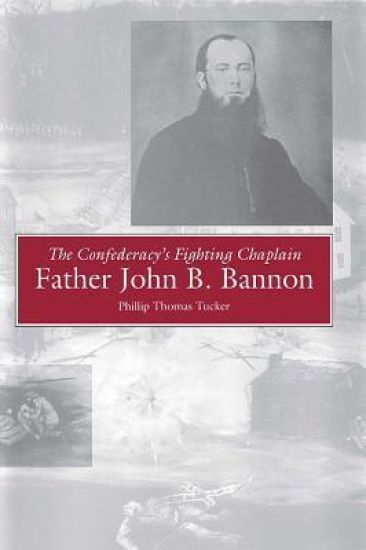
The Confederacy Fighting Chaplain is the remarkable story of the Irishman who brought the Bible and his own resourcefulness and daring to both the battlefield and the diplomatic field—a story that has been largely ignored for more than 130 years. The biography of John B. Bannon also chronicles the forgotten Southerners—the Irish immigrants of the Confederacy—whose colorful and crucial role in the Civil War has been seriously neglected. John B. Bannon was born in Ireland in 1829 and raised in peat-bog country. Educated at the Royal College of St. Patrick at Maynooth, he was ordained a priest in May 1853. Ireland was still suffering from the effects of the Potato Famine, which caused thousands of Irish to emigrate to the United States. In response to the need for Roman Catholic priests to minister to America\u2019s immigrant population, Father Bannon was sent to the Archidiocese of St. Louis, Missouri, shortly after his ordination. Many of the Irish parishioners of St. Louis lived in a crowded corner of the city without money, assistance or land. Father Bannon soon became a leading civic and religious figure in St. Louis. An impressive character, he was described as a \u201chandsome man, over six feet in height, with splendid form and intellectual face, courteous manners, and of great personal magnetism, conversing entertainingly and with originality and great wit, in a manner all his own.\u201d By 1860, Missouri contained the second largest Irish population and the largest German population in the Southern and border states, and when the war reached Missouri, Father Bannon volunteered to serve on the battlefield by tending to the wounded and dying. During the war he served as chaplain-soldier in perhaps the finest combat unit on either side—the First Missouri Confederate Brigade. He impressed his fellow Confederates by attending the wounded at the front lines during battle, while most chaplains stayed to the rear. This tall, athletic man was a striking figure with his slouch had and butternut-colored uniform with a red cloth cross on the left shoulder. Various accounts praised the chaplain: A veteran wrote that the chaplain \u201cwas everywhere in the midst of battle when the fire was heaviest and the bullets thickest.\u201d General Sterling Price wrote: \u201cThe greatest soldier I ever saw was Father Bannon. In the midst of the fray he would step in and take up a fallen soldier.\u201d After the fall of Vicksburg, where Bannon had worked under dangerous fire, he journeyed to Richmond and received recognition and special diplomatic duties from President Jefferson Davis. Bannon conceived a brilliant strategy to gain recognition for the Confederacy from Pope Pius IX and thus open the door for recognition from Britain and France. On a mission for Davis he acted as a secret agent in Ireland during an all-important clandestine effort to stop the flood of Irish immigrants pouring into the Union armies at a critical time—before the decisive campaigns of 1864. After the war he joined the Jesuit order in Ireland, where he served until his death in 1913. The story of Father Bannon is indeed the story of the Missouri Irish Confederates, whose role in the conflict likewise has been neglected. Without doubt, Father Bannon stands out as an important religious-diplomatic personality of the Confederacy. Few men played such a distinguished and diverse role during the Civil War.
Slave Laws in Virginia

Slave Laws in Virginia

Phillip J. Schwarz

University of Georgia Press
2010
pokkari
The five essays in Slave Laws in Virginia explore two centuries of the ever-changing relationship between a major slave society and the laws that guided it. The topics covered are diverse, including the African judicial background of African American slaves, Thomas Jefferson’s relationship with the laws of slavery, the capital punishment of slaves, nineteenth-century penal transportation of slaves from Virginia as related to the interstate slave trade and the changing market for slaves, and Virginia’s experience with its own fugitive slave laws. Through the history of one large extended family of ex-slaves, Philip J. Schwarz’s conclusion examines how the law shaped the interaction between former slaves and masters after emancipation.Instead of relying on a static view of these two centuries, the author focuses on the diverse and changing ways that lawmakers and law enforcers responded to slaves’ behavior and to whites’ perceptions of and assumptions about that behavior.
Forced Sacrifice as Ethnic Protest

Forced Sacrifice as Ethnic Protest

Phillip B. Gonzales

Peter Lang Publishing Inc
2000
nidottu
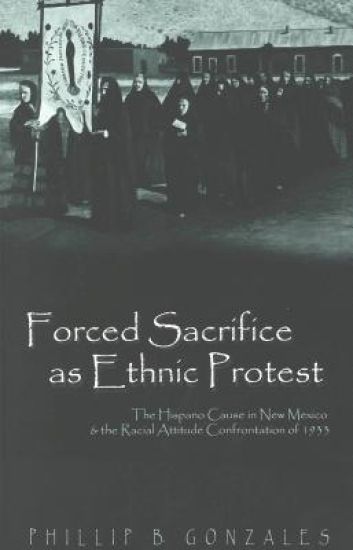
"Forced Sacrifice as Ethnic Protest" brings to light important aspects of identity politics by introducing -forced sacrifice- as a type of protest that ethnic minorities in the United States occasionally mount, particularly against liberal regimes in public institutions. Social science concepts and the literature on social sacrifice help define a spontaneous confrontation in which the protest crowd dramatically forces the institution to dismiss - that is, to sacrifice - one of its own agents as a symbolic concession to ethnic inequality and as a way to open up social reform. The Racial Attitude Confrontation of 1933, involving the Hispanos of New Mexico, is analyzed in terms of forced sacrifice. The Hispano cause is clarified as a significant tradition of ethnic mobilization that arose in the Southwest between the 1880s and the 1930s, revealing some key symbolic and instrumental elements of identity as minority groups mobilize for their interests."
Black Heart

Black Heart

Phillip M. Richards

Peter Lang Publishing Inc
2005
nidottu
Black Heart is a provocative and polemical critique of African American literary studies at the beginning of the twenty-first century. Through a series of sharp and insightful essays on a wide range of critical thinkers, Phillip M. Richards traces what he sees as an erosion of moral reflection in African American literary culture - a process that has left contemporary black academic criticism socially, politically, and culturally hollow. Exploring the work of Henry Louis Gates, Jr., Michael Dyson, Karla Holloway and others, Black Heart sets forth the rhetorical strategies of present-day African American critical writing, and probes the ethical dimensions of its institutional life in the academy, the media, and the public sphere. Richards undertakes to recover the procedures by which cultural and moral value may be recovered for black literary culture and to establish the possibilities for a new humanism in African American writing and literary culture.
Dead Last

Dead Last

Phillip G. Payne

Ohio University Press
2008
sidottu
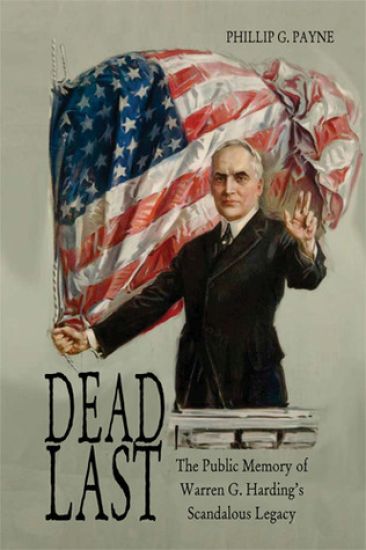
If George Washington and Abraham Lincoln are the saints in America’s civil religion, then the twenty-ninth president, Warren G. Harding, is our sinner. Prior to the Nixon administration, the Harding scandals were the most infamous of the twentieth century. Harding is consistently judged a failure, ranking dead last among his peers. By examining the public memory of Harding, Phillip G. Payne offers the first significant reinterpretation of his presidency in a generation. Rather than repeating the old stories, Payne examines the contexts and continued meaning of the Harding scandals for various constituencies. Payne explores such topics as Harding’s importance as a midwestern small-town booster, his rumored black ancestry, the role of various biographers in shaping his early image, the tension between public memory and academic history, and, finally, his status as an icon of presidential failure in contemporary political debates. Harding was a popular president and was widely mourned when he died in office in 1923; but with his death began the construction of his public memory and his fall from political grace. In Dead Last, Payne explores how Harding’s name became synonymous with corruption, cronyism, and incompetence and how it is used to this day as an example of what a president should not be.
Dead Last

Dead Last

Phillip G. Payne

Ohio University Press
2008
pokkari
If George Washington and Abraham Lincoln are the saints in America's civil religion, then the twenty-ninth president, Warren G. Harding, is our sinner. Prior to the Nixon administration, the Harding scandals were the most infamous of the twentieth century. Harding is consistently judged a failure, ranking dead last among his peers. By examining the public memory of Harding, Phillip G. Payne offers the first significant reinterpretation of his presidency in a generation. Rather than repeating the old stories, Payne examines the contexts and continued meaning of the Harding scandals for various constituencies. Payne explores such topics as Harding's importance as a midwestern small-town booster, his rumored black ancestry, the role of various biographers in shaping his early image, the tension between public memory and academic history, and, finally, his status as an icon of presidential failure in contemporary political debates. Harding was a popular president and was widely mourned when he died in office in 1923; but with his death began the construction of his public memory and his fall from political grace. In Dead Last, Payne explores how Harding's name became synonymous with corruption, cronyism, and incompetence and how it is used to this day as an example of what a president should not be.
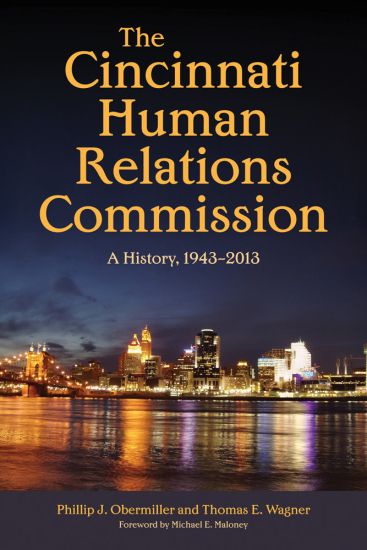
The Cincinnati Human Relations Commission

The Cincinnati Human Relations Commission

Phillip J. Obermiller; Thomas E. Wagner

Ohio University Press
2017
sidottu
In the summer of 1943, as World War II raged overseas, the United States also faced internal strife. Earlier that year, Detroit had erupted in a series of race riots that killed dozens and destroyed entire neighborhoods. Across the country, mayors and city councils sought to defuse racial tensions and promote nonviolent solutions to social and economic injustices. In Cincinnati, the result of those efforts was the Mayor's Friendly Relations Committee, later renamed the Cincinnati Human Relations Commission (CHRC). The Cincinnati Human Relations Commission: A History, 1943–2013, is a decade-by-decade chronicle of the agency: its accomplishments, challenges, and failures. The purpose of municipal human relations agencies like the CHRC was to give minority groups access to local government through internal advocacy, education, mediation, and persuasion—in clear contrast to the tactics of lawsuits, sit-ins, boycotts, and marches adopted by many external, nongovernmental organizations. In compiling this history, Phillip J. Obermiller and Thomas E. Wagner have drawn on an extensive base of archival records, reports, speeches, and media sources. In addition, archival and contemporary interviews provide first-person insight into the events and personalities that shaped the agency and the history of civil rights in this midwestern city.
Introduction to Algebraic Curves

Introduction to Algebraic Curves

Phillip Griffiths; Kuniko Weltin

AMERICAN MATHEMATICAL SOCIETY
1989
pokkari
Algebraic curves and compact Riemann surfaces comprise the most developed and arguably the most beautiful portion of algebraic geometry. This book provides a foundation to proceed to advanced texts in general algebraic geometry, complex manifolds, and Riemann surfaces, as well as algebraic curves.
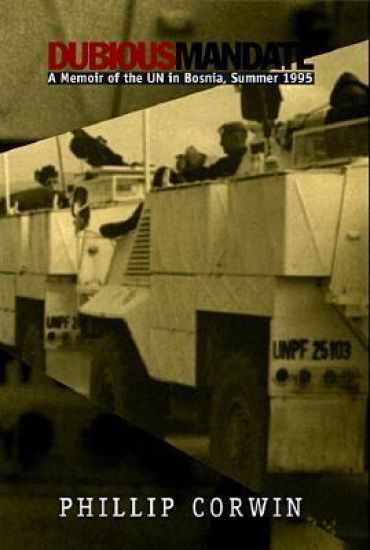
Dubious Mandate

Dubious Mandate

Phillip Corwin

Duke University Press
1999
sidottu
A critical year in the history of peacekeeping, 1995 saw the dramatic transformation of the role of United Nations’ forces in Bosnia from a protective force to being an active combatant under NATO leadership. Phillip Corwin, the UN’s chief political officer in Sarajevo during the summer of that year, presents an insider’s account of the momentous events that led to that transformation. Dubious Mandate interweaves personal experiences of daily life in a war zone-supply shortages, human suffering, assassination attempts, corruption-with historical facts, as Corwin challenges commonly held views of the war with his own highly informed, discerning, and trenchant political commentary. Sympathetic to the UN’s achievements, yet skeptical of its acquiescence to the use of military force, Corwin is critical both of the Bosnian government’s tactics for drawing NATO into the conflict and of NATO’s eagerness to make peace by waging war. He challenges the popular depiction of the Bosnian government as that of noble victim, arguing that the leaders of all three sides in the conflict were “gangsters wearing coats and ties.” Highly caustic about Western reportage, he examines the policies of various Western political and military leaders and gives a detailed account of a pivotal phase of the war in Bosnia, a period that culminated with NATO’s massive bombing of Bosnian Serb targets and ultimately led to the Dayton Peace Agreement. Without a proper understanding of this critical period, he argues, it is difficult to understand the greater scope of the conflict. Corwin also offers insightful portraits of some of the leading players in the Bosnian drama, including Yasushi Akashi, the UN’s top official in the former Yugoslavia in 1994–95; General Rupert Smith, the British commander in Sarajevo in 1995; and Hasan Muratovic, a future Bosnian prime minister. Capturing the essence of a tense and difficult time, Dubious Mandate will interest diplomats, politicians, military personnel, scholars, and those still trying to fathom the continuing mission of the United Nations and the unfolding of events in the former Yugoslavia during the 1990s.
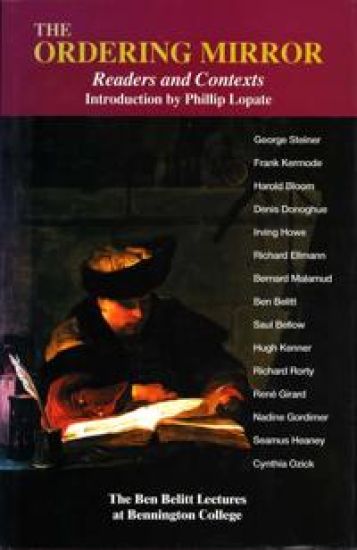
The Ordering Mirror

The Ordering Mirror

Phillip Lopate

Fordham University Press
1993
sidottu
In 1977, Bennington College alumna Edith Barbour Andrews established the Ben Belitt Lectureships in gratitude to her teacher Ben Belitt and dedicated the publication of the lectures (in the form of chapbooks) to the memory of William Troy, another of her beloved teachers. The collection, published here in one volume, comprises lectures by some of the most inspiring writers and keenest critics of our time. In his introduciton to The Ordering Mirror, Phillip Lopate contrasts the anticipations and the audience/lecturer dynamic inherent in attending yearly lecture, with the experience of reading them, and the opportunity for reflection and comparison. Lopate summarizes that, "It is enough to appreciate that we are watching masters of the game of essay-writing, who, even as they comment on the masterpieces of other writers, practice their own wizardry." The volume includes: George Steiner, "The Uncommon Reader" (1978) Frank Kermode, "Divination" (1979) Harold Bloom, "To the Tally of My Soul: Whitman's Image of Voice" (1980) Denis Donoghue, "The Politics of Modern Criticism" (1981) Irving Howe, "The Making of a Critic" (1982) Richard Ellman, "The Uses of Decadence: Wilde, Yeats, Joyce" (1983) Bernard Malamud, "Long Work, Short Life" (1984) Ben Belitt, "Literature and Belief: Three 'Spiritual Exercises'" (1985) Saul Bellow, "Summations" (1987) Hugh Kenner, "Magics and Spells (about curses, charms, and riddles)" (1987) Richard Rorty, "The Barber of Kasbeam: Nabokov on Cruelty" (1988) Rene Girard, "Collective Violence and Sacrifice in Shakespeare's Julius Caesar" (1989) Nadine Gordimer, "Three in a Bed: Fiction, Morals and Politics" (1990) Seamus Heaney, "Dylan the Durable?: On Dylan Thomas" (1992) Cynthia Ozick, "What Henry James Knew" (1992)
Red Apple

Red Apple

Phillip Deery

FORDHAM UNIVERSITY PRESS
2014
sidottu
From the late 1940s through the 1950s, McCarthyism disfigured the American political landscape. Under the altar of anticommunism, domestic Cold War crusaders undermined civil liberties, curtailed equality before the law, and tarnished the ideals of American democracy. In order to preserve freedom, they jettisoned some of its tenets. Congressional committees worked in tandem, although not necessarily in collusion, with the FBI, law firms, university administrations, publishing houses, television networks, movie studios, and a legion of government agencies at the federal, state, and local levels to target "subversive" individuals. Exploring the human consequences of the widespread paranoia that gripped a nation, Red Apple presents the international and domestic context for the experiences of these individuals: the House Un-American Activities Committee, hearings of the Joint Anti-Fascist Refugee Committee, resulting in the incarceration of its chairman, Dr. Edward Barsky, and its executive board; the academic freedom cases of two New York University professors, Lyman Bradley and Edwin Burgum, culminating in their dismissal from the university; the blacklisting of the communist writer Howard Fast and his defection from American communism; the visit of an anguished Dimitri Shostakovich to New York in the spring of 1949; and the attempts by O. John Rogge, the Committee's lawyer, to find a "third way" in the quest for peace, which led detractors to question which side he was on. Examining real-life experiences at the "ground level," Deery explores how these six individuals experienced, responded to, and suffered from one of the most savage assaults on civil liberties in American history. Their collective stories illuminate the personal costs of holding dissident political beliefs in the face of intolerance and moral panic that is as relevant today as it was seventy years ago.
Red Apple

Red Apple

Phillip Deery

Fordham University Press
2016
pokkari
From the late 1940s through the 1950s, McCarthyism disfigured the American political landscape. Under the altar of anticommunism, domestic Cold War crusaders undermined civil liberties, curtailed equality before the law, and tarnished the ideals of American democracy. In order to preserve freedom, they jettisoned some of its tenets. Congressional committees worked in tandem, although not necessarily in collusion, with the FBI, law firms, university administrations, publishing houses, television networks, movie studios, and a legion of government agencies at the federal, state, and local levels to target "subversive" individuals. Exploring the human consequences of the widespread paranoia that gripped a nation, Red Apple presents the international and domestic context for the experiences of these individuals: the House Un-American Activities Committee, hearings of the Joint Anti-Fascist Refugee Committee, resulting in the incarceration of its chairman, Dr. Edward Barsky, and its executive board; the academic freedom cases of two New York University professors, Lyman Bradley and Edwin Burgum, culminating in their dismissal from the university; the blacklisting of the communist writer Howard Fast and his defection from American communism; the visit of an anguished Dimitri Shostakovich to New York in the spring of 1949; and the attempts by O. John Rogge, the Committee's lawyer, to find a "third way" in the quest for peace, which led detractors to question which side he was on. Examining real-life experiences at the "ground level," Deery explores how these six individuals experienced, responded to, and suffered from one of the most savage assaults on civil liberties in American history. Their collective stories illuminate the personal costs of holding dissident political beliefs in the face of intolerance and moral panic that is as relevant today as it was seventy years ago.