Kirjojen hintavertailu. Mukana 11 244 527 kirjaa ja 12 kauppaa.

Kirjahaku

Etsi kirjoja tekijän nimen, kirjan nimen tai ISBN:n perusteella.

1000 tulosta hakusanalla Philo
Philosophy in Germany 1831–1933

Philosophy in Germany 1831–1933

Herbert Schnädelbach

Cambridge University Press
1984
pokkari
The hundred years covered by this book, from the death of Hegel to the establishment of the Third Reich, is often regarded as the heyday of German philosophy, of metaphysics in the grand style and of what J. S. Mill characterised as 'the German or a priori view of human knowledge'. Yet apart from selective attention to individual figures, such as Nietzsche, Schopenhauer, Husserl or Heidegger, little is known by English-speaking philosophers of most of the animating concerns and continuing traditions of German philosophy of the time. This book sets out to present a detailed history of the period, adopting a thematic approach which emphasises the more distinctive German approach. It is hoped that the growing but piecemeal interest in German philosophy will be both stimulated and consolidated by this book, which should also interest individuals working in related areas such as the history of ideas, religious studies and the history of science.
Philosophy and an African Culture

Philosophy and an African Culture

Kwasi Wiredu

Cambridge University Press
1980
pokkari
What can philosophy contribute to African culture? What can it draw from it? Could there be a truly African philosophy that goes beyond traditional folk thought? Kwasi Wiredu tries in these essays to define and demonstrate a role for contemporary African philosophers which is distinctive but by no means parochial. He shows how they can assimilate the advances of analytical philosophy and apply them to the general social and intellectual changes associated with 'modernisation' and the transition to new national identities. But we see too how they can exploit traditional resources and test the assumptions of Western philosophy against the intimations of their own language and culture. The volume as a whole presents some of the best non-technical work of a distinguished African philosopher, of importance equally to professional philosophers and to those with a more general interest in contemporary African thought and culture.
Philosophy of Mathematics

Philosophy of Mathematics

Cambridge University Press
1984
pokkari
The twentieth century has witnessed an unprecedented ‘crisis in the foundations of mathematics’, featuring a world-famous paradox (Russell’s Paradox), a challenge to ‘classical’ mathematics from a world-famous mathematician (the ‘mathematical intuitionism’ of Brouwer), a new foundational school (Hilbert’s Formalism), and the profound incompleteness results of Kurt Gödel. In the same period, the cross-fertilization of mathematics and philosophy resulted in a new sort of ‘mathematical philosophy’, associated most notably (but in different ways) with Bertrand Russell, W. V. Quine, and Gödel himself, and which remains at the focus of Anglo-Saxon philosophical discussion. The present collection brings together in a convenient form the seminal articles in the philosophy of mathematics by these and other major thinkers. It is a substantially revised version of the edition first published in 1964 and includes a revised bibliography. The volume will be welcomed as a major work of reference at this level in the field.
Philosophers of Peace and War

Philosophers of Peace and War

W. B. Gallie

Cambridge University Press
1979
pokkari
Intellectual eminence apart, what did Kant, Clausewitz, Marx and Engels, and Tolstoy have in common? Professor Gallic argues that they made contributions to 'international theory' – to the understanding of the character and causes of war and of the possibility of peace between nations – which were of unrivalled originality in their own times and remain of undiminished importance in ours. But these contributions have been either ignored or much misunderstood ; chiefly because, as with all intellectual efforts in unexplored fields, they were often imperfectly expressed, and were also overshadowed by their author's more striking achievements. Professor Gallic has sorted out, compared and contrasted, criticised and re-phrased the teachings of his chosen authors on peace and war.
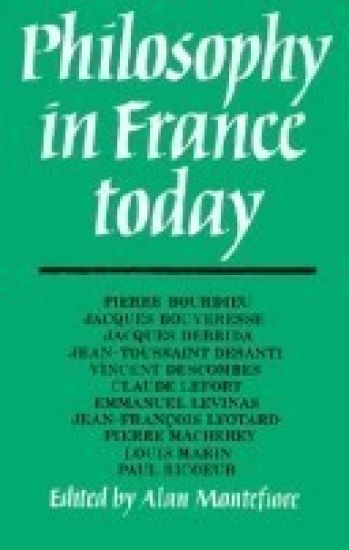
Philosophy in France Today

Philosophy in France Today

Cambridge University Press
1983
pokkari
Eleven leading contemporary French philosophers give here more or less direct presentations and exemplifications of their work. All the essays, with one exception, were specifically written for this volume and for an English-speaking readership - the exception is the first publication anywhere of Jacques Derrida’s defence of his thèse d’état in 1980, based on his published works. As a collection the essays convey the style, tone and preoccupations, as well as the range and diversity, of French philosophical thinking as it is being practised today. They will stimulate and inform the rapidly growing interest in this area outside France.
Philosophical Issues in Aristotle's Biology
Aristotle’s biological works - constituting over 25% of his surviving corpus and for centuries largely unstudied by philosophically oriented scholars - have been the subject of an increasing amount of attention of late. This collection brings together some of the best work that has been done in this area, with the aim of exhibiting the contribution that close study of these treatises can make to the understanding of Aristotle’s philosophy. The book is divided into four parts, each with an introduction which places its essays in relation to each other and to the wider issues of the book as a whole. The first part is an overview of the relationship of Aristotle’s biology to his philosophy; the other three each concentrate on a set of issues central to Aristotelian study - definition and demonstration; teleology and necessity in nature; and metaph themes such as the unity of matter and form and the nature of substance.
Philosophy and Practice

Philosophy and Practice

Cambridge University Press
1985
pokkari
This book was first published in 1985. The journal is concerned with the study of philosophy in all its branches: logic, metaphysics, epistemology, ethics, aesthetics, social and political philosophy and the philosophies of religion, science, history, language, mind and education. The journal is not committed to any particular school or method and contributors are expected to avoid needless technicality. There is a section on new books which includes reviews, book notes and a list of books received.
Philosophical Papers: Volume 3, Realism and Reason

Philosophical Papers: Volume 3, Realism and Reason

Hilary Putnam

Cambridge University Press
1985
pokkari
This is the third volume of Hilary Putnam’s philosophical papers, published in paperback for the first time. The volume contains his major essays from 1975 to 1982, which reveal a large shift in emphasis in the ‘realist’ position developed in his earlier work. While not renouncing those views, Professor Putnam has continued to explore their epistemological consequences and conceptual history. He now, crucially, sees theories of truth and of meaning that derive from a firm notion of reference as inadequate.
Philosophical Papers: Volume 2, Philosophy and the Human Sciences
Charles Taylor has been one of the most original and influential figures in contemporary philosophy: his 'philosophical anthropology' spans an unusually wide range of theoretical interests and draws creatively on both Anglo-American and Continental traditions in philosophy. A selection of his published papers is presented here in two volumes, structured to indicate the direction and essential unity of the work. He starts from a polemical concern with behaviourism and other reductionist theories (particularly in psychology and the philosophy of language) which aim to model the study of man on the natural sciences. This leads to a general critique of naturalism, its historical development and its importance for modern culture and consciousness; and that in turn points, forward to a positive account of human agency and the self, the constitutive role of language and value, and the scope of practical reason. The volumes jointly present some two decades of work on these fundamental themes, and convey strongly the tenacity, verve and versatility of the author in grappling with them. They will interest a very wide range of philosophers and students of the human sciences.
Philosophical Papers: Volume 1, Human Agency and Language

Philosophical Papers: Volume 1, Human Agency and Language

Charles Taylor

Cambridge University Press
1985
pokkari
Charles Taylor has been one of the most original and influential figures in contemporary philosophy: his ‘philosophical anthropology’ spans an unusually wide range of theoretical interests and draws creatively on both Anglo-American and Continental traditions in philosophy. A selection of his published papers is presented here in two volumes, structured to indicate the direction and essential unity of the work. He starts from a polemical concern with behaviourism and other reductionist theories (particularly in psychology and the philosophy of language) which aim to model the study of man on the natural sciences. This leads to a general critique of naturalism, its historical development and its importance for modern culture and consciousness; and that in turn points, forward to a positive account of human agency and the self, the constitutive role of language and value, and the scope of practical reason. The volumes jointly present some two decades of work on these fundamental themes, and convey strongly the tenacity, verve and versatility of the author in grappling with them. They will interest a very wide range of philosophers and students of the human sciences.
Philosophy and Medical Welfare

Philosophy and Medical Welfare

J. M. Bell; Susan Mendus

Cambridge University Press
1989
pokkari
This volume of papers, arising from the Royal Institute of Philosophy Conference on Philosophy and Medical Welfare, includes contributions from doctors, nurses, and administrators in the field of health care as well as academics in the disciplines of philosophy, economics, and politics.
Philosophers and Kings

Philosophers and Kings

Gary McCulloch

Cambridge University Press
1991
sidottu
Philosophers and Kings examines how the theme of ‘education for leadership’ has developed, changed and declined in English secondary education during the twentieth century. Once celebrated as an authentic and distinctive English tradition, education for leadership has fallen into decline and disrepute, usurped by the ideals of equality and competitive individualism and discredited by its own inherent limitations and implications. There have, however, been important attempts during the present century to revive and reassert education for leadership by adapting it to a rapidly changing social and political context. These efforts at rehabilitation originally centred on the elite public schools, but increasingly involved state secondary schools that catered for larger groups of the population: the classic tradition began to mutate in directions that allowed it to support the claims of industry and science. Indeed, education for leadership could prove attractive to radical and even socialist educational initiatives, but the perceived failure of the latter, and the deepening of other forms of educational and social inequality, rendered the concept increasingly suspect in the changing educational and political climate of the 1980s.
Philosophy and Politics

Philosophy and Politics

G. M. K. Hunt

Cambridge University Press
1990
pokkari
This original collection explores one recurrent theme connecting philosophy and politics: the relation between the nature of man and the structure of society. It does so by concentrating on the topical issue of the market economy as an attempt to resolve the clash between individual autonomy and collective action. Beginning with a historical and personal recollection by Enoch Powell and a response by Robert Skidelsky, the volume then provides a forum for political theorists and philosophers to take issue on the fundamental topics of markets and morals; liberal man; and equality and libertarianism. It succeeds equally as a stimulating textbook and a book for the general reader who wishes to understand the philosophical issues arising in a market economy.
Philosophy and Biblical Interpretation

Philosophy and Biblical Interpretation

Peter Addinall

Cambridge University Press
1991
sidottu
This study explores the nature of the conflict between science and religion. It shows through a detailed examination of this conflict as it was manifested in nineteenth-century Britain that religion and science, properly understood, cannot co-exist in mutual harmony. The legacy of their conflict in the last century has been passed on to the twentieth century, greatly to the detriment of religious belief. It is the author's contention that a return to the essentials of Kant's critical philosophy would lay bare the profound differences between religious and scientific approaches to the world, and the nature of the choice to be made between them. In its effort to demarcate the outlines of a genuine biblical theology (and to articulate the proper procedures for producing one) the book casts light on important questions of biblical interpretation, and demands a radical reassessment of the meaning of science for society.
Philosophy, Science, and Religion in England 1640–1700
This collection of essays looks at the distinctively English intellectual, social and political phenomenon of Latitudinarianism, which emerged during the Civil War and Interregnum and came into its own after the Restoration, becoming a virtual orthodoxy after 1688. Dividing into two parts, it first examines the importance of the Cambridge Platonists, who sought to embrace the newest philosophical and scientific movements within Church of England orthodoxy, and then moves into the later seventeenth century, from the Restoration onwards, culminating in essays on the philosopher John Locke. These contributions establish a firmly interdisciplinary basis for the subject, while collectively gravitating towards the importance of discourse and language as the medium for cultural exchange. The variety of approaches serves to illuminate the cultural indeterminacy of the period, in which inherited models and vocabularies were forced to undergo revisions, coinciding with the formation of many cultural institutions still governing English society.
Philolaus of Croton: Pythagorean and Presocratic

Philolaus of Croton: Pythagorean and Presocratic

Philolaus

Cambridge University Press
1993
sidottu
This is the first comprehensive study for nearly 200 years of what remains of the writings of the Presocratic philosopher Philolaus of Croton (c. 470–385 BC). These fragments are crucial to our understanding of one of the most influential schools of ancient philosophy, the Pythagoreans; they also show close ties with the main lines of development of Presocratic thought, and represent a significant response to thinkers such as Parmenides and Anaxagoras. Professor Huffman presents the fragments and testimonia (including the spurious fragments in a separate section for reference) with accompanying translations and introductory chapters and interpretive commentary. He not only produces further argument for the authenticity of much that used to be neglected, but also undertakes a critique of Aristotle’s testimony, opening the way for a quite new reading of fifth-century Pythagoreanism in general and of Philolaus in particular. Philolaus is revealed as a serious natural philosopher.
Philosophy, Religion and the Spiritual Life

Philosophy, Religion and the Spiritual Life

Michael McGhee

Cambridge University Press
1992
pokkari
A new agenda for the philosophy of religion emerges from this interdisciplinary collection. Going outside the traditional concerns of natural theology, the distinguished contributors to this volume explore such topics as the nature of selfhood and its images in the ancient, the medieval and the modern world; the role of philosophy as a route to wisdom; non-conceptual awareness; and the nature of love and its relation to attention. Discussion focuses on the figures of Plato and Augustine, William James and the Absolute Idealist F. H. Bradley, Kierkegaard and Heidegger, as well as leading figures of the Tibetan Buddhist tradition.
Philosophy in an Age of Pluralism

Philosophy in an Age of Pluralism

Cambridge University Press
1994
pokkari
This is the first comprehensive evaluation of Charles Taylor’s work and a major contribution to leading questions in philosophy and the human sciences as they face an increasingly pluralistic age. Charles Taylor is one of the most influential contemporary moral and political philosophers: in an era of specialisation he is one of the few thinkers who has developed a comprehensive philosophy which speaks to the conditions of the modern world in a way that is compelling to specialists in various disciplines. This collection of specially commissioned essays brings together twelve distinguished scholars from a variety of fields to discuss critically Taylor’s work. The topics range from the history of philosophy, to truth, modernity and postmodernity, theism, interpretation, the human sciences, liberalism, pluralism and difference. Taylor responds to all the contributions and re-articulates his own views.
Philosophy and Government 1572–1651

Philosophy and Government 1572–1651

Richard Tuck

Cambridge University Press
1993
pokkari
Philosophy and Government is a major new contribution to our understanding of European political theory which will challenge the perspectives in which political thought is understood. Framed as a general account of the period between 1572 and 1651 it charts the formation of a distinctively modern political vocabulary, based upon arguments of political necessity and raison d’etat in the work of the major theorists. Whilst Dr Tuck pays detailed attention to Montaigne, Grotius, Hobbes and the theorists of the English Revolution, he also reconsiders the origins of their conceptual vocabulary in humanist thought - particularly scepticism and stoicism - and its development and appropriation during the revolutions in Holland and France. This book will be welcomed by all historians of political thought and those interested in the development of the idea of the state.
Philosophy, Psychology and Psychiatry

Philosophy, Psychology and Psychiatry

A. Phillips Griffiths

Cambridge University Press
1995
pokkari
Philosophy of mind as traditionally understood has rarely engaged directly with psychology and psychiatry. This collection establishes the importance of this interdisciplinary approach and explores new directions in the ‘philosophy of psychiatry and psychology’. The essays are by a distinguished group of contributors whose interests and expertise embrace the cognitive, biological and medical sciences as well as the social sciences and humanities. The topics are wide ranging and raise fundamental questions such as what establishes personality or personal identity; how should insanity - or sanity - be defined; what is ‘consent’? Readers, like the contributors, will come from a wide range of backgrounds, and find the volume suggests new approaches and offers new insights.