Kirjahaku
Etsi kirjoja tekijän nimen, kirjan nimen tai ISBN:n perusteella.
1000 tulosta hakusanalla R J Stanton
I Georgia i 1939 fører en rekke drap til at Joseph og vennene hans danner gruppen Vokterne, som ønsker å beskytte innbyggerne mot ondskapen. Selv når drapene tar slutt, følges Joseph bestandig av en skygge av frykt. Først femti år etter står han ansikt til ansikt med det marerittet som har overskygget livet hans. Lydbok på MP3-CD Lest av: Christoffer Staib
Kant’s Second Critique and the Problem of Transcendental Arguments
R.J. Benton
Kluwer Academic Publishers
1978
nidottu
This work is in no way intended as a commentary on the second Cri tique, or even on the Analytic of that book. Instead I have limited myself to the attempt to extract the essential structure of the argument of the Analytic and to exhibit it as an instance of a transcendental argument (namely, one establishing the conditions of the possibility of a practical cognitive viewpoint). This limitation of scope has caused me, in some cases, to ignore or treat briefly concrete questions of Kant's practical philosophy that deserve much closer consideration; and in other cases it has led me to relegate questions that could not be treated briefly to appendixes ,in order not to distract from the development of the argu ment. As a result, it is the argument-structure itself that receives pri mary attention, and I think some justification should be offered for this concentration on what may seem to be a purely formal concern. One of the most common weaknesses of interpretations of Kant's works is a failure to distinguish the level of generality at which Kant's argument is being developed. This failure is particularly fatal in dealing with the Critiques, since in interpreting them it is important to keep clearly in mind that it is not this or that cognition that is at stake, but the possibility of (a certain kind of) knowledge as such.
This book presents a mechanist philosophy of mind. I hold that the human mind is a system of computational or recursive rules that are embodied in the nervous system; that the material presence of these rules accounts for perception, conception, speech, belief, desire, intentional acts, and other forms of intelligence. In this edition I have retained the whole of the fIrst edition except for discussion of issues which no longer are relevant in philosophy of mind and cognitive psychology. Earlier reference to disputes of the 1960's and 70's between hard-line empiricists and neorationalists over the psychological status of grammars and language acquisition, for instance, has simply been dropped. In place of such material I have entered some timely or new topics and a few changes. There are brief references to the question of computer versus distributed processing (connectionist) theories. Many of these questions dissolve if one distinguishes as I now do in Chapter II between free and embodied algorithms. I have also added to my comments on artifIcal in telligence some reflections. on Searle's Chinese Translator. The irreducibility of machine functionalist psychology in my version or any other has been exaggerated. Input, output, and state entities are token identical to physical or biological things of some sort, while a machine system as a collection of recursive rules is type identical to representatives of equivalence classes. This nuld technicality emerges in Chapter XI. It entails that so-called "anomalous monism" is right in one sense and wrong in another.
Psychiatrische Stoornissen
R J Beerthuis; I a Van Berckelaer-Onnes; E Van Daalen; R J Van Der Gaag; H Grietens; E De Haan; P J Hoekstra; L J Kalverdijk; F Lamers-Winkelman; J J Louwe; M Meijer; M D Oosterhoff; B Orobio De Castro; C W Van Overveld; E Plomp; S P Ripken; L F Van Der Steen; J Ubbels; F Verheij; F C Verhulst; M Visser; E J De Wilde; C a M De Wit
Bohn Stafleu Van Loghum
2009
pokkari
During the past decade interest in quality management has greatly increased. One of the central elements of Total Quality Management is Statistical Process Control, more commonly known as SPC. This book describes the pitfalls and traps which businesses encounter when implementing and assuring SPC. Illustrations are given from practical experience in various companies. The following subjects are discussed: implementation of SPC, activity plan for achieving statistically controlled processes, statistical tools, and lastly, consolidation and improvement of the results. Also, an extensive checklist is provided with which a business can determine to what extent it has succeeded in the actual application of SPC. Audience: This volume is written for companies which are going to implement SPC, or which need a new impetus in order to get SPC properly off the ground. It will be of interest in particular to researchers whose work involves statistics and probability, production, operation and manufacturing management, industrial organisation and mathematical and quantitative methods. It will also appeal to specialists in engineering and management, for example in the electronic industry, discrete parts industry, process industry, automotive and aircraft industry and food industry.
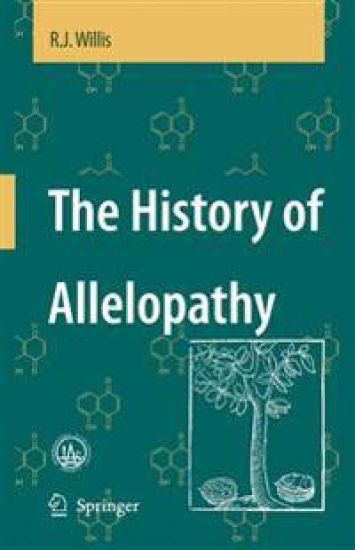
This book had its beginnings about thirty-five years ago, when I migrated to Australia from Canada, and began a doctoral study concerning the role of allelopathy in forests of the eucalypt known in Australia as mountain ash (Eucalyptus regnans), under the supervision of Dr Kingsley Rowan and the late Dr David Ashton. In first assembling materials for the usual survey of the relevant literature, I came to realise that the relative youth of Australia as a nation and its geographical remoteness were to be barriers in fully dealing with historical concepts. At times, the simplest option was to buy the requisite antiquarian books, if they were not readily available from local libraries. I remember that one of the first such works that I acquired was de Candolle’s Physiologie Végétale, and it was then that I began to learn that the history of allelopathy had been only superficially investigated. Allelopathy is a topic which has been very much in the limelight of plant ecology in the past few decades. It is a controversial topic which has a surprisingly large body of literature associated with it, yet the mere existence of allelopathy as an ecological process is still considered doubtful by many. Most students of allelopathy seem to have assumed that the topic has been c- menced in 1937 with the work of Hans Molisch, or to those more historically minded, the theories of A. P.
This book has been considered by academicians and scholars of great significance and value to literature. This forms a part of the knowledge base for future generations. We have represented this book in the same form as it was first published. Hence any marks seen are left intentionally to preserve its true nature.
A vocabulary of central Sakai (dialect of the aboriginal communities in the Gopeng Valley)
R J Wilkinson
Alpha Edition
2020
pokkari
Papers On Malay Subjects; Life And Customs (Part I) The Incidents Of Malay Life
R J Wilkinson
Alpha Edition
2020
pokkari
This book has been considered by academicians and scholars of great significance and value to literature. This forms a part of the knowledge base for future generations. So that the book is never forgotten we have represented this book in a print format as the same form as it was originally first published. Hence any marks or annotations seen are left intentionally to preserve its true nature.
Among the Sioux: A Story of the Twin Cities and the Two Dakotas, is many of the old classic books which have been considered important throughout the human history. They are now extremely scarce and very expensive antique. So that this work is never forgotten we republish these books in high quality, using the original text and artwork so that they can be preserved for the present and future generations. This whole book has been reformatted, retyped and designed. These books are not made of scanned copies of their original work and hence the text is clear and readable.
Understanding Drama contains 70 short essays that analyse a number of geographically diverse, historically significant plays-among them Oedipus Tyrannos, King Lear, Tartuffe, Long Day's Journey into Night, Hedda Gabler, Androcles and the Lion, Our Town, A Streetcar Named Desire, Death of a Salesman, Riders to the Sea, Old Times, Who's Afraid of Virginia Woolf?, Glengarry Glen Ross, Buried Child, The Threepenny Opera, and Edward II. Supplementing these model essays are a Step-by-Step Approach to Play Analysis, a Glossary of Dramatic Terms, Study Guides, Topics for Writing and Discussion, Bibliographical Resources, and a comprehensive Index. Written with students in mind, these critical essays cover many important plays included in most dramatic literature courses and will provide students with practical models to help them improve their own writing and analytical skills. Presenting a detailed yet objective examination of the structure, style, imagery, and language of the plays, this textbook also offers analyses of character, action, dialogue, and setting that can be translated into concepts for theatrical production-or that can at least provide the kind of understanding of a play with which a theatre practitioner could fruitfully quarrel.