Kirjojen hintavertailu. Mukana 11 244 527 kirjaa ja 12 kauppaa.

Kirjahaku

Etsi kirjoja tekijän nimen, kirjan nimen tai ISBN:n perusteella.

1000 tulosta hakusanalla Ray Perman

Coherent X-Ray Optics

Coherent X-Ray Optics

David Paganin

Oxford University Press
2013
nidottu
This book gives a thorough treatment of the rapidly-expanding field of coherent X-ray optics, which has recently experienced something of a renaissance with the availability of third-generation synchrotron sources. It is the first book of its kind. The author begins with a treatment of the fundamentals of X-ray diffraction for both coherent and partially coherent radiation, together with the interactions of X-rays with matter. X-ray sources, optical elements and detectors are then discussed, with an emphasis on their role in coherent X-ray optics. Various facets of coherent X-ray imaging are then discussed, including holography, interferometry, self imaging, phase contrast and phase retrieval. Lastly, the foundations of the new field of singular X-ray optics are examined. Most topics are developed from first principles, with numerous references given to the contemporary research literature. This book will be useful to X-ray physicists and students, together with optical physicists and engineers who wish to learn more about the fascinating subject of coherent X-ray optics.
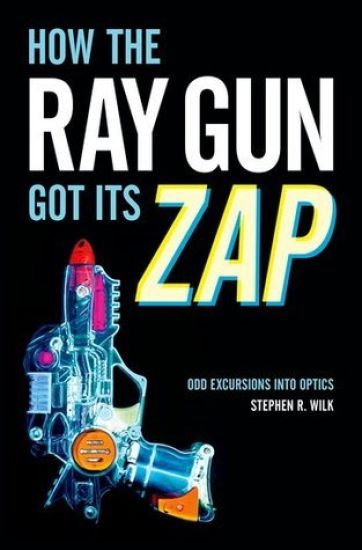
How the Ray Gun Got Its Zap

How the Ray Gun Got Its Zap

Stephen R. Wilk

Oxford University Press Inc
2013
sidottu
How the Ray Gun Got Its Zap is a collection of essays that discusses odd and unusual topics in optics. Though optics is a fairly specialized branch of physics, this book extracts from the discipline topics that are particularly interesting, mysterious, culturally relevant, or accessible. The essays all first appeared, in abbreviated form, in Optics and Photonics News and in The Spectrograph; the author has updated and expanded upon each of them for this book. The book is divided into three thematic sections: History, Weird Science, and Pop Culture. Chapters will discuss surprising uses of optics in classics and early astronomy; explain why we think of the sun as yellow when it is actually white; present how the laser is used in popular film; and profile the eccentric scientists who contributed to optics. The essays are short and entertaining, and can be read in any order. The book should appeal to general audiences interested in optics or physics more generally, as well as members of the scientific community who are curious about optics phenomena.
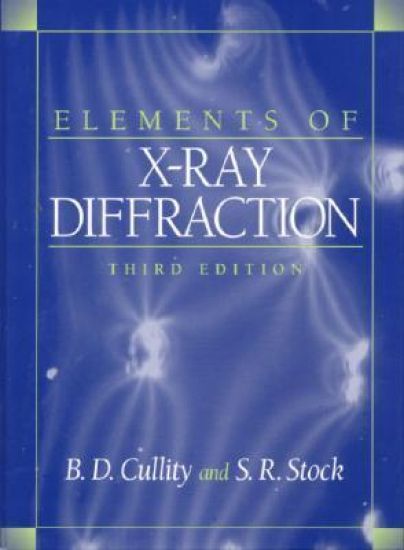
Elements of X-Ray Diffraction

Elements of X-Ray Diffraction

B.D. Cullity

Pearson
2001
sidottu
Designed for Junior/Senior undergraduate courses. This revision of a classical text is intended to acquaint the reader, who has no prior knowledge of the subject, with the theory of x-ray diffraction, the experimental methods involved, and the main applications. The text is a collection of principles and methods designed directly for the student and not a reference tool for the advanced reader.
A Little Ray of Obsidian Black
Bee Neilsen: she's sugar and spice and a little bit morbid. Drawing inspiration from the work of Tim Burton, Edgar Allan Poe, and her experience working in a funeral home, Bee Neilsen is a self-described scribbler, coffee-lover, and connoisseur of all things spooky. When she isn't working or writing, Bee enjoys relaxing with her dog, cooking, and eating her weight in hummus.A Little Ray of Obsidian Black is Bee's debut collection of dark poetry and flash fiction
A Book about Ray

A Book about Ray

Ellen Levy

MIT PRESS LTD
2024
sidottu
The first full-career survey of the idiosyncratic life and work of Ray Johnson, a collagist, performance artist, and pioneer of mail art.Ray Johnson (1927-1995), a.k.a. “New York’s most famous unknown artist,” was notorious for the elaborate games he played with the institutions of the art world, soliciting their attention even as he rejected their invitations. In A Book about Ray, Ellen Levy offers a comprehensive study of the artist who turned the business of career-making into a tongue-in-cheek performance, tracing his artistic development from his arrival at Black Mountain College in 1945 to his death in 1995. Levy describes Johnson’s practice as one that was constantly shifting—whether in tone, in its address to potential audiences, or among three primary artistic modes: collage, performance, and correspondence art. A Book about Ray takes an elliptical path, circling around rather than trying to arrest in flight the elusive artist and his purposefully ephemeral art. By crafting the book in this way, Levy evokes Ray Johnson’s art in the moment of its making and draws readers into the artist’s world, while making them feel, from the beginning, that they somehow already know their way around that world. In exploring Johnson’s scene, readers will also encounter the artists who influenced him, like Joseph Cornell and Marcel Duchamp, and his friends and peers like Jasper Johns, Allan Kaprow, Robert Rauschenberg, and Andy Warhol. The work of such figures will look forever different in light of Johnson’s subversive take on their shared aesthetic.Suitable for readers both new to Ray Johnson and those already familiar with his work, A Book about Ray is a complete and vital portrait of an American original.
Introduction to X-Ray Spectrometric Analysis

Introduction to X-Ray Spectrometric Analysis

Eugene P. Bertin

Kluwer Academic/Plenum Publishers
1978
nidottu
X-ray fluorescence spectrometry has been an established, widely practiced method of instrumental chemical analysis for about 30 years. However, although many colleges and universities offer full-semester courses in optical spectrometric methods of instrumental analysis and in x-ray dif­ fraction, very few offer full courses in x-ray spectrometric analysis. Those courses that are given are at the graduate level. Consequently, proficiency in this method must still be acquired by: self-instruction; on-the-job training and experience; "workshops" held by the x-ray instrument manu­ facturers; the one- or two-week summer courses offered by a few uni­ versities; and certain university courses in analytical and clinical chemistry, metallurgy, mineralogy. geology, ceramics. etc. that devote a small portion of their time to applications of x-ray spectrometry to those respective disciplines. Moreover, with all due respect to the books on x-ray spectrometric analysis now in print, in my opinion none is really suitable as a text or manual for beginners in the discipline. In 1968, when I undertook the writing of the first edition of my previous book, Principles and Practice of X-Ray Spectrometric Analysis,* my objective was to provide a student text. However, when all the material was compiled, I decided to provide a more comprehensive book, which was also lacking at that time. Although that book explains principles, instrumentation, and methods at the begin­ ner's level, this material is distributed throughout a mass of detail and more advanced material.
Advances in X-Ray Analysis

Advances in X-Ray Analysis

Kluwer Academic/Plenum Publishers
1986
sidottu
The 37th Annual Denver Conference on Applications of X-Ray Analysis was held August 1-5, 1988, at the Sheraton Steamboat Resort and Conference Center, Steamboat Springs, Colorado. As usual, alternating with x-ray diffraction, the emphasis this year was x-ray fluorescence, but as has been the pattern for several occasions over the last few years, the Plenary Session did not deal with that subject, specifically. In an attempt to introduce the audience to one of the new developments in x-ray analysis, the title of the session was "High Brilliance Sources/Applications," and dealt exclusively with synchrotron radiation, a topic which has made a very large impact on the x-ray community over the last decade. As the organizer and co-chairman of the Plenary Session (with Paul Predecki), it is my responsibility to report on that session here. The Conference had the privilege of obtaining the services of some of the preeminent practitioners of research using this remarkable x-ray source; they presented the audience with unusually lucid descriptions of the work which has been accomplished in the development and application of the continuous, high intensity, tunable, polarized and collimated x-rays available from no facility other than these specialized storage rings. The opening lecture (and I use that term intentionally) was an enthusiastic description of "What is Synchrotron Radiation?" by Professor Boris Batterman of Cornell University and the Cornell High Energy Synchrotron Sourc(! (CHESS).
Advances in X-Ray Analysis

Advances in X-Ray Analysis

Kluwer Academic/Plenum Publishers
1989
sidottu
The 37th Annual Denver Conference on Applications of X-Ray Analysis was held August 1-5, 1988, at the Sheraton Steamboat Resort and Conference Center, Steamboat Springs, Colorado. As usual, alternating with x-ray diffraction, the emphasis this year was x-ray fluorescence, but as has been the pattern for several occasions over the last few years, the Plenary Session did not deal with that subject, specifically. In an attempt to introduce the audience to one of the new developments in x-ray analysis, the title of the session was "High Brilliance Sources/Applications," and dealt exclusively with synchrotron radiation, a topic which has made a very large impact on the x-ray community over the last decade. As the organizer and co-chairman of the Plenary Session (with Paul Predecki), it is my responsibility to report on that session here. The Conference had the privilege of obtaining the services of some of the preeminent practitioners of research using this remarkable x-ray source; they presented the audience with unusually lucid descriptions of the work which has been accomplished in the development and application of the continuous, high intensity, tunable, polarized and collimated x-rays available from no facility other than these specialized storage rings. The opening lecture (and I use that term intentionally) was an enthusiastic description of "What is Synchrotron Radiation?" by Professor Boris Batterman of Cornell University and the Cornell High Energy Synchrotron Sourc(! (CHESS).
Advances in X-Ray Analysis

Advances in X-Ray Analysis

Kluwer Academic/Plenum Publishers
1992
sidottu
The proceedings of the combined First Pacific-International Congress on X-Ray Analytical Methods (PICXAM) and Fortieth Annual Conference on Applications of X-Ray Analysis, held in Hilo and Honolulu Hawaii, August 1991, comprise reports on the latest developments in international research on X-ray fl
Structure Determination by X-ray Crystallography

Structure Determination by X-ray Crystallography

M. Ladd

Springer Science+Business Media
1995
sidottu
X-ray crystallography provides us with the most accurate picture we can get of atomic and molecular structures in crystals. It provides a hard bedrock of structural results in chemistry and in mineralogy. In biology, where the structures are not fully crystalline, it can still provide valuable results and, indeed, the impact here has been revolutionary. It is still an immense field for young workers, and no doubt will provide yet more striking developments of a major character. It does, however, require a wide range of intellectual application, and a considerable ability in many fields. This book will provide much help. It is a very straightforward and thorough guide to every aspect of the subject. The authors are ex­ perienced both as research workers and as teachers of standing, and this is shown in their clarity of exposition. There are plenty of illustrations and worked examples to aid the student to obtain a real grasp of the subject. The practical side is encouraged by the very clarity of the theory.
Advances in X-ray Analysis

Advances in X-ray Analysis

Kluwer Academic / Plenum Publishers
1993
sidottu
Proceedings of the 41st Annual Conference on Applications of X-ray Analysis, held at Colorado Springs, Colorado in August 1992. The volume is divided into ten sections: mathematical techniques in x-ray spectrometry; analysis of light elements by x-ray spectrometry; XRS techniques and instrumentation
Advances in X-Ray Analysis

Advances in X-Ray Analysis

Kluwer Academic/Plenum Publishers
1995
sidottu
The 43rd Annual Conference on Applications ofX-ray Analysis was held August 1-5, 1994, at the Sheraton Steamboat Resort & Conference Center in Steamboat Springs, Colorado. The Denver X-Ray Conference has evolved from the 1950's into an international forum for the interaction of scientists, engineers and technologists interested in the use of x-rays in materials characterization. It has not only acted as a venue but has both stimulated and nurtured many of the principal developments in this field over the years. The major changes that have been occurring on the national and international scene as a result of the end of the cold war have dramatic-ally affected the way the materials community does business. The removal of defense priorities and development funds from most new materials initiatives has stimulated the char­ acterization communities to look to increasing the speed of their methods. This is being accom­ plished via the development of very fast dynamic characterization procedures which can rapidly and intelligently monitor and optimize the formation of a desired microstructure. The develop­ ment of intelligent characterization procedures applied in real-time during the manufacturing process can lead to the ability to design desired microstructures. Another potential advantage to this approach is its ability to characterize the actual amount of material which goes into a final product; permitting a rapid transition from R&D to manufacturing by avoiding the prob­ lems associated with scale-up.
Advances in X-Ray Analysis

Advances in X-Ray Analysis

Kluwer Academic/Plenum Publishers
1998
sidottu
The 39th Denver Conference on Applications of X-ray Analysis was held July 31-August 4, 1995, at the Sheraton Hotel, Colorado Springs, Colorado. The year 1995 was a special year for the X-ray analysis community, since it represented the 100th anniversary ofthe discovery ofX-rays by Wilhelm Roentgen. In commemoration of this event, the Plenary Session of the conference was entitled "THE ROENTGEN COMMEMORATIVE SESSION:1895-1995, "100 YEARS OF PROGRESS IN X-RA Y SCIENCE AND APPLICATIONS". It is interesting to note that while we celebrate 100 years ofthe use ofX-ray techniques in general, and about 80 years ofX-ray diffraction and spectroscopy in particular, the Denver X-ray Conference has been in place for about half ofthat time period! Like the X-ray methods it represents, the Denver Conference on Applications ofX-ray Analysis has grown and matured, has survived the rigors oftime, and today, provides the worlds' best annual forum for the exchange of experiences and developments in the various fields ofX-ray analysis. Imagine, when the Denver Conference started in 1951, there were no personal computer- in fact, there were no computers, period! There was no SEM, no microprobe, there were no Si(Li) detectors, no transistors, no synchrotrons, Hugo Rietveld was a child, and many members who regularly attend Denver Meetings today, weren't even born yet! As I write this foreword, a copy of volurne 1 of Advances in X-ray Analysis lays in front of me on my desk.
Structure Determination by X-ray Crystallography

Structure Determination by X-ray Crystallography

Mark F.C. Ladd; Rex A. Palmer

Kluwer Academic/Plenum Publishers
2003
muu
I was highly flattered when I was asked by Mark Ladd and Rex Palmer if I would write the Foreword to this Fourth Edition of their book. "Ladd & Palmer" is such a well-known and classic book on the subject of crystal structure determination, one of the standards in the field: I did feel daunted by the prospect, and wondered if I could do justice to it. The determination of crystal structures by X-ray crystallography has come a long way since the 1912 discoveries of von Laue and the Braggs. In the intervening years great advances have been made, so that today it is almost taken for granted that crystal structures can be determined in which hundreds, if not thousands, of sepa­ rate atomic positions can be found with apparent ease. In the early years the struc­ tures of relatively simple materials, such as the alkali halides, were often argued over and even disputed, whereas today we routinely see published structures of most complex molecular crystals, including the structures of viruses and proteins.
The Art of X-Ray Reading

The Art of X-Ray Reading

Clark Roy Peter

Little, Brown Company
2017
pokkari
Where do writers learn their best moves? They use a technique that Roy Peter Clark calls X-ray reading, a form of reading that lets you penetrate beyond the surface of a text to see how meaning is actually being made. In THE ART OF X-RAY READING, Clark invites you to don your X-ray reading glasses and join him on a guided tour through some of the most exquisite and masterful literary works of all time, from The Great Gatsby to Lolita to The Bluest Eye, and many more. Along the way, he shows you how to mine these masterpieces for invaluable writing strategies that you can add to your aresenal and apply in your own writing. Once you've experienced X-ray reading, your writing will never be the same again.
Small Angle X-Ray and Neutron Scattering with Applications to Geomaterials

Small Angle X-Ray and Neutron Scattering with Applications to Geomaterials

Yixin Zhao; Shimin Liu; Yingfeng Sun

Elsevier - Health Sciences Division
2023
nidottu
Small Angle X-Ray and Neutron Scattering with Applications to Geomaterials provides techniques for the analysis of geomaterials, which is of great significance for humans because geomaterials are related to earthquake, resource development, underground spaces, carbon dioxide storage, and more. The book introduces the fundamental theory of small angle X-ray and neutron scattering and covers pore accessibility characterization for natural rocks from four aspects, including quantitative evaluation of pore structure heterogeneity and anisotropy, quantification of pore modification in coals due to pulverization, estimation and modeling of coal pore accessibility, and nanoscale coal deformation and alteration of porosity and pore orientation under uniaxial compression. Finally, interactions between pore structures and fluid behaviors in geomaterials are introduced, along with the connections between small-angle scattering and other techniques (NMR cytophotometry, Transmission Electron Microscopy and synchrotron radiation SAXS and nano-CT) described.
High Resolution X-Ray Diffractometry And Topography

High Resolution X-Ray Diffractometry And Topography

D.K. Bowen; Brian K. Tanner

CRC Press
2019
nidottu
The study and application of electronic materials has created an increasing demand for sophisticated and reliable techniques for examining and characterizing these materials. This comprehensive book looks at the area of x-ray diffraction and the modern techniques available for deployment in research, development, and production. It provides the theoretical and practical background for applying these techniques in scientific and industrial materials characterization. The main aim of the book is to map the theoretical and practical background necessary to the study of single crystal materials by means of high-resolution x-ray diffraction and topography. It combines mathematical formalisms with graphical explanations and hands-on practical advice for interpreting data.
Calculating X-ray Tube Spectra

Calculating X-ray Tube Spectra

Gavin Poludniowski; Artur Omar; Pedro Andreo

TAYLOR FRANCIS LTD
2022
sidottu
Calculating x-ray tube spectra provides a comprehensive review of the modelling of x-ray tube emissions, with a focus on medical imaging and radiotherapy applications. It begins by covering the relevant background, before discussing modelling approaches, including both analytical formulations and Monte Carlo simulation. Historical context is provided, based on the past century of literature, as well as a summary of recent developments and insights. The book finishes with example applications for spectrum models, including beam quality prediction and the calculation of dosimetric and image-quality metrics.This book will be a valuable resource for postgraduate and advanced undergraduate students studying medical radiation physics, in addition to those in teaching, research, industry and healthcare settings whose work involves x-ray tubes.Key Features:Covers simple modelling approaches as well as full Monte Carlo simulation of x-ray tubes.Bremsstrahlung and characteristic contributions to the spectrum are discussed in detail.Learning is supported by free open-source software and an online repository of code.An online repository of the code that accompanies this book can be found here: https://bitbucket.org/caxtus
Calculating X-ray Tube Spectra

Calculating X-ray Tube Spectra

Gavin Poludniowski; Artur Omar; Pedro Andreo

TAYLOR FRANCIS LTD
2024
nidottu
Calculating x-ray tube spectra provides a comprehensive review of the modelling of x-ray tube emissions, with a focus on medical imaging and radiotherapy applications. It begins by covering the relevant background, before discussing modelling approaches, including both analytical formulations and Monte Carlo simulation. Historical context is provided, based on the past century of literature, as well as a summary of recent developments and insights. The book finishes with example applications for spectrum models, including beam quality prediction and the calculation of dosimetric and image-quality metrics.This book will be a valuable resource for postgraduate and advanced undergraduate students studying medical radiation physics, in addition to those in teaching, research, industry and healthcare settings whose work involves x-ray tubes.Key Features:Covers simple modelling approaches as well as full Monte Carlo simulation of x-ray tubes.Bremsstrahlung and characteristic contributions to the spectrum are discussed in detail.Learning is supported by free open-source software and an online repository of code.An online repository of the code that accompanies this book can be found here: https://bitbucket.org/caxtus