Kirjojen hintavertailu. Mukana 11 244 527 kirjaa ja 12 kauppaa.

Kirjahaku

Etsi kirjoja tekijän nimen, kirjan nimen tai ISBN:n perusteella.

1000 tulosta hakusanalla Rebecca Rovit

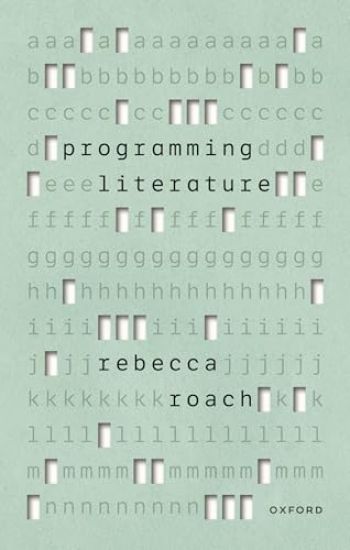
Programming Literature

Programming Literature

Rebecca Roach

Oxford University Press
2025
sidottu
This is a book about the messy, archival worlds of literature and computing, and the myriad of relations that have existed between the two. Before J. M. Coetzee was a writer of Nobel-Prize winning novels, the South African was a programmer for one of the most significant Cold War supercomputer projects in Britain. Experimental British writer Christine Brooke-Rose worked at Bletchley Park with Alan Turing. When not opining about modernism, Canadian literary critic Hugh Kenner was a devoted computer hobbyist. Literary scholars have often not known what to make of these 'other careers': intimidating, irrelevant, outside of the scope of literary studies, surely? When they do make links, it is often via the frame of formal logic that has dominated discussions of both computer history and literary modernism. This book starts from a different assumption: that, far from irrelevant, these material experiences were significant in the development of the literary projects of writers including Coetzee, Brooke-Rose, Kenner, William Gaddis, and Kamau Brathwaite. It contends that it is in the practice and the archive, rather than on the plane of abstraction, that we can best see this influence. Addressing literary scholars, media and computer historians, and digital theorists alike, Programming Literature productively reframes contemporary debates around artificial intelligence, the value of the humanities, and tech culture by emphasizing just how material these worlds have always been.
Vergil's Green Thoughts

Vergil's Green Thoughts

Rebecca Armstrong

Oxford University Press
2019
sidottu
The Eclogues, Georgics, and Aeneid abound with plants, yet much Vergilian criticism underestimates their significance beyond attractive background detail or the occasional symbolic set-piece. This volume joins the growing field of nature-centred studies of literature, looking head-on at Vergil's plants and trees to reveal how fundamental they are to an understanding of the poet's outlook on religion, culture, and mankind's place within the world. Divided into two parts, the first explores the religious and more diffusely numinous aspects of Vergil's plants, from awe-inspiring sacred groves to divinely promoted fields of corn, and shows how both cultivated and uncultivated plants fit within and help to shape the complex landscape of Vergilian (and, more broadly, Roman) religious thought. In the second half of the book, the focus shifts towards human interactions with plants from the perspectives of both cultivation and relaxation, exploring the love-hate relationship with vegetation which sometimes supports and sometimes contests the human self-image as the world's dominant species. Combining a series of close readings of a wide range of passages with the identification of broader patterns of association, Vergil's Green Thoughts appositely reveals and celebrates the complexity and variety of Vergilian flora.
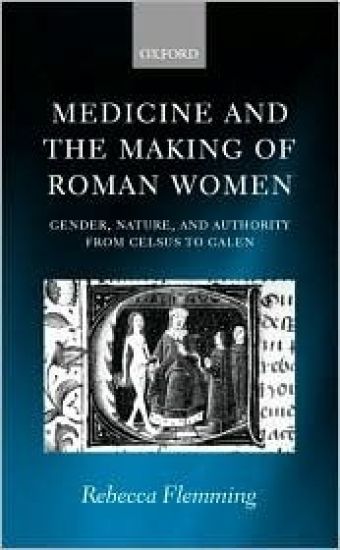
Medicine and the Making of Roman Women

Medicine and the Making of Roman Women

Rebecca Flemming

Oxford University Press
2000
sidottu
In this book Dr Flemming includes new translations of some of the works of medical practitioners from Celsus, writing during the reign of Tiberius, to Galen, whose career ended under the Severans, and puts their ideas about women's bodies in their social and philosophical contexts. Relations between women and medicine are now a major area of historical enquiry, but the Roman imperial era, despite the plentiful material it offers and the critical role it plays in the formation of the Western medical tradition, has received less than its fair share of the attention. This book seeks to redress the balance as it investigates female involvement in the manifold medical activities of the Roman world: how women fared as practitioners and patients, how they were understood and described in the copious medical writings of the period, and what effects those understandings and descriptions had in wider society. Dr Flemming examines both the contribution of medicine to gender in the Roman Empire, and the contribution of gender to medicine, and argues that the particularities of the Roman relationship between the two has much to reveal about how systems of sexual difference work in general.
Reproductive Health and Human Rights

Reproductive Health and Human Rights

Rebecca J. Cook; Bernard M. Dickens; Mahmoud F. Fathalla

Clarendon Press
2003
sidottu
The concept of reproductive health promises to play a crucial role in improving health care provision and legal protection for women around the world. This is an authoritative and much-needed introduction to and defence of the concept of reproductive health, which though internationally endorsed, is still contested. The authors are leading authorities on reproductive medicine, women's health, human rights, medical law, and bioethics. They integrate their disciplines to provide an accessible but comprehensive picture. They analyse 15 cases from different countries and cultures, and explore options for resolution. The aim is to equip readers to fashion solutions in their own health care circumstances, compatibly with ethical, legal and human rights principles.
Reproductive Health and Human Rights

Reproductive Health and Human Rights

Rebecca J. Cook; Bernard M. Dickens; Mahmoud F. Fathalla

Clarendon Press
2003
nidottu
The concept of reproductive health promises to play a crucial role in improving women's health and rights around the world. It was internationally endorsed by a United Nations conference in 1994, but remains controversial because of the challenge it presents to conservative agencies: it challenges policies of suppressing public discussion on human sexuality and regulating its private expressions. Reproductive Health and Human Rights is designed to equip healthcare providers and administrators to integrate ethical, legal, and human rights principles in protection and promotion of reproductive health, and to inform lawyers and women's health advocates about aspects of medicine and healthcare systems that affect reproduction. Rebecca Cook, Bernard Dickens, and Mahmoud Fathalla, leading international authorities on reproductive medicine, human rights, medical law, and bioethics, integrate their disciplines to provide an accessible but comprehensive introduction to reproductive and sexual health. They analyse fifteen case-studies of recurrent problems, focusing particularly on resource-poor settings. Approaches to resolution are considered at clinical and health system levels. They also consider kinds of social change that would relieve the underlying conditions of reproductive health dilemmas. Supporting the explanatory chapters and case-studies are extensive resources of epidemiological data, human rights documents, and research materials and websites on reproductive and sexual health. In explaining ethics, law, and human rights to healthcare providers and administrators, and reproductive health to lawyers and women's health advocates, the authors explore and illustrate limitations and dysfunctions of prevailing health systems and their legal regulation, but also propose opportunities for reform. They draw on the values and principles of ethics and human rights recognized in national and international legal systems, to guide healthcare providers and administrators, lawyers, governments, and national and international agencies and legal tribunals. Reproductive Health and Human Rights will be an invaluable resource for all those working to improve services and legal protection for women around the world. Updates to this book, and information on translations to French, Spanish, Portuguese, Chinese and Arabic are now available at www.law.utoronto.ca/faculty/cook/ReproductiveHealth.html
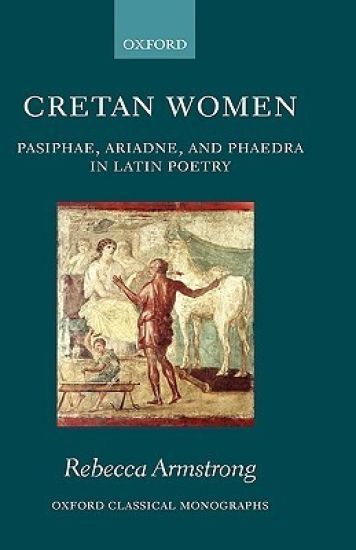
Cretan Women

Cretan Women

Rebecca Armstrong

Oxford University Press
2006
sidottu
In this detailed study of the representations of Pasiphae, Ariadne, and Phaedra in Latin poetry, Rebecca Armstrong investigates both the literary history of the myths (the Greek roots, the interactions between Roman versions) and their cultural resonance. In addition to close readings of the major treatments of each woman's story (in Catullus, Virgil, Ovid, and Seneca), she offers extended thematic explorations of the importance of memory, wildness, and morality in the myths. By extending the net to encompass three women (all from the same ill-fated family), the book gives a clear picture of the complexity and fascinating interconnectedness of myths and texts in Ancient Rome.
Mainstreaming Torture

Mainstreaming Torture

Rebecca Gordon

Oxford University Press Inc
2014
sidottu
The terrorist attacks of September 11, 2001 reopened what many people in America had long assumed was a settled ethical question: Is torture ever morally permissible? Within days, some began to suggest that, in these new circumstances, the new answer was yes. Rebecca Gordon argues that September 11 did not, as some have said, change everything, and that institutionalized state torture remains as wrong today as it was on the day before those terrible attacks. Furthermore, U.S. practices during the war on terror are rooted in a history that began long before September 11, a history that includes both support for torture regimes abroad and the use of torture in American jails and prisons.The terrorist attacks of September 11, 2001 reopened what Gordon argues that the most common ethical approaches to tortureutilitarianism and deontology (ethics based on adherence to duty)do not provide sufficient theoretical purchase on the problem. Both approaches treat torture as a series of isolated actions that arise in moments of extremity, rather than as an ongoing, historically and socially embedded practice. She advocates instead a virtue ethics approach, based in part on the work of Alasdair MacIntyre. Such an approach better illumines tortures ethical dimensions, taking into account the implications of torture for human virtue and flourishing. An examination of torture's effect on the four cardinal virtuescourage, temperance, justice, and prudence (or practical reason)suggests specific ways in which each of these are deformed in a society that countenances torture.many people in America had long assumed was a settled Mainstreaming Torture concludes with the observation that if the United States is to come to terms with its involvement in institutionalized state torture, there must be a full and official accounting of what has been done, and those responsible at the highest levels must be held accountable.
Let Me Be a Refugee

Let Me Be a Refugee

Rebecca Hamlin

Oxford University Press Inc
2014
sidottu
Why do decision-makers in similar liberal democracies interpret the same legal definition in very different ways? International law provides states with a common definition of a 'refugee' as well as guidelines outlining how asylum claims should be decided. Yet, the processes by which countries determine who should be granted refugee status look strikingly different, even across nations with many political, cultural, geographical, and institutional commonalities. This book compares the refugee status determination (RSD) regimes of three popular asylum seeker destinations - the United States, Canada, and Australia. Despite similarly high levels of political resistance to accepting asylum seekers across these three states, once asylum seekers cross their borders, they access three very different systems. These differences are significant both in terms of asylum seekers' experience of the process and in terms of their likelihood of being found to be a refugee. The book moves beyond the claim by some scholars that asylum seeker destinations are uniformly becoming more exclusionary, and the contrary assertions of other scholars that the same destinations are converging on a new inclusive internationalism leading to the decline of state sovereignty. Instead, I find these states to be running on three distinct trajectories, none of which are totally restrictive or expansive. Based on a multi-method analysis of all three countries, including a year of fieldwork with in-depth interviews of policy-makers and asylum-seeker advocates, observations of refugee status determination hearings, and a large-scale case analysis, I find that cross-national differences have less to do with political debates over admission and border control policy than with the level of insulation the administrative decision-making agency enjoys from either political interference or judicial review. Administrative justice is conceptualized and organized differently in every state, and so states vary in how they draw the line between refugee and non-refugee.
Let Me Be a Refugee

Let Me Be a Refugee

Rebecca Hamlin

Oxford University Press Inc
2014
nidottu
Why do decision-makers in similar liberal democracies interpret the same legal definition in very different ways? International law provides states with a common definition of a 'refugee' as well as guidelines outlining how asylum claims should be decided. Yet, the processes by which countries determine who should be granted refugee status look strikingly different, even across nations with many political, cultural, geographical, and institutional commonalities. This book compares the refugee status determination (RSD) regimes of three popular asylum seeker destinations - the United States, Canada, and Australia. Despite similarly high levels of political resistance to accepting asylum seekers across these three states, once asylum seekers cross their borders, they access three very different systems. These differences are significant both in terms of asylum seekers' experience of the process and in terms of their likelihood of being found to be a refugee. The book moves beyond the claim by some scholars that asylum seeker destinations are uniformly becoming more exclusionary, and the contrary assertions of other scholars that the same destinations are converging on a new inclusive internationalism leading to the decline of state sovereignty. Instead, I find these states to be running on three distinct trajectories, none of which are totally restrictive or expansive. Based on a multi-method analysis of all three countries, including a year of fieldwork with in-depth interviews of policy-makers and asylum-seeker advocates, observations of refugee status determination hearings, and a large-scale case analysis, I find that cross-national differences have less to do with political debates over admission and border control policy than with the level of insulation the administrative decision-making agency enjoys from either political interference or judicial review. Administrative justice is conceptualized and organized differently in every state, and so states vary in how they draw the line between refugee and non-refugee.
Constructing Authorship in the Work of Günter Grass

Constructing Authorship in the Work of Günter Grass

Rebecca Braun

Oxford University Press
2008
sidottu
This book traces a longstanding concern with issues of authorship throughout the work of Günter Grass, Germany's best-known contemporary writer and public intellectual. Through detailed close-readings of all of his major literary works from 1970 onwards and careful analysis of his political writings from 1965 to 2005, it argues that Grass's tendency to insert clearly recognisable self-images into his literary texts represents a coherent and calculated reaction to his constant exposure in the media-led public sphere. It underlines the degree of play which has characterised Grass's relationship to this sphere and himself as part of it and explains how a concern with the very concept of authorship has conditioned the way his work as a whole has developed on both thematic and structural levels. The major achievement of this study is to develop a new interpretative paradigm for Grass's work. It explains for the first time how his playful tendency to manipulate his own authorial image conditions all levels of his texts and is equally manifest in literary and political realms.
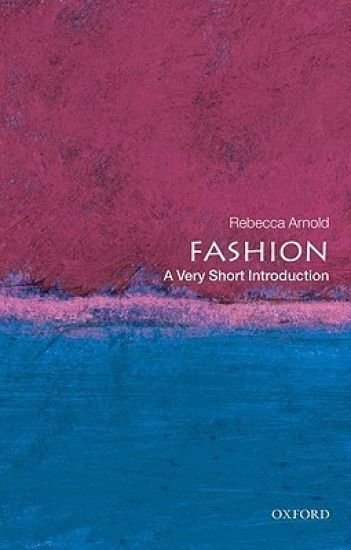
Fashion

Fashion

Rebecca Arnold

Oxford University Press
2009
nidottu
Fashion is a dynamic global industry that plays an important role in the economic, political, cultural, and social lives of an international audience. It spans high art and popular culture, and plays a significant role in material and visual culture. This book introduces fashion's myriad influences and manifestations. Fashion is explored as a creative force, a business, and a means of communication. From Karl Lagerfeld's creative reinventions of Chanel's iconic style to the multicultural reference points of Indian designer Manish Arora, from the spectacular fashion shows held in nineteenth century department stores to the mix-and-match styles of Japanese youth, the book examines the ways that fashion both reflects and shapes contemporary culture. Using historical and contemporary examples, it gives a clear understanding of how fashion has developed since the renaissance, while raising questions about its status, ethical credibility, and influence on consumers. The book provides insight into the structure of the fashion industry and how fashions are designed, promoted and consumed, in relation to relevant historical, social and cultural contexts. It is structured thematically, to look at the role and development of designers, the growth of shopping and the different businesses involved in making and selling fashionable clothes. Fashion's relationship to the wider culture is also explored, by considering its representation in art and collaborations between designers and artists, the moral controversies surrounding fashion, and attempts to produce ethical clothing, and the effects of globalisation on the fashion trade. ABOUT THE SERIES: The Very Short Introductions series from Oxford University Press contains hundreds of titles in almost every subject area. These pocket-sized books are the perfect way to get ahead in a new subject quickly. Our expert authors combine facts, analysis, perspective, new ideas, and enthusiasm to make interesting and challenging topics highly readable.
Long Cases for the Final FRCR 2B

Long Cases for the Final FRCR 2B

Rebecca Hanlon; John Curtis; Hulya Wieshmann; David White; Caren Landes; Val Gough

Oxford University Press
2011
nidottu
This comprehensive revision book contains 42 practice long cases, to help radiology trainees revise for and succeed at the Final FRCR Part 2B examination. Each case is presented as it would appear in the exam, with a selection of high quality imaging and clinical details, followed by a separate model answer section, formatted in line with the Royal College guidance notes. Each case also comes with key points explaining the answer and a further reading list. Written by a highly-qualified team of authors, with a wealth of clinical, teaching and exam experience, the book also contains essential hints and tips on exam technique to help radiology trainees pass this final hurdle.
Trade Unions in Western Europe

Trade Unions in Western Europe

Rebecca Gumbrell-McCormick; Richard Hyman

Oxford University Press
2013
sidottu
Trade unions in most of Europe are on the defensive: in recent decades they have lost membership, sometimes drastically; their collective bargaining power has declined, as has their influence on government; and in many countries, their public respect is much diminished. This book explores the challenges facing trade unions and their responses in ten west European countries: Britain, Ireland, Sweden, Denmark, Germany, Austria, the Netherlands, Belgium, France, and Italy. Based on a substantial number of interviews with key union representatives and academic experts in each country, together with the collection of a large amount of union documentation and background material, the book gives an account of how trade unionism has evolved in each country, the main recent challenges that unions have faced, and their responses. The book engages with the debates of the past two decades on union modernization and revitalization, and more generally with theories of institutional change and the literature on varieties of capitalism. Some observers ask whether unions remain relevant socio-economic actors, but challenging times can stimulate new thinking, and hence provide new opportunities. This book aims to show why trade unions are (still) important subjects for scientific analysis: first, as a means of collective 'voice' allowing employees to challenge management control and bringing a measure of balance to the employment relationship; second, as a form of 'countervailing power' to the socio-economic dominance of capital; and third, their potential as a 'sword of justice' to defend the weak, vulnerable and disadvantaged, express a set of values in opposition to the dominant political economy, and offer aspirations for a different--and better--form of society.
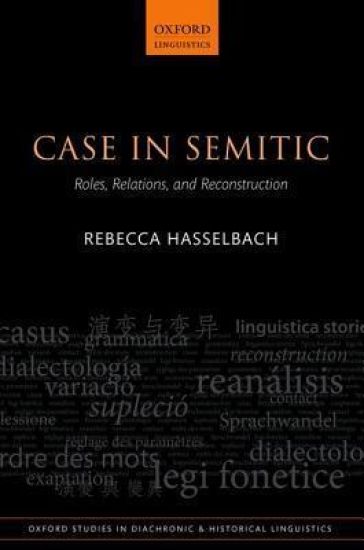
Case in Semitic

Case in Semitic

Rebecca Hasselbach

Oxford University Press
2013
sidottu
This book sets out a new reconstruction for the Semitic case system. It is based on a detailed analysis of the expression of grammatical roles and relations in the attested Semitic languages and, for the first time, brings typological methods to bear in the study of these features in Semitic languages and their reconstruction for proto-Semitic. Professor Hasselbach supports her argument with detailed analyses of a wide range of data and presents it in a way that will be accessible to both Semitists and typologists. The volume is divided into seven chapters: the first discusses basic methodologies used in Semitic linguistics and the limitations thereof. The second presents the evidence for morphological case-marking in the individual Semitic languages, the conventional reconstruction of Proto-Semitic, and the evidence which conflicts with it. The third introduces typological concepts and methods and their deployment in Semitic. Chapter 4 considers the case alignment of early Semitic. Chapter 5 presents a detailed study of marking structures and patterns and considers what these reveal about the nature of the original case system. Chapter 6 looks at the functions of case markers, considers the light they cast on the nominal system, and shows that the reconstruction of early Semitic as ergative is implausible. In the final chapter the author argues that early Semitic had a different nominal system from that of the later Semitic languages. She shows that the course of its development has parallels in other Afroasiatic languages, including Berber and Cushitic. Her book sheds important new light on the history of the Semitic languages and on the early development of the Afro-Asiatic language family as a whole.
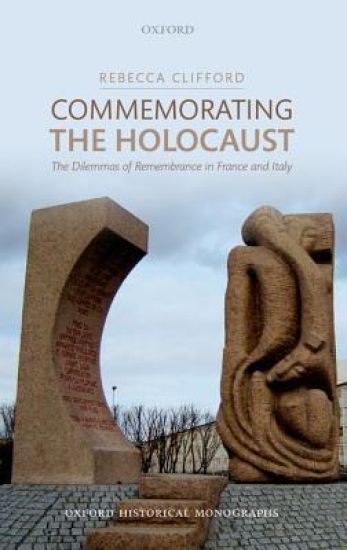
Commemorating the Holocaust

Commemorating the Holocaust

Rebecca Clifford

Oxford University Press
2013
sidottu
Commemorating the Holocaust reveals how and why the Holocaust came to play a prominent role in French and Italian political culture in the period after the end of the Cold War. By charting the development of official, national Holocaust commemorations in France and Italy, Rebecca Clifford explains why the wartime persecution of Jews, a topic ignored or marginalized in political discourse through much of the Cold War period, came to be a subject of intense and often controversial debate in the 1990s and 2000s. How and why were official Holocaust commemorations created? Why did the drive for states to 'remember' their roles in the persecution of Jewish populations accelerate only after the collapse of the Cold War? Who pressed for these commemorations, and what motivated their activism? To what extent was the discourse surrounding national Holocaust commemorations really about the genocide at all? Commemorating the Holocaust explores these key questions, challenging commonly-held assumptions about the origins of and players involved in the creation of Holocaust memorial days. Clifford draws conclusions that shed light both on the state of Holocaust memory in France and Italy, and more broadly on the collective memory of World War II in contemporary Europe.
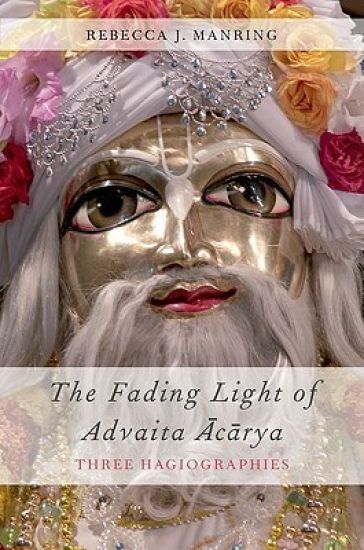
The Fading Light of Advaita Acarya

The Fading Light of Advaita Acarya

Rebecca J. Manring

Oxford University Press Inc
2012
sidottu
Rebecca J. Manring offers an illuminating study and translation of three hagiographies of Advaita Acarya, a crucial figure in the early years of the devotional Vaisnavism which originated in Bengal in the fifteenth century. Advaita Acarya was about fifty years older than the movement's putative founder, Caitanya, and is believed to have caused Caitanya's advent by ceaselessly storming heaven, calling for the divine presence to come to earth. Advaita was a scholar and highly respected pillar of society, whose status lent respectability and credibility to the new movement. A significant body of hagiographical and related literature about Advaita Acarya has developed since his death, some as late as the early twentieth century. The three hagiographic texts included in The Fading Light of Advaita Acarya examine the years of Advaita's life that did not overlap with Caitanya's lifetime, and each paints a different picture of its protagonist. Each composition clearly advocates the view that Advaita was himself divine in some way, and a few go so far as to suggest that Advaita reflected even greater divinity than Caitanya, through miraculous stories that can be found nowhere else in Bengali Vaisnava literature. Manring provides a detailed introduction to these texts, as well as remarkably faithful translations of Haricarana Dasa's Advaita Mangala, Laudiya Krsnadasa's Balya-lila-sutra, and Isana Nagara's Advaita Prakasa.
The Fading Light of Advaita Acarya

The Fading Light of Advaita Acarya

Rebecca J. Manring

Oxford University Press Inc
2012
nidottu
Rebecca J. Manring offers an illuminating study and translation of three hagiographies of Advaita Acarya, a crucial figure in the early years of the devotional Vaisnavism which originated in Bengal in the fifteenth century. Advaita Acarya was about fifty years older than the movement's putative founder, Caitanya, and is believed to have caused Caitanya's advent by ceaselessly storming heaven, calling for the divine presence to come to earth. Advaita was a scholar and highly respected pillar of society, whose status lent respectability and credibility to the new movement. A significant body of hagiographical and related literature about Advaita Acarya has developed since his death, some as late as the early twentieth century. The three hagiographic texts included in The Fading Light of Advaita Acarya examine the years of Advaita's life that did not overlap with Caitanya's lifetime, and each paints a different picture of its protagonist. Each composition clearly advocates the view that Advaita was himself divine in some way, and a few go so far as to suggest that Advaita reflected even greater divinity than Caitanya, through miraculous stories that can be found nowhere else in Bengali Vaisnava literature. Manring provides a detailed introduction to these texts, as well as remarkably faithful translations of Haricarana Dasa's Advaita Mangala, Laudiya Krsnadasa's Balya-lila-sutra, and Isana Nagara's Advaita Prakasa.
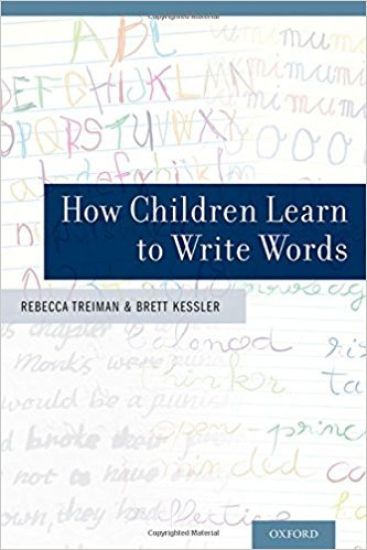
How Children Learn to Write Words

How Children Learn to Write Words

Rebecca Treiman; Brett Kessler

Oxford University Press Inc
2014
sidottu
Writing allows people to convey information to others who are remote in time and space, vastly increasing the range over which people can cooperate and the amount they can learn. Mastering the writing system of one's language is crucial for success in a modern society. This book examines how children learn to write words. It provides a theoretical framework that integrates findings from a wide range of age groups--from children who are producing their first scribbles to experienced spellers who are writing complex words. To set the stage for these discussions, early chapters of the book consider the nature of writing systems and the nature of learning itself. The following chapters review various aspects of orthographic development, including the learning of symbol shapes and punctuation. Each chapter reviews research with learners of a variety of languages and writing systems, revealing underlying similarities. Discussions of how orthography is and should be taught are incorporated into each chapter, making the book of interest to educators as well as to psychologists, cognitive scientists, and linguists. This book is unique in the range of topics and languages that it covers and the degree to which it integrates linguistic insights about the nature of writing systems with discussions of how people learn to use these systems. It is written in a scholarly yet accessible manner, making it suited for a wide audience.
Faith, Politics, and Power

Faith, Politics, and Power

Rebecca Sager

Oxford University Press Inc
2012
nidottu
There is often more than meets the eye where politics, religion and money are concerned. This is certainly the case with the Faith-Based Initiative. Section 104, a small provision of the 1996 Welfare Reform bill called "Charitable Choice," was the beginning of what we now know as the Faith-Based Initiative. In its original form, the Initiative was intended to ensure that small religious groups were not discriminated against in the awarding of government funding to provide social services. While this was the beginning of the story for the initiative, it is not the end. Instead Charitable Choice served as the launching pad for growing implementation of Faith-Based Initiatives. These new policies and practices exist despite the fact that all levels of government already contract with religious organizations to provide social services. Nevertheless, government actors have been implementing the Initiative in myriad ways, creating new policies where none appear necessary. Using data from multiple sources this book examines how and why states have been creating these policies and practices. The data reveal three key aspects of faith-based policy implementation by states: appointment of state actors known as Faith-Based Liaisons, passage of legislation, and development of state Faith-Based Policy conferences. These practices created a system in which neither the greatest hopes of its supporters, nor the greatest fears of its opponents have been realized. Supporters had hoped the Faith-Based Initiative would be about solving problems of poverty and an over-burdened welfare system, while opponents feared rampant proselytizing with government funds. Instead, these initiatives by and large did not offer substantial new fiscal support to those in need. In the place of this hope and fear, and despite the good intentions of many, these initiatives became powerful political symbols in the fight to reshape church/state relationships and distribution of political power.
The Spirit Moves West

The Spirit Moves West

Rebecca Y. Kim

Oxford University Press Inc
2015
sidottu
With the extraordinary growth of Christianity in the global south has come the rise of "reverse missions," in which countries in Asia, Africa, and Latin America send missionaries to re-evangelize the West. In The Spirit Moves West, Rebecca Kim focuses on South Korea as a case study of how non-Western missionaries evangelize Americans, particularly white Americans. Known as the "Asian Protestant Superpower," South Korea now sends more missionaries abroad than any country except the United States; there are approximately 22,000 Korean missionaries in over 160 countries. Drawing on four years of in-depth interviews, participant observation, and surveys of South Korea's largest non-denominational missionary-sending agency, University Bible Fellowship, Rebecca Kim gives us an inside look at reverse missions. Conducting her research both in the US and South Korea, she studies the motivations and methods of Korean evangelicals who have sought to "bring the gospel back" to America since the 1970s. She also explores how a mission movement from the global South could evolve over time in the West. The Spirit Moves West is the first empirically-grounded examination of a much-discussed phenomenon, which concludes by considering what the future of non-Western, especially Korean, missions will bring.