Kirjojen hintavertailu. Mukana 11 627 463 kirjaa ja 12 kauppaa.

Kirjahaku

Etsi kirjoja tekijän nimen, kirjan nimen tai ISBN:n perusteella.

1000 tulosta hakusanalla Robert Alan Ward

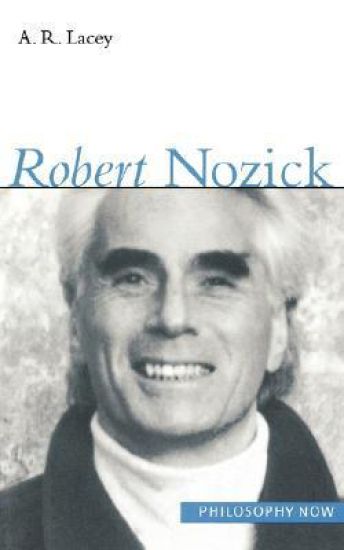
Robert Nozick

Robert Nozick

A. R. Lacey

PRINCETON UNIVERSITY PRESS
2001
sidottu
Although best known for the hugely influential Anarchy, State, and Utopia (1974), Robert Nozick has eschewed the label ''political philosopher, '' as the vast majority of his writings have focused on other areas. Indeed, the breadth of Nozick's work is perhaps greater than that of any other contemporary philosopher. A. R. Lacey presents the first book to give full and proper discussion of Nozick's philosophy as a whole and of critical reactions to it, spanning areas as diverse as ethics, epistemology, and philosophy of religion. The book begins by examining Anarchy, State, and Utopia and moves on to Nozick's noted work on the theory of knowledge and his notion of ''tracking the truth.'' Lacey explores the philosopher's metaphysical writings, including his ''closest continuer theory'' of personal identity, and his reflections on free will and the existence of God. He addresses the moral basis of Nozick's political philosophy in depth. Later chapters discuss his ideas of ''symbolic utility, '' his evolutionary account of rationality, and his varying treatments of Newcomb's Paradox. The book concludes with more general topics, including Nozick's thoughts on the meaning of life and what those who search for it are really looking for. Given Nozick's reluctance to respond to his critics, the book's discussion of the secondary literature on his work is invaluable. Throughout, Lacey finds themes that unite Nozick's diverse writings, noting, for example, his hostility to coercion of all kinds. Illuminating, informative, and clearly written, the book will be welcomed as an authoritative guide to Nozick's philosophical thinking.
Robert Nozick

Robert Nozick

A. R. Lacey

Princeton University Press
2001
pokkari
Although best known for the hugely influential Anarchy, State, and Utopia (1974), Robert Nozick has eschewed the label ''political philosopher,'' as the vast majority of his writings have focused on other areas. Indeed, the breadth of Nozick's work is perhaps greater than that of any other contemporary philosopher. A. R. Lacey presents the first book to give full and proper discussion of Nozick's philosophy as a whole and of critical reactions to it, spanning areas as diverse as ethics, epistemology, and philosophy of religion. The book begins by examining Anarchy, State, and Utopia and moves on to Nozick's noted work on the theory of knowledge and his notion of ''tracking the truth.'' Lacey explores the philosopher's metaphysical writings, including his ''closest continuer theory'' of personal identity, and his reflections on free will and the existence of God. He addresses the moral basis of Nozick's political philosophy in depth. Later chapters discuss his ideas of ''symbolic utility,'' his evolutionary account of rationality, and his varying treatments of Newcomb's Paradox. The book concludes with more general topics, including Nozick's thoughts on the meaning of life and what those who search for it are really looking for. Given Nozick's reluctance to respond to his critics, the book's discussion of the secondary literature on his work is invaluable. Throughout, Lacey finds themes that unite Nozick's diverse writings, noting, for example, his hostility to coercion of all kinds. Illuminating, informative, and clearly written, the book will be welcomed as an authoritative guide to Nozick's philosophical thinking.
The Bard: Robert Burns, a Biography

The Bard: Robert Burns, a Biography

Robert Crawford

PRINCETON UNIVERSITY PRESS
2009
sidottu
No writer is more charismatic than Robert Burns. Wonderfully readable, The Bard catches Burns's energy, brilliance, and radicalism as never before. To his international admirers he was a genius, a hero, a warm-hearted friend; yet to the mother of one of his lovers he was a wastrel, to a fellow poet he was "sprung . . . from raking of dung," and to his political enemies a "traitor." Drawing on a surprising number of untapped sources--from rediscovered poetry by Burns to manuscript journals, correspondence, and oratory by his contemporaries--this new biography presents the remarkable life, loves, and struggles of the great poet. Inspired by the American and French Revolutions and molded by the Scottish Enlightenment, Burns was in several senses the first of the major Romantics. With a poet's insight and a shrewd sense of human drama, Robert Crawford outlines how Burns combined a childhood steeped in the peasant song-culture of rural Scotland with a consummate linguistic artistry to become not only the world's most popular love poet but also the controversial master poet of modern democracy. Written with accessible elan and nuanced attention to Burns's poems and letters, The Bard is the story of an extraordinary man fighting to maintain a sly sense of integrity in the face of overwhelming pressures. This incisive biography startlingly demonstrates why the life and work of Scotland's greatest poet still compel the attention of the world a quarter of a millennium after his birth.
Robert’s Rules of Order, and Why It Matters for Colleges and Universities Today

Robert’s Rules of Order, and Why It Matters for Colleges and Universities Today

Henry Martyn Robert; Christopher P. Loss

PRINCETON UNIVERSITY PRESS
2021
sidottu
A critical edition of the book that paved the way for the democratization of American higher educationIf you have ever attended a town meeting or business lunch, or participated in a church group or department meeting, or served on a faculty senate or maybe just watched C-SPAN, then you have likely encountered Robert's Rules of Order. This critical edition of Henry M. Robert's essential guide to parliamentary procedure features the original text from 1876 along with a companion essay by Christopher Loss, who artfully recounts the book's publication and popular reception, and sheds light on its enduring value for one of the most vital bastions of democracy itself—the modern university.Loss deftly explains why Robert's simple, elegant handbook to democratic governance captured the imagination of so many ordinary citizens during the Gilded Age and how it has shaped the development of our colleges and universities ever since. He shows how Robert's rules can help faculty, administrators, and students to solve problems and overcome challenges through collaboration, disciplined thinking, trust in the facts, and honesty and fairness from all sides.At a time when people's faith in democracy and higher education has been shaken to its core, Robert's Rules of Order offers a powerful reminder of the importance of democratic norms and practices in American life and institutions.
Robert Pinsky: The First Two Books of Poems

Robert Pinsky: The First Two Books of Poems

Robert Pinsky

PRINCETON UNIVERSITY PRESS
2026
pokkari
The remarkable first two books of poetry by the Pulitzer Prize finalist and former U.S. poet laureate—now combined in a single volume with a new preface by the author Award-winning poet Robert Pinsky’s first two collections—Sadness And Happiness and An Explanation of America—announced the arrival of a major new voice in American poetry. Now, these acclaimed books are presented together in a single volume featuring a new preface by the author, introducing a new generation of readers to the groundbreaking early work of a beloved poet. Sadness And Happiness explores everyday subjects such as the streets and oceanfront of Pinsky’s hometown of Long Branch, New Jersey, while the long title poem of An Explanation of America examines personal and national myths as it transports readers across the states.
Robert Frost and New England

Robert Frost and New England

John C. Kemp

Princeton University Press
2015
pokkari
Though critics traditionally have paid homage to Robert Frost's New England identity by labeling him a regionalist, John Kemp is the first to investigate what was in fact a highly complex relationship between poet and region. Through a frankly revisionist interpretation, he not only demonstrates how Frost's relationship to New England and his attempt to portray himself as the "Yankee farmer poet" affected his poetry; he also shows that the regional identity became a problem both for Frost and for his readers. Originally published in 1979. The Princeton Legacy Library uses the latest print-on-demand technology to again make available previously out-of-print books from the distinguished backlist of Princeton University Press. These editions preserve the original texts of these important books while presenting them in durable paperback and hardcover editions. The goal of the Princeton Legacy Library is to vastly increase access to the rich scholarly heritage found in the thousands of books published by Princeton University Press since its founding in 1905.
Robert Lowell

Robert Lowell

Steven Gould Axelrod

Princeton University Press
2015
pokkari
This major interpretation of the life and art of Robert Lowell exposes the full relationship between the poetry and the personal and national experience to which it is so remarkably connected. Steven Axelrod proposes that the key to our understanding of Lowell's poetic achievement lies precisely in this interpenetration of his life and his art. Originally published in 1978. The Princeton Legacy Library uses the latest print-on-demand technology to again make available previously out-of-print books from the distinguished backlist of Princeton University Press. These editions preserve the original texts of these important books while presenting them in durable paperback and hardcover editions. The goal of the Princeton Legacy Library is to vastly increase access to the rich scholarly heritage found in the thousands of books published by Princeton University Press since its founding in 1905.
Robert Mayer and the Conservation of Energy

Robert Mayer and the Conservation of Energy

Kenneth L. Caneva

Princeton University Press
2015
pokkari
The principle of the conservation of energy was among the most important developments of nineteenth-century physics, and Robert Mayer, a physician from a small city in Germany, was one of its codiscoverers. As ship's doctor on a voyage to the Dutch East Indies in 1840, Mayer noticed that the venous blood he let from a European seaman was lighter than he expected. This observation set off a train of reflections that led him first to conclude that there must be a quantitative relationship between heat and "motion" and then, over several years, to believe in the indestructibility and uncreatability of "force." Rejecting the commonly invoked influence of Naturphilosophie, Kenneth Caneva provides a rich historical context for the problems and issues that concerned Mayer and for the ways in which he gradually came to understand what became known as the conservation of energy. Demonstrating that the development of Mayer's thinking was fostered by a constant search for analogies, Caneva also analyzes the transformation of the life sciences in mid-century Germany and offers a major reevaluation of the status of the "vital force" during that period. The intellectual environment treated here embraces medicine, physiology, physics, chemistry, religion, and spiritualism. Kenneth L. Caneva is Associate Professor of History at the University of North Carolina, Greensboro. Originally published in 1993. The Princeton Legacy Library uses the latest print-on-demand technology to again make available previously out-of-print books from the distinguished backlist of Princeton University Press. These editions preserve the original texts of these important books while presenting them in durable paperback and hardcover editions. The goal of the Princeton Legacy Library is to vastly increase access to the rich scholarly heritage found in the thousands of books published by Princeton University Press since its founding in 1905.
Robert Louis Stevenson and the Romantic Tradition

Robert Louis Stevenson and the Romantic Tradition

Edwin M. Eigner

Princeton University Press
2015
pokkari
Stevenson's fiction is evaluated in the light of the significant Romantic traditions that have influenced the novel and the romance. Stevenson is also considered as a serious writer and compared with Joseph Conrad, Mark Twain, and other major writers of the period. Originally published in 1966. The Princeton Legacy Library uses the latest print-on-demand technology to again make available previously out-of-print books from the distinguished backlist of Princeton University Press. These editions preserve the original texts of these important books while presenting them in durable paperback and hardcover editions. The goal of the Princeton Legacy Library is to vastly increase access to the rich scholarly heritage found in the thousands of books published by Princeton University Press since its founding in 1905.
Robert Frost and New England

Robert Frost and New England

John C. Kemp

Princeton University Press
2016
sidottu
Though critics traditionally have paid homage to Robert Frost's New England identity by labeling him a regionalist, John Kemp is the first to investigate what was in fact a highly complex relationship between poet and region. Through a frankly revisionist interpretation, he not only demonstrates how Frost's relationship to New England and his attempt to portray himself as the "Yankee farmer poet" affected his poetry; he also shows that the regional identity became a problem both for Frost and for his readers. Originally published in 1979. The Princeton Legacy Library uses the latest print-on-demand technology to again make available previously out-of-print books from the distinguished backlist of Princeton University Press. These editions preserve the original texts of these important books while presenting them in durable paperback and hardcover editions. The goal of the Princeton Legacy Library is to vastly increase access to the rich scholarly heritage found in the thousands of books published by Princeton University Press since its founding in 1905.
Robert Lowell

Robert Lowell

Steven Gould Axelrod

Princeton University Press
2016
sidottu
This major interpretation of the life and art of Robert Lowell exposes the full relationship between the poetry and the personal and national experience to which it is so remarkably connected. Steven Axelrod proposes that the key to our understanding of Lowell's poetic achievement lies precisely in this interpenetration of his life and his art. Originally published in 1978. The Princeton Legacy Library uses the latest print-on-demand technology to again make available previously out-of-print books from the distinguished backlist of Princeton University Press. These editions preserve the original texts of these important books while presenting them in durable paperback and hardcover editions. The goal of the Princeton Legacy Library is to vastly increase access to the rich scholarly heritage found in the thousands of books published by Princeton University Press since its founding in 1905.
Robert Mayer and the Conservation of Energy

Robert Mayer and the Conservation of Energy

Kenneth L. Caneva

Princeton University Press
2016
sidottu
The principle of the conservation of energy was among the most important developments of nineteenth-century physics, and Robert Mayer, a physician from a small city in Germany, was one of its codiscoverers. As ship's doctor on a voyage to the Dutch East Indies in 1840, Mayer noticed that the venous blood he let from a European seaman was lighter than he expected. This observation set off a train of reflections that led him first to conclude that there must be a quantitative relationship between heat and "motion" and then, over several years, to believe in the indestructibility and uncreatability of "force." Rejecting the commonly invoked influence of Naturphilosophie, Kenneth Caneva provides a rich historical context for the problems and issues that concerned Mayer and for the ways in which he gradually came to understand what became known as the conservation of energy. Demonstrating that the development of Mayer's thinking was fostered by a constant search for analogies, Caneva also analyzes the transformation of the life sciences in mid-century Germany and offers a major reevaluation of the status of the "vital force" during that period. The intellectual environment treated here embraces medicine, physiology, physics, chemistry, religion, and spiritualism. Kenneth L. Caneva is Associate Professor of History at the University of North Carolina, Greensboro. Originally published in 1993. The Princeton Legacy Library uses the latest print-on-demand technology to again make available previously out-of-print books from the distinguished backlist of Princeton University Press. These editions preserve the original texts of these important books while presenting them in durable paperback and hardcover editions. The goal of the Princeton Legacy Library is to vastly increase access to the rich scholarly heritage found in the thousands of books published by Princeton University Press since its founding in 1905.
Robert Louis Stevenson and the Romantic Tradition

Robert Louis Stevenson and the Romantic Tradition

Edwin M. Eigner

PRINCETON UNIVERSITY PRESS
2016
sidottu
Stevenson's fiction is evaluated in the light of the significant Romantic traditions that have influenced the novel and the romance. Stevenson is also considered as a serious writer and compared with Joseph Conrad, Mark Twain, and other major writers of the period. Originally published in 1966. The Princeton Legacy Library uses the latest print-on-demand technology to again make available previously out-of-print books from the distinguished backlist of Princeton University Press. These editions preserve the original texts of these important books while presenting them in durable paperback and hardcover editions. The goal of the Princeton Legacy Library is to vastly increase access to the rich scholarly heritage found in the thousands of books published by Princeton University Press since its founding in 1905.
Robert E. Lee's Orderly

Robert E. Lee's Orderly

Al Arnold; Meredith James

Orderlyforlee
2017
pokkari
New Chapters: History Lessons In Black & WhiteThe Mystical Black Confederates Meaningful ContactA Black & White Letter to the Church Al Arnold is a descendent of a slave, Turner Hall, Jr. "Uncle Turner," as he was known in his later years, served in the Confederate army as a body servant for two Confederate soldiers and an orderly for RobertE. Lee. As a slave, Turner Hall, Jr. was owned by another prominent Civil War general, Nathan Bedford Forrest.Al began researching his ancestor's life in 2008. At a family reunion, he saw a newspaper caption indicating his ancestor, Turner Hall, Jr. served RobertE. Lee as an orderly in the Civil War. To Al's amaze- ment, his research found a proud Black Confederate who held both Civil War generals in high esteem, even well after the war. At the age of ninety-five, Turner Hall, Jr. cherished a gift from Nathan Bedford Forrest as one of his most treasured possessions.Al was further intrigued that his great-great- grandfather was a celebrated man in his community of Hugo, Oklahoma. Blacks and Whites commemorated him as Hugo's "most distinguished citizen" as a result of his Civil War service. Turner Hall, Jr. lived to be a hundred and four years old. He attended the last Civil War reunion in 1938 at Gettysburg, Pennsylvania. Newsreel cameramen captured him displaying his reunion medals as an example of the typical Black Confederate. viii In 1940, he was interviewed as a Black Con- federate by a nationwide talk radio show in New York City. Turner Hall, Jr. left a trail for his family that Al has uncovered. Al shares his personal journey into his Confederate heritage as a modern Black man. He makes a connection through the life of his ancestor and embraces the premises that history should unite us instead of divide us. He argues that African Americans dishonor their ancestors by attempting to destroy Confederate heritage and by neglecting the historical impact that slaves had on both sides of the Civil War. These are the honest thoughts of a modern Black man who has wrestled with his Confederate heritage while being a Black Christian man in America and who is connected to two famous Civil War generals.
Robert E. Lee's Orderly

Robert E. Lee's Orderly

Al Arnold; Otis Westbrook Pickett

Orderlyforlee
2015
pokkari
A descendant of a slave, Al Arnold, tells his journey of embracing his Confederate heritage. His ancestor, Turner Hall, Jr., a Black Confederate, served as a body servant for two Confederate soldiers and an orderly for General Robert E. Lee. Turner Hall, Jr. returned to Okolona, Mississippi after the Civil War. Hall served a prominent family in that community for five generations. His life's journey eventually led him to Hugo, Oklahoma where he established himself as the town's most distinguished citizen receiving acclaim from Black and White citizens alike for his service. In 1938, his journey continued to Pennsylvania as the last Civil War veteran from his community to attend the final Civil War veteran reunion, as a Black Confederate. He also traveled to New York City and was interviewed by the national talk radio show, "We, The People" in 1940.One hundred and three years after the Civil War, Hall's great-great grandson, Al Arnold, was born in Okolona, Mississippi. Raised in North Mississippi, Al would later discover the history of his ancestor and began an eight year journey of why, how and for what reasons his ancestor served the Confederate armies? To his amazement, Al discovered that seventy two years after the Civil war, his ancestor was a proud Confederate and held in his possession a cherished gift from the Confederate Civil War general, Nathan Bedford Forrest. Al's personal research discovered that his ancestor was owned by Forrest and was enthusiastically warm toward the general and his service to the Confederate armies. This amazing connection to two famous Confederate generals awakened a new perception of curiosity about Confederate heritage in Al and challenged his traditional thoughts. He grew to accept his heritage and now embraces it with a desire to see African Americans embrace Confederate heritage instead of rejecting it on the notion of modern ideology. This is a deep personal journey of faith, heritage, race and family wrapped around the grace of God through the eyes and honest thoughts of a modern black man. Al tells the story of Turner Hall, Jr., his personal Confederate journey and how family and faith has brought harmony to his new found heritage. Arnold argues for the revitalization of the lost Black history of the Civil War era. He bestows dignity and honor on his Confederate ancestor and challenges the traditional thoughts of modern African Americans. Arnold rests in his faith as the uniting force that reconciles our colorful past to our bright future.
Doctrina Christiana: The Timeless Catechism of St. Robert Bellarmine
This catechism can be considered as a valid and effective catechetical tool for the work of the evangelization, a work which has to be realized with a new missionary zeal towards those who don't know the Catholic faith and as well towards those who know it defectively and insufficiently.May those who will read this catechism and those who will use it in the noble and meritorious work of teaching Christian doctrine, may be equipped with the sure and sacred doctrine of the Catholic faith, in order to stand, having their loins girt about with truth, and having on the breastplate of righteousness; and their feet shod with the preparation of the gospel of peace; above all, they shall take the shield of faith, wherewith they shall be able to quench all the fiery darts of the wicked (cf. Eph 6: 14-16). In this way they will be ready always to give an answer to every man that asks them the reason of their hope, with meekness and fear (cf. 1 Peter 3: 15-16).-Bishop Athanasius Schneider, from the ForewordFor the first time, St. Robert Bellarmine's long Catechism, written in the form of a dialogue, has been made available in the English Language.This Catechism was composed by St. Robert Bellarmine in 1598 and received Papal approbation from several Popes, most notably Pope Clement VIII and one of the greatest theologians to ever sit on the throne of St. Peter, Pope Benedict XIV. It was translated into Latin for use throughout the Church and has run through a number of editions throughout the centuries. Being written as a dialogue, it goes beyond the rote memorization of other catechisms (including that of Baltimore) by giving a deep explanation of the teachings of the faith with comparisons and parables.What is wholesome about this Catechism is not only the soundness of its doctrine, but the warmth that a great theologian that was accustomed to dealing with complicated matters of theology descends to lovingly explain the basic truths of faith in a manner that average laity can easily understand. It is not for nothing that St. Robert was made the Patron of all Catechists
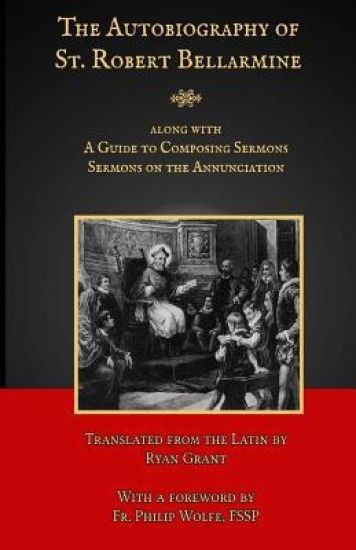
The Autobiography of St. Robert Bellarmine: Also Containing: A Guide to Composing Sermons - Sermons on the Annunciation
"During another chaotic time in the Church, St Philip Neri used to tell his directees that he didn't care what they read, as long as the author's name began with the letters ST. That advice is just as helpful today as it was then." -Fr. Philip Wolfe, FSSP, from the foreword.The first English translation of St. Robert Bellarmine's autobiography is the only account of the saint currently in print. Though Bellarmine never set out to compose any writings, he always did so out of obedience. He wrote this short autobiography for 2 of his brother Jesuits out of courtesy for their request to have an account of his life. It was never intended it for any eyes but theirs, nevertheless it was discovered and published in the 18th century, and became a great success. It is a brief and simple account of the life and travails of a great soul that loved Jesus Christ above all things.Also contained in this volume are St. Robert's advice philosophy for writing sermons, as well as his many sermons on the Gospel Missus est, exploring the depths of the mysteries contained in the Annunciation to the Blessed Virgin, taken from sermons that he preached in Italy while he was a Cardinal in Rome.Appendices have also been added to this addition to add some explanation of historical details that St. Robert relates that are not as clear to us today.
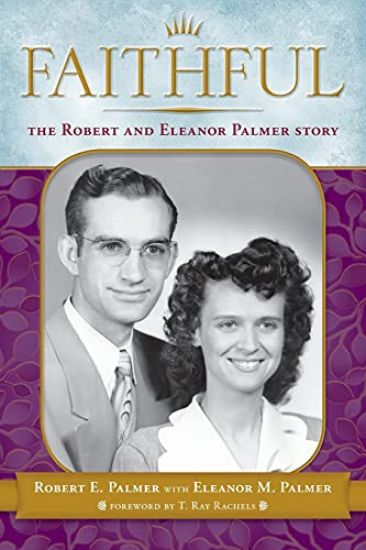
Faithful: The Robert & Eleanor Palmer Story

Faithful: The Robert & Eleanor Palmer Story

Robert E. Palmer

Robert E. Palmer
2017
nidottu
Faithful: The Robert and Eleanor Palmer Story chronicles the Palmers' early roots as children from the Midwest during The Great Depression. It follows their journey to Bible College at Central Bible Institute in Springfield, Missouri where the authors met and would later marry, to serving as assistant pastors in St. Louis and starting a family with the birth of their son, Paul. Faithful then describes the details that led them to be senior pastors in Dunn, North Carolina where there family grew to be a family of four with the birth of their daughter, Phyllis. We then find them relocating to a church in Lee's Summit, Missouri which they also helped to build as well as pastor. All throughout the book there is the theme of service and faithfulness. Eleanor was right there with Bob, lifting up his ministry with her own ministry of music, whether it be playing the organ or the piano or the accordian or leading the choir. There were other calls to churches in the Midwest until the Palmers ultimately received the call to go West, where they have been for the past 37 years at two different churches. With each move to each new city and church, whether it was for 5 years or 11 years or more, The Palmers always listened to the still small voice within and were guided by their God.This book exemplifies steadfastness, trust and faithfulness. The underlying story of being faithful to the purpose to which God had called them is a true testimony of the Palmers' lives. Faithful also describes their lives after pastoring in the pulpit and how they helped be "pastors to pastors" to hundreds of ministers. The book also delves into their work in overseas missions and contains an informative history of the Assemblies of God.