The Descendants Of Roger Chandler Of Concord, Massachusetts, 1658 is a book written by Charles Henry Chandler. This book is a genealogical record of the descendants of Roger Chandler, who settled in Concord, Massachusetts in 1658. It provides a comprehensive account of the Chandler family lineage and includes information on the family's history, origins, and migration patterns. The book is organized chronologically and covers the period from the 1600s to the early 1900s. It includes detailed information on each member of the Chandler family, including birth and death dates, marriages, occupations, and other significant life events. The book also includes photographs and illustrations of family members and their homes, as well as maps and other historical documents. The Descendants Of Roger Chandler Of Concord, Massachusetts, 1658 is an invaluable resource for anyone interested in genealogy, family history, or the history of Concord, Massachusetts.This scarce antiquarian book is a facsimile reprint of the old original and may contain some imperfections such as library marks and notations. Because we believe this work is culturally important, we have made it available as part of our commitment for protecting, preserving, and promoting the world's literature in affordable, high quality, modern editions, that are true to their original work.
The Cipher of Roger Bacon is a book written by William Romaine Newbold that explores the mystery of a manuscript attributed to the medieval philosopher and alchemist, Roger Bacon. The manuscript, known as the Voynich Manuscript, is written in an unknown script and contains illustrations of plants, animals, and astronomical phenomena. Newbold believed that he had cracked the code of the manuscript and that it contained Bacon's secret teachings on alchemy and other esoteric subjects. However, his theory was later debunked, and the manuscript remains an unsolved mystery to this day. The book provides a fascinating insight into the world of medieval alchemy and the attempts to unlock the secrets of the Voynich Manuscript.This is a new release of the original 1928 edition.This scarce antiquarian book is a facsimile reprint of the old original and may contain some imperfections such as library marks and notations. Because we believe this work is culturally important, we have made it available as part of our commitment for protecting, preserving, and promoting the world's literature in affordable, high quality, modern editions, that are true to their original work.
The Opus Majus Of Roger Bacon, V2 is a comprehensive and scholarly work that delves into the scientific and philosophical writings of the medieval scholar, Roger Bacon. Written by Robert Belle Burke, this book is the second volume of a two-part series that explores Bacon's most significant work, Opus Majus.In this volume, Burke provides an in-depth analysis of Bacon's work on optics, alchemy, and mathematics, as well as his contributions to the study of language and grammar. The book also explores Bacon's theories on the nature of knowledge and the importance of empirical observation in scientific inquiry.Burke's writing is clear and concise, making complex ideas accessible to readers without sacrificing intellectual rigor. The book is an essential resource for scholars of medieval science and philosophy, as well as anyone interested in the history of scientific thought. Overall, The Opus Majus Of Roger Bacon, V2 is a meticulously researched and thought-provoking work that sheds new light on one of the most influential thinkers of the medieval period.This is a new release of the original 1928 edition.This scarce antiquarian book is a facsimile reprint of the old original and may contain some imperfections such as library marks and notations. Because we believe this work is culturally important, we have made it available as part of our commitment for protecting, preserving, and promoting the world's literature in affordable, high quality, modern editions, that are true to their original work.
Ace Bailey Versus Roger Crozier: Epic Poetry is a book about two great Canadian hockey legends from Bracebridge, Muskoka, Ontario, Canada. This is a book that boys will enjoy! It looks at the legends and then the author imagines an epic battle between the two superstars. Avery also connects his own story to the legends as he comes from the same place as the two stars and they were big influences in his life.
In his most recent work, the contemporary philosopher Roger Scruton has turned his attention to religion. Although a religious sensibility ties together his astonishingly prodigious and dynamic output asa philosopher, poet and composer, his recent exploration of religious and theological themes from a philosophical point of view has excited a fresh response from scholars. This collection of writings addresses Scruton’s challenging and subtle philosophy of religion for the first time.The volume includes contributions from those who specialize in the philosophy of religion, the history of thought and culture, aesthetics, and church history. The collection is introduced by Mark Dooley, author of two books on Scruton, and includes a response to the writings from Scruton himself in which he develops his idea of the sacred and the erotic and defends the integrity of his work as an attempt to give a sense of the Lebenswelt (or 'lifeworld'): how humans experience the world. He argues that religion emerges from that experience and transforms us from beings bound by causal necessity into persons who acknowledge freedom, obligation and right.A unique and fascinating collection of writings that sheds light on this hitherto unexplored aspect of Roger Scruton's philosophy.
The 18th century was a wealth of knowledge, exploration and rapidly growing technology and expanding record-keeping made possible by advances in the printing press. In its determination to preserve the century of revolution, Gale initiated a revolution of its own: digitization of epic proportions to preserve these invaluable works in the largest archive of its kind. Now for the first time these high-quality digital copies of original 18th century manuscripts are available in print, making them highly accessible to libraries, undergraduate students, and independent scholars.Western literary study flows out of eighteenth-century works by Alexander Pope, Daniel Defoe, Henry Fielding, Frances Burney, Denis Diderot, Johann Gottfried Herder, Johann Wolfgang von Goethe, and others. Experience the birth of the modern novel, or compare the development of language using dictionaries and grammar discourses. ++++The below data was compiled from various identification fields in the bibliographic record of this title. This data is provided as an additional tool in helping to insure edition identification: ++++British LibraryT070080London: printed for Hookham and Carpenter, 1793. 3v.; 12
The 18th century was a wealth of knowledge, exploration and rapidly growing technology and expanding record-keeping made possible by advances in the printing press. In its determination to preserve the century of revolution, Gale initiated a revolution of its own: digitization of epic proportions to preserve these invaluable works in the largest archive of its kind. Now for the first time these high-quality digital copies of original 18th century manuscripts are available in print, making them highly accessible to libraries, undergraduate students, and independent scholars.Western literary study flows out of eighteenth-century works by Alexander Pope, Daniel Defoe, Henry Fielding, Frances Burney, Denis Diderot, Johann Gottfried Herder, Johann Wolfgang von Goethe, and others. Experience the birth of the modern novel, or compare the development of language using dictionaries and grammar discourses. ++++The below data was compiled from various identification fields in the bibliographic record of this title. This data is provided as an additional tool in helping to insure edition identification: ++++British LibraryT070080London: printed for Hookham and Carpenter, 1793. 3v.; 12
The 18th century was a wealth of knowledge, exploration and rapidly growing technology and expanding record-keeping made possible by advances in the printing press. In its determination to preserve the century of revolution, Gale initiated a revolution of its own: digitization of epic proportions to preserve these invaluable works in the largest archive of its kind. Now for the first time these high-quality digital copies of original 18th century manuscripts are available in print, making them highly accessible to libraries, undergraduate students, and independent scholars.Rich in titles on English life and social history, this collection spans the world as it was known to eighteenth-century historians and explorers. Titles include a wealth of travel accounts and diaries, histories of nations from throughout the world, and maps and charts of a world that was still being discovered. Students of the War of American Independence will find fascinating accounts from the British side of conflict. ++++The below data was compiled from various identification fields in the bibliographic record of this title. This data is provided as an additional tool in helping to insure edition identification: ++++British LibraryT041116Sometimes ascribed to John Oldmixon. A satire on Robert Harley, Earl of Oxford.London: printed for A. Baldwin, 1711. 48p.; 8
The 18th century was a wealth of knowledge, exploration and rapidly growing technology and expanding record-keeping made possible by advances in the printing press. In its determination to preserve the century of revolution, Gale initiated a revolution of its own: digitization of epic proportions to preserve these invaluable works in the largest archive of its kind. Now for the first time these high-quality digital copies of original 18th century manuscripts are available in print, making them highly accessible to libraries, undergraduate students, and independent scholars.Delve into what it was like to live during the eighteenth century by reading the first-hand accounts of everyday people, including city dwellers and farmers, businessmen and bankers, artisans and merchants, artists and their patrons, politicians and their constituents. Original texts make the American, French, and Industrial revolutions vividly contemporary.++++The below data was compiled from various identification fields in the bibliographic record of this title. This data is provided as an additional tool in helping to insure edition identification: ++++British LibraryT051700Roger = Henry Boyle, 1st Earl of Shannon. In: 'The patriot miscellany', vol. 2, Dublin, 1756. One of a number of tracts dealing with the political situation in Ireland during the administration of the Duke of Dorset (N.U.C.).Dublin: printed in the year, 1756. 15, 1]p.; 8
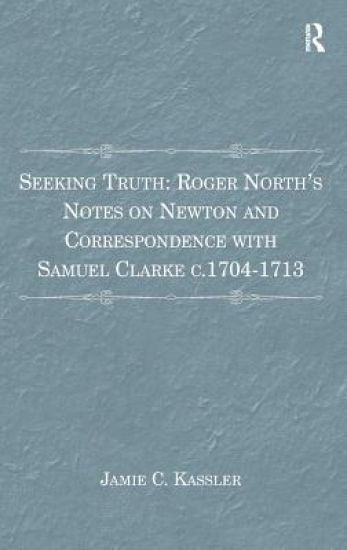
In the early 1690s Roger North was preparing to remove from London to Rougham, Norfolk, where he planned to continue his search for truth, which for him meant knowledge of nature, including human nature. But this search was interrupted by three events. First, between c.1704 and the early part of 1706, he read Newton’s book on rational (quantitative) mechanics and, afterwards, his book on optics in Clarke’s Latin translation. Second, towards the latter part of 1706, he and Clarke, a Norfolk clergyman, corresponded about matters relating to Newton’s two books, after which Clarke removed to London and the correspondence ceased. Third, in 1712 North received a letter from Clarke, requesting him to read and respond to his new publication on the philosophy of the Godhead. As Kassler details, each of these events presented a number of challenges to North’s values, as well as the way of philosophising he had learned as a student and practitioner of the common law. Because he never made public his responses to the challenges, her book also includes editions of North's notes on reading Newton’s books, as well as what now remains of the 1706 and later correspondence with Clarke. In addition, she presents analyses of some of North’s ’second thoughts’ about the issues raised in the notes and 1706 correspondence and, from an examination of Clarke’s main writings, provides a context for understanding the correspondence relating to the 1712 book.




![The Trial of Roger, for the Murder of Lady Betty Ireland, ... on Wednesday the 23d [sic] of March, 1756. the Second Edition](/covers/9781385086995.jpg)