Kirjojen hintavertailu. Mukana 12 390 323 kirjaa ja 12 kauppaa.

Kirjahaku

Etsi kirjoja tekijän nimen, kirjan nimen tai ISBN:n perusteella.

1000 tulosta hakusanalla Rudolf

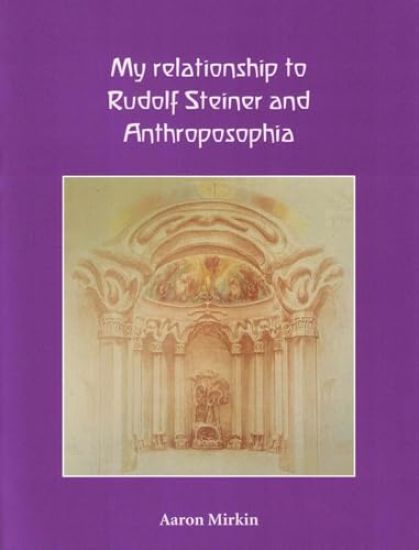
My Relationship to Rudolf Steiner and Anthroposophia
"March 30, 2025, marked the 100th anniversary of the death of Rudolf Steiner: Our great teacher, Bearer of Anthroposophia, Proclaimer of the Second Coming of Christ. How do we relate to him today? How do we relate to Anthroposophia today?" (Aaron Mirkin) In this short but penetrating study, Aaron Mirkin poses essential questions for anyone working with anthroposophy today: Who is Anthroposophia? What does it mean to unite your destiny with the anthroposophical movement? How can you develop a deeper relationship with the being of Rudolf Steiner? At the heart of Mirkin's study is the karma of the anthroposophical movement and the unfolding of this karma in our lives today. Mirkin approaches these riddles in the spirit of self-knowledge and out of a desire to recognize the real tasks at hand. This book is an invitation to contemplate the deeper aspects of what it means to meet anthroposophy now.
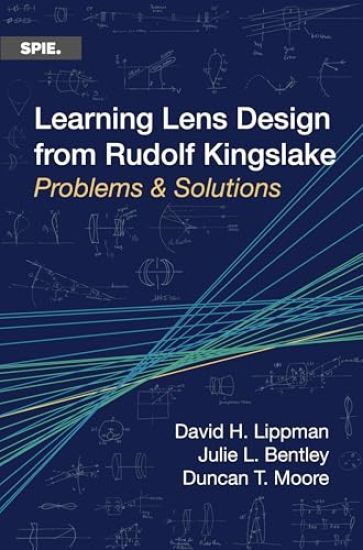
Learning Lens Design from Rudolf Kingslake

Learning Lens Design from Rudolf Kingslake

David H. Lippman; Julie L. Bentley; Duncan T. Moore

SPIE PRESS
2026
sidottu
This book is a tribute to the legacy of lens designer Rudolf Kingslake, a pioneer in the field who taught lens design for 56 years at The Institute of Optics at the University of Rochester. The book introduces a collection of over 150 of his lens design problems, which were handwritten on index cards and used in Kingslake’s courses from the 1930s to the 1980s. Each problem is accompanied by detailed solutions and organized by topic, including: Ray Tracing First-Order Optics Monochromatic Aberrations Chromatic Aberrations Thin Lens Aberrations Optical Systems & Designs
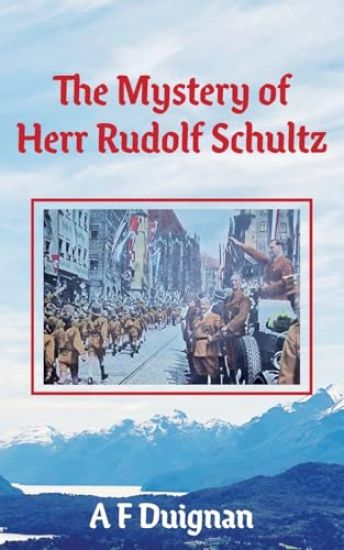
The Mystery of Herr Rudolf Schultz

The Mystery of Herr Rudolf Schultz

A. F. Duignan

ROWANVALE BOOKS
2026
nidottu
Carl Fischer, the last survivor from the Fuhrerbunker, is dying. When his old friend Joseph Blum visits him in his final days, he is entrusted with Carl's many journals - whichexpose the truth about the fate of the most despised monster of the twentieth century, Adolf Hitler. Through Carl's eyes, the reader is drawn into those final days in Berlin, with harrowing details of life at the barricades, life in the Fuhrerbunker, and its aftermath. The real fate of Adolf Hitler, according to Carl's first-hand experience, flies in the face of accepted history. * The author worked for several years in West Berlin, where history was made, meeting survivors who watched it happen. Having witnessed the destruction of their city, many Berliners expressed doubts about the suicides in the bunker, and suggested various explanations of how Hitler could have escaped. This historical novel is a work of fiction, but it provides a compelling alternative account of Hitler's final fate.
Otto Bothlingk an Rudolf Roth: Briefe Zum Petersburger Worterbuch 1852-1885. Index
Der ausfuhrliche Index zu den 482 Briefen des Philologen Otto von Bohtlingk an Rudolf Roth erscheint nun zum 200. Geburtstag des Autors. Der Band besteht aus einem Generalindex, einem Sanskrit-Wortindex, einem Index zu Bohtlingks Spruchen und einer Literaturliste aller von ihm in der Korrespondenz genannten Werke. Der Generalindex bietet eine Vielzahl an Details zur Interaktion zwischen den Kollegen aus der akademischen Welt der zweiten Halfte des 19. Jahrhunderts. Besonders ausfuhrlich indiziert wurden die Angaben zur Entstehung des Petersburger Worterbuchs und von Bohtlingks "Indischen Spruchen". Daruber hinaus wurden auch Begriffe aufgenommen, die den Wissenschaftler in seinem sozialen, seinem politischen wie auch seinem privaten Umfeld zeigen. Im Sanskrit-Wortindex sind diejenigen Worter, uber deren Bearbeitung sich Bohtlingk mit Roth ausgetauscht hat, durch Fettdruck von den anderen abgesetzt, wodurch philologisch interessierten Lesern ein schneller Zugriff ermoglicht wird. Ebenso bietet der Index zu den Indischen Spruchen eine Orientierung uber die Stellen, an denen sich Erwagungen und Korrekturen Bohtlingks zur Textfassung finden.
Conversations with Rudolfo Anaya

Conversations with Rudolfo Anaya

University Press of Mississippi
2013
nidottu
In 1972 Rudolfo Anaya made a quiet entry into American literature with the publication of Bless Me, Ultima. Over the span of twenty-two years, by word of mouth alone, this first novel sold more than 300,000 copies. It was the first Chicano novel to enter the American literary canon, and it helped identify Abaya as one of the founders of Chicano literature.In this collection of interviews Anaya talks about his life and about how New Mexico, his home state, influences his work. The interviews explore also the importance that myths and spiritual matters play in his writings. He shares his intimate knowledge of the long struggle of ethnic writers to gain acceptance by mainstream publishers. Anaya also speaks eloquently and passionately of his faith in Chicano literature and of the politics of ""hate, prejudice, and bigotry"" that minorities face throughout the United States. Yet he remains consistent in his call for all Americans to understand one another. For three decades he has been a tireless agent in the push for multiculturalism and pluralism in America.Anaya is a professor emeritus of English and creative writing at the University of New Mexico. Besides his critically acclaimed novels (Bless Me, Ultima, Heart of Aztlan, Tortuge, Alburquerque, Zia Summer, Rio Grande Fall, and Jalamanata), he has written plays, poems, essays, short stories, and books for children.
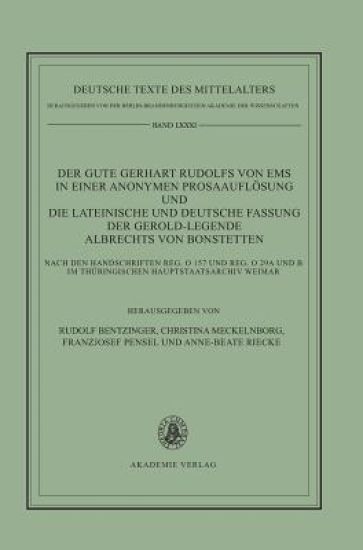
Der Gute Gerhart Rudolfs Von EMS in Einer Anonymen Prosaauflösung Und Die Lateinische Und Deutsche Fassung Der Gerold-Legende Albrechts Von Bonstetten
Die "Deutschen Texte des Mittelalters" wurden 1904 an der Koniglich Preuischen Akademie der Wissenschaften in Berlin gegrundet, um die deutsche mittelalterliche Uberlieferung moglichst vollstandig zu erfassen und eine Reihe der Texte in Ausgaben nach dem Leithandschriftenprinzip zugig zuganglich zu machen. Die Germanisten Gustav Roethe, Erich Schmidt und Konrad Burdach begrundeten ein zweiteiliges Projekt, das heute an der Berlin-Brandenburgischen Akademie der Wissenschaften fortgesetzt wird. Seit 1904 wurden 87 Bande nach dem Leithandschriftenprinzip vorgelegt. Die Methode, die urspunglich vor allem zur Beschleunigung gegenuber umfangreichen kritischen Editionen gedacht war, hat sich im Lauf des Jahrhunderts immer mehr als zukunftstrachtig erwiesen, da hier die Texte in lesbarer und doch handschriftennaher Form verbreitet werden. Schwerpunkte lagen auf geistlicher Dichtung, auf der Literatur des deutschen Ordens sowie auf der Epik des Spatmittelalters. Manche Projekte, wie der "Jungere Titurel" oder die Schriften des Eisenacher Stadtschreibers Johannes Rothe, wurden uberviele Jahrzehnte verfolgt. Als nachstes Groprojekt wird die Arbeitsstelle eine Edition des "Passionals" vorlegen, eines mittelhochdeutschen Reimlegendars aus der Zeit um 1300, das in knapp 43.000 Reimpaarversen die Geschichte Christi, Maria und der Apostel beschreibt. Sprachlich orientiert an der klassischen mittelhochdeutschen Epik, gibt das Werk einen umfassenden Uberblick uber die lebendige Legendenuberlieferung des Mittelalters.