

Kirjahaku
Etsi kirjoja tekijän nimen, kirjan nimen tai ISBN:n perusteella.
1000 tulosta hakusanalla Rudolf Ehwald

Otto Bothlingk an Rudolf Roth: Briefe Zum Petersburger Worterbuch 1852-1885. Index
Harrassowitz
2015
sidottu
Der ausfuhrliche Index zu den 482 Briefen des Philologen Otto von Bohtlingk an Rudolf Roth erscheint nun zum 200. Geburtstag des Autors. Der Band besteht aus einem Generalindex, einem Sanskrit-Wortindex, einem Index zu Bohtlingks Spruchen und einer Literaturliste aller von ihm in der Korrespondenz genannten Werke. Der Generalindex bietet eine Vielzahl an Details zur Interaktion zwischen den Kollegen aus der akademischen Welt der zweiten Halfte des 19. Jahrhunderts. Besonders ausfuhrlich indiziert wurden die Angaben zur Entstehung des Petersburger Worterbuchs und von Bohtlingks "Indischen Spruchen". Daruber hinaus wurden auch Begriffe aufgenommen, die den Wissenschaftler in seinem sozialen, seinem politischen wie auch seinem privaten Umfeld zeigen. Im Sanskrit-Wortindex sind diejenigen Worter, uber deren Bearbeitung sich Bohtlingk mit Roth ausgetauscht hat, durch Fettdruck von den anderen abgesetzt, wodurch philologisch interessierten Lesern ein schneller Zugriff ermoglicht wird. Ebenso bietet der Index zu den Indischen Spruchen eine Orientierung uber die Stellen, an denen sich Erwagungen und Korrekturen Bohtlingks zur Textfassung finden.
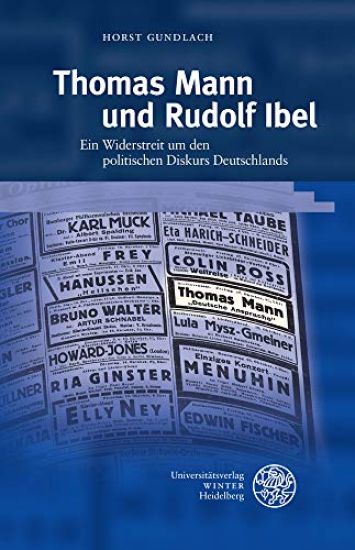
Thomas Mann Und Rudolf Ibel: Ein Widerstreit Um Den Politischen Diskurs Deutschlands
Universitatsverlag Winter
Universitatsverlag Winter
2019
sidottu

"At long last a worthy biography of one of the most fascinating and important figures in Holocaust History -- Rudi Vrba. Alan Twigg not only pulls together many new sources to illuminate Vrba's life before and after his escape from Auschwitz-Birkenau. He also guides the reader through the thicket of fictional and semifictional accounts of Vrba's remarkable escape that have obscured the historical truth until now." -- Christopher R. Browning, historian Holocaust scholar Raul Hilberg declared there were only two great Holocaust heroes -- the leader of the Warsaw Ghetto Uprising (Mordechai Anielewicz) and Rudolf Vrba. After he escaped from Auschwitz-Birkenau in April of 1944, Vrba and his co-escapee Alfr d Wetzler co-authored the Vrba-Wetzler Report, credited with saving 200,000 Hungarian Jews. "No other single act in the Second World War," according to World War II historian Sir Martin Gilbert, "saved so many Jews from the fate that Hitler and the SS had determined for them." As one of the 20th century's most important whistleblowers, Vrba also stands out in Claude Lanzmann's Shoah as a handsome, charismatic and cheerful iconoclast. But the Yad Vashem Holocaust Museum in Israel has limited public awareness of Vrba because he consistently criticized Jewish leaders for failing to adequately forewarn Jews of their fate. Holocaust Hero: The Life and Times of Rudolf Vrba is the introductory volume for a biography project to examine the remarkable life of Rudolf Vrba; including his decorated service with the partisans, his love affairs, his two marriages, his accomplishments as a Nazi hunter and his iconoclastic stamina to always speak the truth about the Holocaust. Compiled over a five-year period by a journalist who knew Vrba, Holocaust Hero provides previously unrevealed information about Vrba based on research at the FDR Presidential Library in New York and interviews with those who knew him, including Robin Vrba, his wife of 31 years, who speaks candidly about her husband for the first time. "Rudi was gorgeous and totally charismatic. And he was funny. I remember we were in Auschwitz for a documentary. We were doing the film inside the camp. Then it was about 5:30 and it was time to leave. We were trying to get out. The gate had been locked. It was really muddy. Everybody started to really fret. How are we going to get out? And Rudi said, loudly, so everyone could hear, 'Never mind. I know another way out '" -- Robin Vrba
Although the name of Rudolf Bultmann is so well-known, and a considerable number of his writings, and specialist discussions of them, are available in English, there has so far been no thorough basic introduction setting out Bultmann's theology in a comprehensive way. This gap has now been admirably filled by the present book, which derives from a series of lectures given by one of Bultmann's pupils at Marburg in celebration of Bultmann's eightieth birthday. Addressed to an audience of widely differing backgrounds, it presupposes no specialist knowledge, and expounds Bultmann's thought with particular vividness, making full use of quotations from his works.

Erkenntnis Orientated: A Centennial Volume for Rudolf Carnap and Hans Reichenbach
Springer
1991
sidottu
Rudolf Carnap was born on May 18, 1891, and Hans Reichenbach on September 26 in the same year. They are two of the greatest philosophers of this century, and they are eminent representatives of what is perhaps the most powerful contemporary philosophical movement. Moreover, they founded the journal Erkenntnis. This is ample reason for presenting, on behalf of Erkenntnis, a collection of essays in honor of them and their philosophical work. I am less sure, however, whether it is a good time for resuming their philosophical impact; their work still is rather part than historical basis of the present philosophical melting-pot. Their basic philosophical theses have currently, it may seem, not so high a standing, but their impact can be seen in numerous detailed issues; they have opened or pushed forward lively fields of research which are still very actively pursued not only within philosophy, but also in many neighboring disciplines. Whatever the present balance of opinions about their philosophical ideas, there is something even more basic in their philosophy than their tenets which is as fresh, as stimulating, as exemplary as ever. I have in mind their way of philosophizing, their conception of how to do philosophy. It is always a good time for reinforcing that conception; and if this volume would manage to do so, it would fully serve its purpose.
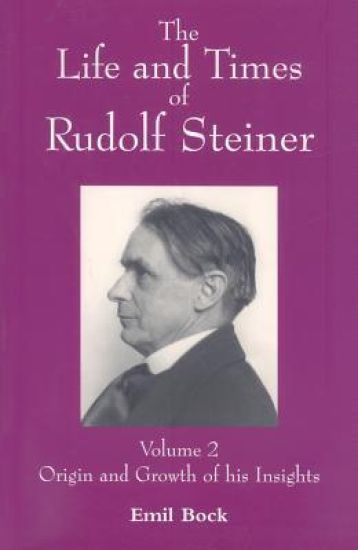
Emil Bock lectured widely on Rudolf Steiner after the Second World War, and during the course of his research he uncovered many previously unknown aspects of Steiner?s life. This book, the second of two volumes, explores some of the themes and ideas in Steiner?s work, as well as exploring the nature of destiny.The early years of Jesus, the Christmas festival and the break from the Theosophical Society to the Anthroposophical Society are just some of the many themes and events covered in this comprehensive study. Bock also examines the circle of people around Steiner at this time and, using Steiner's ideas on karma and reincarnation, draws interesting parallels with Rome, Byzantium, Ephesus and the Grail Castle.

The Sino-Judaic Bibliographies of Rudolf Loewenthal
Hebrew Union College Press,U.S.
1988
nidottu
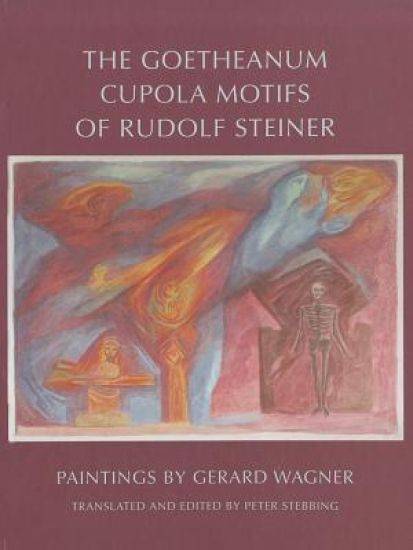
The Goetheanum Cupola Motifs of Rudolf Steiner
SteinerBooks, Inc
2011
sidottu
Gerard Wagner's paintings of Rudolf Stiener's Goetheanum cupola sketches bring these works to a wide audience that would otherwise have little access to or knowledge of those representations of Steiner's artistic spiritual vision contained in the first Goetheanum and lost to the fire that destroyed that great building. Wagner re-created those archetypal motifs in new ways over a period of decades. They constitute an artistic high point of Wagner's work as a whole, but they cannot be separated from the Goetheanum itself, nor can they be fully understood except in the context of anthroposophic spiritual science. In this sense, The Goetheanum Cupola Motifs of Rudolf Steiner points to the historic and spiritual importance of the first Goetheanum building. Rudolf Steiner's lecture on October 25, 1914, and his lecture on the paintings of the small cupola on January 25, 1920, are published in English here for the first, along with color photographs from 1922. Also included are the little-known colored etchings of the Goetheanum window motifs made by by Assya Turgenieff with Rudolf Steiner, as well as other centrally important contributions to an understanding of this new direction in art. Though the main emphasis is on visual examples, the book achieves something more than simply cataloging these works of art. The book conveys, too, a sense of the artistic process itself. Thus, Gerard Wagner's observations here have a special relevance. In addition to the two lectures by Rudolf Steiner and the paintings by Gerard Wagner--in full color--The Goetheanum Cupola Motifs of Rudolf Steiner presents essays from Peter Stebbing, Louise Clason, Assya Turgenieff, and Gerard Wagner. "Along with the architectural and sculptural forms of the double-domed first Goetheanum, the cupola paintings further epitomized the artistic conception of this unique building. The painting motifs extending over the surface of the two cupolas encompassed the evolution of the world as a whole, from its creation by the biblical Elohim to the great epochs of Lemuria and Atlantis that followed. Traversing the post-Atlantean cultural epochs, the beholder was gradually led to the building's central motif: the Mystery of Golgotha as the mid-point of world evolution, with its implications for the future development of the Earth and humanity." --Sergei O. Prokofieff (from his foreword) CONTENTS: Foreword by Sergei O. Prokofieff Preface The Renewal of the Artistic Principle / Rudolf Steiner Goethe and the Goetheanum / Rudolf Steiner The Artists Who Originally Worked on Painting the Cupolas of the First Goetheanum / Peter Stebbing Recollections of the Years of Painting in the Small Cupola of the First Goetheanum / Louise Clason I. THE MOTIFS OF THE LARGE CUPOLA The Large Cupola Sketch-Motifs of Rudolf Steiner Large Cupola Studies of Gerard Wagner A Further Development of the Large Cupola Motifs / Peter Stebbing II. THE MOTIFS OF THE SMALL CUPOLA The Paintings of the Small Cupola / Rudolf Steiner Small Cupola Studies of Gerard Wagner The Question of the North Side: "Counter Colors" or "Complementary Colors"? / Peter Stebbing III. THE COLORED GLASS WINDOW MOTIFS Indications of Rudolf Steiner for Engraving the Window Motifs / Assya Turgenieff On the Windows of the First Goetheanum / Rudolf Steiner The Red Window Middle Motif Metamorphosed (Paintings of Gerard Wagner) APPENDIX A Path of Practice in Painting / Gerard Wagner Biographical Sketches About the Painter Gerard Wagner / Peter Stebbing Selected Bibliography
Logic and Language: Studies Dedicated to Professor Rudolf Carnap on the Occasion of His Seventieth Birthday
Anonymous
Hassell Street Press
2021
sidottu
Logic and Language: Studies Dedicated to Professor Rudolf Carnap on the Occasion of His Seventieth Birthday
Anonymous
Hassell Street Press
2021
nidottu
Gute Gerhard Eine Erzahlung Von Rudolf Von Ems (1840)
KESSINGER PUBLISHING, LLC
2010
nidottu

Der Einfall Des Von Kaiser Rudolf II. in Passau Angeworbenen Kriegsvolkes in Oberosterreich Und Bohmen, 1610-1611 ... Mitgetheilt ... Von Albin Czerny.
Franz Kurz; Albin Czerny
British Library, Historical Print Editions
2011
pokkari

A Guide to the Spiritual Science of Rudolf Steiner
E. Weisshaar
Literary Licensing, LLC
2011
nidottu


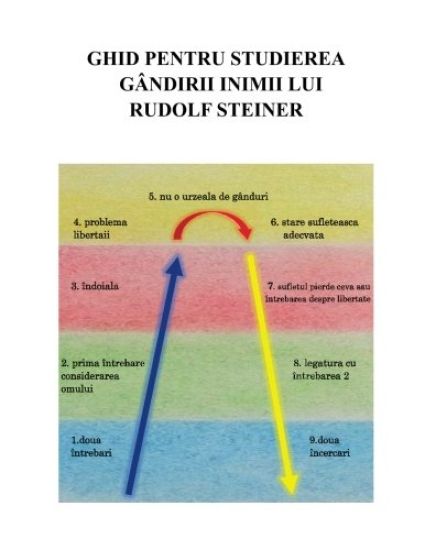
Ghid Pentru Studierea Gandirii Inimii Lui Rudolf Steiner: Traducere Dupa: "A Study Guide for Rudolf Steiner's Heart-Thinking"
Mark Riccio
Createspace Independent Publishing Platform
2016
nidottu
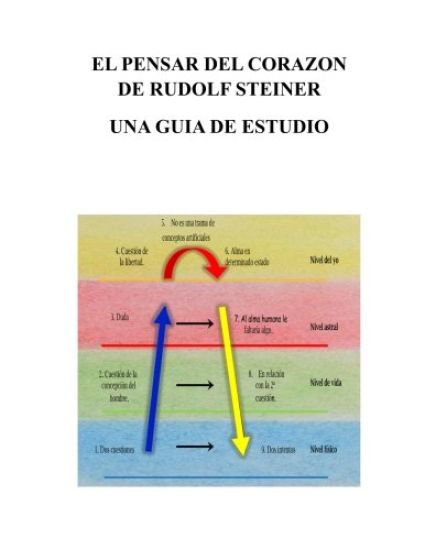
El Pensar Del Corazon De Rudolf Steiner: Una Guia De Estudio
Mark Riccio
Createspace Independent Publishing Platform
2016
nidottu
"Piensen sobre tantos temas que eran realmente fundamentales y como hemos tenido que construir nuestra estructura de pensamiento total una y otra vez a partir del esquema b sico: cuerpo f sico, cuerpo et reo, cuerpo astral y yo... Este es y permanece siendo un hilo fiable en el que engarzar nuestros pensamientos: estos cuatro miembros del ser humano en su entretejido, y luego en un nivel superior, la transformaci n de los tres miembros inferiores: el tercero en el quinto, el segundo en el sexto y el primero en s ptimo miembro de nuestro ser... Est n sentando las bases para su sistema de pensamiento de la misma forma que una vez los dioses hicieron el plan para la Sabidur a del mundo" - Rudolf Steiner