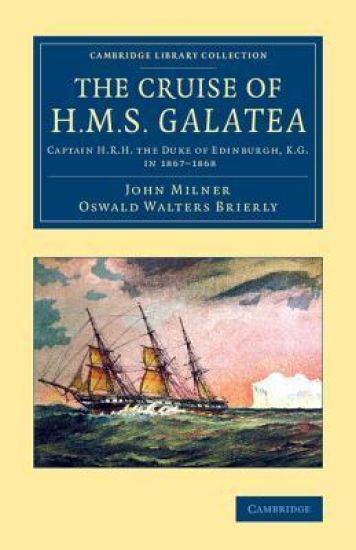
In 1867, Prince Alfred, Queen Victoria's second son, commissioned the Galatea for a voyage around the world which would include the first royal visit to Australia. Stopping along the way in Rio de Janeiro and Cape Town, Alfred was received with great ceremony at each port of call. These visits provided the ship's chaplain John Milner (1822–97) and the artist Oswald Brierly (1817–94) with ample material for this chronicle, published in 1869, which gives background details of each region alongside scenes from the tour, enhanced by illustrations based on Brierly's sketches. The authors drew on various recollections and writings, including a letter from Alfred to his brother describing an elephant hunt in South Africa. The tour was abruptly curtailed in Sydney when a Fenian sympathiser attempted to assassinate the prince, an act which boosted support for the British royal family.
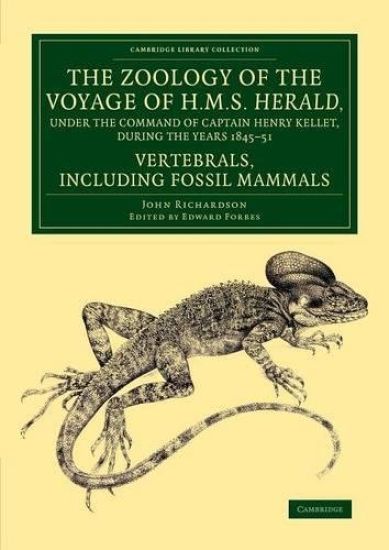
Naval surgeon, Arctic explorer and natural historian, Sir John Richardson (1787–1865) published many works, several of which are reissued in the Cambridge Library Collection, notably the four-volume Fauna Boreali-Americana. At the Haslar Royal Naval Hospital, where he worked towards the end of his career, Richardson built up a library and museum that became renowned for natural history research. His published work was fuelled by his own voyages and the specimens sent back from other expeditions, as was the case for this illustrated work, completed in 1854. Richardson describes the zoological specimens collected during the 1845–51 voyage of the survey ship H.M.S. Herald, which had sailed into Arctic seas and took part in the search for Sir John Franklin. The collected fauna include fossil mammals from the ice cliffs at Eschscholtz Bay in Alaska, first discovered in 1816 by Otto von Kotzebue and his naturalists.
The 18th century was a wealth of knowledge, exploration and rapidly growing technology and expanding record-keeping made possible by advances in the printing press. In its determination to preserve the century of revolution, Gale initiated a revolution of its own: digitization of epic proportions to preserve these invaluable works in the largest archive of its kind. Now for the first time these high-quality digital copies of original 18th century manuscripts are available in print, making them highly accessible to libraries, undergraduate students, and independent scholars.Delve into what it was like to live during the eighteenth century by reading the first-hand accounts of everyday people, including city dwellers and farmers, businessmen and bankers, artisans and merchants, artists and their patrons, politicians and their constituents. Original texts make the American, French, and Industrial revolutions vividly contemporary.++++The below data was compiled from various identification fields in the bibliographic record of this title. This data is provided as an additional tool in helping to insure edition identification: ++++British LibraryT092258Printer from Gaskell.Birmingham: printed by Robert Martin] et se vend Londres, chez Pierre Elmsly, 1768. 32p.; 8