Kirjojen hintavertailu. Mukana 11 342 296 kirjaa ja 12 kauppaa.

Kirjahaku

Etsi kirjoja tekijän nimen, kirjan nimen tai ISBN:n perusteella.

1000 tulosta hakusanalla Samuel Daniel

Samuel Johnson after 300 Years

Samuel Johnson after 300 Years

Cambridge University Press
2012
pokkari
To mark the tercentenary of Samuel Johnson's birth in 2009, the specially-commissioned essays contained here review his scholarly reputation. An international team of experts reflects authoritatively on the various dimensions of literary, historical, critical and ethical life touched by Johnson's extraordinary achievement. The volume distinctively casts its net widely and combines consistently innovative thinking on Johnson's historical role with a fresh sense of present criticism. Chapters cover subjects as diverse as Johnson's moral philosophy, his legal thought, his influence on Jane Austen, and the question of the Johnson canon. The contributors examine the larger theoretical and scholarly contexts in which it is now possible to situate his work, and from which it may often be necessary to differentiate it. All the contributors have a distinguished record of scholarship in eighteenth-century studies, Johnson scholarship, and cultural history and theory.
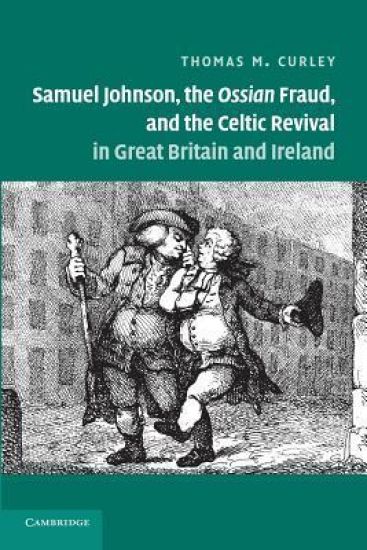
Samuel Johnson, the Ossian Fraud, and the Celtic Revival in Great Britain and Ireland
James Macpherson's famous hoax, publishing his own poems as the writings of the ancient Scots bard Ossian in the 1760s, remains fascinating to scholars as the most successful literary fraud in history. This study presents the fullest investigation of his deception to date, by looking at the controversy from the point of view of Samuel Johnson. Johnson's dispute with Macpherson was an argument with wide implications not only for literature, but for the emerging national identities of the British nations during the Celtic revival. Thomas M. Curley offers a wealth of genuinely new information, detailing as never before Johnson's involvement in the Ossian controversy, his insistence on truth-telling, and his interaction with others in the debate. The appendix reproduces a rare pamphlet against Ossian written with the assistance of Johnson himself. This book will be an important addition to knowledge about both the Ossian controversy and Samuel Johnson.
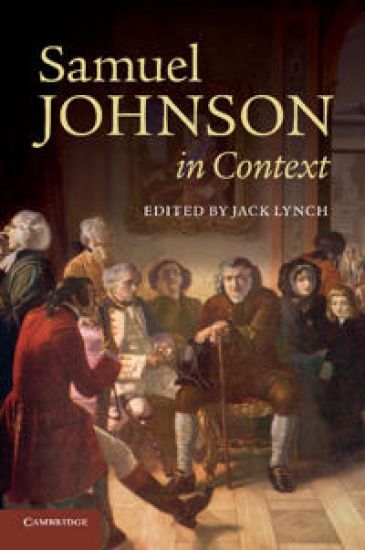
Samuel Johnson in Context

Samuel Johnson in Context

Cambridge University Press
2014
pokkari
Few authors benefit from being set in their contemporary context more than Samuel Johnson. Samuel Johnson in Context is a guide to his world, offering readers a comprehensive account of eighteenth-century life and culture as it relates to his work. Short, lively and eminently readable chapters illuminate not only Johnson's own life, writings and career, but the literary, critical, journalistic, social, political, scientific, artistic, medical and financial contexts in which his works came into being. Written by leading experts in Johnson and in eighteenth-century studies, these chapters offer both depth and range of information and suggestions for further study and research. Richly illustrated, with a chronology of Johnson's life and works and an extensive bibliography, this book is a major new work of reference on eighteenth-century culture and the age of Johnson.
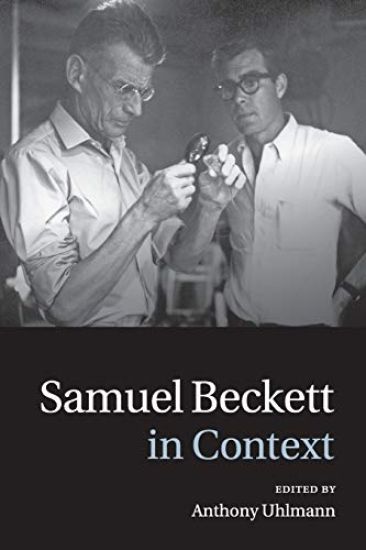
Samuel Beckett in Context

Samuel Beckett in Context

Cambridge University Press
2015
pokkari
When Samuel Beckett first came to international prominence with the success of Waiting for Godot, many critics believed the play was divorced from any recognisable context. The two tramps, and the master and servant they encounter, seemed to represent no one and everyone. Today, critics challenge the assumption that Beckett aimed to break definitively with context, highlighting images, allusions and motifs that tether Beckett's writings to real people, places and issues in his life. This wide-ranging collection of essays from 37 renowned Beckett scholars reveals how extensively Beckett entered into dialogue with important literary traditions and the realities of his time. Drawing on his major works, as well as on a range of letters and theoretical notebooks, the essays are designed to complement each other, building a broad overview that will allow students and scholars to come away with a better sense of Beckett's life, writings and legacy.
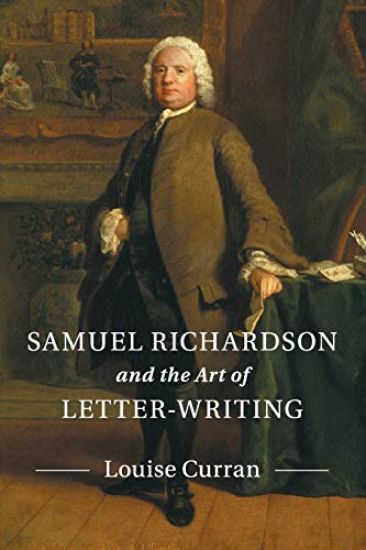
Samuel Richardson and the Art of Letter-Writing

Samuel Richardson and the Art of Letter-Writing

Louise Curran

Cambridge University Press
2018
pokkari
This fascinating study examines Samuel Richardson's letters as important works of authorial self-fashioning. It analyses the development of his epistolary style; the links between his own letter-writing practice and that of his fictional protagonists; how his correspondence is highly conscious of the spectrum of publicity; and how he constructed his letter collections to form an epistolary archive for posterity. Looking backwards to earlier epistolary traditions, and forwards, to the emergence of the lives-in-letters mode of biography, the book places Richardson's correspondence in a historical continuum. It explores how the eighteenth century witnesses a transition, from a period in which an author would rarely preserve personal papers to a society in which the personal lives of writers become privileged as markers of authenticity in the expanded print market. It argues that Richardson's letters are shaped by this shifting relationship between correspondence and publicity in the mid-eighteenth century.
Samuel Pepys: Volume 1

Samuel Pepys: Volume 1

Arthur Bryant

Cambridge University Press
2013
pokkari
In this first volume in his three-volume history of the life and career of Samuel Pepys, originally published in 1933, esteemed historian Arthur Bryant records Pepys's life from his birth to the end of his famous diary in 1669. Bryant draws on Pepys's diary and correspondence to illuminate events including Pepys' operation for bladder stones, the death of his wife Elizabeth and the Great Fire of London. This book will be of value to anyone with an interest in Pepys or Restoration politics.
Samuel Pepys: Volume 2

Samuel Pepys: Volume 2

Arthur Bryant

Cambridge University Press
2013
pokkari
In this second volume in his three-volume history of the life and career of Samuel Pepys, originally published in 1935, esteemed historian Arthur Bryant records Pepys's life from the end of his diary in 1669 to 1683, when Pepys was sent to Tangier to aid in the evacuation of the English colony there. Bryant draws on Pepys' unpublished manuscripts and notes from the Admiralty to illuminate this post-diary period, in which Pepys was accused of participating in a Catholic plot against Charles II as well as being elected MP for Harwich. This book will be of value to anyone with an interest in Pepys or Restoration politics.
Samuel Pepys: Volume 3

Samuel Pepys: Volume 3

Arthur Bryant

Cambridge University Press
2013
pokkari
In this final volume in his three-volume history of the life and career of Samuel Pepys, originally published in 1935, esteemed historian Arthur Bryant records Pepys's life from 1683 to 1689, when he resigned as MP for Harwich and Secretary of the Admiralty. Bryant draws on Pepys' unpublished manuscripts and notes from the Admiralty to illuminate these important years, when he was King's Secretary for the Admiralty under Charles II and James II. This book will be of value to anyone with an interest in Pepys or Restoration politics.
Samuel Pepys and the Royal Navy

Samuel Pepys and the Royal Navy

J. R. Tanner

Cambridge University Press
2013
pokkari
First published in 1920 and originally delivered as the Lees Knowles Lectures in November 1919, this book looks at Pepys' legacy as a naval administrator. Respected Pepys scholar J. R. Tanner examines the ways in which Pepys applied business principles to various facets of naval organization, all while working under a king whose aversion to business-related matters was well known. This book will be of value to anyone with an interest in Pepys or the history of the British Navy.
Samuel Butler (1835–1902)

Samuel Butler (1835–1902)

P. N. Furbank

Cambridge University Press
2014
pokkari
Originally published in 1948, this book presents a concise discussion regarding various aspects of the life and works of the novelist Samuel Butler, author of Erehwon (1872). The text is an amended version of Furbank's 1946 Le Bas Prize winning essay. This book will be of value to anyone with an interest in Samuel Butler and nineteenth-century literature.
Samuel Butler: Characters and Passages from Note-Books

Samuel Butler: Characters and Passages from Note-Books

Samuel Butler

Cambridge University Press
2012
pokkari
Originally published in 1908, as part of the Cambridge English Classics series, this volume of Samuel Butler's writings falls into two parts: the first part was derived from Thyer's edition of The Genuine Remains in Verse and Prose of Mr Samuel Butler; the second part contains previously unpublished material taken from the Butler Manuscripts in the British Library. The text is made up of a series of character sketches and essays on various subjects. An appendix of unclassified observations and an editorial notes section are also included. This book will be of value to anyone with an interest in the works of Butler, the development of satire and seventeenth-century literature in general.
The Journal of Mr Samuel Holmes, Serjeant-Major of the XIth Light Dragoons, During his Attendance, as One of the Guard on Lord Macartney's Embassy to China and Tartary
This journal, kept by a soldier in the Light Dragoons of the voyage to 'China and Tartary' in the years 1792–1793, was published in 1798. Holmes kept his diary during the attempt by Lord Macartney to establish an embassy in China. Macartney returned to Britain unsuccessful, heightening western curiosity about this secluded and mysterious nation, and so this account by a soldier assigned to Lord Macartney's guard remains an important historical source on Europeans in China during this period. While, as the editor's preface admits, the text is not of great literary significance ('written by a worthy, sensible, but unlearned man'), its authenticity and soldier's-eye perspective make it a valuable document for historians today. The journal starts with H. M. S. Lion setting sail from Portsmouth, and ends with its return to British shores; the author notes diverse cultural features of the countries visited, and gives geographical references.
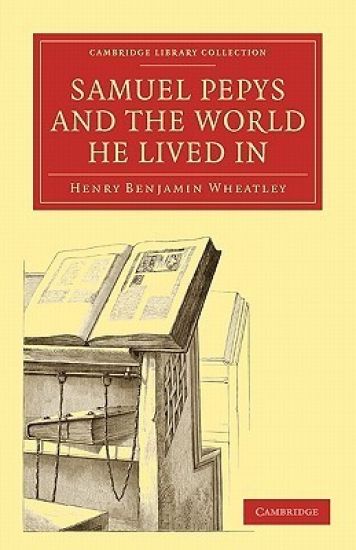
Samuel Pepys and the World He Lived In

Samuel Pepys and the World He Lived In

Henry Benjamin Wheatley

Cambridge University Press
2010
pokkari
Henry Benjamin Wheatley (1838–1917) was an eminent bibliographer, author and editor who served as assistant secretary to the Royal Society of Arts between 1879 and his retirement in 1908. He also had a particular interest in the life of Samuel Pepys (1633–1703), founding the Samuel Pepys Club in 1903 and producing the most reliable edition of Pepys' diary until the Latham edition (1970–1983). This volume, first published in 1880, contains a detailed biography of Pepys. Using contemporary sources, Wheatley discusses Pepys' achievements during the period his diary was kept, his progression in the Navy Board and his resignation in 1689. Wheatley also provides fascinating descriptions of Restoration society, manners and customs, exploring the historical context of Samuel Pepys' life through discussions of various incidents taken from his diary. This volume remains a standard reference for the historical context of Pepys' diary and life.
The Works of Samuel Johnson, LL.D.

The Works of Samuel Johnson, LL.D.

Samuel Johnson

Cambridge University Press
2011
pokkari
Dr Samuel Johnson (1709–84) is regarded as one of the outstanding figures of English literature, as a poet, essayist, moralist, critic, biographer, editor and lexicographer. This collected edition of his works - commissioned by the publisher within hours of Johnson's death, such was his celebrity - was published in 1787 in eleven volumes, edited by his literary executor, the musicologist Sir John Hawkins. Volume 1 is entirely devoted to a biography of Johnson by Hawkins, his close friend. Although Boswell's 1791 Life is much better known, Hawkins had been acquainted with Johnson for far longer, and was present at his death. Although his narrative is less colourful than that of Boswell, he had a better understanding of some aspects of Johnson's character, especially regarding his religious beliefs, and Boswell did not hesitate to borrow from this work.
The Works of Samuel Johnson, LL.D.

The Works of Samuel Johnson, LL.D.

Samuel Johnson

Cambridge University Press
2011
pokkari
Dr Samuel Johnson (1709–84) is regarded as one of the outstanding figures of English literature, as a poet, essayist, moralist, critic, biographer, editor and lexicographer. This collected edition of his works - commissioned by the publisher within hours of Johnson's death, such was his celebrity - was published in 1787 in eleven volumes, edited by his literary executor, the musicologist Sir John Hawkins. Volume 2 contains the first part of his Lives of the Poets, his last major work. This was a commission to provide short accounts of over fifty poets of the seventeenth and eighteenth centuries, and set a new standard for English literary biography. Although not all of the subjects have been regarded as eminent by posterity, and Johnson was criticised for brusque treatment of well-connected courtier poets now largely forgotten, the work was a great success.
The Works of Samuel Johnson, LL.D.

The Works of Samuel Johnson, LL.D.

Samuel Johnson

Cambridge University Press
2011
pokkari
Dr Samuel Johnson (1709–84) is regarded as one of the outstanding figures of English literature, as a poet, essayist, moralist, critic, biographer, editor and lexicographer. This collected edition of his works - commissioned by the publisher within hours of Johnson's death, such was his celebrity - was published in 1787 in eleven volumes, edited by his literary executor, the musicologist Sir John Hawkins. Volume 3 contains the second part of his Lives of the Poets, his last major work. This was a commission to provide short accounts of over fifty poets of the seventeenth and eighteenth centuries, and it set a new standard for English literary biography. Although not all of the subjects have been regarded as eminent by posterity, and Johnson was criticised for brusque treatment of well-connected courtier poets now largely forgotten, the work was a great success.
The Works of Samuel Johnson, LL.D.

The Works of Samuel Johnson, LL.D.

Samuel Johnson

Cambridge University Press
2011
pokkari
Dr Samuel Johnson (1709–84) is regarded as one of the outstanding figures of English literature, as a poet, essayist, moralist, critic, biographer, editor and lexicographer. This collected edition of his works - commissioned by the publisher within hours of Johnson's death, such was his celebrity - was published in 1787 in eleven volumes, edited by his literary executor, the musicologist Sir John Hawkins. Volume 4 contains the third part of his Lives of the Poets, his last major work. This was a commission to provide short accounts of over fifty poets of the seventeenth and eighteenth centuries, and set a new standard for English literary biography. Although not all of the subjects have been regarded as eminent by posterity, the work was a great success. The volume also includes miscellaneous historical and literary biographies of figures such as Paolo Sarpi, Sir Francis Drake and Roger Ascham.
The Works of Samuel Johnson, LL.D.

The Works of Samuel Johnson, LL.D.

Samuel Johnson

Cambridge University Press
2011
pokkari
Dr Samuel Johnson (1709–84) is regarded as one of the outstanding figures of English literature, as a poet, essayist, moralist, critic, biographer, editor and lexicographer. This collected edition of his works - commissioned by the publisher within hours of Johnson's death, such was his celebrity - was published in 1787 in eleven volumes, edited by his literary executor, the musicologist Sir John Hawkins. Volume 5 contains the first part of The Rambler, the periodical published by Johnson twice a week between 1750 and 1752. Modelled on Addison's Spectator, the essays address a wide range of social, religious, political and literary themes, and are not exclusively by Johnson himself: there are contributions by others, particularly women writers such as Hester Chapone and Elizabeth Carter. The Rambler adopted an 'elevated' style, and topics range from criticism of the emerging novel genre to discussions of humanitarian issues such as prostitution and capital punishment.
The Works of Samuel Johnson, LL.D.

The Works of Samuel Johnson, LL.D.

Samuel Johnson

Cambridge University Press
2011
pokkari
Dr Samuel Johnson (1709–84) is regarded as one of the outstanding figures of English literature, as a poet, essayist, moralist, critic, biographer, editor and lexicographer. This collected edition of his works - commissioned by the publisher within hours of Johnson's death, such was his celebrity - was published in 1787 in eleven volumes, edited by his literary executor, the musicologist Sir John Hawkins. Volume 6 contains the second part of The Rambler, the periodical published by Johnson twice a week between 1750 and 1752. Modelled on Addison's Spectator, the essays address a wide range of social, religious, political and literary themes, and are not exclusively by Johnson himself: there are contributions by others, particularly women writers such as Hester Chapone and Elizabeth Carter. The Rambler adopted an 'elevated' style, and topics range from criticism of the emerging novel genre to discussions of humanitarian issues such as prostitution and capital punishment.
The Works of Samuel Johnson, LL.D.

The Works of Samuel Johnson, LL.D.

Samuel Johnson

Cambridge University Press
2011
pokkari
Dr Samuel Johnson (1709–84) is regarded as one of the outstanding figures of English literature, as a poet, essayist, moralist, critic, biographer, editor and lexicographer. This collected edition of his works - commissioned by the publisher within hours of Johnson's death, such was his celebrity - was published in 1787 in eleven volumes, edited by his literary executor, the musicologist Sir John Hawkins. Volume 7 contains the final part of The Rambler, the periodical published by Johnson twice a week between 1750 and 1752. Modelled on Addison's Spectator, the essays address a wide range of social, religious, political and literary themes, and are not exclusively by Johnson himself: there are contributions by others, particularly women writers such as Hester Chapone and Elizabeth Carter. The Rambler adopted an 'elevated' style, and topics range from criticism of the emerging novel genre to discussions of humanitarian issues such as prostitution and capital punishment.