Kirjojen hintavertailu. Mukana 12 414 694 kirjaa ja 12 kauppaa.

Kirjahaku

Etsi kirjoja tekijän nimen, kirjan nimen tai ISBN:n perusteella.

1000 tulosta hakusanalla Smita Yadav

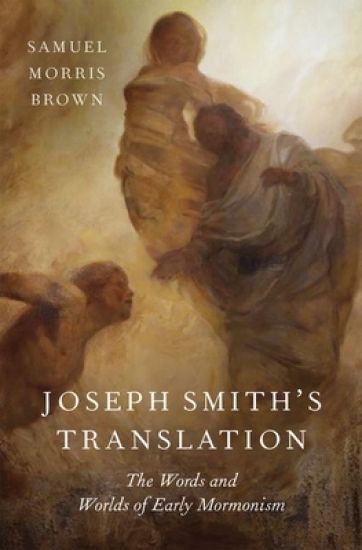
Joseph Smith's Translation

Joseph Smith's Translation

Samuel Morris Brown

Oxford University Press Inc
2020
sidottu
Mormonism's founder, Joseph Smith, claimed to have translated ancient scriptures. He dictated an American Bible from metal plates reportedly buried by ancient Jews in a nearby hill, and produced an Egyptian "Book of Abraham" derived from funerary papyri he extracted from a collection of mummies he bought from a traveling showman. In addition, he rewrote sections of the King James Version as a "New Translation" of the Bible. Smith and his followers used the term translation to describe the genesis of these English scriptures, which remain canonical for the Church of Jesus Christ of Latter-day Saints. Whether one believes him or not, the discussion has focused on whether Smith's English texts represent literal translations of extant source documents. On closer inspection, though, Smith's translations are far more metaphysical than linguistic. In Joseph Smith's Translation, Samuel Morris Brown argues that these translations express the mystical power of language and scripture to interconnect people across barriers of space and time, especially in the developing Mormon temple liturgy. He shows that Smith was devoted to an ancient metaphysics--especially the principle of correspondence, the concept of "as above, so below"--that provided an infrastructure for bridging the human and the divine as well as for his textual interpretive projects. Joseph Smith's projects of metaphysical translation place Mormonism at the productive edge of the transitions associated with shifts toward "secular modernity." This transition into modern worldviews intensified, complexly, in nineteenth-century America. The evolving legacies of Reformation and Enlightenment were the sea in which early Mormons swam, says Brown. Smith's translations and the theology that supported them illuminate the power and vulnerability of the Mormon critique of American culture in transition. This complex critique continues to resonate and illuminate to the present day.
Adam Smith

Adam Smith

Eric Schliesser

Oxford University Press Inc
2019
nidottu
Eric Schliesser's Adam Smith is the product of two decades' reflection by the author on the great Scottish Enlightenment. Unique among treatments of Adam Smith, Schliesser's book treats him as a systematic philosopher. Smith was a giant of the Scottish Enlightenment with polymath interests; Schliesser thus explores Smith's economics and ethics in light of his other commitments on the nature of knowledge, the theory of emotions, the theory of mind, his account of language, the nature of causation, and his views on methodology. He places Smith's ideas in the context of a host of other philosophers, especially Hume, Rousseau, and Newton; and he draws on the reception of Smith's ideas by Sophie de Grouchy, Mary Wollstonecraft, and other philosophers and economists to sketch the elements of, and the detailed connections within, Smith's system. Adam Smith traces the outlines of Smith's intellectual system and situates it in the context of his highly developed views on the norms that govern responsible speech. In particular, the book articulates Smith's concerns about the impact of his public policy recommendations, especially on the least powerful in society. In so doing, Schliesser offers new interpretations of Smith's views on the invisible hand, the Wealth of Nations, his treatment of virtue, the nature of freedom, the individual's relationship to society, his account of the passions, the moral roles of religion, and his treatment of the role of mathematics in economics. While the book does offer a single argument, it is organized in a modular fashion and includes a helpful index; readers with a more focused interest in Smith's achievements can skip to their section of interest.
Adam Smith

Adam Smith

Eric Schliesser

Oxford University Press Inc
2017
sidottu
Eric Schliesser's Adam Smith is the product of two decades' reflection by the author on the great Scottish Enlightenment. Unique among treatments of Adam Smith, Schliesser's book treats him as a systematic philosopher. Smith was a giant of the Scottish Enlightenment with polymath interests; Schliesser thus explores Smith's economics and ethics in light of his other commitments on the nature of knowledge, the theory of emotions, the theory of mind, his account of language, the nature of causation, and his views on methodology. He places Smith's ideas in the context of a host of other philosophers, especially Hume, Rousseau, and Newton; and he draws on the reception of Smith's ideas by Sophie de Grouchy, Mary Wollstonecraft, and other philosophers and economists to sketch the elements of, and the detailed connections within, Smith's system. Adam Smith traces the outlines of Smith's intellectual system and situates it in the context of his highly developed views on the norms that govern responsible speech. In particular, the book articulates Smith's concerns about the impact of his public policy recommendations, especially on the least powerful in society. In so doing, Schliesser offers new interpretations of Smith's views on the invisible hand, the Wealth of Nations, his treatment of virtue, the nature of freedom, the individual's relationship to society, his account of the passions, the moral roles of religion, and his treatment of the role of mathematics in economics. While the book does offer a single argument, it is organized in a modular fashion and includes a helpful index; readers with a more focused interest in Smith's achievements can skip to their section of interest.
Joseph Smith for President

Joseph Smith for President

Spencer W. McBride

Oxford University Press Inc
2021
sidottu
By the election year of 1844, Joseph Smith, the controversial founder of the Church of Jesus Christ of Latter-day Saints, had amassed a national following of some 25,000 believers. Nearly half of them lived in the city of Nauvoo, Illinois, where Smith was not only their religious leader but also the mayor and the commander-in-chief of a militia of some 2,500 men. In less than twenty years, Smith had helped transform the American religious landscape and grown his own political power substantially. Yet the standing of the Mormon people in American society remained unstable. Unable to garner federal protection, and having failed to win the support of former president Martin Van Buren or any of the other candidates in the race, Smith decided to take matters into his own hands, launching his own bid for the presidency. While many scoffed at the notion that Smith could come anywhere close to the White House, others regarded his run—and his religion—as a threat to the stability of the young nation. Hounded by mobs throughout the campaign, Smith was ultimately killed by one—the first presidential candidate to be assassinated. Though Joseph Smith's run for president is now best remembered—when it is remembered at all—for its gruesome end, the renegade campaign was revolutionary. Smith called for the total abolition of slavery, the closure of the country's penitentiaries, and the reestablishment of a national bank to stabilize the economy. But Smith's most important proposal was for an expansion of protections for religious minorities. At a time when the Bill of Rights did not apply to individual states, Smith sought to empower the federal government to protect minorities when states failed to do so. Spencer W. McBride tells the story of Joseph Smith's quixotic but consequential run for the White House and shows how his calls for religious freedom helped to shape the American political system we know today.
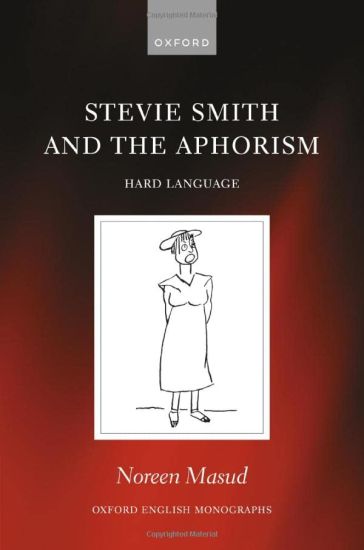
Stevie Smith and the Aphorism

Stevie Smith and the Aphorism

Noreen Masud

Oxford University Press
2022
sidottu
This volume argues that aphorism represents a tool for the social management of emotion. Rhetorically corralled into a slick, collectable shape, the aphorism promises arresting and instantaneous epiphany. However, the accomplished elegance which positions the aphorism's message as self-evidently true in fact works to repel further enquiry, and ultimately ensures that it will be forgotten or bypassed in favour of another aphorism: no less eagerly embraced for the earlier disappointment. Aphorism, therefore, is a form in which dangerous ideas and emotions can be safely displayed and, simultaneously, effaced. Because aphorism's style defuses the imperative to act on what is clearly known, writers like Stevie Smith can use the form to stage a withdrawal from the burden of making an impact on the world. This book finds that Smith's use of aphorism and its related forms (proverb, epitaph, caption, and fragment) offers a route into her texts. With her disconcerting pen-and-ink drawings, dark comedy, and social ventriloquism which stops short of satire, the rhetorical force of Smith's poetry fascinates and arrests its readers, but nevertheless leaves them unable to react coherently or identify the use-value which her writing appears to promise. Drawing on hitherto unpublished archival material, this project argues that Smith's texts resist analysis because, like the aphorisms embedded throughout them, they offer and exemplify a mode of clearly-declared revelation which, at the same time, makes itself unusable.
The Poems of Charlotte Smith

The Poems of Charlotte Smith

Charlotte Smith

Oxford University Press Inc
1995
nidottu
Charlotte Smith's life was the stuff of romantic anguish; upon marriage she felt exiled in "personal slavery", and began publishing poems to earn money while in debtor's prison with her extravagant husband. They subsequently resided in France and lived on subscriptions to her poems and translation work, but she eventually left her husband, "fearing my life was not safe", and began publishing novels annually in order to provide for her children. Smith was the first English poet whom, in retrospect, we could call Romantic, and was particularly influential on Wordsworth's style and ideas. Her poetry, beginning with the first edition of Elegaic Sonnets in 1784, was well received by her contemporaries; her final masterpiece, Beachy Head, published posthumously in 1807, powerfully illustrates the impulse to resolve the self into nature. Today, Smith is known primarily as a novelist (her previously un-reprinted novel, The Banished Man, will appear in the series), but this volume will be the first complete collection of her poems. It promises to revolutionize our ideas about the development of English Romanticism. This unprecedented new series reintroduces women's writings of cultural and literary interest, from the Medieval period through the early nineteenth century, often for the first time since their original publication. Derived from the Brown University Women Writers Project, the series unearths a wide range of neglected gems, dispelling the myth that women wrote little of real value before the Victorian period. Each volume includes an introduction putting the work in its historical and literary context and helpful explanatory notes.
Joseph Smith, Jr.

Joseph Smith, Jr.

Oxford University Press Inc
2009
nidottu
Mormon founder Joseph Smith is one of the most controversial figures of nineteenth-century American history, and a virtually inexhaustible subject for analysis. In this volume, fifteen scholars offer essays on how to interpret and understand Smith and his legacy. Including essays by both Mormons and non-Mormons, this wide-ranging collection is the only available survey of contemporary scholarly opinion on the extraordinary man who started one of the fastest growing religious traditions in the modern world.
Joseph Smith's Gold Plates

Joseph Smith's Gold Plates

Richard Lyman Bushman

OXFORD UNIVERSITY PRESS INC
2023
sidottu
Renowned historian Richard Lyman Bushman presents a vibrant history of the objects that gave birth to a new religion. According to Joseph Smith, in September of 1823 an angel appeared to him and directed him to a hill near his home. Buried there Smith found a box containing a stack of thin metal sheets, gold in color, about six inches wide, eight inches long, piled six or so inches high, bound together by large rings, and covered with what appeared to be ancient engravings. Exactly four years later, the angel allowed Smith to take the plates and instructed him to translate them into English. When the text was published, a new religion was born. The plates have had a long and active life, and the question of their reality has hovered over them from the beginning. Months before the Book of Mormon was published, newspapers began reporting on the discovery of a "Golden Bible." Within a few years over a hundred articles had appeared. Critics denounced Smith as a charlatan for claiming to have a wondrous object that he refused to show, while believers countered by pointing to witnesses who said they saw the plates. Two hundred years later the mystery of the gold plates remains. In this book renowned historian of Mormonism Richard Lyman Bushman offers a cultural history of the gold plates. Bushman examines how the plates have been imagined by both believers and critics--and by treasure-seekers, novelists, artists, scholars, and others--from Smith's first encounter with them to the present. Why have they been remembered, and how have they been used? And why do they remain objects of fascination to this day? By examining these questions, Bushman sheds new light on Mormon history and on the role of enchantment in the modern world.
Hélène Smith

Hélène Smith

Claudie Massicotte

OXFORD UNIVERSITY PRESS INC
2023
sidottu
In 1896, a young Genevan medium named Hélène Smith perceived in trance the following words from a Martian inhabitant: "michma michtmon mimini thouainenm mimatchineg." Those attending her séance dutifully transcribed these words and the event marked the beginning of a series of occult experiences that transported her to the red planet. In her state of trance, Smith came to produce foreign conversations, a new alphabet, and paintings of the Martian surroundings that captured the popular and scientific imagination of Geneva. Alongside her Martian travels, she also retrieved memories of her past lives as a fifteenth-century "Hindoo" princess and as Queen Marie Antoinette. Today, Smith's séances may appear to be nothing more than eccentric practices at the margins of modernity. As author Claudie Massicotte argues, however, the medium came to embody the extreme possibilities of a new form of subjectivity, with her séances becoming important loci for pioneering authors' discoveries in psychology, linguistics, and the arts. Through analyses of archival documents, correspondences, and publications on the medium, Massicotte sheds light on the role of women in the construction of turn-of-the-century psychological discourses, showing how Smith challenged traditional representations of female patients as powerless victims and passive objects of powerful doctors. She shows how the medium became the site of conflicting theories about subjectivity--specifically one's relationship to embodiment, desire, language, art, and madness--while unleashing a radical form of creativity that troubled existing paradigms of modern sciences. Massicotte skillfully retraces the story of this prolific figure and the authors, scientists, and artists she inspired in order to bring to light a forgotten chapter in modern intellectual history.
Hélène Smith

Hélène Smith

Claudie Massicotte

OXFORD UNIVERSITY PRESS INC
2023
nidottu
In 1896, a young Genevan medium named Hélène Smith perceived in trance the following words from a Martian inhabitant: "michma michtmon mimini thouainenm mimatchineg." Those attending her séance dutifully transcribed these words and the event marked the beginning of a series of occult experiences that transported her to the red planet. In her state of trance, Smith came to produce foreign conversations, a new alphabet, and paintings of the Martian surroundings that captured the popular and scientific imagination of Geneva. Alongside her Martian travels, she also retrieved memories of her past lives as a fifteenth-century "Hindoo" princess and as Queen Marie Antoinette. Today, Smith's séances may appear to be nothing more than eccentric practices at the margins of modernity. As author Claudie Massicotte argues, however, the medium came to embody the extreme possibilities of a new form of subjectivity, with her séances becoming important loci for pioneering authors' discoveries in psychology, linguistics, and the arts. Through analyses of archival documents, correspondences, and publications on the medium, Massicotte sheds light on the role of women in the construction of turn-of-the-century psychological discourses, showing how Smith challenged traditional representations of female patients as powerless victims and passive objects of powerful doctors. She shows how the medium became the site of conflicting theories about subjectivity--specifically one's relationship to embodiment, desire, language, art, and madness--while unleashing a radical form of creativity that troubled existing paradigms of modern sciences. Massicotte skillfully retraces the story of this prolific figure and the authors, scientists, and artists she inspired in order to bring to light a forgotten chapter in modern intellectual history.
Adam Smith Across Nations

Adam Smith Across Nations

Cheng-chung Lai

Clarendon Press
2000
sidottu
The materials collected in this volume all concern the translations of and receptions to Adam Smith's The Wealth of Nations in ten non-English-speaking countries. The Wealth of Nations provides the perfect basis for studying the international transmission of economic ideas as it is generally considered to be the foundation of modern political economy, and still continues to be read after more than two centuries. Its appeal crosses national, cultural, and ideological boundaries -- countries investigated here range from China to Sweden -- and its enduring popularity is indicated by its status as the most translated economics book in history. Adam Smith Across Nations includes numerous sections which will of invaluable assistance to any Smith researcher. As well as presenting reviews and analysis from each country from the 18th century to the present day, an appendix lists editions of The Wealth of Nations in 18 languages, enabling the reader to understand the speed and number of translations. Most importantly, an introductory overview synthesises current research on the economic ideological context in the individual countries when The Wealth of Nations was introduced, the motives behind its introduction, its immediate reception, and the nature of the objections to Smith's doctrines. Professor Lai concludes that Smith's impact outside English-speaking country was predominantly limited to the realm of ideas: few of his policy recommendations were put into practice.
The Glasgow Edition of the Works and Correspondence of Adam Smith: VI: Correspondence
In this edition the missing part of one letter and eighteen entirely new ones are presented. The search for these letters even extended to Japan. Therefore, all new Smith letter discovered since 1977 are included. In addition, wherever errors were suspected or misreadings have come to light in the standing text as a result of advice from reviewers and correspondents, these have been corrected.
Adam Smith's Library

Adam Smith's Library

Hiroshi Mizuta

Oxford University Press
2000
sidottu
Adam Smith is considered the founding father of economics. Yet to form an accurate picture of the theoretical basis of his work, it is necessary to know what influenced him. This book is the most up-to-date and comprehensive guide to all the books which were in Adam Smith's library at the time of his death. An invaluable reference work, this book will be of enormous interest to all those interested in the genesis of early economic thought.
Adam Smith's System of Liberty, Wealth, and Virtue
This book examines the influence that Adam Smith's philosophy had on his economics, drawing on the neglected parts of Smith's writings to show that the political and economic theories built logically on his morals. It analyses the significance of his stoic beliefs, his notions of art and music, astronomy, philosophy and war, and shows that Smith's invisible hand was part of a 'system' that was meant to replace medieval Christianity with ethic of virtue in this world rather than the next. Smith was motivated primarily by a political ideal, a moral version of liberalism. He rejected the political philosophy of the Greeks and Christians as authoritarian and unworldly, but contrary to what many economists believe, he also rejected the amoral liberalism that was being advocated by his countryman and friend David Hume. Far from being myopic about self-love, Smith arrived at his theories of free trade, economic growth, and alienation via his reinterpretation of Stoic virtue. Of interest to economists, philosophers, political theorists, sociologists and lawyers concerned with jurisprudence, this book is clearly written, and its innovations reveal the hitherto hidden unity in Smith's overarching system of morals, politics and economics.
Adam Smith's System of Liberty, Wealth, and Virtue
This study analyses the influence that Adam Smith's philosophy had on his Wealth of Nations , and reveals the unity in Smith's extensive system of morals, politics, and economics. It concludes that Smith was motivated by a political ideal, which was moral liberalism. This book is intended for economists, political theorists, and lawyers concerned with jurisprudence. Also the general reader interested in Adam Smith.
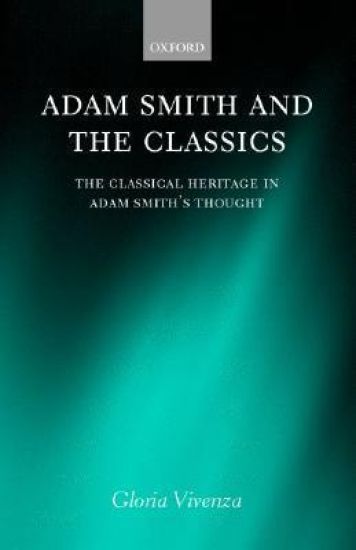
Adam Smith and the Classics

Adam Smith and the Classics

Gloria Vivenza

Oxford University Press
2001
sidottu
Adam Smith and the Classics analyses the influence of classical culture---the work of Plato, Aristotle, Cicero, and the Stoics---on Adam Smith's thought. Vivenza bases her arguments on elements of Smith's work that can be shown to be precise reflections of passages from the classical authors, and on Smith's own acknowledgements that he was so influenced. The bulk of the classical nuances occur in Smith's moral and natural philosophy, but Vivenza also shows that the classics had some impact on his economic thought. The book represents a complete survey of all Adam Smith's writings, and is organized by arguments: natural philosophy, moral philosophy, jurisprudence, topics of economic interest, and literature. A further chapter discusses the very recent consensus among a number of scholars that Smith's writings display strong elements of Stoicism. Adam Smith and the Classics is a significant book, since it shows just how strong an impression the classical training had on the intellectual elite of the eighteenth century. So much so that the classics have left their mark on the scholarship and writings of the time.