Title: Mary Stuart. A poem.]Publisher: British Library, Historical Print EditionsThe British Library is the national library of the United Kingdom. It is one of the world's largest research libraries holding over 150 million items in all known languages and formats: books, journals, newspapers, sound recordings, patents, maps, stamps, prints and much more. Its collections include around 14 million books, along with substantial additional collections of manuscripts and historical items dating back as far as 300 BC.The POETRY & DRAMA collection includes books from the British Library digitised by Microsoft. The books reflect the complex and changing role of literature in society, ranging from Bardic poetry to Victorian verse. Containing many classic works from important dramatists and poets, this collection has something for every lover of the stage and verse. ++++The below data was compiled from various identification fields in the bibliographic record of this title. This data is provided as an additional tool in helping to insure edition identification: ++++ British Library Macauley, Elizabeth Wright; 1823. 8 . 11646.h.14.
Title: Review of the Proceedings of the Legislature of Lower Canada in the session of 1831; with an appendix, etc. By Andrew Stuart.]Publisher: British Library, Historical Print EditionsThe British Library is the national library of the United Kingdom. It is one of the world's largest research libraries holding over 150 million items in all known languages and formats: books, journals, newspapers, sound recordings, patents, maps, stamps, prints and much more. Its collections include around 14 million books, along with substantial additional collections of manuscripts and historical items dating back as far as 300 BC.The HISTORY OF COLONIAL NORTH AMERICA collection includes books from the British Library digitised by Microsoft. This collection refers to the European settlements in North America through independence, with emphasis on the history of the thirteen colonies of Britain. Attention is paid to the histories of Jamestown and the early colonial interactions with Native Americans. The contextual framework of this collection highlights 16th century English, Scottish, French, Spanish, and Dutch expansion. ++++The below data was compiled from various identification fields in the bibliographic record of this title. This data is provided as an additional tool in helping to insure edition identification: ++++ British Library Anonymous; Stuart, Andrew; 1832. 231, 292 p.; 8 . 9555.c.7.
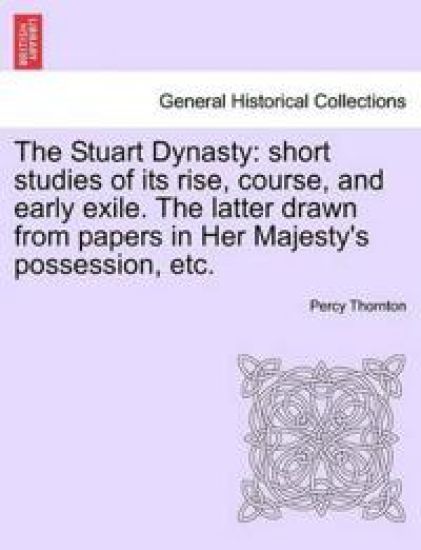
Title: The Stuart Dynasty: short studies of its rise, course, and early exile. The latter drawn from papers in Her Majesty's possession, etc.Publisher: British Library, Historical Print EditionsThe British Library is the national library of the United Kingdom. It is one of the world's largest research libraries holding over 150 million items in all known languages and formats: books, journals, newspapers, sound recordings, patents, maps, stamps, prints and much more. Its collections include around 14 million books, along with substantial additional collections of manuscripts and historical items dating back as far as 300 BC.The GENERAL HISTORICAL collection includes books from the British Library digitised by Microsoft. This varied collection includes material that gives readers a 19th century view of the world. Topics include health, education, economics, agriculture, environment, technology, culture, politics, labour and industry, mining, penal policy, and social order. ++++The below data was compiled from various identification fields in the bibliographic record of this title. This data is provided as an additional tool in helping to insure edition identification: ++++ British Library Thornton, Percy; 1890. xxv, 491 p.; 8 . 9512.g.4.
""Letters and Poems by Mary Stuart, Queen of Scots"" is a collection of personal letters and poems written by Mary Stuart, the former Queen of Scotland, during her imprisonment in England. The book offers a glimpse into the life and thoughts of one of history's most controversial figures. Mary Stuart was a devout Catholic who was forced to abdicate her throne and flee to England after being accused of plotting against her cousin, Queen Elizabeth I of England. She was imprisoned for over 18 years before being executed in 1587. The letters and poems in this book provide insight into Mary's emotions, beliefs, and relationships with her family and friends. They also shed light on the political and religious tensions of the time. This book is a valuable resource for historians, literature enthusiasts, and anyone interested in the life of Mary Stuart and the Tudor era.This scarce antiquarian book is a facsimile reprint of the old original and may contain some imperfections such as library marks and notations. Because we believe this work is culturally important, we have made it available as part of our commitment for protecting, preserving, and promoting the world's literature in affordable, high quality, modern editions, that are true to their original work.
Jeb Stuart: Boy In The Saddle is a biography of the famous Confederate cavalry general, Jeb Stuart, written by Gertrude Hecker Winders. The book chronicles Stuart's life from his childhood in Virginia, where he developed a love for horses and horsemanship, to his time at West Point, where he excelled as a cadet. The book also covers Stuart's military career, including his service in the Mexican-American War and his time as a Confederate general during the American Civil War. The author provides insight into Stuart's tactics and strategies, as well as his relationships with other Confederate leaders, such as Robert E. Lee and Stonewall Jackson.Throughout the book, Winders emphasizes Stuart's personality and character, portraying him as a charismatic and daring leader who was beloved by his troops. She also explores his personal life, including his marriage to Flora Cooke, the daughter of a Union general, and his relationships with his children.Overall, Jeb Stuart: Boy In The Saddle is a comprehensive biography of one of the most famous and influential Confederate generals of the Civil War, offering a detailed look at his life, military career, and personal relationships.Childhood Of Famous Americans Series.This scarce antiquarian book is a facsimile reprint of the old original and may contain some imperfections such as library marks and notations. Because we believe this work is culturally important, we have made it available as part of our commitment for protecting, preserving, and promoting the world's literature in affordable, high quality, modern editions, that are true to their original work.
Jesse Stuart: A Bibliography is a comprehensive reference book that provides a complete list of all the works written by the American author, Jesse Stuart. The book is authored by Woodbridge and Hensley Charles and is an essential resource for anyone interested in the life and works of Jesse Stuart. The bibliography includes all of Stuart's books, including novels, poetry collections, essays, and short stories. The book also includes a detailed introduction that provides an overview of Stuart's life and career, as well as an analysis of his literary style and themes. The bibliography is organized chronologically, making it easy for readers to follow Stuart's development as a writer over time. Each entry in the bibliography includes a brief summary of the work, as well as information about its publication history and critical reception. The book also includes an index of names and subjects, making it easy for readers to find specific information. Overall, Jesse Stuart: A Bibliography is an indispensable resource for scholars, students, and fans of Jesse Stuart's work.Additional Contributing Authors Include Harry Harrison Kroll, Earl Hobson Smith, And Jesse Stuart.This scarce antiquarian book is a facsimile reprint of the old original and may contain some imperfections such as library marks and notations. Because we believe this work is culturally important, we have made it available as part of our commitment for protecting, preserving, and promoting the world's literature in affordable, high quality, modern editions, that are true to their original work.

![Mary Stuart. [A Poem.]](/covers/9781241025786.jpg)
![Mary Stuart. [A Poem.] Second Edition](/covers/9781241028169.jpg)

![Mary Stuart. [A Poem.]](/covers/9781241536251.jpg)
![Review of the Proceedings of the Legislature of Lower Canada in the Session of 1831; With an Appendix, Etc. [By Andrew Stuart.]](/covers/9781241547011.jpg)