Kirjojen hintavertailu. Mukana 12 459 402 kirjaa ja 12 kauppaa.

Kirjahaku

Etsi kirjoja tekijän nimen, kirjan nimen tai ISBN:n perusteella.

1000 tulosta hakusanalla Volker Mahnkopp

International Organization

International Organization

Volker Rittberger; Bernhard Zangl; Andreas Kruck; Hylke Dijkstra

Red Globe Press
2019
nidottu
The third edition of this popular core textbook provides wide-ranging coverage of the structure, internal working, policies and performance of international organizations such as the UN, EU, IMF and World Bank. Such organizations have never been so important in addressing the challenges that face our increasingly globalised world. This book introduces students to theories with which to approach international organizations, their history, and their ability to respond to contemporary issues in world politics from nuclear disarmament, climate change and human rights protection, to trade, monetary and financial relations, and international development. Underpinning the text is the authors' unique model that views international organizations as actual organizations. Reacting to world events, political actors provide the 'inputs' which are converted by the political systems of these organizations (through various decision-making procedures) into 'outputs' that achieve varying levels of real-world impact and effectiveness.This is the perfect text for undergraduate and postgraduate students of politics and international relations taking courses on International organization and global governance, as well as essential reading for those studying the UN, the EU and Globalization. New to this Edition:- Draws on the most recent research in the field and considers some of the significant world events of the last decade to ensure that the book is completely up to date.- Two separate chapters considering Trade and Development, and Finance and Monetary Relations respectively.- Fully accounts for the challenges to international organizations by the emerging powers, the Trump administration and Brexit

International Organization

International Organization

Volker Rittberger; Bernhard Zangl; Andreas Kruck; Hylke Dijkstra

Red Globe Press
2019
sidottu
The third edition of this popular core textbook provides wide-ranging coverage of the structure, internal working, policies and performance of international organizations such as the UN, EU, IMF and World Bank. Such organizations have never been so important in addressing the challenges that face our increasingly globalised world. This book introduces students to theories with which to approach international organizations, their history, and their ability to respond to contemporary issues in world politics from nuclear disarmament, climate change and human rights protection, to trade, monetary and financial relations, and international development. Underpinning the text is the authors' unique model that views international organizations as actual organizations. Reacting to world events, political actors provide the 'inputs' which are converted by the political systems of these organizations (through various decision-making procedures) into 'outputs' that achieve varying levels of real-world impact and effectiveness. This is the perfect text for undergraduate and postgraduate students of politics and international relations taking courses on International organization and global governance, as well as essential reading for those studying the UN, the EU and Globalization. New to this Edition: - Draws on the most recent research in the field and considers some of the significant world events of the last decade to ensure that the book is completely up to date. - Two separate chapters considering Trade and Development, and Finance and Monetary Relations respectively. - Fully accounts for the challenges to international organizations by the emerging powers, the Trump administration and Brexit

Syria under Bashar al-Asad

Syria under Bashar al-Asad

Volker Perthes

Routledge
2017
sidottu
Syria entered a new phase with the death of its long-serving leader, Hafiz al-Asad, and the accession of his son Bashar in 2000. While the new president has disappointed much of the hopes for political opening which he himself has created, Syria is clearly undergoing a process of change. The author analyses the factors of economic and political change in the country, and gives a portrait of its new leadership.
Conflicts and New Departures in World Society
This third volume in the World Society Studies series focuses on a central theme: how market mechanisms can correct the world welfare deficit and also resolve the environmental crisis through processes of sustainable development. The two editors trace how such objectives have been addressed since the 1960s, and describe the parameters of the debate. Conflicts and New Departures in World Society contains original research on confluences and fissures in emerging world society, in both international and domestic arenas.The sixteen contributors offer an unusually wide range of perspectives. Topics include peace and war, core-periphery situations, and social and labor conflicts. Marek Thee traces the quest for a demilitarized and nuclear-free world. Johan Kauf-mann analyzes the role of the United Nations in the post-cold war era. Jill Crystal concentrates on the human rights environment in the Arab World. H.C.F. Mansilla comments on the destruction of the tropical forests in Bolivia. Other contributors include Bruce Russett, Christian Suter, John Foran, Beverly Silver, and Georg Kohler.Conflicts and New Departures in World Society gives intellectual substance to the still nebulous notion of a world society. It does so not by advocacy, but by indicating parallel social, economic, and political conditions that compel new interactions between advanced and developing lands. This books will be of interest to sociologists, environmentalists, and political theorists and scientists.
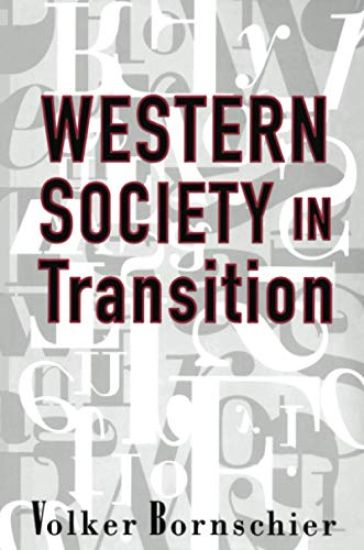
Western Society in Transition

Western Society in Transition

Volker Bornschier

Routledge
2018
nidottu
An enormous acceleration of history has occurred in the current decade, thereby radically changing world society in many respects. The core countries - grouped around the triad formed by the United States, Japan, and the European Union - have experienced successive waves of change marked by phases of ascent, unfolding, and decay of societal models. What seemed stable and predictable in past decades came close to collapse or broke down entirely. As a result, we are now living through a crisis of legitimation characterized by acute contradictions. A new order, with a fresh, basic consensus around an overarching set of norms that allows problems to be solved efficiently, has not yet crystallized.Western Society in Transition examines the succession of societal models of the Western world and indications of its probable shape in the future. Bornschier characterizes the 1985-1995 period as a decade of Third World debt and depression; continued economic decline in the United States; a steady ascent of Japan; Western Europe's move toward political union, and the collapse of the Soviet Union. Against this background, he sketches various elements of a theoretical perspective he calls evolutionary conflict theory. The primary focus of interest of this theory is not on single societies, but on measures of social transformation at the core of world society. Western Society in Transition deals with fundamental questions: How does social order arise and why does it dissolve? What provides social cohesion? What makes society progress? Institutional spheres of Western society such as technology, firms, the market, state building, education, power, conflict, and social movements are analyzed in detail.Peter Lengyel, editor emeritus of the International Social Science Journal says of Western Society in Transition, "I have never seen such a succinct, clear, and persuasive treatment which adroitly draws together elements from economics, history, sociology, and technology into a strictly contemporary kind of political economy." This timely assessment of the Western world will be of interest to social scientists, historians, economists, and international relations scholars.
Hands-On Accelerator Physics Using MATLAB®
Awarded one of BookAuthority's best new Particle Physics books in 2019!Hands-On Accelerator Physics Using MATLAB® provides an introduction into the design and operational issues of a wide range of particle accelerators, from ion-implanters to the Large Hadron Collider at CERN. Many aspects from the design of beam optical systems and magnets, to the subsystems for acceleration, beam diagnostics, and vacuum are covered. Beam dynamics topics ranging from the beam-beam interaction to free-electron lasers are discussed. Theoretical concepts and the design of key components are explained with the help of MATLAB® code. Practical topics, such as beam size measurements, magnet construction and measurements, and radio-frequency measurements are explored in student labs without requiring access to an accelerator.This unique approach provides a look at what goes on 'under the hood' inside modern accelerators and presents readers with the tools to perform their independent investigations on the computer or in student labs. This book will be of interest to graduate students, postgraduate researchers studying accelerator physics, as well as engineers entering the field.Features:Provides insights into both synchrotron light sources and collidersDiscusses technical subsystems, including magnets, radio-frequency engineering, instrumentation and diagnostics, correction of imperfections, control, and cryogenicsAccompanied by MATLAB® code, including a 3D-modeler to visualize the accelerators, and additional appendices which are available on the CRC Press websiteMATLAB live-scripts to accompany the book can be found here: https://ziemann.web.cern.ch/ziemann/mybooks/mlx/
Understanding Renewable Energy Systems

Understanding Renewable Energy Systems

Volker Quaschning

Routledge
2016
sidottu
By mid-century, renewable energy must cover all of our energy supply if we are to phase out nuclear and successfully stop climate change.Now updated and expanded, the 2nd edition of this textbook covers the full range of renewable energy systems and now also includes such current trends as solar power storage, power-to-gas technologies, and the technology paths needed for a successful and complete energy transition. The topics are treated in a holistic manner, bringing together maths, engineering, climate studies and economics, and enabling readers to gain a broad understanding of renewable energy technologies and their potential.Numerous examples are provided for calculations, and graphics help visualize the various technologies and mathematical methodologies. Understanding Renewable Energy Systems is an ideal companion for students of renewable energy at universities or technical colleges on courses such as renewable energy, electrical engineering, engineering technology, physics, process engineering, building engineering, environment, applied mechanics and mechanical engineering, as well as scientists and engineers in research and industry.
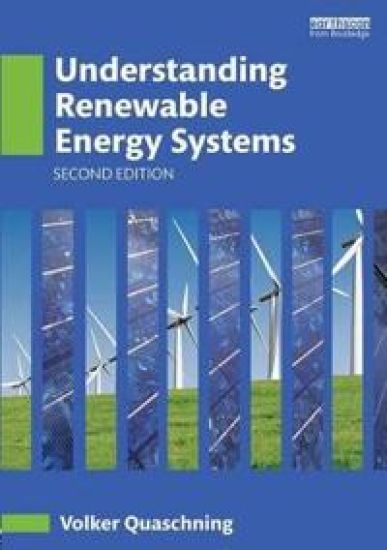
Understanding Renewable Energy Systems

Understanding Renewable Energy Systems

Volker Quaschning

Routledge
2016
nidottu
By mid-century, renewable energy must cover all of our energy supply if we are to phase out nuclear and successfully stop climate change.Now updated and expanded, the 2nd edition of this textbook covers the full range of renewable energy systems and now also includes such current trends as solar power storage, power-to-gas technologies, and the technology paths needed for a successful and complete energy transition. The topics are treated in a holistic manner, bringing together maths, engineering, climate studies and economics, and enabling readers to gain a broad understanding of renewable energy technologies and their potential.Numerous examples are provided for calculations, and graphics help visualize the various technologies and mathematical methodologies. Understanding Renewable Energy Systems is an ideal companion for students of renewable energy at universities or technical colleges on courses such as renewable energy, electrical engineering, engineering technology, physics, process engineering, building engineering, environment, applied mechanics and mechanical engineering, as well as scientists and engineers in research and industry.
The Grammar of Identity

The Grammar of Identity

Volker Gast

Routledge
2015
nidottu
English self-forms and related words from other Germanic languages (e.g. Dutch zelf, Swedish själv, etc.) are used in two different functions: as ‘intensifiers’ (e.g. The president himself made the decision) and as markers of reflexivity (John criticized himself). On the basis of a comparative syntactic and semantic analysis, this book addresses the question of why two such apparently different functions can be expressed by the same word. This question is answered by showing that both intensifying and reflexive self-forms can be analysed as expressing the concept of ‘identity’.In the first part of The Grammar of Identity, the most central facts concerning the distribution of intensifiers in Germanic languages are surveyed and a detailed syntactic and semantic analysis is provided. It is shown that all instances of intensifiers can be analysed as expressions of an identity function. The second part of the book offers an analysis of reflexive self-forms which is based on recent theories of reflexivity, modifying these in some important respects. In particular, the distribution of reflexive self-forms is explained with reference to semantic properties of the sentential environment. In this way, it can be shown that reflexive self-forms – like intensifiers – can be analysed as expressions of an identity function. In addition to providing a thorough comparative description of the hitherto poorly described area of intensifiers in Germanic languages, this book offers an answer to a long standing question in descriptive and theoretical linguistics, namely why self-forms are used in two apparently different functions. By combining analytical methods from syntax, lexical semantics and sentence semantics the study moreover contributes to an understanding of the interaction between structure, meaning and context in a central area of lexico-grammar.
The Silent Death

The Silent Death

Volker Kutscher

Picador USA
2018
nidottu
THE BASIS FOR THE INTERNATIONAL TV SENSATION BABYLON BERLIN " Kutscher's] trick is ingenious...He's created a portrait of an era through the lens of genre fiction."--The New York Times Volker Kutscher, author of the international bestseller Babylon Berlin, continues his Gereon Rath Mystery series with The Silent Death as a police inspector investigates the crime and corruption of a decadent 1930s Berlin in the shadows of the growing Nazi movement. March 1930: The film business is in a process of change. Talking films are taking over the silver screen and many a producer, cinema owner, and silent movie star is falling by the wayside. Celebrated actress Betty Winter is hit by a spotlight while filming a talkie. At first it looks like an accident, but Superintendent Gereon Rath finds clues that point to murder. While his colleagues suspect the absconded lighting technician, Rath's investigations take him in a completely different direction, and he is soon left on his own. Steering clear of his superior who wants him off the case, Rath's life gets more complicated when his father asks him to help Cologne mayor Konrad Adenauer with a case of blackmail, and ex-girlfriend Charly tries to renew their relationship--all while tensions between Nazis and Communists escalate to violence.
Babylon Berlin: Book 1 of the Gereon Rath Mystery Series
THE BASIS FOR THE INTERNATIONAL TV SENSATION BABYLON BERLIN "Cabaret on cocaine...captures the dark glamour of a briefly exhilarating time between the wars."--NPRBabylon Berlin is the first book in the international-bestselling series from Volker Kutscher that centers on Detective Gereon Rath caught up in a web of drugs, sex, political intrigue, and murder in Berlin as Germany teeters on the edge of Nazism. It's 1929 and Berlin is the vibrating metropolis of post-war Germany--full of bars and brothels and dissatisfied workers at the point of revolt. Gereon Rath is new in town and new to the police department. When a dead man without an identity, bearing traces of atrocious torture, is discovered, Rath sees a chance to find his way back into the homicide division. He discovers a connection with a circle of oppositional exiled Russians who try to purchase arms with smuggled gold in order to prepare a coup d' tat. But there are other people trying to get hold of the gold and the guns, too. Raths finds himself up against paramilitaries and organized criminals. He falls in love with Charlotte, a typist in the homicide squad, and misuses her insider's knowledge for his personal investigations. And as he gets further entangled with the case, he never imagined becoming a suspect himself. " Kutscher's] trick is ingenious...He's created a portrait of an era through the lens of genre fiction."--The New York Times
Goldstein: A Gereon Rath Mystery

Goldstein: A Gereon Rath Mystery

Volker Kutscher

Picador USA
2019
nidottu
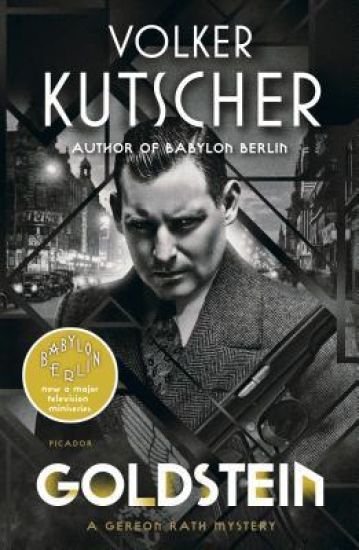
The Basis for the International TV Sensation Babylon BerlinOne of CrimeReads's Favorite Crime Books of the Year (Selected by Paul French) Volker Kutscher, author of the international bestseller Babylon Berlin, continues his Gereon Rath Mystery series with Goldstein as a police inspector investigates the crime and corruption of a decadent 1930s Berlin in the shadows of the growing Nazi movement. Berlin, 1931. A power struggle is taking place in Berlin's underworld. The American gangster Abraham Goldstein is in residence at the Hotel Excelsior. As a favour to the FBI, the police put him under surveillance with Detective Gereon Rath on the job. As Rath grows bored and takes on a private case for his seedy pal Johann Marlow, he soon finds himself in the middle of a Berlin street war. Meanwhile Rath's on-off girlfriend, Charly, lets a young woman she is interrogating escape, and soon her investigations cross Rath's from the other side. Berlin is a divided city where two worlds are about to collide: the world of the American gangster and the expanding world of Nazism. " Kutscher's] trick is ingenious...He's created a portrait of an era through the lens of genre fiction."--The New York Times
Conflict Management and Peacebuilding: Pillars of a New American Grand Strategy (Enlarged Edition)

Conflict Management and Peacebuilding: Pillars of a New American Grand Strategy (Enlarged Edition)

Volker C. Franke; Robert H. Dorff; Strategic Studies Institute; U.S. Army War College

Lulu.com
2014
nidottu
The authors examine the utility of the U.S. Government's whole-of-government (WoG) approach for responding to the challenging security demands of operations in Iraq and Afghanistan. They specifically discuss the strategic objectives of interagency cooperation particularly in the areas of peacebuilding and conflict management. Discussions range from the conceptual to the practical, with a focus on the challenges and desirability of interagency cooperation in international interventions. Shared were experiences and expertise on the need for and future of an American grand strategy in an era characterized by increasingly complex security challenges and shrinking budgets. All agreed that taking the status quo for granted was a major obstacle to developing a successful grand strategy and that government, the military, international and nongovernmental organizations, and the private sector are all called on to contribute their best talents and efforts to joint global peace and security efforts.
Towards a European Energy Union

Towards a European Energy Union

Volker Roeben

Cambridge University Press
2019
pokkari
The European Union is poised to establish a genuine European Energy Union with the new powers conferred on it by the Lisbon Treaty. Since 2014, it has been developing and implementing an energy strategy that responds to the three overarching priorities of climate change, political security, and economic competitiveness by 2030. The European Energy Union aims to provide secure, sustainable and affordable energy throughout the cycle of production, transport and consumption. This book outlines the legal regime underpinning this regulatory strategy, which integrates EU law with international law and with the law of the member states and affiliated states. It analyses and explains the increasing interaction between these legal orders in achieving the shared objective of transforming the European and global energy systems. This book will appeal to scholars and students of energy law and Policy at both European and international levels.
A Primer on String Theory

A Primer on String Theory

Volker Schomerus

Cambridge University Press
2017
pokkari
Since its conception in the 1960s, string theory has been hailed as one of the most promising routes we have to unify quantum mechanics and general relativity. This book provides a concise introduction to string theory explaining central concepts, mathematical tools and covering recent developments in physics including compactifications and gauge/string dualities. With string theory being a multidisciplinary field interfacing with high energy physics, mathematics and quantum field theory, this book is ideal for both students with no previous knowledge of the field and scholars from other disciplines who are looking for an introduction to basic concepts.
Eight Days in May: The Final Collapse of the Third Reich

Eight Days in May: The Final Collapse of the Third Reich

Volker Ullrich

Liveright Publishing Corporation
2023
nidottu
In a bunker deep below Berlin's Old Reich Chancellery, Adolf Hitler and his new bride, Eva Braun, took their own lives just after 3:00 p.m. on April 30, 1945--Hitler by gunshot to the temple, Braun by ingesting cyanide. But the F hrer's suicide did not instantly end either Nazism or the Second World War in Europe. Far from it: the eight days that followed were among the most traumatic in modern history, witnessing not only the final paroxysms of bloodshed and the frantic surrender of the Wehrmacht, but the total disintegration of the once-mighty Third Reich.In Eight Days in May, the award-winning historian and Hitler biographer Volker Ullrich draws on an astonishing variety of sources, including diaries and letters of ordinary Germans, to narrate a society's descent into Hobbesian chaos. In the town of Demmin in the north, residents succumbed to madness and committed mass suicide. In Berlin, Soviet soldiers raped German civilians on a near-unprecedented scale. In Nazi-occupied Prague, Czech insurgents led an uprising in the hope that General George S. Patton would come to their aid but were brutally put down by German units in the city. Throughout the remains of Third Reich, huge numbers of people were on the move, creating a surrealistic tableau: death marches of concentration-camp inmates crossed paths with retreating Wehrmacht soldiers and groups of refugees; columns of POWs encountered those of liberated slave laborers and bombed-out people returning home. A taut, propulsive narrative, Eight Days in May takes us inside the phantomlike regime of Hitler's chosen successor, Admiral Karl D nitz, revealing how the desperate attempt to impose order utterly failed, as frontline soldiers deserted and Nazi Party fanatics called on German civilians to martyr themselves in a last stand against encroaching Allied forces. In truth, however, the post-Hitler government represented continuity more than change: its leaders categorically refused to take responsibility for their crimes against humanity, an attitude typical not just of the Nazi elite but also of large segments of the German populace. The consequences would be severe. Eight Days in May is not only an indispensable account of the Nazi endgame, but a historic work that brilliantly examines the costs of mass delusion.
Germany 1923

Germany 1923

Volker Ullrich

WW NORTON CO
2023
sidottu
The great Austrian writer Stefan Zweig confided in his autobiography: “I have a pretty thorough knowledge of history, but never, to my recollection, has it produced such madness in such gigantic proportions.” He was referring to Germany in 1923, a “year of lunacy,” defined by hyperinflation, violence, a political system on the verge of collapse, the rise of Adolf Hitler and the Nazi Party and separatist movements threatening to rip apart the German nation. Most observers found it miraculous that the Weimar Republic—the first German democracy—was able to survive, though some of the more astute realised that the feral undercurrents unleashed that year could lead to much worse. Now, a century later, best-selling author Volker Ullrich draws on letters, memoirs, newspaper articles and other sources to present a riveting chronicle of one of the most difficult years any modern democracy has ever faced—one with haunting parallels to our own political moment.
Germany 1923

Germany 1923

Volker Ullrich

WW NORTON CO
2024
nidottu
As the great Austrian writer Stefan Zweig confided in his autobiography, written in exile, “I have a pretty thorough knowledge of history, but never, to my recollection, has it produced such madness in such gigantic proportions.” He was referring to the situation in Germany in 1923. It was a “year of lunacy”, defined by hyperinflation, a political system on the verge of collapse and separatist movements that threatened Germany’s territorial integrity. Most significantly, Adolf Hitler launched his infamous Beer Hall Putsch in Munich—a failed coup that nonetheless drew international attention and demonstrated the Nazis’ ruthless determination to seize power. In Germany 1923, award-winning historian Volker Ullrich draws on letters, memoirs, newspaper articles and other sources from the time to present a captivating new history of those explosive twelve months. The crisis began when the French invaded the Ruhr Valley in January to force Germany to pay the reparations it owed under the Treaty of Versailles, which had ended the Great War. For years, German leaders had embraced inflationary policies to finance the costs of defeat, and, as Ullrich demonstrates, the invasion utterly destroyed the value of the German mark. Before the war, the exchange rate was 4.2 marks to the dollar. By 20 November 1923, a dollar was worth an incomprehensible 4.2 trillion marks and a loaf of bread cost 200 billion. Facing the abyss, many ordinary Germans called for a national messiah. Among the figures to vie for that role was Hitler, a thirty-four-year-old veteran who possessed a uniquely malevolent personal magnetism. Although the Nazi coup in November was put down and Hitler arrested, the putsch showed just how tenuous the first German democracy, the Weimar Republic, was at its core. As Ullrich’s panoramic narrative reveals, other Germans responded to the successive crises by launching a cultural revolution: 1923 witnessed the emergence of a multitude of new movements, from Dada to Bauhaus, and of such iconoclasts as Bertolt Brecht, George Grosz and Franz Kafka. Yet most observers were amazed that the Weimar Republic was able to survive, and the more astute realised that the feral undercurrents unleashed could lead to much worse. Publishing a century after that fateful year, Germany 1923 is a riveting chronicle of one of the most challenging times any modern democracy has faced, one with haunting parallels to our own political moment.
Fateful Hours: The Collapse of the Weimar Republic

Fateful Hours: The Collapse of the Weimar Republic

Volker Ullrich

W. W. Norton Company
2025
sidottu
Democracies are fragile. Freedoms that seem secure can be lost. Few historical periods illustrate this as clearly as the Weimar Republic. Fateful Hours tells one of the greatest dramas in world history: the failure of Germany's first democracy, culminating in the horrific rise of the Third Reich.The Weimar Republic was born under an inauspicious star. Germany resoundingly lost the First World War and was hobbled by harsh conditions imposed by the Treaty of Versailles. Continual crises--hyperinflation, violence, and political instability--shook the republic, only letting up during a brief period of stability in the 1920s. But the first German democracy was not always destined for failure. Historian Volker Ullrich proves that there were many opportunities to lay the tracks differently, from the founding phase through Hitler's election in 1933. Ultimately, the republic's fate depended on the choices of individuals. Thus, this history carries an urgent reminder: It is up to us whether democracy lives or dies.