

Kirjahaku
Etsi kirjoja tekijän nimen, kirjan nimen tai ISBN:n perusteella.
1000 tulosta hakusanalla W L Williams

Museum of Antiquity; A Description of Ancient Life
L W Yaggy; Thomas Louis Haines
Outlook Verlag
2024
pokkari
Reprint of the original, first published in 1883.

Museum of Antiquity; A Description of Ancient Life
L W Yaggy; Thomas Louis Haines
Outlook Verlag
2024
pokkari
Reprint of the original, first published in 1883.

Crystal Gems for the Sabbath School. Containing a Choice Collection of New Hymns and Tunes
L W Aikin
Outlook Verlag
2024
pokkari
Reprint of the original, first published in 1875.

Crystal Gems for the Sabbath School. Containing a Choice Collection of New Hymns and Tunes
L W Aikin
Outlook Verlag
2024
sidottu
Reprint of the original, first published in 1875.


New Technologies in Radiation Oncology
L.W. Brady; H.-P. Heilmann; M. Molls
Springer-Verlag Berlin and Heidelberg GmbH Co. K
2005
sidottu
This book provides an overview of recent advances in radiation oncology, many of which have originated from physics and engineering sciences. The new technologies in this field have a complex physical, mathematical and technical background that technical assistants, dosimetrists, and physicians frequently find difficult to comprehend. However, this book is specifically designed to be readily understandable by professionals and students with a medical background as well as by newcomers to radiation oncology from the field of physics. All relevant areas of the subject are covered in detail, including 3D imaging and image processing, 3D treatment planning, modern treatment techniques, patient positioning, and aspects of verification and quality assurance.
Combined Modality Therapy of Central Nervous System Tumors
L.W. Brady; H.-P. Heilmann; M. Molls
Springer-Verlag Berlin and Heidelberg GmbH Co. K
2003
nidottu
The American Cancer Society anticipates that 16,500 patients will be diagnosed with primary malignant tumors of the central nervous system in 2000, with about 200,000 individuals presenting with brain metastases. The advances in the treatment of solid tumors have contributed significantly to the major increase in metastatic cancers to the brain. Of the primary malignant tumors of the brain, more than 50% are high-grade gliomas; the incidence has been increasing among older patients over the past decade. Major developments in new technologies in the treatment of primary brain tumors as well as metastatic disease are covered in depth. Even though management is difficult, advances are being made. This book is a concerted effort to present data regarding basic science research efforts alongside their translation into clinical practice using combined, integrated multimodal programs of treatment. Progress has been made, but innovatice approaches need to be pursued.
Multimodal Concepts for Integration of Cytotoxic Drugs
L.W. Brady; H.-P. Heilmann; M. Molls
Springer-Verlag Berlin and Heidelberg GmbH Co. K
2006
sidottu
Over recent decades, combined modality treatment has drastically improved the cure rates for various malignant tumors. Further progress is expected through the design of sound combinations involving recently developed drugs. The first part of this book summarizes the rationale and the preclinical data for combined treatment with ionizing radiation and pharmaceutical agents. Individual chapters focus on different forms of combined treatment, with due consideration being given to a range of drugs and to emerging combinations with small molecules and antibodies. The second part of the book comprises a series of disease-specific chapters in which the clinical results of combined modality treatment are presented. The text, written by acknowledged experts, is specifically designed to be accessible to professionals from the various disciplines involved in multidisciplinary cancer care and to residents in radiation oncology training programs.
Clinical Target Volumes in Conformal and Intensity Modulated Radiation Therapy
L.W. Brady; H.-P. Heilmann; M. Molls
Springer-Verlag Berlin and Heidelberg GmbH Co. K
2003
sidottu
Conformal radiation therapy represents a new challenge for radiation oncologists. It offers the prospect of either increasing the radiation dose to target tissues while delivering a similar dose to organs at risk, or reducing the dose to organs at risk while maintaining the dose to target tissues. First, lymph node areas at risk are established using the available data from pathological examination of surgical specimens and/or pattern of locoregional relapse. Then, based on a three-dimensional description of the anatomical regions where the areas at risk are located, guidelines for the delineation of the clinical target volumes are proposed. The data presented should enable the reader to make appropriate decisions regarding the selection and delineation of the target volumes when confronted with the most frequent tumor types and sites.The book will contribute to paving the way for more effective radiation oncology in the twenty-first century.
Thermoradiotherapy and Thermochemotherapy
L.W. Brady; H.-P. Heilmann
Springer-Verlag Berlin and Heidelberg GmbH Co. K
1995
sidottu
Hyperthermia has been found to be of great benefit in combination with radiation therapy or chemotherapy in the management of patients with difficult and com plicated tumor problems. It has been demonstrated to increase the efficacy, of ionising radiation when used locally but also has been of help in combination with systemic chemotherapy where hyperthermia is carried out to the total body. Problems remain with regard to maximizing the effects of hyperthermia as in fluenced by blood flow, heat loss, etc. The present volume defines the current knowledge relative to hyperthermia with radiation therapy and/or chemotherapy, giving a comprehensive overview of its use in cancer management. Philadelphia/Hamburg, June 1995 L.W. BRADY H.-P. HEILMANN Preface In an attempt to overcome tumor resistance, hypoxia, or unfavorable tumor condi tions, oncological research has come to focus on gene therapy, immunotherapy, new cytotoxic agents, and increasingly sophisticated radiotherapy. Radiation research has been directed towards heavy particle therapy and modification of the radiation response by either protecting or sensitizing agents. Improved dose localization using rotational or conformal strategies has also been implemented. Recently, changes in radiation fractionation schedules have shown promise of better results. Hyperthermia in cancer therapy can be viewed similarly as another means to increase the sensitivity of tumors to radio- and chemotherapy.
Progress and Perspective in the Treatment of Lung Cancer
L.W. Brady; H.-P. Heilmann
Springer-Verlag Berlin and Heidelberg GmbH Co. K
1999
sidottu
Lung cancer is not a single disease process but is a group of biologically variable diseases. Therefore, accurate and complete diagnosis along with complete workup of the patient prior to decision-making in treatment is essential to devise the most appropriate treatment strategy. In North America adenocarcinoma of the lung now accounts for about 40% of all lung cancers and stage for stage these tumors have a poorer prognosis than squamous cell cancers of the lung. Many prognostic indicators have been identified such as genetic markers and neuroen docrine differentiation, which have important roles to play in identifying the patients who would benefit most from active treatment. Screening and early detection have been thought to be sine qua non in early diagnosis of lung cancer. However, a number of controlled trials assessing the value of annual screening for lung cancer have demonstrated in some studies that chest X-rays and/or cytology screening may improve stage distribution, resectability, survival, and fatality but has not shown an impact on disease-specific mortality rates. The Mayo Clinic lung project compar ing quarterly chest X-rays and sputum cytology with routine care in more than 10 000 male smokers indicated that 5-year survival following treatment in the screened patients was better than rates in contemporary clinical practice. However, arguments have been ad vanced as to factors that might have biased the clinical benefits. Other trials are currently under way to deal with this issue along with new molecular markers that may enhance sputum sensitivity.
Radiotherapy for Non-Malignant Disorders
L.W. Brady; H.-P. Heilmann; M. Molls; C. Nieder
Springer-Verlag Berlin and Heidelberg GmbH Co. K
2007
sidottu
Non-malignant, or "benign", diseases can be successfully treated using ionizing rad- tion technologies. It was first proposed in 1898 by Sokoloff, who reported the analgesic effects of radiotherapy for painful rheumatoid arthritis. Since then, the use of these techniques for painful muscle-skeletal diseases has gained acceptance particularly in Europe but is still carried out actively in the United States. Non-malignant diseases that are amenable to radiotherapy can be classified as inflammatory, degenerative, hype- roliferative, functional, or other disorders. However, the topographic and morphologic considerations are more relevant. Even though radiation therapy for "benign" diseases has not been pursued actively since the 1950s, more recent interest has dictated that it can be a very effective treatment modality. The use of radiotherapy can be justified for invasive and aggressive growth such as that seen with desmoids, for cosmetic d- figurations and functional loss as seen with keloids or endocrine orbitopathy, or for life-threatening complications such as hepatic hemangiomas or juvenile angiofibromas that occur in children or adolescents. Many of the non-malignant diseases can have a major and lasting effect on quality of life by causing pain or other serious symptoms, particularly when other methods of treatment are unavailable, have failed, or may induce more side effects. It is not generally the first choice of therapy in these non-malignant diseases, but it is acceptable as defined. The book edited by Seegenschmiedt et al.
Combined Modality Therapy of Central Nervous System Tumors
L.W. Brady; H.-P. Heilmann; M. Molls
Springer-Verlag Berlin and Heidelberg GmbH Co. K
2000
sidottu
The American Cancer Society anticipates that 16,500 patients will be diagnosed with primary malignant tumors of the central nervous system in 2000, with about 200,000 individuals presenting with brain metastases. The advances in the treatment of solid tumors have contributed significantly to the major increase in metastatic cancers to the brain. Of the primary malignant tumors of the brain, more than 50% are high-grade gliomas; the incidence has been increasing among older patients over the past decade. Major developments in new technologies in the treatment of primary brain tumors as well as metastatic disease are covered in depth. Even though management is difficult, advances are being made. This book is a concerted effort to present data regarding basic science research efforts alongside their translation into clinical practice using combined, integrated multimodal programs of treatment. Progress has been made, but innovatice approaches need to be pursued.
Age-Related Macular Degeneration
L.W. Brady; H.-P. Heilmann; M. Molls
Springer-Verlag Berlin and Heidelberg GmbH Co. K
2000
sidottu
Age-related macular degeneration (ARMD) is a frequent disease of the elderly and the most common cause of blindness. Recently, various new treatment options have become available for ARMD. This book, written by recognized experts and including the results of international study groups, provides a comprehensive report on these treatments, documenting their rationale, uses, side-effects, and benefits. It will be of immense value to all with an interest in ARMD.
Advances in Radiation Oncology in Lung Cancer
L.W. Brady; H.-P. Heilmann; M. Molls
Springer-Verlag Berlin and Heidelberg GmbH Co. K
2010
nidottu
Although decades of laboratory and clinical research have led to incremental improvement in treatment outcome, lung cancer remains one of the most deadly diseases. This volume is unique in being devoted solely to the radiation oncology of lung cancer, and will be of great value to all who are involved in the diagnosis and treatment of the disease. Both non-small cell and small cell lung cancer are considered in detail. Current state-of-the-art treatment strategies and novel approaches that promise further improvements in outcome are explained and evaluated, with the aid of high-quality illustrations. Treatment-related toxicity is discussed, and further individual chapters focus on topics such as quality of life studies, prognostic factors and pitfalls in the design and analysis of clinical trials.
Multimodal Concepts for Integration of Cytotoxic Drugs
L.W. Brady; H.-P. Heilmann; M. Molls
Springer-Verlag Berlin and Heidelberg GmbH Co. K
2010
nidottu
Over recent decades, combined modality treatment has drastically improved the cure rates for various malignant tumors. Further progress is expected through the design of sound combinations involving recently developed drugs. The first part of this book summarizes the rationale and the preclinical data for combined treatment with ionizing radiation and pharmaceutical agents. Individual chapters focus on different forms of combined treatment, with due consideration being given to a range of drugs and to emerging combinations with small molecules and antibodies. The second part of the book comprises a series of disease-specific chapters in which the clinical results of combined modality treatment are presented. The text, written by acknowledged experts, is specifically designed to be accessible to professionals from the various disciplines involved in multidisciplinary cancer care and to residents in radiation oncology training programs.
Clinical Target Volumes in Conformal and Intensity Modulated Radiation Therapy
L.W. Brady; H.-P. Heilmann; M. Molls
Springer-Verlag Berlin and Heidelberg GmbH Co. K
2011
nidottu
Conformal radiation therapy represents a new challenge for radiation oncologists. It offers the prospect of either increasing the radiation dose to target tissues while delivering a similar dose to organs at risk, or reducing the dose to organs at risk while maintaining the dose to target tissues. First, lymph node areas at risk are established using the available data from pathological examination of surgical specimens and/or pattern of locoregional relapse. Then, based on a three-dimensional description of the anatomical regions where the areas at risk are located, guidelines for the delineation of the clinical target volumes are proposed. The data presented should enable the reader to make appropriate decisions regarding the selection and delineation of the target volumes when confronted with the most frequent tumor types and sites.The book will contribute to paving the way for more effective radiation oncology in the twenty-first century.
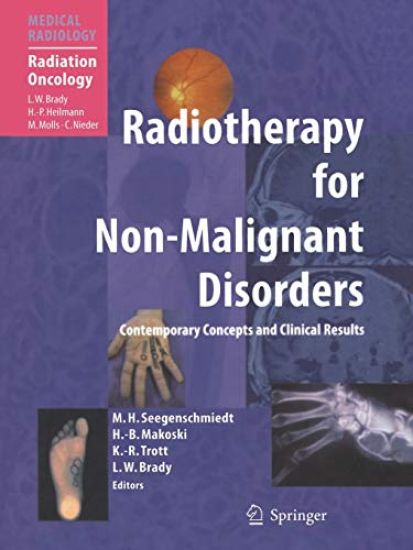
Radiotherapy for Non-Malignant Disorders
L.W. Brady; H.-P. Heilmann; M. Molls; C. Nieder
Springer-Verlag Berlin and Heidelberg GmbH Co. K
2010
nidottu
Non-malignant, or "benign", diseases can be successfully treated using ionizing rad- tion technologies. It was first proposed in 1898 by Sokoloff, who reported the analgesic effects of radiotherapy for painful rheumatoid arthritis. Since then, the use of these techniques for painful muscle-skeletal diseases has gained acceptance particularly in Europe but is still carried out actively in the United States. Non-malignant diseases that are amenable to radiotherapy can be classified as inflammatory, degenerative, hype- roliferative, functional, or other disorders. However, the topographic and morphologic considerations are more relevant. Even though radiation therapy for "benign" diseases has not been pursued actively since the 1950s, more recent interest has dictated that it can be a very effective treatment modality. The use of radiotherapy can be justified for invasive and aggressive growth such as that seen with desmoids, for cosmetic d- figurations and functional loss as seen with keloids or endocrine orbitopathy, or for life-threatening complications such as hepatic hemangiomas or juvenile angiofibromas that occur in children or adolescents. Many of the non-malignant diseases can have a major and lasting effect on quality of life by causing pain or other serious symptoms, particularly when other methods of treatment are unavailable, have failed, or may induce more side effects. It is not generally the first choice of therapy in these non-malignant diseases, but it is acceptable as defined. The book edited by Seegenschmiedt et al.