Kirjojen hintavertailu. Mukana 11 505 150 kirjaa ja 12 kauppaa.

Kirjahaku

Etsi kirjoja tekijän nimen, kirjan nimen tai ISBN:n perusteella.

1000 tulosta hakusanalla Adam Rapp

Adam and the Mother

Adam and the Mother

Oxford University Press
2009
muu
for unaccompanied SSATB choir (with optional soprano solo) Combining a number of early lullaby texts in one setting, Adam and the Mother is a haunting carol recalling the fall of Adam. It combines irregular melodic lines with lilting ostinato passages and will appeal to experienced choirs looking for a unique addition to the Christmas repertory.
Adam lay y-bounden

Adam lay y-bounden

Oxford University Press
2001
muu
for SATB unaccompanied A simple setting of this popular medieval Advent carol which has great originality and impact. The style is controlled, almost austere, and the effect is hypnotic. This is an unsettling but poignant piece that forces the listener to confront the mystery of Christ's coming foretold in the words.
Adam of Bockenfield and his circle on Aristotle's De memoria et reminiscentia
An edited text of the teaching of Adam of Bockenfield, a key figure in the history of the introduction of Aristotle's natural philosophy in England. It offers an edition of three early Latin commentaries on the tract On memory and recollection, all of them produced in the nascent Faculty of Arts at the University of Oxford. The book consists of three main sections. The introduction to the critical edition enlightens the complex history of the manuscripts and the scientific method followed by the editors. The historical and doctrinal introduction tries to illustrate the difficult reception of Aristotelian theories of memory in a context where other competing theories pre-existed and where natural philosophy as a university discipline was in the process of being built at Oxford. The last section consists of the critical edition of the Latin text of three commentaries on the De memoria et reminiscentia by Aristotle, two anonymous and one by Adam of Bockenfield, as well as in the English translation of the latter.
Adam Bede

Adam Bede

George Eliot

Clarendon Press
2001
sidottu
The Clarendon edition of Adam Bede (1859) is the first critical edition of the work that established George Eliot's reputation. Its extensive textual apparatus lists manuscript and first edition variants from the copy-text, which is the corrected eighth edition of 1861 -- her last revision of the book. The introduction locates the genesis of the novel in Eliot's family history, her travels, and her reading of literature and biography, and describes the composition process, including her debate with the publisher John Blackwood about the suitability of the subject-matter for a family audience, as both author and publisher anticipated its appearing initially in Blackwood's Edinburgh Magazine. Using Blackwood's publication ledgers, it also establishes the details of the eleven complete or nearly complete resettings of the novel in Eliot's lifetime; and examines the author's revisions to a manuscript that is popularly, but erroneously, thought to have been little altered, giving detailed attention to the dialect in the context of more than 900 variants between manuscript and first edition.
The Chronicle of Adam Usk 1377-1421

The Chronicle of Adam Usk 1377-1421

Adam Usk

Clarendon Press
1997
sidottu
Adam Usk, the full details of whose remarkable life are here revealed for the first time, was born in Usk around the middle of the fourteenth century. Through the patronage of the Mortimer family - the earls of March - he studied law at Oxford, eventually rising to hold a chair in civil law there, before entering the service of Archbishop Arundel and, ultimately, of King Henry IV of England. He was an eye-witness to the revolution of 1399, but soon after this, having left England for Rome, he fell out with Henry IV and spent several years in exile, accused of collaborating with the Welsh rebel leader, Owain Glyn Dwr. Eventually, having returned to Wales secretly, he managed to gain a pardon from the king in 1411, and thus spent his remaining years, until his death in 1430, in relative peace. His chronicle, which is a first-hand source for the fall of Richard II, for the turbulent politics of Rome between 1402 and 1406, and for the Glyn Dwr revolt, also provides a fascinating insight - with its mixture of autobiography, political intrigue, and the supernatural - into the mind of a highly educated medieval author.
Adam Smith Across Nations

Adam Smith Across Nations

Cheng-chung Lai

Clarendon Press
2000
sidottu
The materials collected in this volume all concern the translations of and receptions to Adam Smith's The Wealth of Nations in ten non-English-speaking countries. The Wealth of Nations provides the perfect basis for studying the international transmission of economic ideas as it is generally considered to be the foundation of modern political economy, and still continues to be read after more than two centuries. Its appeal crosses national, cultural, and ideological boundaries -- countries investigated here range from China to Sweden -- and its enduring popularity is indicated by its status as the most translated economics book in history. Adam Smith Across Nations includes numerous sections which will of invaluable assistance to any Smith researcher. As well as presenting reviews and analysis from each country from the 18th century to the present day, an appendix lists editions of The Wealth of Nations in 18 languages, enabling the reader to understand the speed and number of translations. Most importantly, an introductory overview synthesises current research on the economic ideological context in the individual countries when The Wealth of Nations was introduced, the motives behind its introduction, its immediate reception, and the nature of the objections to Smith's doctrines. Professor Lai concludes that Smith's impact outside English-speaking country was predominantly limited to the realm of ideas: few of his policy recommendations were put into practice.
The Glasgow Edition of the Works and Correspondence of Adam Smith: VI: Correspondence
In this edition the missing part of one letter and eighteen entirely new ones are presented. The search for these letters even extended to Japan. Therefore, all new Smith letter discovered since 1977 are included. In addition, wherever errors were suspected or misreadings have come to light in the standing text as a result of advice from reviewers and correspondents, these have been corrected.
Adam Smith's Library

Adam Smith's Library

Hiroshi Mizuta

Oxford University Press
2000
sidottu
Adam Smith is considered the founding father of economics. Yet to form an accurate picture of the theoretical basis of his work, it is necessary to know what influenced him. This book is the most up-to-date and comprehensive guide to all the books which were in Adam Smith's library at the time of his death. An invaluable reference work, this book will be of enormous interest to all those interested in the genesis of early economic thought.
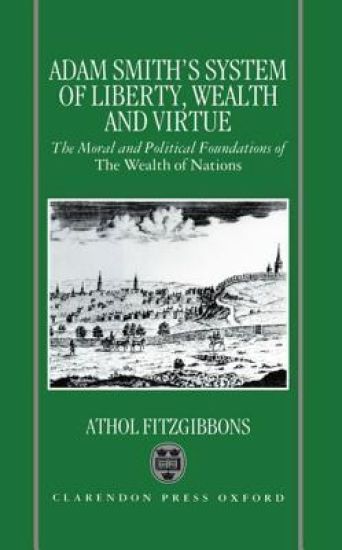
Adam Smith's System of Liberty, Wealth, and Virtue
This book examines the influence that Adam Smith's philosophy had on his economics, drawing on the neglected parts of Smith's writings to show that the political and economic theories built logically on his morals. It analyses the significance of his stoic beliefs, his notions of art and music, astronomy, philosophy and war, and shows that Smith's invisible hand was part of a 'system' that was meant to replace medieval Christianity with ethic of virtue in this world rather than the next. Smith was motivated primarily by a political ideal, a moral version of liberalism. He rejected the political philosophy of the Greeks and Christians as authoritarian and unworldly, but contrary to what many economists believe, he also rejected the amoral liberalism that was being advocated by his countryman and friend David Hume. Far from being myopic about self-love, Smith arrived at his theories of free trade, economic growth, and alienation via his reinterpretation of Stoic virtue. Of interest to economists, philosophers, political theorists, sociologists and lawyers concerned with jurisprudence, this book is clearly written, and its innovations reveal the hitherto hidden unity in Smith's overarching system of morals, politics and economics.
Adam Smith's System of Liberty, Wealth, and Virtue
This study analyses the influence that Adam Smith's philosophy had on his Wealth of Nations , and reveals the unity in Smith's extensive system of morals, politics, and economics. It concludes that Smith was motivated by a political ideal, which was moral liberalism. This book is intended for economists, political theorists, and lawyers concerned with jurisprudence. Also the general reader interested in Adam Smith.
Adam Smith and the Classics

Adam Smith and the Classics

Gloria Vivenza

Oxford University Press
2001
sidottu
Adam Smith and the Classics analyses the influence of classical culture---the work of Plato, Aristotle, Cicero, and the Stoics---on Adam Smith's thought. Vivenza bases her arguments on elements of Smith's work that can be shown to be precise reflections of passages from the classical authors, and on Smith's own acknowledgements that he was so influenced. The bulk of the classical nuances occur in Smith's moral and natural philosophy, but Vivenza also shows that the classics had some impact on his economic thought. The book represents a complete survey of all Adam Smith's writings, and is organized by arguments: natural philosophy, moral philosophy, jurisprudence, topics of economic interest, and literature. A further chapter discusses the very recent consensus among a number of scholars that Smith's writings display strong elements of Stoicism. Adam Smith and the Classics is a significant book, since it shows just how strong an impression the classical training had on the intellectual elite of the eighteenth century. So much so that the classics have left their mark on the scholarship and writings of the time.
Adam Smith

Adam Smith

Christopher J. Berry

Oxford University Press
2018
nidottu
In 1776 Adam Smith (1723-90) wrote The Wealth of Nations , a book so foundational it has led to him being called the 'father of economics'. Today he is associated with the promotion of self-interest, a defence of greed and a criticism of any governmental 'interference' in market transactions which, if left to the 'invisible hand', will produce prosperity and liberty. Yet if Smith is actually read these associations are more a caricature than a faithful portrait. In this Very Short Introduction, Christopher Berry offers a balanced and nuanced view of this seminal thinker, embedding his fierce defence of free trade, competition, and assault on special interests in contemporary European history, politics, and philosophy. As Berry explores, Smith was far more than an economist. His book The Theory of Moral Sentiment, offered a complex account of ethics in the context of human social behaviour. His scope as a professor at the University of Glasgow, a major centre of the Scottish Enlightenment, was extensive. Beyond courses in philosophy and jurisprudence he also gave classes covering history, literature, and language. In addition to his two major works he also wrote a pioneering study of the history of astronomy as an illustration of the motivations that drive humans to seek answers to questions. He produced, again derived from his Glasgow classroom, an analysis of the development of grammar and language. As Christopher Berry shows, Adam Smith was no narrow thinker, but rather one who produced not only one of the greatest books in the history of social science, but also a wide-ranging body of work that remains significant today. ABOUT THE SERIES: The Very Short Introductions series from Oxford University Press contains hundreds of titles in almost every subject area. These pocket-sized books are the perfect way to get ahead in a new subject quickly. Our expert authors combine facts, analysis, perspective, new ideas, and enthusiasm to make interesting and challenging topics highly readable.
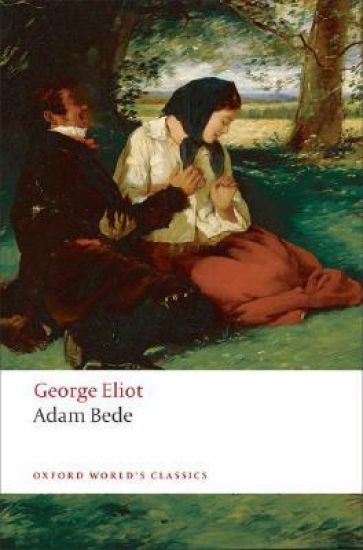
Adam Bede

Adam Bede

George Eliot

Oxford University Press
2008
nidottu
'Our deeds carry their terrible consequences...consequences that are hardly ever confined to ourselves.' Pretty Hetty Sorrel is loved by the village carpenter Adam Bede, but her head is turned by the attentions of the fickle young squire, Arthur Donnithorne. His dalliance with the dairymaid has unforeseen consequences that affect the lives of many in their small rural community. First published in 1859, Adam Bede carried its readers back sixty years to the lush countryside of Eliot's native Warwickshire, and a time of impending change for England and the wider world. Eliot's powerful portrayal of the interaction of ordinary people brought a new social realism to the novel, in which humour and tragedy co-exist, and fellow-feeling is the mainstay of human relationships. Faith, in the figure of Methodist preacher Dinah Morris, offers redemption to all who are willing to embrace it. This new edition is based on the definitive Clarendon edition and Eliot's corrected text of 1861. ABOUT THE SERIES: For over 100 years Oxford World's Classics has made available the widest range of literature from around the globe. Each affordable volume reflects Oxford's commitment to scholarship, providing the most accurate text plus a wealth of other valuable features, including expert introductions by leading authorities, helpful notes to clarify the text, up-to-date bibliographies for further study, and much more.
Adam Smith’s Islands

Adam Smith’s Islands

John C. Weaver

MCGILL-QUEEN'S UNIVERSITY PRESS
2025
nidottu
Many developed countries restructured relations between state and economy from the late 1970s into the 1990s. Among them, New Zealand went far, fast, and left a clear trail, making it possible to study economic restructuring as it occurred, with all the debates, uncertainty, surprises, mistakes, and accomplishments this entailed. Adam Smith’s Islands reveals the inside life of a government determined to revolutionize its nation’s politics and economy.While the 1980s economic restructuring of members of the Organisation for Economic Co-operation and Development and former Warsaw Pact countries can seem like a foregone conclusion from the vantage point of the twenty-first century, John Weaver examines how local and global institutions had to come together to implement social adjustments in New Zealand. Mounting evidence that the state had not functioned as an effective manager split the business community and primary producers between defenders of subsidization and free-market insurgents. Reforms undertaken by the governing Labour Party included abandoning currency controls, privatizing state-run businesses, ending a multitude of open and disguised subsidies, tightening fiscal responsibility, and reforming taxation. Adam Smith’s Islands focuses on the verifiable: direct primary sources from dozens of state collections and deposits of personal papers. The archival cornucopia informing this history supports a narrative that has little in common with intellectual histories of neoliberalism. To understand how the relationship between the economy and the state changed, we need to grasp how and why core institutions, practices, and cultural beliefs shed some of their once potent legitimacy.Through the lens of New Zealand, Adam Smith’s Islands examines larger questions about policy dilemmas, the global flow of capital, and the sustainability of social adjustments in economic restructuring. In so doing, it casts new light on the formation and history of what is casually labelled today as the neoliberal state.
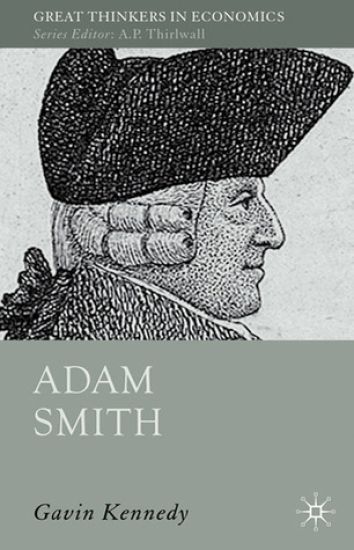
Adam Smith

Adam Smith

G. Kennedy

Palgrave Macmillan
2008
nidottu
This book presents the authentic Adam Smith and explores his underlying approach and radical thinking, aiming to re-establish his original intentions. The book provides a crucial reminder of how relevant Adam Smith was in his own time, and how relevant he remains as we experience the worldwide spread of opulence today.