Kirjojen hintavertailu. Mukana 12 363 415 kirjaa ja 12 kauppaa.

Kirjahaku

Etsi kirjoja tekijän nimen, kirjan nimen tai ISBN:n perusteella.

1000 tulosta hakusanalla Al Tran

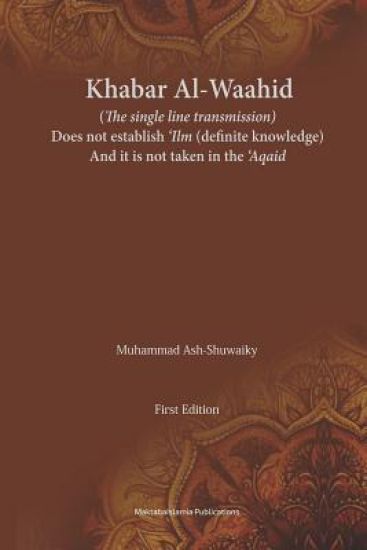
Khabar Al-Waahid (the Single Line Transmission): Khabar Al Waahid Does Not Establish 'ilm and It Is Not Taken in the 'aqaid
Over the years there has been a major discussion among students of knowledge and Fuqahaa about the subject of Khabr Ahaad whether it establishes 'Ilm i.e definite knowledge or not and thereby the question if it can be accepted in the 'Aqaaid. Scholars who claim that the khabr ahaad establishes 'Ilm and can be accepted in 'Aqaaid say that only the Jahmiyah, Mu'tazilah, Jabriyyah and Khawaarij differ in regards to this subject. The Author of this book considers those carrying this view as people who have gone away from the principles of Usool and has written this book as a detailed refutation about their views explaining why their viewpoint is not based on daleel (evidences) from the Quran, Sunnah and Ijma'a As Sahabaah to support it.
The Quran - English Translation with Surah Introduction - Volume 11: Surah 25: al-Furqan (The Criterion); Surah 26: ash-Shu'ara' (The Poets); Surah 27
THE QURAN - ENGLISH TRANSLATION WITH SURAH INTRODUCTION - VOLUME 11Saheeh International TranslationSaheeh International is a very popular and recommended translation by many scholars and is a default translation on many sites/VOLUME 11Surah 25: al-Furqan (The Criterion)Surah 26: ash-Shu'ara' (The Poets)Surah 27: an-Naml (The Ants)Size: 7.44" x 9.69" (18.9 x 24.61 cm)This is a good choice for students or adults who is seeking for a light copy of the Quran Translation for their research and studying purposes.
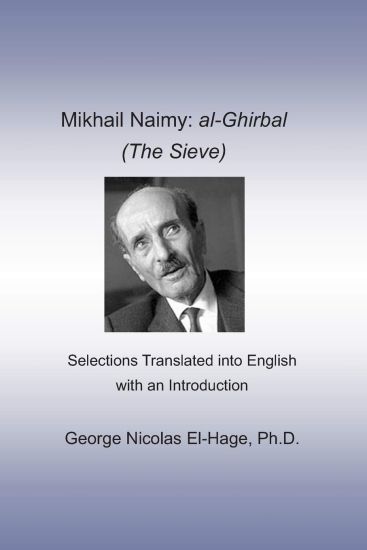
Mikhail Naimy: al-Ghirbal (The Sieve): Selections Translated into English with an Introduction
When The members of the Pen Bond Association (al-Rabita al-Qalamiya), a distinguished group of "like-minded" authors to borrow Naimy's phrase, were busy writing and publishing in New York City and striving to modernize and change the course of Arabic Literature, there was another group in the Middle East, particularly in Egypt (The Diwan Group) trying, within the limitations imposed on them by their closed environment, to do the same but with much less success. Perhaps it is not fair to compare the achievements and impact of these two separate groups on the modernization of Arabic literature and poetry at the turn of the twentieth century and the three decades that followed because al-Akkad, al-Mazini, and to some extent Shoukry, although they were open-minded and wanted to be tolerant of new ideas and literary theories, they still lived in a very conservative and extremely traditional society that worshiped the past and adhered to ancient rules of grammar, linguistics, morphology, and prosody. In al-Akkad, Naimy found a partner, a "like-minded" counterpart across the seas, who shared with him some basic understanding of the role of literature, poetry, the poet, and the critic. These two prominent authors had more in common even if al-Akkad insisted on putting language above the poet, thus disagreeing with Naimy who believed that language is but an instrument and a means to an end. Nevertheless, it was befitting that al-Akkad was chosen to write the introduction to the first edition of Naimy's influential book of literary criticism, al-Ghirbal, because the Egyptian Scholar was also in his own way trying to innovate in an environment shackled with a heavy inheritance of outworn traditions and forced to still wear the outmoded garments of a bygone world. As a critic, Naimy ignited a revolution that set new standards for literary criticism in modern Arabic literature. Al-Ghirbal is a decisive and definitive statement which rejects the years of stagnation that plagued Arabic literature and offers new rules and guidance to replace the archaic ones. The book bravely admits that thanks to Western literature and theories of literary criticism, we started to witness a noticeable change in Arabic literature. It introduces and legitimizes the theater, acting, the role of the actor, the play writer, and novelist as well as the important act of translating and the vital role of the translator. Placing the book in its proper historical timeframe, we realize that many of the revolutionary ideas and concepts advanced in al-Ghirbal were at the time of its publication considered avant-garde, radical, and almost heretical. The amazing fact is that the message of this book is as relevant today as it was valid and pertinent then, and if Naimy returned to life, he would not change a word in the book. Al-Ghirbal's message was strong and clear. It was certainly meant to awaken the sleepy and "lazy" minds and souls and to shock, anger, and even hurt the sensitivity of its readers and the hosts of versifiers and pretenders who thought they were poets and drive them to rethink, reconsider, and reevaluate. All said, al-Ghirbal remains one the most powerful documents on literary criticism in modern Arabic literature since the turn of the twentieth century. It abounds with sarcasm that bites but also with wisdom that enlightens and guides. It also summarizes the position of the Pen Bond Association (al-Rabita al-Qalamiya) regarding poetry and the role of the poet and of literature as they viewed it and strongly advocated to popularize and modernize it.
La segunda transición: De la sociedad del bienestar al neoliberalismo salvaje

La segunda transición: De la sociedad del bienestar al neoliberalismo salvaje

Asociacion De Txikiteros Indignados

Createspace Independent Publishing Platform
2013
nidottu
Libro que recoge un a o de vida del blog La Segunda Transici n, de la Asociaci n de Txikiteros Indignados, un blog con m s de 140.000 visitas durante ese a o de vida, m s de 150 entradas, todas recogidas y categorizadas en este libro. Durante este a o se ha hablado de la situaci n del pa s, de Europa, del mundo, y se han explicado conceptos b sicos de por qu se ha llegado a esta situaci n, as como recetas para poder salir de esta crisis.
del Desastre Al Milagro: Cómo Experimentar Una Verdadera Transformación En Cristo / From a Mess to a Miracle: Experiencing True Transformation in Chri
Cuando Kimberly Daniels dej las calles y entreg su vida a Jes s, pens que su lucha hab a terminado, porque crey que en la iglesia estar a rodeada de las personas m s amorosas del mundo. Pero pronto descubri que en su nueva vida hab a gente que era tan peligrosa para su salud espiritual como cualquier persona de su pasado. En Del desastre al milagro ella expone las trampas del enemigo que est n operando dentro de nuestras iglesias e impiden que los creyentes experimenten una vida verdaderamente transformada en Cristo. Con un audaz llamado aun cambio radical, no se anda con miramientos cuando le ense a c mo: Agudizar su discernimiento espiritual Demoler fortalezas Derribar dolos Evitar las serpientes en los bancos de iglesias Y mucho m s NO LE DE CABIDA A SATANAS DENTRO DE LA IGLESIA ENGLISH DESCRIPTION Don't give Satan a foothold inside the church When Kimberly Daniels left the streets and came into the church, she thought her struggle was over, believing that she was surrounded by the most loving people in the world. But she soon discovered that there were people in her new life who were just as dangerous to her spiritual health as anyone in her past. In From a Mess to a Miracle she exposes the enemy's traps that are at work inside our churches that prevent believers from experiencing a truly transformed life in Christ. With a bold call for radical change, she pulls no punches as she teaches you how to: - Sharpen your spiritual discernment - Demolish strongholds - Tear down idols - Avoid snakes in the pews, and more
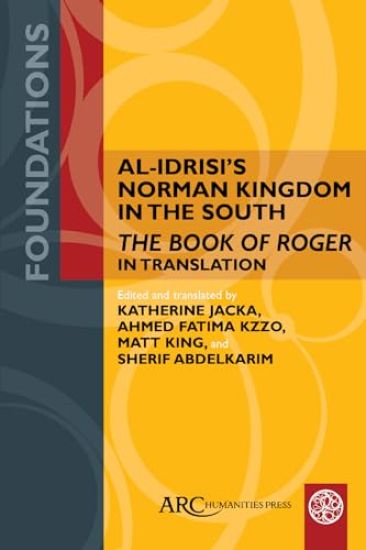
Al-Idrisi's Norman Kingdom in the South: The Book of Roger in Translation
The Book of Roger is a twelfth-century Arabic geographical treatise commissioned by King Roger II of Sicily and compiled by the Muslim polymath al-Idrisi. On its completion in around 1157 it was the most detailed description of the known world produced up to that point. This translation covers Sicily, the seat of King Roger's government, along with the other parts of the Norman kingdom in the South: southern Italy, the Adriatic, and Ifriqiya, as well as the book's preface. Presented in English translation for the first time this text offers insight into Roger's motivation in commissioning such an endeavour, and the relationship between king and scholar. A comprehensive introduction explores what this important work tells us about the Norman kingdom in the South in the Middle Ages, while a series of detailed maps will enhance the reader's appreciation of the richness of al-Idrisi's data.