

Kirjahaku
Etsi kirjoja tekijän nimen, kirjan nimen tai ISBN:n perusteella.
1000 tulosta hakusanalla Alan C. Hanscom
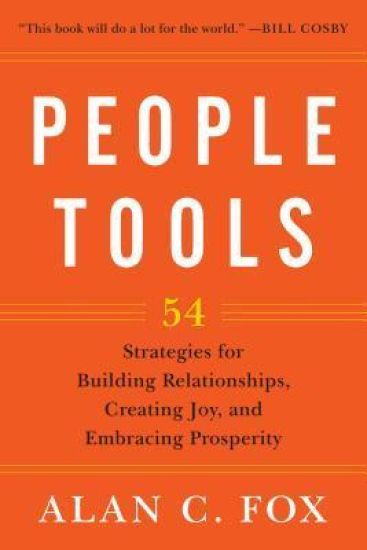
NEW YORK TIMES BESTSELLER!Getting along well with others is the real secret to success and happiness. In tens of thousands of classrooms we teach reading, writing, and arithmetic and yet we leave solutions to the universal problems of human relationships to be discovered, if at all, by trial and error. The trial is painful and the error is costly.People Tools: 54 Strategies for Building Relationships, Creating Joy, and Embracing Prosperity, provides time-proven techniques that you can use to build a better, happier, more successful life. It is the perfect resource for busy people looking for fast and effective solutions to the challenges we face every day.PRACTICAL WISDOM ON EVERY PAGEPeople Tools are practical and easy to understand. From developing self-confidence, to improving communication skills, to finding constructive ways to resolve conflict, each People Tool addresses a specific issue and provides a simple, straightforward strategy that you can adopt to bring about a positive result. Some of the useful People Tools in the book include: The Belt Buckle. When words are different than action (The Belt Buckle), trust the Belt Buckle, not the words.Buy a Ticket. To make something good happen in your life you have to participate.Catching a Feather. An alternative to the endless chase, this Tool reveals how to attract people you want to be closer to.Patterns Persist. Prior actions are predictive of future behaviors.Catch Them Being Good. Rewards are more effective than punishments. TIME-TESTED TOOLS TO ENHANCE YOUR WELLBEINGAlthough you may recognize the more intuitive techniques in People Tools, this sourcebook provides explanations and helpful examples from a vast collection of different tools designed to help you further expand your own existing repertoire of skills.Open the book to any page and you will find a useful solution. Each tool is illustrated with insightful stories and amusing anecdotes that are relevant and relatable. The stories will reel you in but the advice will change your life.
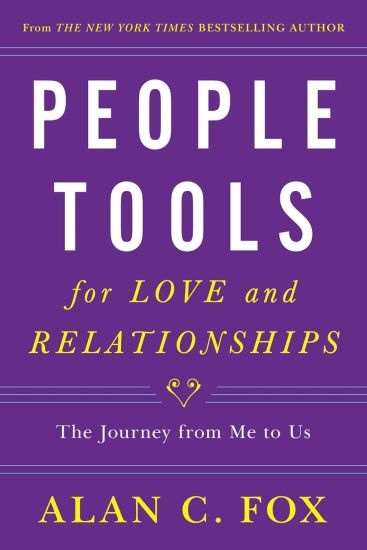
People Tools for Love and Relationships Volume 3
Alan C. Fox; Sara Fox
Select Books Inc
2015
nidottu
Love is the answer and you are the key to unlocking its potential. From the popular New York Times best-selling author of the People Tools series comes People Tools for Love and Relationships. With 49 easy to use tools, Alan Fox's latest installment will teach you how to create and maintain great relationships with immediate results.Finding love isn't always easy. Being in love and sustaining that love can be even harder. Alan Fox is full of practical advice and guidelines for keeping things fresh and celebrating love in all its manifestations. These toolsare specifically designed to teach you everything you need to nourish a long and fulfilling relationship. Each tool is fleshed out with colorful anecdotes and Fox's own discerning insights. It's time to take full responsibility for creating and maintaining your ideal relationship. Stop blaming others—the key to a great relationship is you.People Tools is packed with the wisdom of a full, long, and varied life. Alan Fox will guide you through the ins and outs of building worthwhile, rewarding relationships. Learn to: · Find the right person, and be the right person· Work out core issues and compromise· Accept the things you can't change· Find the right way to say "I'm sorry"· Know when to put yourself first· Live without regret
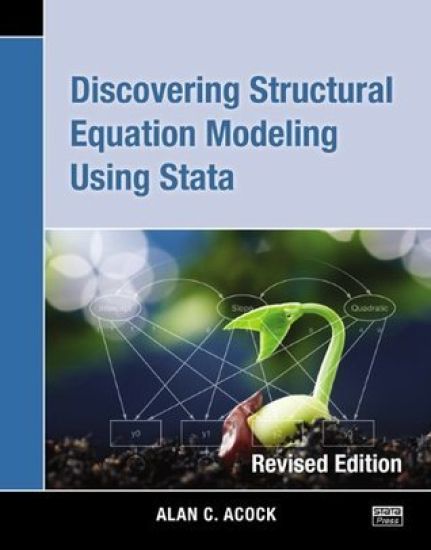
Discovering Structural Equation Modeling Using Stata, Revised Edition is devoted to Stata’s sem command and all it can do. Learn about its capabilities in the context of confirmatory factor analysis, path analysis, structural equation modeling, longitudinal models, and multiple-group analysis. Each model is presented along with the necessary Stata code, which is parsimonious, powerful, and can be modified to fit a wide variety of models. The datasets used are downloadable, offering a hands-on approach to learning.A particularly exciting feature of Stata is the SEM Builder. This graphical interface for structural equation modeling allows you to draw publication-quality path diagrams and fit the models without writing any programming code. When you fit a model with the SEM Builder, Stata automatically generates the complete code that you can save for future use. Use of this unique tool is extensively covered in an appendix and brief examples appear throughout the text.
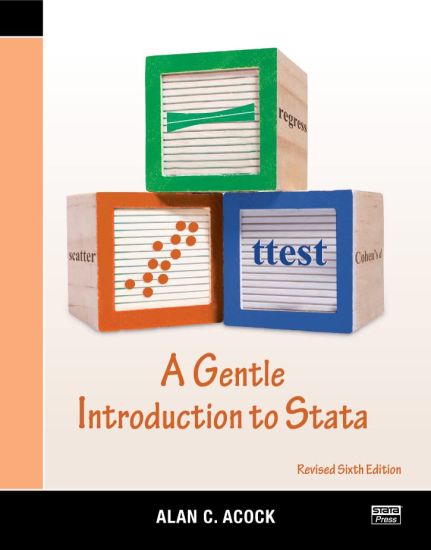
Alan C. Acock's A Gentle Introduction to Stata, Revised Sixth Edition is aimed at new Stata users who want to become proficient in Stata. After reading this introductory text, new users will be able to not only use Stata well but also learn new aspects of Stata.Acock assumes that the user is not familiar with any statistical software. This assumption of a blank slate is central to the structure and contents of the book. Acock starts with the basics; for example, the part of the book that deals with data management begins with a careful and detailed example of turning survey data on paper into a Stata-ready dataset. When explaining how to go about basic exploratory statistical procedures, Acock includes notes that will help the reader develop good work habits. This mixture of explaining good Stata habits and explaining good statistical habits continues throughout the book.Acock is quite careful to teach the reader all aspects of using Stata. He covers data management, good work habits (including the use of basic do-files), basic exploratory statistics (including graphical displays), and analyses using the standard array of basic statistical tools (correlation, linear and logistic regression, and parametric and nonparametric tests of location and dispersion). He also successfully introduces some more advanced topics such as multiple imputation and multilevel modeling in a very approachable manner. Acock teaches Stata commands by using the menus and dialog boxes while still stressing the value of Stata commands and do-files. In this way, he ensures that all types of users can build good work habits. Each chapter has exercises that the motivated reader can use to reinforce the material.The tone of the book is friendly and conversational without ever being glib or condescending. Important asides and notes about terminology are set off in boxes, which makes the text easy to read without any convoluted twists or forward referencing. Rather than splitting topics by their Stata implementation, Acock arranges the topics as they would appear in a basic statistics textbook; graphics and postestimation are woven into the material naturally. Real datasets, such as the General Social Surveys from 2002, 2006, and 2016, are used throughout the book.The focus of the book is especially helpful for those in the behavioral and social sciences because the presentation of basic statistical modeling is supplemented with discussions of effect sizes and standardized coefficients. Various selection criteria, such as semipartial correlations, are discussed for model selection. Acock also covers a variety of commands available for evaluating reliability and validity of measurements.The revised sixth edition is fully up to date for Stata 17, including updated discussion and images of Stata's interface and modern command syntax. In addition, examples include new features such as the table command and collect suite for creating and exporting customized tables as well as the option for creating graphs with transparency.

“Benji & the Giant Kite is a children’s book that comes as a breath of fresh air. It does everything that a children’s book should do.” - Dragonfly Sweetness blog “The life lessons are plainly articulated and you gather a sense of where each lesson will take you and why.” - Growing with Grey blog “The enchanting story of a young boy who learns that possessing something is not quite as meaningful as letting it go.” - Jinxy Kids The second book in the Benji series from bestselling author Alan. C. Fox! In a small shop, Benji sees a beautiful kite. It’s huge and it’s bright orange. But the kite is also very expensive. Benji takes on all kind of jobs to earn the money to buy the kite . . . Then finally, the day comes he can fly it! An inspiring read-aloud picture book about ambition, perseverance, and kite-flying. For aspiring aviators ages 4 and up.

10 Days That Changed America: Volume 1: The Colonial Years
Alan C. Elliott; Terry D. Bilhartz
Green Publishing House, LLC
2014
nidottu

10 Days That Changed America, Volume 2: Building a Nation
Alan C. Elliott; Terry D. Bilhartz
Green Publishing House, LLC
2014
nidottu
This book presents a series of cultural situations that could occur within the first one-hundred days of a school year: responding to entrenched vocabularies and behaviors, addressing professional and instructional bad habits, enacting alternative teaching scripts, leveraging a policy blindside, redefining the goals and practices of teams, and implementing outside-the-box programs. Each cultural situation offers a new school leader the opportunity to redefine the goals, values, and practices of an entrenched school culture—the Central High way. Administrators reading the title of this book may view one hundred days as an arbitrary number picked out of administrative thin air. I argue that disrupting and replacing organizational and instructional routines is a race against time. Every school day that goes by without some sign of creative destruction is one more day that comfortable organizational and instructional routines live on in main offices and classrooms.The idea for this book originated from a question I asked a former student of mine who had just signed a contract to become the principal of a high school. We were discussing the complexities of changing a school culture when I asked the following question: “What would you do on the first day in your new office to change your school’s culture?” The response to that question described a series managerial routines that all new administrators have learned to perform as they move from the classroom to the main office: organize the office, meet staff, tour the building, write a newsletter, examine data, and visit community venues. Nothing in this conversation described strategies for redefining the beliefs and values of an entrenched school culture.With this conversation in mind, I made it a point in my formal and informal contacts with school administrators to always ask the question: “What would you do in the first day in your new office to change your school’s culture?” The most common responses involved reviewing district documents, touring facilities, meeting staff, listening to stakeholders and managing systems. In each conversation, school leaders populated their responses with the current jargon of school reform: learning communities, data mining, standards-based curriculum, differentiated learning, common core standards, formative assessment, race to the top, continuous improvement, etc. While these responses encompass reasonable behaviors on the first day in the main office, not one of these actions possesses the capacity to connect educational values expressed in school mission statements—why are we here—to daily organizational and instructional routines. Each activity gives the appearance of leading, but produces no connections between beliefs, values, and practices. Although none of these responses would make or break a school culture, they do represent a pattern of thinking and behaving that holds out little possibility of fundamentally changing a school’s culture.
This book presents a series of cultural situations that could occur within the first one-hundred days of a school year: responding to entrenched vocabularies and behaviors, addressing professional and instructional bad habits, enacting alternative teaching scripts, leveraging a policy blindside, redefining the goals and practices of teams, and implementing outside-the-box programs. Each cultural situation offers a new school leader the opportunity to redefine the goals, values, and practices of an entrenched school culture—the Central High way. Administrators reading the title of this book may view one hundred days as an arbitrary number picked out of administrative thin air. I argue that disrupting and replacing organizational and instructional routines is a race against time. Every school day that goes by without some sign of creative destruction is one more day that comfortable organizational and instructional routines live on in main offices and classrooms.The idea for this book originated from a question I asked a former student of mine who had just signed a contract to become the principal of a high school. We were discussing the complexities of changing a school culture when I asked the following question: “What would you do on the first day in your new office to change your school’s culture?” The response to that question described a series managerial routines that all new administrators have learned to perform as they move from the classroom to the main office: organize the office, meet staff, tour the building, write a newsletter, examine data, and visit community venues. Nothing in this conversation described strategies for redefining the beliefs and values of an entrenched school culture.With this conversation in mind, I made it a point in my formal and informal contacts with school administrators to always ask the question: “What would you do in the first day in your new office to change your school’s culture?” The most common responses involved reviewing district documents, touring facilities, meeting staff, listening to stakeholders and managing systems. In each conversation, school leaders populated their responses with the current jargon of school reform: learning communities, data mining, standards-based curriculum, differentiated learning, common core standards, formative assessment, race to the top, continuous improvement, etc. While these responses encompass reasonable behaviors on the first day in the main office, not one of these actions possesses the capacity to connect educational values expressed in school mission statements—why are we here—to daily organizational and instructional routines. Each activity gives the appearance of leading, but produces no connections between beliefs, values, and practices. Although none of these responses would make or break a school culture, they do represent a pattern of thinking and behaving that holds out little possibility of fundamentally changing a school’s culture.

This Book is written to help Addicts that are in Recovery or still in Decision Mode. The Author has been in Recovery for 39 Years and has Experienced all that he Publishes. If you Disagree with some of my Statements of Help; that is your Right: I can only Publicize that which has worked for me. After Detox, we Addicts find a new Life Style and we must take Action to Accomplish it. Please CROSS THE LINE from Your Old Ways to a New Life I Hope my Book will give you a Path to follow on a Yearly Basis. Reading my Book Daily will help you find the Correct Path but will not fix your Addiction: You and God are the only ones who can Neutralize the Addiction and Move Forward to a Life of Happiness and Love. Amen



Ophthalmic Drug Therapy Pocket Guide, Clinical Ophthalmology
Alan C Westeren
Xlibris Us
2023
pokkari


The Alamo and its defenders, according to historian Stephen L. Hardin, "transcended mere history; both entered the realm of myth." Indeed, the siege and battle of the Alamo serves today as a definition of American character. The date of March 6, 1836, is forever ensconced in the annals of history. But what happened in the twelve days leading up to the final battle of March 6? And did events transpire in the final battle as history has led us to believe? As Hardin stated in the foreword for this book, "Myth has so shrouded every aspect of the Alamo story that it becomes hard to separate the factual from the fanciful. Understand and appreciate the myth. Understand and appreciate the historical reality. But, please, graze them in different pastures." Author Alan Huffines has researched both the history and the myth of the Alamo. What he found lacking in Alamo accounts was a perspective unaffected by either history or myth. In this book he portrays the events preliminary to and during the battle from the viewpoint of the participants. In a day-by-day chronology of the thirteen days, he presents original Texian and Mexican perspectives so that the reader may decide which may be accurate and which possibly embellished. His critical analysis of the participants' reports, through extensive annotation, points out inconsistencies and provides considerable food for thought. The renowned military artist Gary S. Zaboly fastidiously researched primary sources for accuracy in clothing, weapons, architecture, geography, and so on, resulting in maps and artwork that offer a new visual perspective of the Alamo and those who were involved with the siege. Through the author's research and the artist's fine illustrations, the thirteen days come into focus, and the people who experienced the sights, smells, sounds, and emotions of that two-week period are allowed "to speak finally for themselves."
30 Valuable Lessons of Life: True and Working Advice That Will Change Your Life
Alan C. &. Ann G.
Independently Published
2018
nidottu
We are all stuck in a cobweb of life, It's hard for us to move forward as the obstacles which we face pull us down. It drains away the life in you leaving you feeling helpless with zero motivation. Why is that even when we have a foolproof plan in whatever it might be related to for example a diet, a workout regime or a business model. The only reason why we come across numerous failure is that we don't do things the right way and our mindset is not focused. What we require to get out of this cobweb of life is the RIGHT mindset before you pursue ANY goal. This book contains 30 EASY and PRACTICAL ways which will force you to think in the right direction and let loose your real potential to reach your dreams.

Business Management for Engineers will help anyone with a technical background understand, and appreciate, the business side of the engineering profession. This book is intended to make you more successful as an engineer by giving you a better understanding of how organizations conduct business. Mastery of a technical skill is quite fulfilling, but if you want to be more than a technical contributor you must know how to work within the business constraints as well. If we define engineering to be the application of science, then business is the application of economics. We'll go a step further and define engineering to be the application of science to develop new products or services that are "useful"; and business to be the application of economics to develop new products or services that are "profitable."A product may be of interest to a great many people, but if the business providing it is not profitable, the business will lose money and, barring financial subsidies, will go out of business - so the product will disappear from the market.Similarly, a product may generate world class profits, but if the product is not useful - if it does not add value to the buyer - no one will buy it, so again the product will disappear from the market. Engineering and business, go hand in hand. To be truly successful, engineers must develop products that are both useful AND profitable. This book will help anyone with a technical background appreciate the business aspect to the project you are supporting. Even if you work for a "not for profit" business, any project you will be assigned to will have a budget and schedule. Exceed the budget and the business must cut other projects to pay for the overrun. Fall past due on the schedule, and the business will have to find a way to make up the lost time - maybe by cutting other projects. There is always a business aspect to any engineering project. Business Management for Engineers will help technical professionals understand how to balance business success with technical excellence.


In the early hours of November 16, 1959, a commercial airliner mysteriously plunges into the Gulf of Mexico and quickly becomes one of the most baffling mysteries in aviation history. Presumed dead in the wreckage of Flight 967, ticketed passenger Dr. Robert Vernon Spears is alive and well, speeding west on a southern highway, seizing the chance to leave his past behind--a past that defies all belief. But when Dr. Spears' old friend is also discovered missing, a more sinister plot begins to emerge. In the months that follow, the nation is spellbound by bizarre revelations of substituted passengers, hypnosis, deception, and hidden identities--dramatized across the headlines through a soap-opera rivalry between the wives of the two missing men. Each new twist is stranger than the last, as a larger web of political bribery, police corruption, crime, and deception is slowly uncovered. In a feature 1960 cover story, Life magazine concluded it was "a case so bizarre that even the most imaginative mystery writer would hesitate to use the plot." Yet, as incredible as this seemed at the time, it was still only a fraction of a much larger story spanning decades--of imposters, society romance, underground abortion rings, Hollywood connections, forgery, aliases, artful dodgers, and naturopathic quackery--with a cast of characters to match. Each player on a trajectory toward involvement, in one form or another, in the Flight 967 enigma. At the center was one of America's most prolific yet mysterious confidence men--a kind man, a gentleman, and a model husband. In a story that has never been told. Until now.