Kirjojen hintavertailu. Mukana 12 083 983 kirjaa ja 12 kauppaa.

Kirjahaku

Etsi kirjoja tekijän nimen, kirjan nimen tai ISBN:n perusteella.

1000 tulosta hakusanalla Albert Tschepe

The Collected Papers of Albert Einstein, Volume 1

The Collected Papers of Albert Einstein, Volume 1

Albert Einstein

Princeton University Press
1987
sidottu
Volume 1 presents important new material on the young Einstein. Over half the documents made available here were discovered by the editors, including a significant group of over fifty letters that Einstein exchanged with Mileva Maric, his fellow student and future wife. These letters, together with other previously unpublished documents, provide an entirely new view of Einstein's youth. The documents in the volume also foreshadow the emergence of his extraordinary creative power. In them is manifested his intense commitment to scientific work and his interest in certain themes that proved to be central to his thinking during the next decade. We can follow, for example, the beginnings of his preoccupation with the electrodynamics of moving bodies that was to lead to the development of this special theory of relativity. For the first time it can be seen how closely he followed such contemporary developments in physics as Planck's work on radiation theory and Drude's work on the electron theory of metals. In addition to all of Einstein's known correspondence and other writings from this period, the volume includes the relevant portions of all third-party letters and other contemporary documents that provide additional information about his secondary schooling at the Aargau Cantonal School; his four years at the Swiss Federal Plytechnical School, or the ETH; and his search for a job after graduation. Included in the volume are those sections of an unpublished biography by Einstein's sister, Maja Winteler-Einstein, which deal with his early years; his extensive notes on a physics course he took at the ETH; and previously unpublished photographs of the young Einstein and his teachers and friends. Documents in Volume 1 portray Einstein's experiences during the two stressful years after his graduation from the ETH in Zurich. Denied a position as an Assistant at the ETH, he lived a hand-to-mouth existence while he looked for a post at other universities; then he attempted to find a secondary-school post, and finally sought a nonacademic job. Tension with his parents over his plans to marry Mileva Maric is evident throughout this period. With the help of a friend, he finally found work at the Swiss Patent Office, the haven where he would spend the next seven years. Freed from his financial worries, he entered on one of the most productive periods of his life, as the next volume, Writings (1901-1910), will document.
The Collected Papers of Albert Einstein, Volume 1 (English)

The Collected Papers of Albert Einstein, Volume 1 (English)

Albert Einstein

Princeton University Press
1987
pokkari
Volume 1 presents important new material on the young Einstein. Over half the documents made available here were discovered by the editors, including a significant group of over fifty letters that Einstein exchanged with Mileva Maric, his fellow student and future wife. These letters, together with other previously unpublished documents, provide an entirely new view of Einstein's youth. The documents in the volume also foreshadow the emergence of his extraordinary creative power. In them is manifested his intense commitment to scientific work and his interest in certain themes that proved to be central to his thinking during the next decade. We can follow, for example, the beginnings of his preoccupation with the electrodynamics of moving bodies that was to lead to the development of this special theory of relativity. For the first time it can be seen how closely he followed such contemporary developments in physics as Planck's work on radiation theory and Drude's work on the electron theory of metals. In addition to all of Einstein's known correspondence and other writings from this period, the volume includes the relevant portions of all third-party letters and other contemporary documents that provide additional information about his secondary schooling at the Aargau Cantonal School; his four years at the Swiss Federal Plytechnical School, or the ETH; and his search for a job after graduation. Included in the volume are those sections of an unpublished biography by Einstein's sister, Maja Winteler-Einstein, which deal with his early years; his extensive notes on a physics course he took at the ETH; and previously unpublished photographs of the young Einstein and his teachers and friends. Documents in Volume 1 portray Einstein's experiences during the two stressful years after his graduation from the ETH in Zurich. Denied a position as an Assistant at the ETH, he lived a hand-to-mouth existence while he looked for a post at other universities; then he attempted to find a secondary-school post, and finally sought a nonacademic job. Tension with his parents over his plans to marry Mileva Maric is evident throughout this period. With the help of a friend, he finally found work at the Swiss Patent Office, the haven where he would spend the next seven years. Freed from his financial worries, he entered on one of the most productive periods of his life, as the next volume, Writings (1901-1910), will document.
The Collected Papers of Albert Einstein, Volume 2

The Collected Papers of Albert Einstein, Volume 2

Albert Einstein

Princeton University Press
1990
sidottu
This volume of The Collected Papers of Albert Einstein contains the scientific work Einstein published during the first decade of his career, and includes some of the most significant achievements of twentieth-century physics. The first paper was written in 1900 by the twenty-one-year-old Einstein, newly graduated from the Swiss Federal Polytechnical School, or ETH, in Zurich and still searching in vain for a job. The last paper in this volume is the text of an invited lecture given in 1909 to a major scientific meeting by Einstein after he was appointed to his first academic post at the University of Zurich. He had already been recognized as an important theoretical physicist on the basis of the work reprinted here, particularly the three masterpieces that appeared in quick succession during 1905, Einstein's year of miracles. In one of these papers Einstein showed how one could finally confirm the ancient view that matter is composed of discrete atoms, and even measure the numbers and masses of these atoms. In a second paper, which even he referred to as "very revolutionary," he argued that the observed properties of thermal radiation suggest that it consists not of waves, but rather of localized particles of energy which he called energy quanta. The third and most famous paper set forth the special theory of relativity, solving some long-standing difficulties, but requiring a significant change in our understanding of those basic concepts, space and time.
The Collected Papers of Albert Einstein, Volume 2 (English)

The Collected Papers of Albert Einstein, Volume 2 (English)

Albert Einstein

Princeton University Press
1989
pokkari
Every document in The Collected Papers of Albert Einstein appears in the language in which it was written, and this supplementary paperback volume presents the English translations of all non-English materials. This translation does not include notes or annotation of the documentary volume and is not intended for use without the original language documentary edition which provides the extensive editorial commentary necessary for a full historical and scientific understanding of the documents.
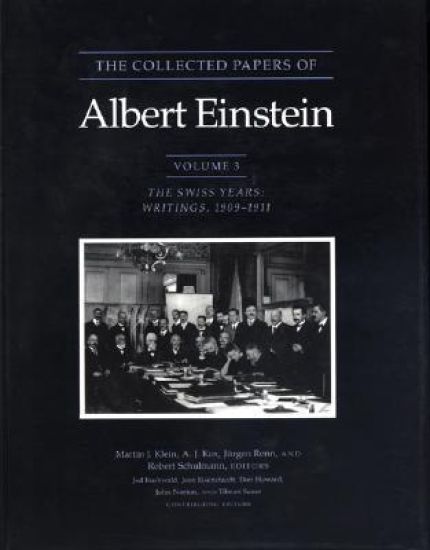
The Collected Papers of Albert Einstein, Volume 3

The Collected Papers of Albert Einstein, Volume 3

Albert Einstein

Princeton University Press
1994
sidottu
This volume of The Collected Papers of Albert Einstein presents Einstein's writings for the two-year period starting in October 1909. The initial date marks Einstein's departure from the Swiss Patent Office at Bern, which had been his professional home for seven years, and the beginning of his first academic appointment, at the University of Zurich. The volume concludes with the masterful report that Einstein, by then a full professor at the German-language university in Prague, gave to the original Solvay Congress, the first international meeting devoted to the problems of radiation and the quantum theory. Most of Einstein's efforts during these years went into his struggle with these ever more perplexing problems of quanta, on which he made discouragingly little progress. Einstein's new academic career naturally required him to teach, and almost half of this volume consists of the previously unpublished notes he wrote in preparation for his lectures on mechanics, on electricity and magnetism, and on kinetic theory and statistical mechanics. The last of these is particularly interesting in reflecting some of his research interests. Several papers here are concerned with aspects of the special theory of relativity, but it is Einstein's article of June 1911 that is a harbinger of things to come: it contains his calculation of the bending of light in a gravitational field on the basis of his equivalence principle. Martin J. Klein is Bass Professor of the History of Science and Professor of Physics at Yale University and Senior Editor of The Collected Papers of Albert Einstein. A. J. Kox teaches history of science at the University of Amsterdam, Jurgen Renn is Assistant Professor of Philosophy and Physics at Boston University, and Robert Schulmann is Assistant Professor of History at Boston University.
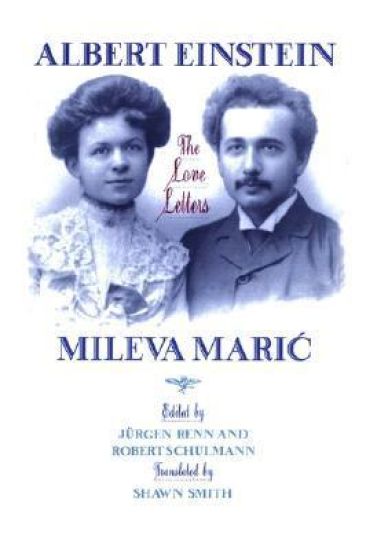
Albert Einstein, Mileva Maric

Albert Einstein, Mileva Maric

Albert Einstein

Princeton University Press
2000
pokkari
In 1903, despite the vehement objections of his parents, Albert Einstein married Mileva Maric, the companion, colleague, and confidante whose influence on his most creative years has given rise to much speculation. Beginning in 1897, after Einstein and Maric met as students at the Swiss Federal Polytechnic, and ending shortly after their marriage, these fifty-four love letters offer a rare glimpse into Einstein's relationship with his first wife while shedding light on his intellectual development in the period before the annus mirabilis of 1905. Unlike the picture of Einstein the lone, isolated thinker of Princeton, he appears here both as the burgeoning enfant terrible of science and as an amorous young man beset, along with his fiance, by financial and personal struggles--among them the illegitimate birth of their daughter, whose existence is known only by these letters. Describing his conflicts with professors and other scientists, his arguments with his mother over Maric, and his difficulty obtaining an academic position after graduation, the letters enable us to reconstruct the youthful Einstein with an unprecedented immediacy. His love for Maric, whom he describes as "a creature who is my equal, and who is as strong and independent as I am," brings forth his serious as well as playful, often theatrical nature. After their marriage, however, Maric becomes less his intellectual companion, and, failing to acquire a teaching certificate, she subordinates her professional goals to his. In the final letters Einstein has obtained a position at the Swiss Patent Office and mentions their daughter one last time to his wife in Hungary, where she is assumed to have placed the girl in the care of relatives. Informative, entertaining, and often very moving, this collection of letters captures for scientists and general readers alike a little known yet crucial period in Einstein's life.
The Collected Papers of Albert Einstein, Volume 3 (English)

The Collected Papers of Albert Einstein, Volume 3 (English)

Albert Einstein

Princeton University Press
1994
pokkari
This volume of The Collected Papers of Albert Einstein presents Einstein's writings for the two-year period starting in October 1909. The initial date marks Einstein's departure from the Swiss Patent Office at Bern, which had been his professional home for seven years, and the beginning of his first academic appointment, at the University of Zurich. The volume concludes with the masterful report that Einstein, by then a full professor at the German-language university in Prague, gave to the original Solvay Congress, the first international meeting devoted to the problems of radiation and the quantum theory. Most of Einstein's efforts during these years went into his struggle with these ever more perplexing problems of quanta, on which he made discouragingly little progress. Einstein's new academic career naturally required him to teach, and almost half of this volume consists of the previously unpublished notes he wrote in preparation for his lectures on mechanics, on electricity and magnetism, and on kinetic theory and statistical mechanics. The last of these are particularly interesting in reflecting some of his research interests. Several papers here are concerned with aspects of the special theory of relativity, but it is Einstein's article of June 1911 that is a harbinger of things to come: it contains his calculation of the bending of light in a gravitational field on the basis of his equivalence principle. Martin J. Klein is Bass Professor of the History of Science and Professor of Physics at Yale University and Senior Editor of The Collected Papers of Albert Einstein. A. J. Kox teaches history of science at the University of Amsterdam, Jurgen Renn is Assistant Professor of Philosophy and Physics at Boston University, and Robert Schulmann is Assistant Professor of History at Boston University.
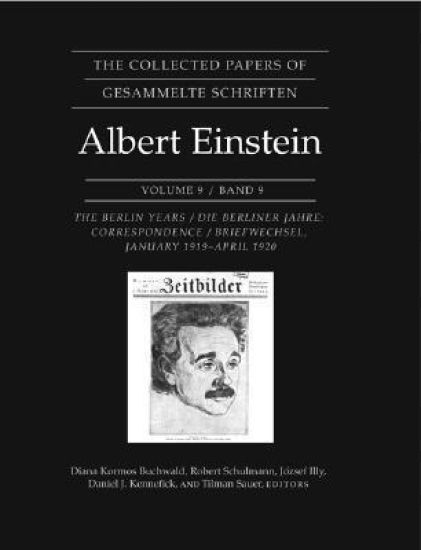
The Collected Papers of Albert Einstein, Volume 9

The Collected Papers of Albert Einstein, Volume 9

Albert Einstein

Princeton University Press
2004
sidottu
The present volume, set in the turbulent post-World War I period, finds Einstein awaiting news of the 1919 British eclipse expedition to test the general relativistic prediction of the deflection of starlight by the sun. With the expedition's success, he becomes the first science celebrity of our age. Deeply interested in the other, stellar redshift test of his theory, Einstein supports astronomers engaged in experimental work on the issue. Piqued by early suggestions of a unified field theory, he ponders how to unify gravitation and electromagnetic field theory and also works to resolve contradictions between the new quantum physics and relativity. His open-minded exchanges with colleagues may challenge his later image as the stubborn critic of quantum mechanics. We see Einstein deeply engaged in discussing social and political issues, participating in humanitarian efforts, and intervening on behalf of intellectuals condemned to death after the fall of the Bavarian Soviet republic. He faced anti-Semitic outbursts, reflected increasingly on his own identity as a Jew and assisted in efforts toward the establishment of the Hebrew University. As an internationalist opponent of war, and a German-speaking Swiss citizen whose renown was sealed by the Englishman Eddington's confirmation of relativity, Einstein mitigated postwar hostility toward German scholars. Correspondence with family and friends documents his divorce, remarriage to his cousin, and his closeness to his two sons. Notwithstanding evidence in newly uncovered material concerning efforts to lure Einstein back to Switzerland, and also to the Netherlands, Einstein, entertaining high hopes for the young Weimar Republic, remained in Berlin. This volume reveals new facets of Einstein as he constructively participated in German and European scientific, academic, and cultural life.
The Collected Papers of Albert Einstein, Volume 9. (English)

The Collected Papers of Albert Einstein, Volume 9. (English)

Albert Einstein

Princeton University Press
2004
pokkari
The present volume, set in the turbulent post-World War I period, finds Einstein awaiting news of the 1919 British eclipse expedition to test the general relativistic prediction of the deflection of starlight by the sun. With the expedition's success, he becomes the first science celebrity of our age. Deeply interested in the other, stellar redshift test of his theory, Einstein supports astronomers engaged in experimental work on the issue. Piqued by early suggestions of a unified field theory, he ponders how to unify gravitation and electromagnetic field theory and also works to resolve contradictions between the new quantum physics and relativity. His open-minded exchanges with colleagues may challenge his later image as the stubborn critic of quantum mechanics. We see Einstein deeply engaged in discussing social and political issues, participating in humanitarian efforts, and intervening on behalf of intellectuals condemned to death after the fall of the Bavarian Soviet republic. He faced anti-Semitic outbursts, reflected increasingly on his own identity as a Jew and assisted in efforts toward the establishment of the Hebrew University. As an internationalist opponent of war, and a German-speaking Swiss citizen whose renown was sealed by the Englishman Eddington's confirmation of relativity, Einstein mitigated postwar hostility toward German scholars. Correspondence with family and friends documents his divorce, remarriage to his cousin, and his closeness to his two sons. Notwithstanding evidence in newly uncovered material concerning efforts to lure Einstein back to Switzerland, and also to the Netherlands, Einstein, entertaining high hopes for the young Weimar Republic, remained in Berlin. This volume reveals new facets of Einstein as he constructively participated in German and European scientific, academic, and cultural life. Since this translation includes only select portions of Volume 9, it is not recommended for purchase without the main volume.
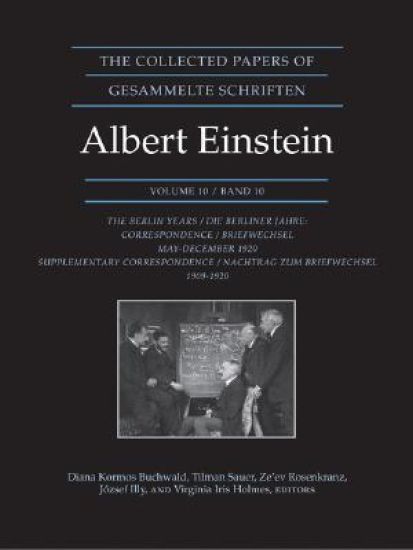
The Collected Papers of Albert Einstein, Volume 10

The Collected Papers of Albert Einstein, Volume 10

Albert Einstein

Princeton University Press
2006
sidottu
The first half of this volume presents a substantial amount of heretofore unavailable correspondence. From among family letters closed for twenty years after the death of Margot Einstein, who donated them to the Albert Einstein Archives in Jerusalem, the volume presents, for the first time, letters written by Einstein's sons, the adolescent Hans Albert and little Eduard, and numerous letters written by Einstein to his cousin and future second wife Elsa Einstein. Combined with newly available correspondence with his close friend Heinrich Zangger, this supplementary correspondence provides vivid and intimate details of Einstein's private life. It documents the emotional bonds to his family and friends; the severe deprivations caused by the war to family members in Berlin and Zurich; the fragile health of Mileva Einstein-Maric during these years of separation and divorce; the worries and joys of caring for the sons; and Einstein's views on German and international politics during this turbulent period. The second half finds Einstein full of optimism about Germany's new democracy. He vigorously promotes general relativity and the endeavors of other scientists toward its further confirmation. He responds to the rising interest in his work among philosophers, as attested by correspondence with M. Schlick, H. Reichenbach, R. Carnap, E. Cassirer, and H. Vaihinger. And yet he is embroiled in vociferous, politically tinged, public attacks on his theory of relativity. He considers leaving Berlin, which would have deprived the Weimar Republic of its most famous scientist. In many letters, colleagues, friends, and unknown admirers offer support. Einstein travels to Leyden, where he is appointed a visiting professor and where, in the circle of friends such as P. Ehrenfest, H. A. Lorentz, and H. Kamerlingh Onnes, he is involved in lively debates on issues related to quantum physics. He visits Oslo and Copenhagen, where he meets with N. Bohr, and receives invitations to the United States, anticipating his first visit to the New World in 1921. ENGLISH TRANSLATION: A translation of selected non-English texts included in Volume 10 is available in paperback, http://www.pupress.princeton.edu/titles/8332.html. Since this supplementary paperback includes only select portions of Volume 10, it is not recommended for purchase without the main volume.
The Collected Papers of Albert Einstein, Volume 10 (English)

The Collected Papers of Albert Einstein, Volume 10 (English)

Albert Einstein

Princeton University Press
2006
pokkari
Since this supplementary paperback includes only select portions of Volume 10, it is not recommended for purchase without the main volume http://www.pupress.princeton.edu/titles/8331.html. The first half of this volume presents a substantial amount of heretofore unavailable correspondence. From among family letters closed for twenty years after the death of Margot Einstein, who donated them to the Albert Einstein Archives in Jerusalem, the volume presents, for the first time, letters written by Einstein's sons, the adolescent Hans Albert and little Eduard, and numerous letters written by Einstein to his cousin and future second wife Elsa Einstein. Combined with newly available correspondence with his close friend Heinrich Zangger, this supplementary correspondence provides vivid and intimate details of Einstein's private life. It documents the emotional bonds to his family and friends; the severe deprivations caused by the war to family members in Berlin and Zurich; the fragile health of Mileva Einstein-Maric during these years of separation and divorce; the worries and joys of caring for the sons; and Einstein's views on German and international politics during this turbulent period. The second half finds Einstein full of optimism about Germany's new democracy. He vigorously promotes general relativity and the endeavors of other scientists toward its further confirmation. He responds to the rising interest in his work among philosophers, as attested by correspondence with M. Schlick, H. Reichenbach, R. Carnap, E. Cassirer, and H. Vaihinger. And yet he is embroiled in vociferous, politically tinged, public attacks on his theory of relativity. He considers leaving Berlin, which would have deprived the Weimar Republic of its most famous scientist. In many letters, colleagues, friends, and unknown admirers offer support. Einstein travels to Leyden, where he is appointed a visiting professor and where, in the circle of friends such as P. Ehrenfest, H. A. Lorentz, and H. Kamerlingh Onnes, he is involved in lively debates on issues related to quantum physics. He visits Oslo and Copenhagen, where he meets with N. Bohr, and receives invitations to the United States, anticipating his first visit to the New World in 1921.
The Collected Papers of Albert Einstein, Volume 11

The Collected Papers of Albert Einstein, Volume 11

Albert Einstein

Princeton University Press
2009
sidottu
This index volume provides quick access to the most authoritative compilation of documents and information concerning Einstein's work and correspondence for the first half of his life. It offers readers a Cumulative Index to the first ten volumes of the collected papers, the first complete bibliography of Einstein's scientific and nonscientific writings until 1921, and a succinct biographical time line. This volume is an invaluable research tool for delving into Einstein's written legacy; his interactions with colleagues, institutions, friends, and family; and his scientific, political, educational, and social activities. Volume 11 presents three important and unique bibliographies: the List of Writings, 1891-1921; the Einstein Bibliography, 1901-1921; and a Cumulative Bibliography and Index of Citations for Volumes 1-10. The List of Writings includes all of Einstein's manuscripts that remained unpublished by 1921, while the Einstein Bibliography includes documents that were republished during this period. The Cumulative Bibliography and Index of Citations lists all literature written by authors cited in at least one of the first ten volumes of the series. This volume also contains two complete lists of Einstein's correspondence up through 1920, and a Chronology of Einstein's life for the years 1879-1921. The first list presents the correspondence in chronological order, while the second list presents the correspondence in alphabetical order by correspondent. The indexes and bibliographies implicitly correct inconsistencies and errata across the different volumes. Other corrections are explicitly collected in a List of Errata for the first ten volumes of the series.
The Collected Papers of Albert Einstein, Volume 12

The Collected Papers of Albert Einstein, Volume 12

Albert Einstein

Princeton University Press
2009
sidottu
In this latest volume, Einstein's visible public persona is amply documented in his correspondence, honors and prizes, lectures and travels, articles, and the many solicitations asking him to join public initiatives. Einstein joins a Zionist fundraising mission led by Ch. Weizmann, and he visits the United States for the first time. Einstein travels to major cities, including New York, Boston, and Chicago, and he delivers his now famous Princeton Lectures. Scientific issues remain at the core of Einstein's preoccupations. Correspondence with N. Bohr, W. Bothe, P. Ehrenfest, H. Geiger, H. A. Lorentz, L. Meitner, and A. Sommerfeld records Einstein's interest in and contributions to the emerging modern quantum theory. He addresses conceptual problems, such as the fundamental nature of light and its emission mechanism, in a proposed experiment with canal rays. Einstein continues to engage in original research, other expert opinions, and patent applications. Throughout the year, Einstein navigates complex territory in his professional and personal life. He travels with his older son to Bologna, yet turns down repeated invitations to Munich. He mends his friendship with M. Born, but receives stinging criticism from F. Haber for traveling to the United States. He supports the nomination of Masaryk for a Nobel Peace Prize, travels to Amsterdam in order to intervene on behalf of Germany at the Paris reparations conference, and assists Russian physicists in their efforts to rebuild and develop Russian science. Einstein's letters reveal his Social Democratic political positions.
The Collected Papers of Albert Einstein, Volume 12 (English)

The Collected Papers of Albert Einstein, Volume 12 (English)

Albert Einstein

Princeton University Press
2009
pokkari
Every document in The Collected Papers of Albert Einstein appears in the language in which it was written, and this supplementary paperback volume presents the English translations of all non-English materials. This translation does not include notes or annotation of the documentary volume and is not intended for use without the original language documentary edition which provides the extensive editorial commentary necessary for a full historical and scientific understanding of the documents.
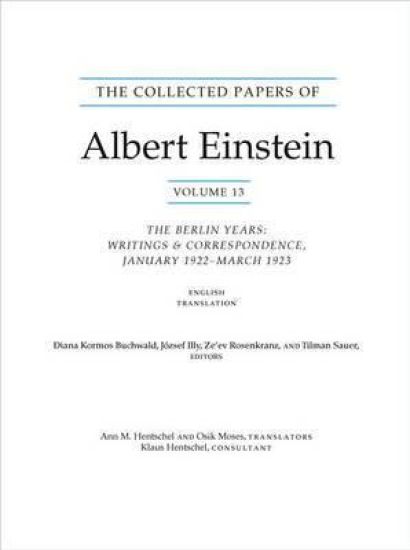
The Collected Papers of Albert Einstein, Volume 13

The Collected Papers of Albert Einstein, Volume 13

Albert Einstein

Princeton University Press
2012
sidottu
In April 1922, we find Einstein lecturing in Paris, engaged in reestablishing ties among scientists in former enemy nations. Meanwhile, back in Berlin, political tensions are rising. In June, the brutal murder of his friend, Germany's foreign minister, Walther Rathenau, heavily affects Einstein who, for a while, fears for his own safety and briefly contemplates leaving Berlin and abandoning academic life altogether. When only a few months later it is announced that he will be awarded the Nobel Prize, after more than a decade of nominations, Einstein is on a steamer heading from Europe to Japan. As we learn in this volume, although he knew in advance of the coming prize, he nevertheless embarked on his longest voyage yet. His travel diary, published here for the first time, recounts in poetic prose the hectic schedule on land, the contemplative rest at sea, and his musings on science, philosophy, and art during his first encounter with the Far East, Palestine, and Spain. Einstein's work and intense scientific exchanges--with N. Bohr, P. Ehrenfest, A. Sommerfeld, M. Born, and others--during these fifteen months result in remarkable publications and intellectual developments. A paper written with Ehrenfest shows with uncompromising clarity that the outcome of the recent Stern-Gerlach experiment could not be explained by either classical or quantum theory. In a similar vein, he analyzes the phenomenon of superconductivity. Clearly among the leading quantum theorists, he focuses on its conceptual bases, tirelessly proposing crucial experiments that could decide between classical and quantum physics. We also see foundational interests develop in his concerns with a unified field theory of electromagnetism and gravitation. A translation of selected non-English texts included in Volume 13 is available in paperback at http://press.princeton.edu/titles/9874.html
The Collected Papers of Albert Einstein, Volume 13

The Collected Papers of Albert Einstein, Volume 13

Albert Einstein

Princeton University Press
2012
pokkari
A translation of selected non-English texts included in Volume 13 is available in paperback. Since this supplementary paperback includes only select portions of Volume 13, it is not recommended for purchase without the main volume. Every document in The Collected Papers of Albert Einstein appears in the language in which it was written, and this supplementary paperback volume presents the English translations of select portions of non-English materials in Volume 13. This translation does not include notes or annotation of the documentary volume and is not intended for use without the original language documentary edition which provides the extensive editorial commentary necessary for a full historical and scientific understanding of the documents.
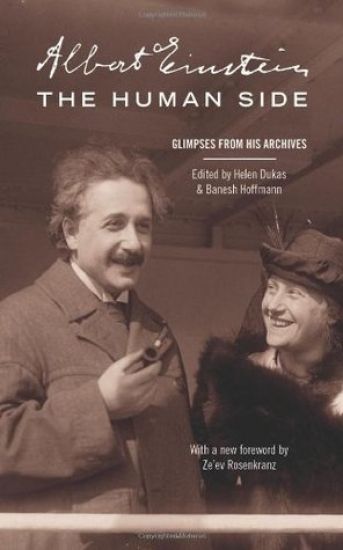
Albert Einstein, The Human Side

Albert Einstein, The Human Side

Albert Einstein; Ze’ev Rosenkranz

Princeton University Press
2013
pokkari
Modesty, humor, compassion, and wisdom are the traits most evident in this illuminating selection of personal papers from the Albert Einstein Archives. The illustrious physicist wrote as thoughtfully to an Ohio fifth-grader, distressed by her discovery that scientists classify humans as animals, as to a Colorado banker who asked whether Einstein believed in a personal God. Witty rhymes, an exchange with Queen Elizabeth of Belgium about fine music, and expressions of his devotion to Zionism are but some of the highlights found in this warm and enriching book.
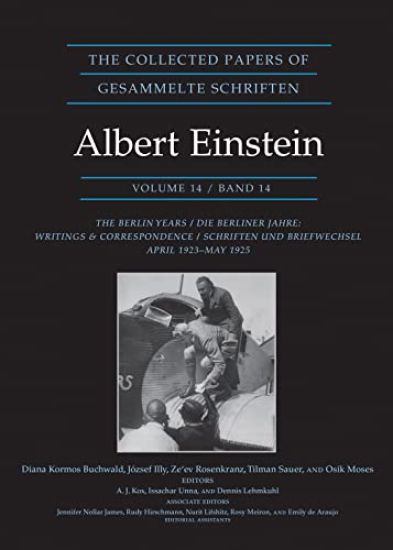
The Collected Papers of Albert Einstein, Volume 14

The Collected Papers of Albert Einstein, Volume 14

Albert Einstein

Princeton University Press
2015
sidottu
The more than one thousand letters and several dozen writings included in this volume cover the years immediately before the final formulation of new quantum mechanics. The discovery of the Compton effect in 1923 vindicates Einstein's light quantum hypothesis. Niels Bohr still criticizes Einstein's conception of light quanta and advances an alternative theory, but Walther Bothe and Hans Geiger perform a difficult experiment that decides in favor of Einstein's theory. At the same time, Satyendranath Bose sends a new quantum theoretical derivation of Planck's law to Einstein and he discovers what is now known as Bose-Einstein condensation. Einstein attempts to reformulate a unified theory of the gravitational and electromagnetic fields. In early November 1923, Einstein flees overnight to the Netherlands in the wake of threats on his life and anti-Semitic rioting in Berlin. He rejoins the International Committee on Intellectual Cooperation in June 1924, and supports the idea of a European union. He joins the board of governors of Hebrew University, which opens in April 1925, and celebrates the event in Buenos Aires while on a seven-week lecture tour of Argentina, Uruguay, and Brazil. During this period, he delivers lectures, meets with heads of state, visits major institutions, and attends receptions hosted by the local Jewish and German communities. He has a serious, but short-lived, falling out with his son Hans Albert and his first wife Mileva Maric-Einstein over how to invest part of the Nobel Prize money and he rescues his sister Maja and her husband from debt on their house. Einstein has a fourteen-month romantic relationship with his secretary, Betty Neumann, which he ends in October 1924.
The Collected Papers of Albert Einstein, Volume 14 (English)

The Collected Papers of Albert Einstein, Volume 14 (English)

Albert Einstein

Princeton University Press
2015
pokkari
In the almost one hundred writings and more than one thousand letters included in this volume, Einstein is revealed yet again as the consummate puzzler of myriad scientific problems as well as the invested participant in social and political engagements. He continues to explore the light quantum, whose reality is confirmed by new experiments, and to attempt to formulate a unified theory of gravitation and electromagnetism. He travels to South America, where he lectures widely on relativity, rejoins the International Committee on Intellectual Cooperation, and supports the idea of a European union. Einstein has a fourteen-month romantic relationship with his secretary, Betty Neumann, which ends in October 1924.
The Travel Diaries of Albert Einstein

The Travel Diaries of Albert Einstein

Albert Einstein

PRINCETON UNIVERSITY PRESS
2018
sidottu
Albert Einstein’s travel diary to the Far East and Middle EastIn the fall of 1922, Albert Einstein, along with his then-wife, Elsa Einstein, embarked on a five-and-a-half-month voyage to the Far East and Middle East, regions that the renowned physicist had never visited before. Einstein's lengthy itinerary consisted of stops in Hong Kong and Singapore, two brief stays in China, a six-week whirlwind lecture tour of Japan, a twelve-day tour of Palestine, and a three-week visit to Spain. This handsome edition makes available the complete journal that Einstein kept on this momentous journey.The telegraphic-style diary entries record Einstein's musings on science, philosophy, art, and politics, as well as his immediate impressions and broader thoughts on such events as his inaugural lecture at the future site of the Hebrew University in Jerusalem, a garden party hosted by the Japanese Empress, an audience with the King of Spain, and meetings with other prominent colleagues and statesmen. Entries also contain passages that reveal Einstein's stereotyping of members of various nations and raise questions about his attitudes on race. This beautiful edition features stunning facsimiles of the diary's pages, accompanied by an English translation, an extensive historical introduction, numerous illustrations, and annotations. Supplementary materials include letters, postcards, speeches, and articles, a map of the voyage, a chronology, a bibliography, and an index.Einstein would go on to keep a journal for all succeeding trips abroad, and this first volume of his travel diaries offers an initial, intimate glimpse into a brilliant mind encountering the great, wide world.