This report models the effect of filling institutional requirement (IR) positions on a career field's health. The report also examines how changing the number of IRs affects the operational development, career experience diversity, and career paths of space officers. The fill rates of most space jobs would not be affected by reductions in the total number of IRs allocated to the space career field. IR effects on space officers' careers could be lessened by careful job selection and position prioritization.
This book is a story of how ideas become culture. It shows how intuited ideas and feelings come to interpret the world as to the human condition and the desirable way of responding to it. It shows how such perceptions become articulated as world-outlooks-religions, philosophies, or ideologies that can be shared by others. And finally-out of their embedded sense of the human condition and how to respond to it-these world-outlooks give their particular logic to variations in cultural development. This logic is seen in the consistency of form and function found in such universal cultural features as art, reason, education, warfare, ethics, psychology, inventiveness, government, law, industriousness, class-structure, and economics. Modify a world-outlook and-even under the same name-these cultural features will begin to change in understandable ways. This book introduces a theory making all this understandable. Using psychological dispositions in explaining individual behavior or assertions of human nature in explaining the foundations of civilizations-people have always expounded their understanding of other people's approaches to life by describing specific mentalities behind such approaches. As part of their belief/culture systems, all societies have examples of human mentalities within their myths, histories, and literature. When stripped to their essences, it turns out that the range and types of mentalities recognized are remarkably the same within all societies. What differs is which of these mentalities are allowed to grow into religions, philosophies or ideologies-interpreting the human condition and how to respond to it-and which mentalities are blocked in their expression. Within this pattern are the starting points of the agreements and disagreements that are most distinctly human-ultimately concerning what people will live or die for-or send their children to die for. Grounded at different levels of this struggle are the elements most unique to the humanities and social sciences-and the basis for an integrated understanding of their subject matters. The phenomenon of people interpreting the human condition and approaching life differently out of different mentalities has long been recognized by scholars and thinkers as a starting point for explaining variations within the belief/cultural systems of the world. Yet, the elements, connections, and processes involved have never been fully recognized or understood within a single framework of thought-that is, from an Archimedean perspective or within a single sweep of the mind. The elements, connections, and processes of this phenomenon remain only partially understood and in fragments as did the pattern of the solar system prior to Copernicus or the explanation of variation within flora and fauna prior to Darwin. By mentioning these breakthroughs in science, I am suggesting the magnitude of what has been attempted in this study-and I am inviting criticisms suitable for claims of this order. Regarding the human phenomenon that I have been describing as having been understood in imprecise and fragmented terms, I have reduced its elements to their natural essentials and shown how the interplay between them can be viewed in terms of logical outcomes rather than rough correlations. What I am offering is a comprehensive theory for understanding the emergence of-and variations within-the most important intellectual and uniquely human cultural expressions of individuals, groups, societies, and civilizations. I have shown this to be understandable within a single framework-allowing new material to be integrated with older material as it is being learned and older material, long held in isolation, to be newly discovered as connected to other knowledge. The theory should prove useful at all levels of teaching and learning as well as to those involved in understanding and implementing social decisions.
Designed as a sequel to the authors' Introduction to Gauge Field Theory, Supersymmetric Gauge Field Theory and String Theory introduces first-year graduate students to supersymmetric theories, including supergravity and superstring theories. Starting with the necessary background in quantum field theory, the book covers the three key topics of high-energy physics. The emphasis is on practical calculations rather than abstract generalities or phenomenological results. Where possible, the authors show how to calculate, connecting the theoretical with the phenomenological. While the field continues to advance and grow, this book addresses the basic theory at the core and will likely remain relevant even if more advanced ideas change.
This field guide provides a simplified version of The Canadian Forest Fire Behavior Prediction (FBP) System, presented in tabular format. It was prepared to assist field staff in making first approximations of FBP System outputs when computer-based applications are not available.
Introduction to Gauge Field Theory provides comprehensive coverage of modern relativistic quantum field theory, emphasizing the details of actual calculations rather than the phenomenology of the applications. Forming a foundation in the subject, the book assumes knowledge of relativistic quantum mechanics, but not of quantum field theory. The book is ideal for graduate students, advanced undergraduates, and researchers in the field of particle physics.
Introduction to Gauge Field Theory provides comprehensive coverage of modern relativistic quantum field theory, emphasizing the details of actual calculations rather than the phenomenology of the applications. Forming a foundation in the subject, the book assumes knowledge of relativistic quantum mechanics, but not of quantum field theory. The book is ideal for graduate students, advanced undergraduates, and researchers in the field of particle physics.
Cosmology in Gauge Field Theory and String Theory focuses on the cosmological implications of the gauge theories of particle physics and of string theory. The book first examines the universe's series of phase transitions in which the successive gauge symmetries of the higher-temperature phase were spontaneously broken after the big bang, discussing relics of these phase transitions, more generic relics (baryons, neutrinos, axions), and supersymmetric particles (neutralinos and gravitinos). The author next studies supersymmetric theory, supergravity theory, and the constraints on the underlying field theory of the universe's inflationary era. The book concludes with a discussion of black hole solutions of the supergravity theory that approximates string theory at low energies and the insight that string theory affords into the microscopic origin of the Bekenstein-Hawking entropy. Cosmology in Gauge Field Theory and String Theory provides a modern introduction to these important problems from a particle physicist's perspective. It is intended as an introductory textbook for a first course on the subject at a graduate level.
Birds of the Southwest Pacific is a comprehensive field guide to the avian species found in the region between Samoa, New Caledonia, and Micronesia. Written by the renowned ornithologist Ernst Mayr, this book offers a detailed account of over 500 bird species, including their physical characteristics, behavior, and distribution. The guide is organized by family and includes full-color illustrations and range maps for each species. Mayr's expertise and attention to detail make this book an invaluable resource for birdwatchers, naturalists, and researchers interested in the avian fauna of the Southwest Pacific.Preface By Robert Cushman Murphy. Edited By Margaret B. Hickey.This scarce antiquarian book is a facsimile reprint of the old original and may contain some imperfections such as library marks and notations. Because we believe this work is culturally important, we have made it available as part of our commitment for protecting, preserving, and promoting the world's literature in affordable, high quality, modern editions, that are true to their original work.
The Collapse Of Cotton Tenancy: Summary Of Field Studies And Statistical Surveys, 1933-1935 is a book written by Charles Spurgeon Johnson. This book provides a detailed analysis of the collapse of cotton tenancy in the United States during the years 1933-1935. The author has conducted extensive field studies and statistical surveys to gather information about the factors that led to the decline of cotton tenancy in the country. The book is divided into several chapters, each focusing on a different aspect of the collapse of cotton tenancy. The author discusses the economic, social, and political factors that contributed to the decline of cotton tenancy. He also examines the role of government policies, market forces, and technological advancements in shaping the cotton industry during this period. The Collapse Of Cotton Tenancy: Summary Of Field Studies And Statistical Surveys, 1933-1935 is a well-researched and informative book that sheds light on an important period in American history. It provides readers with a comprehensive understanding of the factors that led to the collapse of cotton tenancy and its impact on the cotton industry and the broader economy. The book is a valuable resource for scholars, historians, and anyone interested in the history of agriculture and rural life in the United States.This scarce antiquarian book is a facsimile reprint of the old original and may contain some imperfections such as library marks and notations. Because we believe this work is culturally important, we have made it available as part of our commitment for protecting, preserving, and promoting the world's literature in affordable, high quality, modern editions, that are true to their original work.
This work has been selected by scholars as being culturally important and is part of the knowledge base of civilization as we know it.This work is in the public domain in the United States of America, and possibly other nations. Within the United States, you may freely copy and distribute this work, as no entity (individual or corporate) has a copyright on the body of the work.Scholars believe, and we concur, that this work is important enough to be preserved, reproduced, and made generally available to the public. To ensure a quality reading experience, this work has been proofread and republished using a format that seamlessly blends the original graphical elements with text in an easy-to-read typeface.We appreciate your support of the preservation process, and thank you for being an important part of keeping this knowledge alive and relevant.
A reminder that war is not always, or even generally, good for long-term growth Many believe that despite its destructive character, war ultimately boosts long-term economic growth. For the United States this view is often supported by appeal to the experience of the Second World War, understood as a triumph of both production and productivity. Alexander Field shows that between 1941 and 1945 manufacturing productivity actually declined, depressed by changes in the output mix and resource shocks from enemy action, including curtailed access to natural rubber and, on the Eastern Seaboard, petroleum. The war forced a shift away from producing goods in which the country had a great deal of experience toward those in which it had little. Learning by doing was only a partial counterbalance to the intermittent idleness and input hoarding that characterized a shortage economy and dragged down productivity. The conflict distorted human and physical capital accumulation, and once it ended, America stopped producing most of the new goods. The war temporarily shut down basic scientific research and the ongoing development of civilian goods. U.S. world economic dominance in 1948, Field shows, was due less to the experience of making war goods and more to the country’s productive potential in 1941.
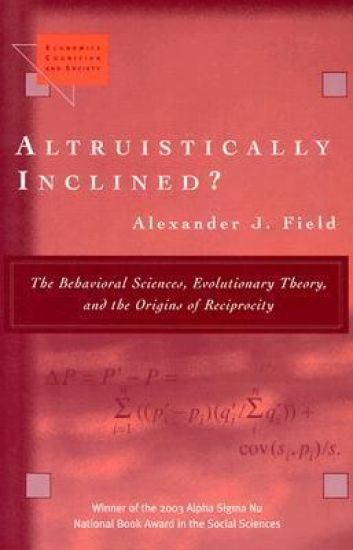
Altruistically Inclined? examines the implications of recent research in the natural sciences for two important social scientific approaches to individual behavior: the economic/rational choice approach and the sociological/anthropological. It considers jointly two controversial and related ideas: the operation of group selection within early human evolutionary processes and the likelihood of modularity—domain-specific adaptations in our cognitive mechanisms and behavioral predispositions.Experimental research shows that people will often cooperate in one-shot prisoner's dilemma (PD) games and reject positive offers in ultimatum games, contradicting commonly accepted notions of rationality. Upon first appearance, predispositions to behave in this fashion could not have been favored by natural selection operating only at the level of the individual organism.Emphasizing universal and variable features of human culture, developing research on how the brain functions, and refinements of thinking about levels of selection in evolutionary processes, Alexander J. Field argues that humans are born with the rudiments of a PD solution module—and differentially prepared to learn norms supportive of it. His emphasis on failure to harm, as opposed to the provision of affirmative assistance, as the empirically dominant form of altruistic behavior is also novel.The point of departure and principal point of reference is economics. But Altruistically Inclined? will interest a broad range of scholars in the social and behavioral sciences, natural scientists concerned with the implications of research and debates within their fields for the conduct of work elsewhere, and educated lay readers curious about essential features of human nature.Alexander J. Field is the Michel and Mary Orradre Professor of Economics at Santa Clara University.