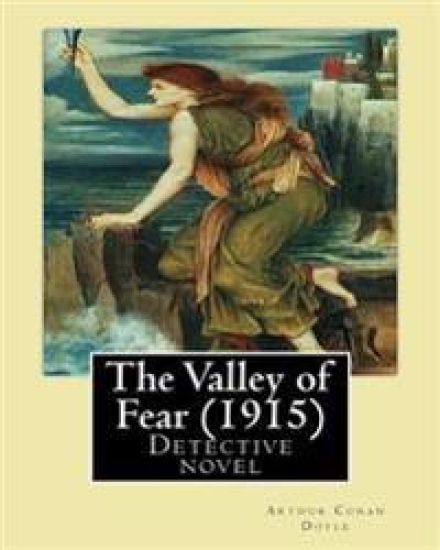
The Valley of Fear is the fourth and final Sherlock Holmes novel by Sir Arthur Conan Doyle. It is loosely based on the Molly Maguires and Pinkerton agent James McParland. The story was first published in the Strand Magazine between September 1914 and May 1915. The first book edition was copyrighted in 1914, and it was first published by George H. Doran Company in New York on 27 February 1915, and illustrated by Arthur I. Keller. PLOT: The novel starts with Sherlock Holmes receiving a cipher message from Fred Porlock (pseudonym), an agent of Professor Moriarty. After Porlock sends the message, however, he changes his mind for fear of Moriarty's discovering that he is a traitor. He decides not to send the key to the cipher, but he sends Holmes a note telling of this decision. From the cipher message and the second note, Holmes is able to deduce that it is a book-cipher and that the book used for the encryption is a common book, large (with at least 534 pages), printed in two columns per page, and standardized. An almanac fits these conditions exactly. Holmes tries the latest edition of Whitaker's Almanac, which he had only received a few days earlier, and fails; he then tries the previous edition. With this almanac, Holmes is able to successfully decipher the message as a warning that "some devilry is intended against one Douglas", a country gentleman residing at Birlstone House. Some minutes later, Inspector Macdonald arrives at Baker Street with news that a Mr. John Douglas of Birlstone Manor House, Birlstone, Sussex, has been murdered. Holmes tells MacDonald of Porlock's warning, suggesting Moriarty's involvement. However, MacDonald doesn't fully believe that the educated and well-respected Moriarty is a criminal. Holmes, Watson, and MacDonald travel to Birlstone House, an ancient moated manor house, to investigate the crime. Douglas had been murdered the evening before. Cecil Barker, a frequent guest at Birlstone House, had been in his room at half-past eleven when he heard the report of a gun, according to his testimony. He had rushed down to find Douglas lying in the center of the room nearest the front door of the house; a sawed-off shotgun lay across the murdered man's chest. He had been shot at close range, receiving the full charge of the shotgun in the face. His head was blown 'almost to pieces'. Barker had rushed to the village police station and notified Sergeant Wilson, who was in charge of the station. Wilson followed Barker to the house after notifying the county authorities. The sergeant had begun investigating immediately. Barker drew his attention the open window, and to a smudge of blood like the mark of a boot-sole upon the window sill. The drawbridge over the moat had been raised at 6:00 pm. Barker speculated that the murderer had entered by the drawbridge before that time, hid in the room, and left by the window directly after killing Douglas. The moat was only a few feet deep, and could be easily crossed.... Sir Arthur Ignatius Conan Doyle (22 May 1859 - 7 July 1930) was a British writer and physician, most noted for creating the fictional detective Sherlock Holmes and writing stories about him which are generally considered milestones in the field of crime fiction.
The Adventures of Gerard is a compilation of short stories that Sir Arthur Conan Doyle wrote regarding a French Brigadier named Etienne Gerard who thinks very highly of himself as can be reflected in how he told his stories. The book is divided into chapters containing different segments of his life as a soldier under the leadership of Napoleon together with his personal exploits and the romance that swept his way in between. Typical of war stories, some depicts bloody encounters with his enemies and how he was able to escape those encounters. However, there were soft moments particularly his encounter with women along the way even if she is from their enemy.Brigadier Gerard is the hero of a series of historical short stories by the British writer Arthur Conan Doyle. The hero, Etienne Gerard, is a Hussar officer in the French Army during the Napoleonic Wars. Gerard's most notable attribute is his vanity - he is utterly convinced that he is the bravest soldier, greatest swordsman, most accomplished horseman and most gallant lover in all France. Gerard is not entirely wrong, since he displays notable bravery on many occasions, but his self-satisfaction undercuts this quite often. Obsessed with honour and glory, he is always ready with a stirring speech or a gallant remark to a lady. Conan Doyle, in making his hero a vain, and often rather uncomprehending, Frenchman, was able to satirise both the stereotypical English view of the French and - by presenting them from Gerard's baffled point of view - English manners and attitudes....Gerard tells the stories from the point of view of an old man now living in retirement in Paris. We discover that he was born in Gascony in the early 1780s (he is 25 in "How the Brigadier Captured Saragossa"). In "How the Brigadier Rode to Minsk" he attends a review of troops about to depart for the Crimea (1854-5), and this is the last identifiable date in his life, although "The Last Adventure of the Brigadier" has a still later setting, with Gerard about to return to his Gascon homeland. He first joins the 2nd Hussars - the Hussars of Chamberan - around 1799, serving as a lieutenant and junior captain. He first sees action at Marengo in Italy in 1800. He transfers to the 3rd Hussars of Conflans in 1807 as a senior captain. He speaks somewhat idiosyncratic English, having learned it from an officer of the Irish Brigade of the French Army. By 1810 he is colonel of the 2nd Hussars. He serves in Spain, Portugal, Italy, Germany and Russia. He is awarded the Grand-Cross of the L gion d'honneur by Napoleon in 1814. There are various discrepancies in the accounts of his life, not the least that in none of the stories except the last is he married. Conan Doyle enthusiasts have noted that Gerard is modelled on the real-life Baron Jean Baptiste Antoine Marcellin de Marbot, a noted French light cavalry officer during the Napoleonic Wars. Conan Doyle wrote with great affection about Marbot's memoirs in Through the Magic Door. The fictional Gerard is not to be confused with the real Napoleonic officer Etienne Maurice G rard (1777-1852), who rose to become a Marshal and later Prime Minister of France.... Sir Arthur Ignatius Conan Doyle KStJ, DL (22 May 1859 - 7 July 1930) was a British writer and physician, most noted for creating the fictional detective Sherlock Holmes and writing stories about him which are generally considered milestones in the field of crime fiction. He is also known for writing the fictional adventures of a second character he invented, Professor Challenger, and for popularising the mystery of the Mary Celeste. He was a prolific writer whose other works include fantasy and science fiction stories, plays, romances, poetry, nonfiction and historical novels.
The Lost World is a novel released in 1912 by Sir Arthur Conan Doyle concerning an expedition to a plateau in the Amazon basin of South America where prehistoric animals (dinosaurs and other extinct creatures) still survive. It was originally published serially in the popular Strand Magazine and illustrated by New-Zealand-born artist Harry Rountree during the months of April-November 1912. The character of Professor Challenger was introduced in this book. The novel also describes a war between indigenous people and a vicious tribe of ape-like creatures. PLOT: Edward Malone, a reporter for the Daily Gazette, asks his news editor, McArdle, for a dangerous and adventurous mission in order to impress the woman he loves, Gladys Hungerton. He is sent to interview the cantankerous Professor Challenger, who has become notorious for claims made about his recent expedition to South America. The professor has been plagued by intrusive reporters and, being a formidable man of great strength, has taken to forcibly ejecting them, despite the resulting police prosecutions. To gain entry Malone pretends to be an honest enquirer, but is quickly discovered, assaulted and thrown into the street. Although this is witnessed by a policeman, Malone does not press charges as the original deceit was his. Challenger is suitably impressed, and decides to reveal something of his discovery of living dinosaurs in South America. Malone is invited to a scientific gathering that evening at which he volunteers, along with the biologist Professor Summerlee and the Amazon adventurer Lord John Roxton, to travel to South America to investigate the claims. After a long and arduous journey through Brazil, the explorers reach a volcanic plateau jutting far above the jungle. Upon climbing up to the plateau, one of their local guides who has a score to settle with Roxton destroys their temporary bridge across a precipice, trapping the explorers on the dinosaurs' plateau. The explorers encounter five iguanodons and are later attacked by pterodactyls, and Roxton finds some blue clay in which he takes a great interest. After numerous encounters with dinosaurs, Challenger, Summerlee, and Roxton are captured by a race of 'ape-men'. While in the ape-men's village, they discover a tribe of anatomically-modern humans (calling themselves Accala) inhabiting the other side of the plateau, with whom the ape-men (called Doda by the Accala) are at war. With the help of the expedition's firepower, the Accala conquer the ape-men; and insist that the expedition remain on the plateau. With the help from the young prince of the Accala, whom they had saved from the ape-men, the expedition discover a tunnel to the outside world, where they join a large rescue party. Upon return to England, they present their report, which include pictures and a newspaper report by Malone, but they are disbelieved by the public until Challenger shows as proof a live pterodactyl, which then escapes into the Atlantic Ocean. At dinner, Roxton reveals that the blue clay contains diamonds, about 200,000 worth, to be split between them. Challenger plans to open a private museum, Summerlee plans to retire and categorize fossils, and Roxton plans to return to the lost world. Malone returns to his love, Gladys, only to find that she had married a solicitor's clerk in his absence. He therefore volunteers to join Roxton's voyage... Sir Arthur Ignatius Conan Doyle KStJ, DL (22 May 1859 - 7 July 1930) was a British writer and physician, most noted for creating the fictional detective Sherlock Holmes and writing stories about him which are generally considered milestones in the field of crime fiction.
The Tragedy of the Korosko (1898) is a novel by Sir Arthur Conan Doyle. It was serialized a year earlier in The Strand magazine between May and December 1897. It was later adapted into a play Fires of Fate by Doyle. The play was in turn twice adapted into film, a 1923 silent film and a 1932 talkie. PLOT: A group of European tourists are enjoying their trip to Egypt in the year 1895. They are sailing up the River Nile in "a turtle-bottomed, round-bowed stern-wheeler", the Korosko. They intend to travel to Abousir at the southern frontier of Egypt, after which the Dervish country starts. They are attacked and abducted by a marauding band of Dervish warriors. The novel contains a strong defence of British Imperialism and in particular the Imperial project in North Africa. It also reveals the very great suspicion of Islam felt by many Europeans at the time. Sir Arthur Ignatius Conan Doyle KStJ, DL (22 May 1859 - 7 July 1930) was a British writer and physician, most noted for creating the fictional detective Sherlock Holmes and writing stories about him which are generally considered milestones in the field of crime fiction. He is also known for writing the fictional adventures of a second character he invented, Professor Challenger, and for popularising the mystery of the Mary Celeste. He was a prolific writer whose other works include fantasy and science fiction stories, plays, romances, poetry, nonfiction and historical novels.
The Sign of the Four (1890), also called The Sign of Four, is the second novel featuring Sherlock Holmes written by Sir Arthur Conan Doyle. Doyle wrote four novels and 56 stories starring the fictional detective. PLOT: The story is set in 1888.The Sign of the Four has a complex plot involving service in India, the Indian Rebellion of 1857, a stolen treasure, and a secret pact among four convicts ("the Four" of the title) and two corrupt prison guards. It presents the detective's drug habit and humanizes him in a way that had not been done in the preceding novel, A Study in Scarlet (1887). It also introduces Doctor Watson's future wife, Mary Morstan. According to Mary, in December 1878, her father had telegraphed her upon his safe return from India and requested her to meet him at the Langham Hotel in London. When Mary arrived at the hotel, she was told her father had gone out the previous night and not returned. Despite all efforts, no trace has ever been found of him. Mary contacted her father's only friend who was in the same regiment and had since retired to England, one Major John Sholto, but he denied knowing her father had returned. The second puzzle is that she has received six pearls in the mail from an anonymous benefactor, one per year since 1882 after answering an anonymous newspaper query inquiring for her. With the last pearl she received a letter remarking that she has been wronged and asking for a meeting. Holmes takes the case and soon discovers that Major Sholto had died in 1882 and that within a short span of time Mary began to receive the pearls, implying a connection. The only clue Mary can give Holmes is a map of a fortress found in her father's desk with the names of Jonathan Small, Mahomet Singh, Abdullah Khan and Dost Akbar. Holmes, Watson, and Mary meet Thaddeus Sholto, the son of the late Major Sholto and the anonymous sender of the pearls. Thaddeus confirms the Major had seen Mary's father the night he died; they had arranged a meeting to divide a priceless treasure Sholto had brought home from India. While quarreling over the treasure, Captain Morstan-long in weak health-suffered a heart attack. Not wanting to bring attention to the object of the quarrel-and also worried that circumstances would suggest that he had killed Morstan in an argument, particularly since Morstan's head struck a table as he fell-Sholto disposed of the body and hid the treasure. However, he himself suffered from poor health and an enlarged spleen (possibly due to malaria, as a quinine bottle stands by his bed). His own health became worse when he received a letter from India in early 1882. Dying, he called his two sons and confessed to Morstan's death and was about to divulge the location of the treasure when he suddenly cried, "Keep him out " before falling back and dying. The puzzled sons glimpsed a face in the window, but the only trace was a single footstep in the dirt. On their father's body is a note reading "The Sign of Four". Both brothers quarreled over whether a legacy should be left to Mary Morstan, and Thaddeus left his brother Bartholomew, taking a chaplet and sending its pearls to Mary. The reason he sent the letter is that Bartholomew has found the treasure and possibly Thaddeus and Mary might confront him for a division of it.... Sir Arthur Ignatius Conan Doyle KStJ, DL (22 May 1859 - 7 July 1930) was a British writer and physician, most noted for creating the fictional detective Sherlock Holmes and writing stories about him which are generally considered milestones in the field of crime fiction.