Kirjahaku
Etsi kirjoja tekijän nimen, kirjan nimen tai ISBN:n perusteella.
1000 tulosta hakusanalla Barbara Johnson Witcher
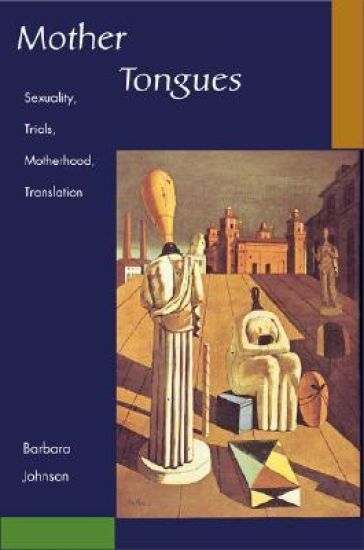
Charles Baudelaire, Walter Benjamin, and Sylvia Plath make up the odd trio on which this book is based. It is in the surprising and revealing links between them--links pertaining to troublesome mothers, elusive foreign languages, and professional disappointments--that Barbara Johnson maps the coordinates of her larger claims about the ideal of oneness in every area of life, and about the damage done by this ideal. The existence of sexual difference precludes an original or ultimate "one" who would represent all of mankind; the plurality of languages makes it impossible to think that one doesn't live in translation; and the plurality of the sexes means that every human being came from a woman's body, and some will reproduce this feat, while others won't. In her most personal and deeply considered book about difference, Johnson asks: Is the mother the guardian of a oneness we have never had? The relations that link mothers, bodies, words, and laws serve as the guiding puzzles as she searches for an answer.
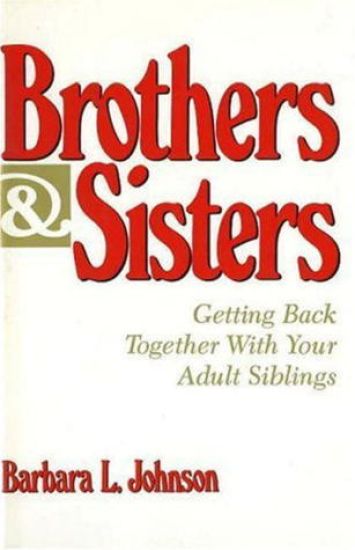
Time and circumstances often separate adult siblings from the family closeness they once knew. Based on a decade of research and more than 200 personal interviews, this book is filled with abundant case histories that reflect the heartening, sometimes heartbreaking, tugs and ties that brothers and sisters experience after they have grown up.

Unweaving 'The Odyssey': Barbara Köhler’s 'Niemands Frau'
Rebecca May Johnson
Institute of Modern Languages Research
2019
sidottu


The Works of Samuel Johnson, LL.D. a New Edition. with an Essay on His Life and Genius by Arthur Murphy. with a Portrait. Edited by A. Chalmers.
Samuel Johnson; Alexander Chalmers; Barbara Ed Murphy
British Library, Historical Print Editions
2011
pokkari
Title: The Works of Samuel Johnson, LL.D. A new edition ... With an essay on his life and genius by Arthur Murphy. With a portrait. Edited by A. Chalmers.]Publisher: British Library, Historical Print EditionsThe British Library is the national library of the United Kingdom. It is one of the world's largest research libraries holding over 150 million items in all known languages and formats: books, journals, newspapers, sound recordings, patents, maps, stamps, prints and much more. Its collections include around 14 million books, along with substantial additional collections of manuscripts and historical items dating back as far as 300 BC.The NOVELS OF THE 18th & 19th CENTURIES collection includes books from the British Library digitised by Microsoft. The collection includes major and minor works from a period which saw the development and triumph of the English novel. These classics were written for a range of audiences and will engage any reading enthusiast. ++++The below data was compiled from various identification fields in the bibliographic record of this title. This data is provided as an additional tool in helping to insure edition identification: ++++ British Library Johnson, Samuel; Chalmers, Alexander; Murphy; 1806. 12 vol.; 8 . 012273.eee.8.

1850 Census, Eastern Kentucky, Volume 5. Includes Counties of Breathitt, Carter, Floyd, Greenup, Johnson, Lawrence, Letcher, Morgan, Perry and Pike
Byron Sistler; Barbara Sistler; Samuel Sistler
Janaway Publishing, Inc.
2012
nidottu
Embattled and belittled, demonized and deemed passé, feminism today seems becalmed without being calm. This is as true in literary criticism as elsewhere in the culture--yet it is in literary criticism that these essays locate the renewed promises, possibilities, and applications of feminist thought. In fresh readings of a wide array of texts--legal, literary, cinematic, philosophical, and psychoanalytical--renowned literary theorist Barbara Johnson demonstrates that the conflicts and uncertainties that beset feminism are signs not of a dead end, but of a creative turning-point. Employing surprising juxtapositions, The Feminist Difference looks at fiction by black writers from a feminist/psychoanalytic perspective; at poetry from Phillis Wheatley to Baudelaire and Marceline Desbordes-Valmore; and at feminism and law, particularly in the work of Patricia Williams and the late Mary Joe Frug. Toni Morrison and Sigmund Freud, John Keats and Jane Campion, Charlotte Perkins Gilman and Nathaniel Hawthorne, Nella Larson and Heinz Kohut are among the many occasions for Johnson's rich, stimulating, unfailingly close reading of moments at which feminism seems to founder in its own contradictions--moments that re-emerge here as sources of a revitalized critical awareness.In the final analysis, Johnson argues, literature is essential for feminism because it is the place where impasses can be kept and opened for examination, where questions can be guarded and not forced into a premature validation of the available paradigms. In her book literature appears not as a predetermined set of works but as a mode of cultural work, the work of making readable those impossible and necessary things that cannot yet be spoken.
Moving effortlessly between symbolist poetry and Barbie dolls, artificial intelligence and Kleist, Kant, and Winnicott, Barbara Johnson not only clarifies psychological and social dynamics; she also re-dramatizes the work of important tropes—without ever losing sight of the ethical imperative with which she begins: the need to treat persons as persons.In Persons and Things, Johnson turns deconstruction around to make a fundamental contribution to the new aesthetics. She begins with the most elementary thing we know: deconstruction calls attention to gaps and reveals that their claims upon us are fraudulent. Johnson revolutionizes the method by showing that the inanimate thing exposed as a delusion is central to fantasy life, that fantasy life, however deluded, should be taken seriously, and that although a work of art “is formed around something missing,” this “void is its vanishing point, not its essence.” She shows deftly and delicately that the void inside Keats’s urn, Heidegger’s jug, or Wallace Stevens’s jar forms the center around which we tend to organize our worlds.The new aesthetics should restore fluidities between persons and things. In pursuing it, Johnson calls upon Ovid, Keats, Poe, Plath, and others who have inhabited this in-between space. The entire process operates via a subtlety that only a critic of Johnson’s caliber could reveal to us.
Human Fertility in Russia Since the Nineteenth Century
Ansley Johnson Coale; Barbara A. Anderson; Erna Härm
Princeton University Press
2015
pokkari
The birth rate in late-nineteenth century Russia was high and virtually constant, but by 1970 it had fallen by about two-thirds. Although similar reductions have occurred in other countries, the decline in Russian fertility is of particular interest because it took place in a setting of great ethnic heterogeneity and under economic and social institutions different from those in the West. This book tells the full statistical story of trends in Russian fertility since the first census in 1897 by examining the conditions--social, economic, cultural, and demographic--that existed at the beginning of and during the decline in human fertility. Originally published in 1979. The Princeton Legacy Library uses the latest print-on-demand technology to again make available previously out-of-print books from the distinguished backlist of Princeton University Press. These editions preserve the original texts of these important books while presenting them in durable paperback and hardcover editions. The goal of the Princeton Legacy Library is to vastly increase access to the rich scholarly heritage found in the thousands of books published by Princeton University Press since its founding in 1905.

Human Fertility in Russia Since the Nineteenth Century
Ansley Johnson Coale; Barbara A. Anderson; Erna Härm
Princeton University Press
2016
sidottu
The birth rate in late-nineteenth century Russia was high and virtually constant, but by 1970 it had fallen by about two-thirds. Although similar reductions have occurred in other countries, the decline in Russian fertility is of particular interest because it took place in a setting of great ethnic heterogeneity and under economic and social institutions different from those in the West. This book tells the full statistical story of trends in Russian fertility since the first census in 1897 by examining the conditions--social, economic, cultural, and demographic--that existed at the beginning of and during the decline in human fertility. Originally published in 1979. The Princeton Legacy Library uses the latest print-on-demand technology to again make available previously out-of-print books from the distinguished backlist of Princeton University Press. These editions preserve the original texts of these important books while presenting them in durable paperback and hardcover editions. The goal of the Princeton Legacy Library is to vastly increase access to the rich scholarly heritage found in the thousands of books published by Princeton University Press since its founding in 1905.

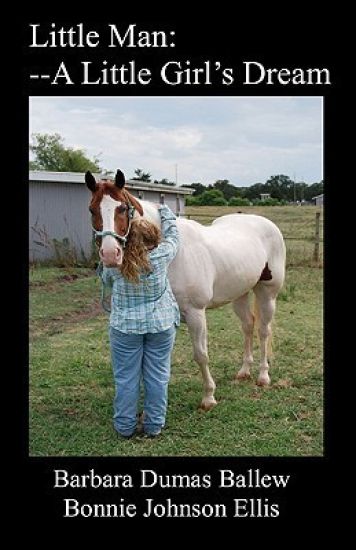
Little Man: --A Little Girl's Dream
Bonnie Johnson Ellis; Barbara Dumas Ballew
Createspace Independent Publishing Platform
2010
nidottu

Stranger, the Miracle Dog
Bonnie Johnson Ellis; Barbara Dumas Ballew
Createspace Independent Publishing Platform
2011
nidottu
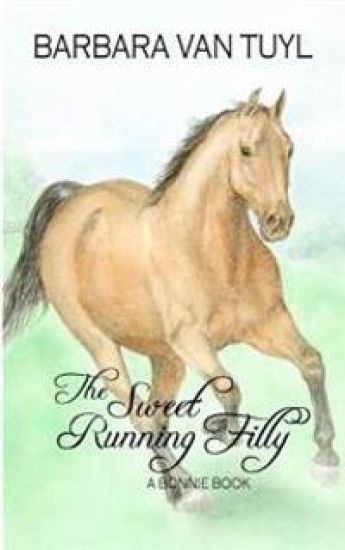
The Sweet Running Filly: A Bonnie Book
Pat Johnson; Barbara Van Tuyl
Createspace Independent Publishing Platform
2014
nidottu
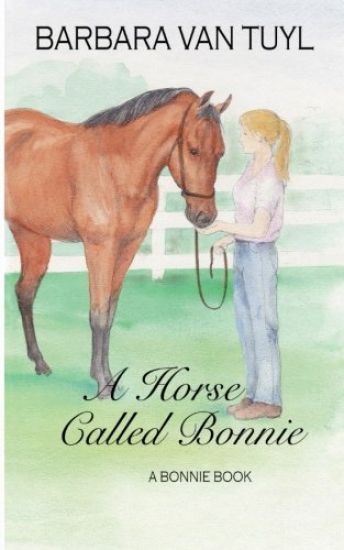
A Horse Called Bonnie: A Bonnie Book
Pat Johnson; Barbara Van Tuyl
Createspace Independent Publishing Platform
2014
nidottu