Kirjojen hintavertailu. Mukana 12 459 402 kirjaa ja 12 kauppaa.

Kirjahaku

Etsi kirjoja tekijän nimen, kirjan nimen tai ISBN:n perusteella.

1000 tulosta hakusanalla Barbara Raue

Guelph Ontario Book 1 in Colour Photos: Saving Our History One Photo at a Time

Guelph Ontario Book 1 in Colour Photos: Saving Our History One Photo at a Time

Barbara Raue

Createspace Independent Publishing Platform
2015
nidottu
Guelph, known as "The Royal City, is located 100 kilometers (62 miles) west of downtown Toronto at the intersection of Highways 6 and 7. Guelph was founded on St. George's Day, April 23, 1827, the feast day of the patron saint of England. The town was named to honour Britain's royal family, the Hanoverians who were descended from the Guelfs, the ancestral family of George IV, the reigning British monarch.John Galt designed the town to resemble a European city centre with squares, broad main streets and narrow side streets, resulting in a variety of block sizes and shapes. The street plan was designed to resemble a lady's fan with many of the streets forming triangles (the segments of the fan).The first cable TV system began in Guelph with their first broadcast being the coronation of Queen Elizabeth II in 1953. The Speed and Eramosa Rivers flow through the city.Riverside Park is an 80-acre park built around a portion of the Speed River that runs through Guelph. The park opened in 1905.Our family lived continuously in Guelph from the time I was four years old until 1969. Guelph was an often returned to place for our family from 1948 to 1954; whenever Dad was out of work, he would head back to Guelph where Mom's cousin and husband, Rosa and Carl Saillian, lived and had their Armenian Rug cleaning and installation business. We often watched Uncle Carl shampooing carpets in the large garage beside their house on Stevenson Street. One year when Dad was out of work, Dad dug out the basement under the Saillian's home to make a recreation room; Dad was a hard worker and completed the work much quicker than they expected. I attended S.S. No. 1 School from 1957 to 1963, then I was shuffled around to a few schools to complete Grades 7 and 8. I attended John F. Ross C.V.I. for high school. Riverside Park was a place we often visited for picnics and swimming. We lived across the road from the Ontario Reformatory (O.R.) grounds and we often saw a prison guard with a group of prisoners keeping the lawns looking beautiful. Since the reformatory moved to Milton, the grounds are in poor shape with animals digging tunnels through the grass. We swam in the lake at the O.R. I have many happy memories of growing up in this city.
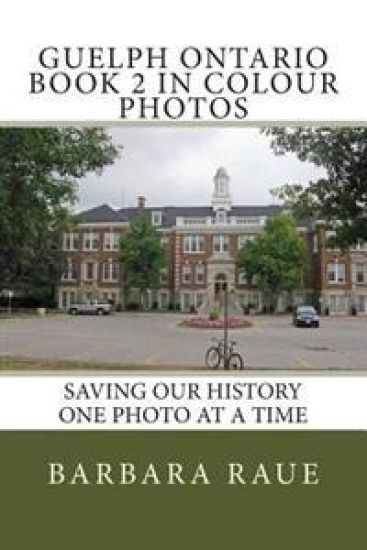
Guelph Ontario Book 2 in Colour Photos: Saving Our History One Photo at a Time

Guelph Ontario Book 2 in Colour Photos: Saving Our History One Photo at a Time

Barbara Raue

Createspace Independent Publishing Platform
2015
nidottu
Guelph, known as "The Royal City, is located 100 kilometers (62 miles) west of downtown Toronto at the intersection of Highways 6 and 7. Guelph was founded on St. George's Day, April 23, 1827, the feast day of the patron saint of England. The town was named to honour Britain's royal family, the Hanoverians who were descended from the Guelfs, the ancestral family of George IV, the reigning British monarch.John Galt designed the town to resemble a European city centre with squares, broad main streets and narrow side streets, resulting in a variety of block sizes and shapes. The street plan was designed to resemble a lady's fan with many of the streets forming triangles (the segments of the fan).The first cable TV system began in Guelph with their first broadcast being the coronation of Queen Elizabeth II in 1953. The Speed and Eramosa Rivers flow through the city.Riverside Park is an 80-acre park built around a portion of the Speed River that runs through Guelph. The park opened in 1905.Our family lived in Guelph from the time I was four years old until 1969. Guelph was an often returned to place for our family from 1948 to 1954; whenever Dad was out of work, he would head back to Guelph where Mom's cousin and husband, Rosa and Carl Saillian, lived and had their Armenian Rug cleaning and installation business. We often watched Uncle Carl shampooing carpets in the large garage beside their house on Stevenson Street. One year when Dad was out of work, Dad dug out the basement under the Saillian's home to make a recreation room; Dad was a hard worker and completed the work much quicker than they expected. I attended S.S. No. 1 School from 1957 to 1963, and then I was shuffled around to a few schools to complete Grades 7 and 8. I went to John F. Ross C.V.I. for high school. Riverside Park was a place we often visited for picnics and swimming. We lived across the road from the Ontario Reformatory (O.R.) grounds and we often saw a prison guard with a group of prisoners keeping the lawns looking beautiful. Since the reformatory moved to Milton, the grounds are in poor shape with animals digging tunnels through the grass. We swam in the lake at the O.R. I have many happy memories of growing up in this city.The Ontario Agricultural College, the oldest part of the University of Guelph, began in 1873 as an associate agricultural college of the University of Toronto. The Government of Ontario purchased 550 acres of land from F. W. Stone to build the college. In 1964, the Ontario Agricultural College, Ontario Veterinary College and Macdonald Institute combined to become the University of Guelph and Wellington College.MoffatMoffat is located north of the 401, southeast of Guelph. We lived in Moffat from the fall of 1954 to the spring of 1956. Moffat was a small village with farms and a few homes on two side streets, a post office, general store, and a school. We moved from Moffat to the outskirts of Guelph on Old York Road across from the Ontario Reformatory grounds. When the boundary of Guelph extended eastward, the name of our road became Beaumont Crescent and our house number was 18.
Hamilton Ontario Book 1 in Colour Photos: Saving Our History One Photo at a Time

Hamilton Ontario Book 1 in Colour Photos: Saving Our History One Photo at a Time

Barbara Raue

Createspace Independent Publishing Platform
2015
nidottu
John Ryckman, born in Barton township (where present day downtown Hamilton is), described the area in 1803 as he remembered it: "The city in 1803 was all forest. The shores of the bay were difficult to reach or see because they were hidden by a thick, almost impenetrable mass of trees and undergrowth... Bears ate pigs, so settlers warred on bears. Wolves gobbled sheep and geese, so they hunted and trapped wolves. They also held organized raids on rattlesnakes on the mountainside. There was plenty of game. Many a time have I seen a deer jump the fence into my back yard, and there were millions of pigeons which we clubbed as they flew low."Hamilton, the centre of a densely populated and industrialized region, is located in Southern Ontario on the western part of Lake Ontario. Hamilton Harbour marks the northern limit of the city, and the Niagara Escarpment runs through the middle of the city bisecting it into "upper" and "lower" parts. There are over one hundred waterfalls and cascades within the city, most of which are on or near the Bruce Trail as it winds through the Niagara Escarpment.Two steel manufacturing companies, Stelco and Dofasco, were formed in 1910 and 1912, and Procter & Gamble opened a manufacturing plant in 1914. McMaster University moved from Toronto to Hamilton, an airport was built in 1940, a Studebaker assembly line started in 1948, the Burlington Bay Skyway Bridge was built in 1958, and the first Tim Horton's store opened in 1964.On January 1, 2001, the new City of Hamilton was formed through the amalgamation of the former city and the six municipalities of Stoney Creek, Glanbrook, Ancaster, Dundas, and Flamborough.We have lived in Hamilton for more than 40 years; it is here that we raised our three children.
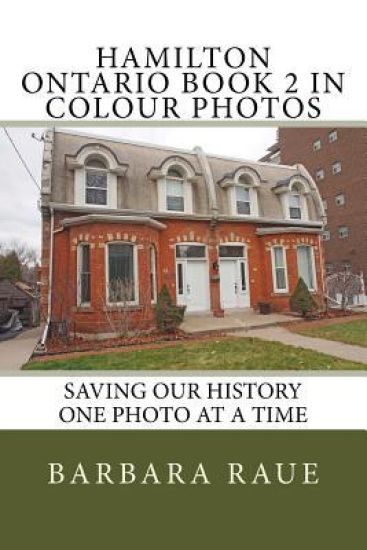
Hamilton Ontario Book 2 in Colour Photos: Saving Our History One Photo at a Time

Hamilton Ontario Book 2 in Colour Photos: Saving Our History One Photo at a Time

Barbara Raue

Createspace Independent Publishing Platform
2015
nidottu
Hamilton, the centre of a densely populated and industrialized region, is located in Southern Ontario on the western part of Lake Ontario. Hamilton Harbour marks the northern limit of the city, and the Niagara Escarpment runs through the middle of the city bisecting the city into "upper" and "lower" parts. There are over one hundred waterfalls and cascades within the city, most of which are on or near the Bruce Trail as it winds through the Niagara Escarpment.Two steel manufacturing companies, Stelco and Dofasco, were formed in 1910 and 1912, and Procter & Gamble opened a manufacturing plant in 1914. McMaster University moved from Toronto to Hamilton, an airport was built in 1940, a Studebaker assembly line started in 1948, the Burlington Bay Skyway Bridge was built in 1958, and the first Tim Horton's store opened in 1964.The city experienced a devastating fire at the Plastimet plastics plant in 1997 with about three hundred firefighters battling the blaze on Wellington Street North when tons of PVC Plastic caught on fire. On January 1, 2001, the new City of Hamilton was formed through the amalgamation of the former city and the six municipalities of Stoney Creek, Glanbrook which includes Mount Hope, Ancaster, Dundas, and Flamborough which includes Waterdown.Hamilton is home to the Royal Botanical Gardens, McMaster University and Mohawk College. The Canadian Football League's Hamilton Tiger Cats began playing at the new Tim Hortons Field in 2014, which was built as part of the 2015 Pan American Games which will be jointly hosted by Toronto and Hamilton.We have lived in Hamilton for more than 40 years; it is here that we raised our three children.
Hamilton Ontario Book 3 in Colour Photos: Saving Our History One Photo at a Time

Hamilton Ontario Book 3 in Colour Photos: Saving Our History One Photo at a Time

Barbara Raue

Createspace Independent Publishing Platform
2015
nidottu
In 1784, thousands of United Empire Loyalists settled in Upper Canada (what is now southern Ontario). Iroquois loyal to Britain arrived from the United States and were settled on reserves. Between 1788 and 1793, the townships at the Head-of-the-Lake were surveyed and named.John Ryckman, born in Barton township (where present day downtown Hamilton is), described the area in 1803 as he remembered it: "The city in 1803 was all forest. The shores of the bay were difficult to reach or see because they were hidden by a thick, almost impenetrable mass of trees and undergrowth... Bears ate pigs, so settlers warred on bears. Wolves gobbled sheep and geese, so they hunted and trapped wolves. They also held organized raids on rattlesnakes on the mountainside. There was plenty of game. Many a time have I seen a deer jump the fence into my back yard, and there were millions of pigeons which we clubbed as they flew low."Hamilton, the centre of a densely populated and industrialized region, is located in Southern Ontario on the western part of Lake Ontario. Hamilton Harbour marks the northern limit of the city, and the Niagara Escarpment runs through the middle of the city bisecting the city into "upper" and "lower" parts. There are over one hundred waterfalls and cascades within the city, most of which are on or near the Bruce Trail as it winds through the Niagara Escarpment.Two steel manufacturing companies, Stelco and Dofasco, were formed in 1910 and 1912, and Procter & Gamble opened a manufacturing plant in 1914. The Pigott Building was the city's first high-rise building constructed in 1929. McMaster University moved from Toronto to Hamilton, an airport was built in 1940, a Studebaker assembly line started in 1948, the Burlington Bay Skyway Bridge was built in 1958, and the first Tim Horton's store opened in 1964.
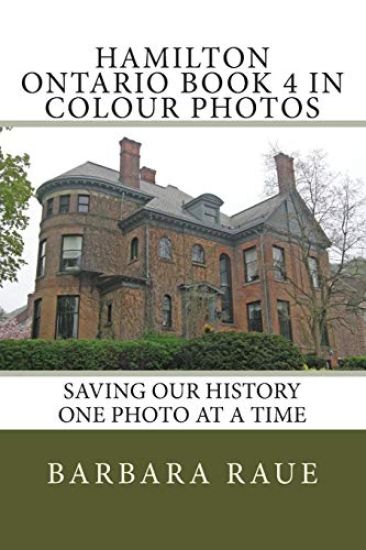
Hamilton Ontario Book 4 in Colour Photos: Saving Our History One Photo at a Time

Hamilton Ontario Book 4 in Colour Photos: Saving Our History One Photo at a Time

Barbara Raue

Createspace Independent Publishing Platform
2015
nidottu
In 1784, thousands of United Empire Loyalists settled in Upper Canada (what is now southern Ontario). They were soon followed by more Americans attracted by the availability of inexpensive, arable land. Large numbers of Iroquois loyal to Britain arrived from the United States and were settled on reserves. Between 1788 and 1793, the townships at the Head-of-the-Lake were surveyed and named.Hamilton, the centre of a densely populated and industrialized region, is located in Southern Ontario on the western part of Lake Ontario. There are over one hundred waterfalls and cascades within the city, most of which are on or near the Bruce Trail as it winds through the Niagara Escarpment.Two steel manufacturing companies, Stelco and Dofasco, were formed in 1910 and 1912, and Procter & Gamble opened a manufacturing plant in 1914. The Pigott Building was the city's first high-rise building constructed in 1929. McMaster University moved from Toronto to Hamilton, an airport was built in 1940, a Studebaker assembly line started in 1948, the Burlington Bay Skyway Bridge was built in 1958, and the first Tim Horton's store opened in 1964.Hamilton is home to the Royal Botanical Gardens, McMaster University and Mohawk College. The Canadian Football League's Hamilton Tiger Cats began playing at the new Tim Hortons Field in 2014, which was built as part of the 2015 Pan American Games which will be jointly hosted by Toronto and Hamilton.On January 1, 2001, the new City of Hamilton was formed through the amalgamation of the former city and six surrounding municipalities.We have lived in Hamilton for more than 40 years; it is here that we raised our three children.
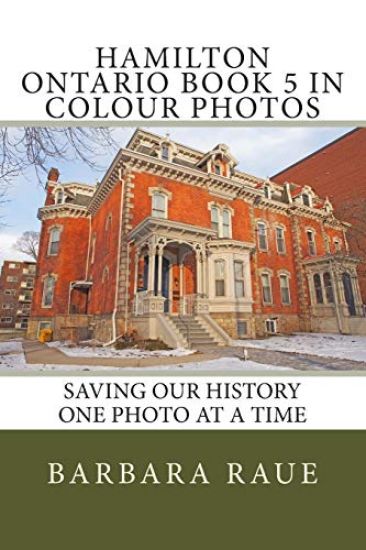
Hamilton Ontario Book 5 in Colour Photos: Saving Our History One Photo at a Time

Hamilton Ontario Book 5 in Colour Photos: Saving Our History One Photo at a Time

Barbara Raue

Createspace Independent Publishing Platform
2015
nidottu
John Ryckman, born in Barton township (where present day downtown Hamilton is), described the area in 1803 as he remembered it: "The city in 1803 was all forest. The shores of the bay were difficult to reach or see because they were hidden by a thick, almost impenetrable mass of trees and undergrowth... Bears ate pigs, so settlers warred on bears. Wolves gobbled sheep and geese, so they hunted and trapped wolves. They also held organized raids on rattlesnakes on the mountainside. There was plenty of game. Many a time have I seen a deer jump the fence into my back yard, and there were millions of pigeons which we clubbed as they flew low."Hamilton, the centre of a densely populated and industrialized region, is located in Southern Ontario on the western part of Lake Ontario. Hamilton Harbour marks the northern limit of the city, and the Niagara Escarpment runs through the middle of the city bisecting it into "upper" and "lower" parts. There are over one hundred waterfalls and cascades within the city, most of which are on or near the Bruce Trail as it winds through the Niagara Escarpment.Two steel manufacturing companies, Stelco and Dofasco, were formed in 1910 and 1912, and Procter & Gamble opened a manufacturing plant in 1914. McMaster University moved from Toronto to Hamilton, an airport was built in 1940, a Studebaker assembly line started in 1948, the Burlington Bay Skyway Bridge was built in 1958, and the first Tim Horton's store opened in 1964.On January 1, 2001, the new City of Hamilton was formed through the amalgamation of the former city and the six municipalities of Stoney Creek, Glanbrook, Ancaster, Dundas, and Flamborough. We have lived in Hamilton for more than 40 years; it is here that we raised our three children.
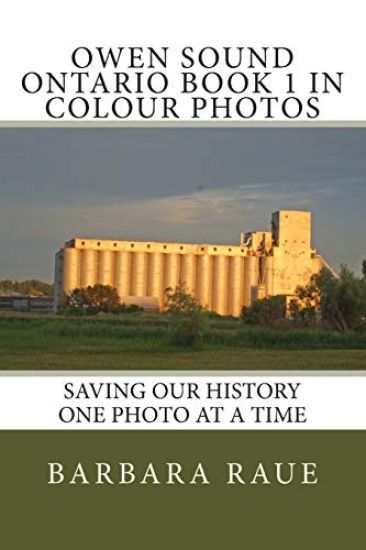
Owen Sound Ontario Book 1 in Colour Photos: Saving Our History One Photo at a Time

Owen Sound Ontario Book 1 in Colour Photos: Saving Our History One Photo at a Time

Barbara Raue

Createspace Independent Publishing Platform
2015
nidottu
Owen Sound is located on the southern shores of Georgian Bay in a valley below the sheer rock cliffs of the Niagara Escarpment. The city is located at the mouths of the Pottawatomi and Sydenham Rivers. It has tree-lined streets, many parks, and tree-covered hillsides and ravines.This area of the upper Great Lakes was first surveyed in 1815 by William Fitzwilliam Owen and Lieutenant Henry W. Bayfield. The inlet was named "Owen's Sound" in honour of the explorer's older brother, Admiral Sir Edward Owen.The city was first known as Sydenham when it was settled in 1840 by Charles Rankin. Prior to his arrival, the area was inhabited by the Ojibway people. In 1857 the name was changed to Owen Sound. For much of its history, it was a major port city known as the "Chicago of the North."The Tom Thomson Memorial Art Gallery is located in Owen Sound. Tom Thomson was born in 1877 and grew up in a home that appreciated literature and music. He worked as an engraver. In 1912, he sketched in Algonquin Park and canoed the Spanish River. The result was a full size canvas, Northern Lake. He returned each year to Algonquin Park where he supported himself as a ranger and guide as he continued to paint, producing masterpieces such as Autumn Foliage, The West Wind, and Northern River.William Avery "Billy" Bishop was born in Owen Sound in 1894. Given a .22 rifle one Christmas, Billy was offered 25 cents for every squirrel he shot. "One bullet - one shot" became Billy's motto. Bishop flew planes in the First World War. Courage and marksmanship made him one of the war's greatest fighter pilots.Norman Bethune was born in 1890 in Gravenhurst. From childhood he dreamed of becoming a doctor like his paternal grandfather, one of the founders of the University of Toronto's Medical School. The family moved to Owen Sound where Norman finished high school. In 1914, one year short of finishing his medical training, he left for France as a stretcher bearer, Navy surgeon, and as a senior medical officer in the new Royal Canadian Air Force. After returning home to Canada, he was appointed to the McGill University teaching staff where, as a thoracic surgeon he invented new surgical instruments. He supported a universal health insurance plan for Canadians. While in Spain during the Spanish Civil War, he organized a mobile blood transfusion service, the first of its kind. In 1938, Bethune went to China to work in Mao Tse-Tung's 8th route army, performing surgical operations in field hospitals. He cut his hand and it became infected and led to his death in 1939. The Gravenhust home where he was born has been restored as the Bethune Memorial Home.Agnes Campbell Macphail was born in 1890 in Grey County. In 1921, she became the first woman to be elected to the Canadian parliament. She was later elected to the Ontario Legislature where she was responsible for the province's first equal pay legislation.
Owen Sound Ontario Book 2 in Colour Photos: Saving Our History One Photo at a Time

Owen Sound Ontario Book 2 in Colour Photos: Saving Our History One Photo at a Time

Barbara Raue

Createspace Independent Publishing Platform
2015
nidottu
Owen Sound is located on the southern shores of Georgian Bay in a valley below the sheer rock cliffs of the Niagara Escarpment. The city is located at the mouths of the Pottawatomi and Sydenham Rivers. It has tree-lined streets, many parks, and tree-covered hillsides and ravines.In 1814-1818, the first Admiralty Survey of Lake Ontario and the coastal waters of Georgian Bay was undertaken by Captain William Fitzwilliam Owen, Royal Naval Officer, surveyor, land-owner, politician, author and justice of the peace. He named the bay and the future site of Owen Sound after his family. His successor, Admiral Henry Wolsey Bayfield, completed the first survey of lakes Erie, Huron, and Superior in 1817-1825. The work of these officers rendered great service to Canada by increasing the safety of navigation.The city was first known as Sydenham when it was settled in 1840 by Charles Rankin. Prior to his arrival, the area was inhabited by the Ojibway people. In 1851 the name was changed to Owen Sound. For much of its history, it was a major port city known as the "Chicago of the North."Owen Sound Bay is a valley in the Niagara Escarpment formed by rivers that cut through the escarpment limestone. The valley begins where the Sydenham River cuts down through the escarpment at Inglis Falls and extends out through the bay beyond Bayview Point for a total distance of 16 kilometres.As the Niagara Escarpment winds its way across southern Ontario, it is interrupted by many deep valleys carved out by the erosive forces of water and ice. Like Colpoy's Bay to the north, Owen Sound Bay is a drowned valley partially hidden under Georgian Bay. Other escarpment valleys like the Dundas Valley are buried under glacial sediments, while the Beaver and Bighead Valleys are occupied by rivers.Today the Niagara Escarpment continues to slowly erode back from its present position.
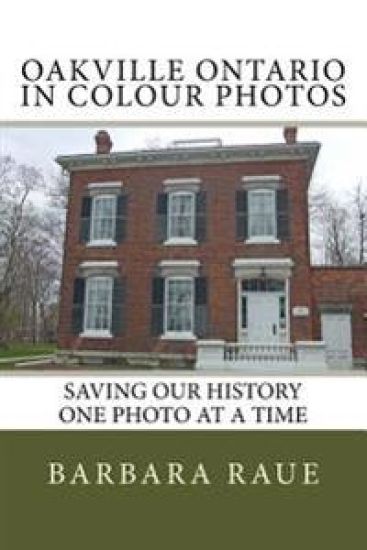
Oakville Ontario in Colour Photos: Saving Our History One Photo at a Time

Oakville Ontario in Colour Photos: Saving Our History One Photo at a Time

Barbara Raue

Createspace Independent Publishing Platform
2015
nidottu
Under the Royal Proclamation of 1763, European settlement could not proceed without a formal treaty with the aboriginal proprietors of the land. In 1805 the Mississauga agreed to surrender all the lands from Etobicoke River to Burlington Bay. Since the fishery was important to them, the Mississauga insisted on reserving for themselves the lower portions of the rivers, including Sixteen Mile Creek, together with the flood plains where they had their camps and small cornfields. These reserved parcels were ceded to the Crown in 1820. The Mississauga moved out of the area in 1847. Their descendants now live at the New Credit Reserve near Hagersville, Ontario.Oakville is situated on Lake Ontario in southern Ontario. In 1793, Dundas Street was surveyed for a military road. By 1807, British immigrants settled the area around Dundas Street and on the shores of Lake Ontario. In 1827, George Chalmers built a settlement with water-powered mills beside the Sixteen at the Dundas crossing. A small sawmill and gristmill were constructed on the valley bottom at the edge of a pond formed by a dam. In future years, a church, school, ashery, blacksmith shop, distillery, and tavern provided services to the local farmers. The village continued to prosper with the addition of a tannery, carding mill and steam stave mill until the coming of the railroad to Oakville in 1855.In 1827, William Chisholm purchased 960 acres of uncleared land at the mouth of Sixteen Mile Creek. He built mills, and laid out the Town of Oakville and opened the harbour to shipping. As the village prospered and grew, roads and ships were built to connect it with the rest of Upper Canada. The area was developed by his son, Robert Kerr Chisholm and his brother-in-law Thomas Merrick. Oakville's first industries included shipbuilding, timber shipment, and wheat farming. The town became industrialized with the opening of oil refineries, and Procor (manufactured railway shipping cars), and the establishment of the Ford Motor Company's Canadian headquarters and plant.Trafalgar Township settlers lived in isolation in the early years. Travel was difficult and there was no newspaper or postal service. The first stagecoach service began along Dundas Street in the 1820s. By 1833, stagecoaches were also travelling along Lakeshore Road, and Oakville had regular steamship service to Hamilton and York.Farmers north of Oakville needed a road to deliver their crops to Oakville's mills and harbour. In 1831 the House of Assembly provided funds for the construction of Seventh Line or Trafalgar Road. Fifteen years later this road was upgraded to a planked road complete with toll booths.With postal service beginning in 1822 and a newspaper (the Oakville Observer) starting up in 1836, Oakville and Trafalgar Townships early years of isolation came to an end.
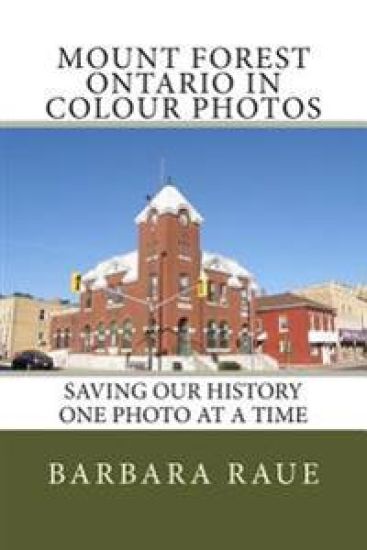
Mount Forest Ontario in Colour Photos: Saving Our History One Photo at a Time

Mount Forest Ontario in Colour Photos: Saving Our History One Photo at a Time

Barbara Raue

Createspace Independent Publishing Platform
2015
nidottu
Mount ForestMount Forest is located at the junction of Highways 6 and 89 on a height of land near the headwaters of the Saugeen River. In 1871, eighteen years after the town was surveyed, it had ten hotels, eight churches and eighteen stores; the first train came into Mount Forest later that year.Prior to European settlement, present day Mount Forest was prime hunting ground for the Saugeen Ojibway peoples due to its location on the Saugeen River. Originally known as Maitland Hills, its name was changed to Mount Forest in 1853. The name change came about because it was discovered that the village was actually on the Saugeen River system not on the Maitland River as had previously been supposed.The village was surveyed into lots in 1853. By 1864, the population had grown to 1185 so that it qualified to be incorporated as a village. By 1879 it had become an incorporated town. The 1871 town directory stated that Mount Forest had ten hotels, eight churches and eighteen stores. Later that year the railway was completed and the first train entered Mount Forest pulled by a wood-burning engine.A local newspaper, the Mount Forest Confederate, was first printed in 1867. For the first year, the newspaper was sent to village residents free of charge, but the second year it began charging 50 cents per year.The first public school was built in 1856. The first high school was originally in the Old Drill Hall, but was an unsuitable location because it was beside the Market Square where livestock sales were held monthly. The new high school was built in 1878. A third high school was founded in 2004 with the combination of the Mount Forest District High school and the neighboring Town of Arthur.GoblesGobles is located on concession 1 of Blenheim Township about two miles west of Princeton. In 1855 Gobles Corners was named after the late William L. Goble, son of Rev. Jacob Goble, who came to Canada from New York State in 1811 and settled on Concession 1 of Blenheim Township about 1816. Jacob Goble was elected first Deacon of the Blenheim Free Communion Church (Baptist) in 1822. He kept the office in his general store on the west side of the Blenheim Township three quarter town line near the G.W.R. tracks at Gobles. He held the position until December 19, 1873 when he resigned. When the railway was built the station bore the name "Gobles". A post office was established at Gobles on July 1, 1855, with William L. Goble as postmaster with a mail route begun between Gobles Corners and Princeton. Alex Milmine made one trip per week for two months between July and September 1855. This route was continued by W. L. Goble until September 30, 1858. Two trips per week were made by horse or vehicle. Between September 30, 1858 and September 30, 1863, the pay was $50.00 per year for two trips per week. William L. Goble also had the contract for mail conveying from Gobles Corners post office to the railway station. Twelve trips per week were made for two months in 1859 and 1860 and again in September 1863 in connection with the travelling post office. For nine months commencing October 1, 1863, Jasper G. Goble carried mail on foot six times per week from the Gobles Corners post office to the railway station for which he received $37.00. He continued this for four years until 1867. Jasper G. Goble was the son of William L. Goble. He became postmaster on April 1, 1874 and resigned on August 15, 1896. The population in 1875 was 50. The name of the post office was changed to Gobles on November 1, 1895. All of the postmasters kept the post office in the same general store started by W. L. Goble. The last postmaster at Gobles was B. J. Force, farmer, thresher, storekeeper, from April 23, 1912 to May 1, 1940, when the office was closed. Gobles then became part of the rural mail delivery on R.R. No. 1 Princeton.
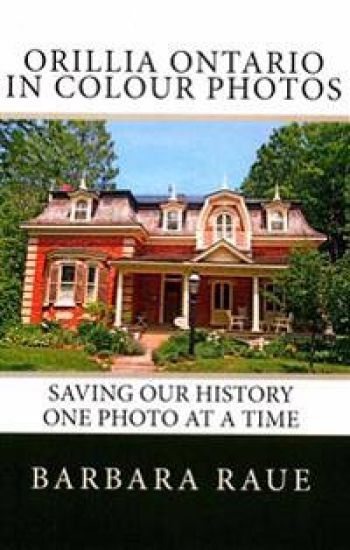
Orillia Ontario in Colour Photos: Saving Our History One Photo at a Time

Orillia Ontario in Colour Photos: Saving Our History One Photo at a Time

Barbara Raue

Createspace Independent Publishing Platform
2015
nidottu
Orillia is located in Central Ontario between Lake Couchiching and Lake Simcoe, 135 kilometres (84 miles) north of Toronto. Both lakes are part of the Trent-Severn Waterway. Travel north on Lake Couchiching, then through three locks and the only marine railway in North America leads to Georgian Bay on Lake Huron. Travelling south-east across Lake Simcoe, through many locks (including two of the highest hydraulic lift locks in the world) eventually leads to Lake Ontario. From either of these Great Lakes one can connect to the St. Lawrence and then to the Atlantic Ocean. The history of what is today the City of Orillia dates back at least several thousand years. Archaeologists have uncovered evidence of fishing by the Huron and Iroquois peoples in the area over 4,000 years ago. The site of an Ojibwa reserve from 1830 to 1838, Orillia subsequently prospered as an agricultural and lumbering community. Early history of the area includes visits from Samuel de Champlain nearly 400 years ago, in the early 17th century. The following century, fur traders and explorers travelled the area extensively. Due to logging and rail links with Toronto and Georgian Bay, Orillia became a commercial centre and summer resort in the mid-1800s. William Tudhope opened a blacksmith shop in 1864 at Andrew and Colborne Streets. By the end of the century, William's son James headed the Tudhope Carriage Company as part of a conglomerate of businesses. In 1866, Thomas Mulcahy launched his mercantile career in dry goods with the opening of his California Store. Mulcahy and his sons were responsible for the construction of many of Orillia's dwellings and commercial buildings. Andrew Tait was the President of the Huntsville Lumber Company. Tait was a major employer and said to be Orillia's first millionaire. Orillia was founded as a village in 1867 and incorporated as a town in 1875.In Stephen Leacok's 1912 book Sunshine Sketches of a Little Town, Orillia was used as the basis for the fictional town known as "Mariposa". The book was based on Leacock's experiences in the town and the city has since the book's release attempted to mimic the fictional location in as many ways as possible. Orillia is known as the "Sunshine City". The Stephen Leacock Museum is a National Historic Site in Orillia.William E. Bell's 1989 novel Five Days of the Ghost was set in Orillia with many readers recognizing popular local spots, including the Guardian Angels Catholic Church, the Samuel de Champlain statue in Couchiching Beach Park and Big Chief Island in the middle of Lake Couchiching. Orillia is also known as the birthplace of Gordon Lightfoot. During World War II, Orillia produced munitions and aircraft parts at plants that later began manufacturing equipment for the mining and pulp and paper industry.Orillia was incorporated as a city in 1969. Today, Orillia is as popular a vacation spot as it was a century ago and proudly celebrates its heritage by working hard to preserve historic properties in the downtown. It owns three of the most prominent and attractive 19th-century buildings in the core - the landmark Orillia Opera House, the Sir Sam Steele Memorial Building and Central Public School.
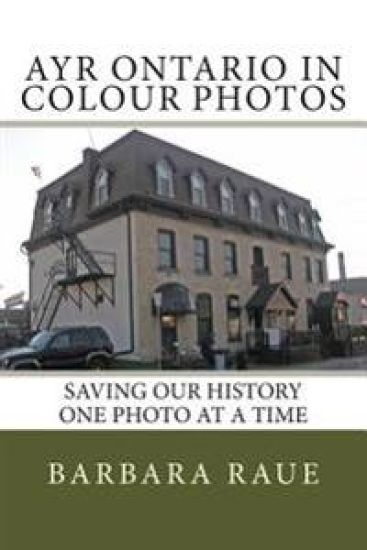
Ayr Ontario in Colour Photos: Saving Our History One Photo at a Time

Ayr Ontario in Colour Photos: Saving Our History One Photo at a Time

Barbara Raue

Createspace Independent Publishing Platform
2015
nidottu
Ayr is located south of Kitchener and west of Cambridge, and south of Highway 401. The history of the village of Ayr is steeped in the traditions and lifestyles of its founders. Ayr remains a well preserved example of a rural agrarian community. In 1824, Abel Mudge built a saw mill and flour mill at the junction of Cedar Creek and the Nith River. This was the first of three settlements, Jedburgh in the east (Main Street), Nithvale in the west (Piper Street) and Mudge's Mill in the centre (Stanley/Northumberland Streets) in what is today the Village of Ayr. Jedburgh began in 1832 when John Hall, a young immigrant from Jedburgh, Scotland, purchased a 75-acre parcel of land that included the area now flooded by Jedburgh Dam. By 1850 Hall had developed several industries, including a flour mill, sawmill and distillery with water power provided by the damming of Cedar Creek. At the same time a smaller settlement, Nithvale, was founded to the west of Mudge's Mill where a small sawmill opened along the Nith River. The growth of these communities, particularly Jedburgh and Mudge's Mill, occurred after 1832 with the immigration of settlers from the Scottish Lowlands. These immigrants were drawn to Canada by promises of inexpensive, fertile land made available by the major landholder of the district at the time, William Dickson. While Jedburgh and Mudge's Mill bitterly fought for supremacy, Nithvale lagged behind in terms of development. The battle between the two communities officially ended in 1840 when Robert Wyllie established a post office under the name "Ayr", a name influenced by the large number of former Ayrshire, Scotland immigrants who were drawn to Canada by promises of inexpensive, fertile land. In 1846-47 Daniel Manley's mill was built, William Baker's store was established and John Watson's foundry constructed with Watson's Dam its power reservoir. These three key businesses played large roles in Ayr's early success as did the coming of the Credit Valley Railway in 1879. James Somerville began the first Ayr newspaper in 1854.
Daddy Where Are You?

Daddy Where Are You?

Barbara Raue

Createspace Independent Publishing Platform
2015
nidottu
What is it like to grow up without a father? There is no male figure to guide you through the ups and downs of life. What challenges are there to face alone?Thankfully we had a wonderful mother who took her responsibility as a parent very seriously and was conscious of meeting the needs of her growing family while staying within a fixed budget. She passed that knowledge on to us so that we can enjoy life and not live with debt hanging over us and pulling us down.From skipping rope to bouncing balls, from paddling to swimming, from reading to writing, Barbara shares her experiences of an ordinary life with challenges to be faced and obstacles to overcome. From childhood to adulthood, to marriage, to her first child, and then two more, from her first job, to her first car, to moving on in a career, Barbara shares her life.From her first camera in the days of film that had to be developed, to digital photography, Barbara's hobby now incorporates an interest in architecture, and she shares her pictures in Saving Our History One Photo at a Time.From figure skating to work with Pioneer Boys and Girls groups, Barbara shows her growth as she embarks on a lifelong learning curve that explores her interest in art, history, photography, geology, astrology, reading and writing. Where did things come from and who discovered or created them? Barbara found out in her studies on inventions.Barbara continues trying to be the best mother and grandmother she can be, to be the best wife she can be, to be the best family historian she can be, to put together the best photography books she can. It is the journey that she lives, its successes and failures, pressing on towards the goals in mind. Her children and grandchildren are important to her and the most precious thing she can give them is herself.As she lives each day, she is open to guidance and direction from above and looks for new opportunities to pursue. Things which were a passing interest to her have become passions. She never thought she would be writing books for others to enjoy. For years she compiled family history books on various branches of the family, but never thought she would produce a biography, a novel, or an autobiography. She has found that she loves to write.The future is unknown but anticipated with wonder and excitement.
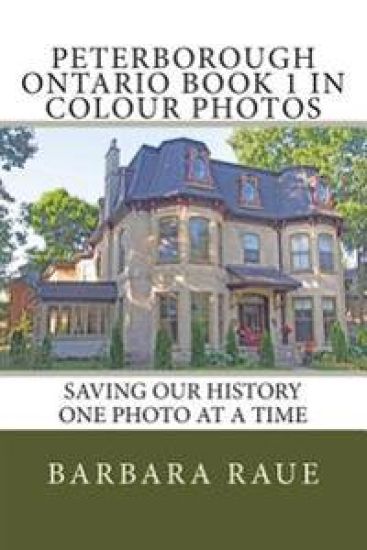
Peterborough Ontario Book 1 in Colour Photos: Saving Our History One Photo at a Time
Peterborough is a city on the Otonabee River in central Ontario, 125 kilometres (78 miles) northeast of Toronto. Peterborough's nickname of "The Electric City" underscores the historical and present day importance of technology and manufacturing as an economic base of the city which has operations from large multi-national companies such as Seimans, Rolls Royce, and General Electric. Peterborough is known as the gateway to the Kawarthas, "cottage country", a large recreational region of the province. In 1818, Adam Scott settled on the west shore of the Otonabee River and the following year he began construction of a sawmill and gristmill, establishing the area as Scott's Plains. The mill was located at the foot of present-day King Street and was powered by water from Jackson Creek.The year 1825 marked the arrival of 1,878 Irish immigrants from the city of Cork, a British Parliament experimental emigration plan to transport poor Irish families to Upper Canada. The scheme was managed by Peter Robinson, a politician in York (present-day Toronto). Scott's Plains was renamed Peterborough in his honour. The Irish emigrated from the Emerald Isle to escape over-crowding, poverty, political unrest, religious tensions, disease and the potato famine. By 1851 almost half of the town of Peterborough claimed Irish ancestry. They cleared the land in the rolling hills of the Peterborough countryside In 1845, Sandford Fleming, inventor of Standard Time and designer of Canada's first postage stamp, moved to the city to live with Dr. John Hutchison and his family, staying until 1847. Dr. John Hutchison was one of Peterborough's first resident doctors.Beginning in the late 1850s, a canoe building industry grew up in and around Peterborough. The Peterborough Canoe Company was founded in 1893, with the factory being built on the site of the original Adam Scott mill. From 1928-36 the Johnson Motor Company/Outboard Marine (the makers of motorized boat engines) was established as an outgrowth of the original industry.Peterborough was one of the first places in the country to begin generating hydro electrical power (even before the plants at Niagara Falls). Companies like Edison General Electric Company (later Canadian General Electric) and America Cereal Company (later to become Quaker Oats, and in 2001 PepsiCo, Inc.), opened to take advantage of cheap hydro-electric power.
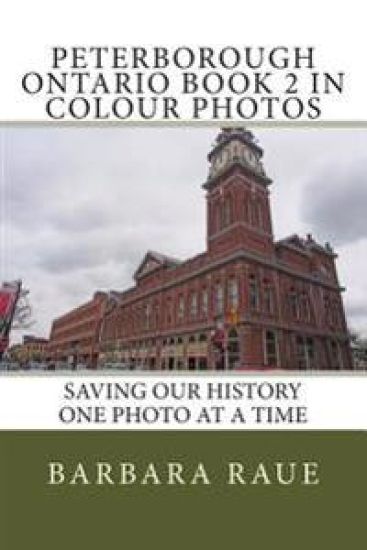
Peterbrough Ontario Book 2 in Colour Photos: Saving Our History One Photo at a Time

Peterbrough Ontario Book 2 in Colour Photos: Saving Our History One Photo at a Time

Barbara Raue

Createspace Independent Publishing Platform
2015
nidottu
Peterborough is a city on the Otonabee River in central Ontario, 125 kilometres (78 miles) northeast of Toronto. Peterborough's nickname of "The Electric City" underscores the historical and present day importance of technology and manufacturing as an economic base of the city which has operations from large multi-national companies such as Seimans, Rolls Royce, and General Electric. Peterborough is known as the gateway to the Kawarthas, "cottage country", a large recreational region of the province. In 1818, Adam Scott settled on the west shore of the Otonabee River and the following year he began construction of a sawmill and gristmill, establishing the area as Scott's Plains. The mill was located at the foot of present-day King Street and was powered by water from Jackson Creek.The year 1825 marked the arrival of 1,878 Irish immigrants from the city of Cork, a British Parliament experimental emigration plan to transport poor Irish families to Upper Canada. The scheme was managed by Peter Robinson, a politician in York (present-day Toronto). Scott's Plains was renamed Peterborough in his honour. The Irish emigrated from the Emerald Isle to escape over-crowding, poverty, political unrest, religious tensions, disease and the potato famine. By 1851 almost half of the town of Peterborough claimed Irish ancestry. They cleared the land in the rolling hills of the Peterborough countryside In 1845, Sandford Fleming, inventor of Standard Time and designer of Canada's first postage stamp, moved to the city to live with Dr. John Hutchison and his family, staying until 1847. Dr. John Hutchison was one of Peterborough's first resident doctors.Beginning in the late 1850s, a canoe building industry grew up in and around Peterborough. The Peterborough Canoe Company was founded in 1893, with the factory being built on the site of the original Adam Scott mill. From 1928-36 the Johnson Motor Company/Outboard Marine (the makers of motorized boat engines) was established as an outgrowth of the original industry.Peterborough was one of the first places in the country to begin generating hydro electrical power (even before the plants at Niagara Falls). Companies like Edison General Electric Company (later Canadian General Electric) and America Cereal Company (later to become Quaker Oats, and in 2001 PepsiCo, Inc.), opened to take advantage of cheap hydro-electric power.
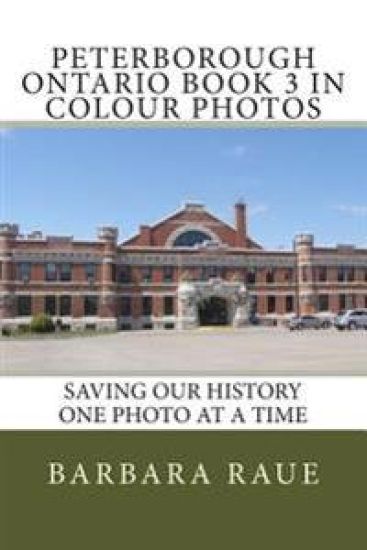
Peterborough Ontario Book 3 in Colour Photos: Saving Our History One Photo at a Time
Peterborough is a city on the Otonabee River in central Ontario, 125 kilometers (78 miles) northeast of Toronto. Peterborough's nickname of "The Electric City" underscores the historical and present day importance of technology and manufacturing as an economic base of the city which has operations from large multi-national companies such as Seimans, Rolls Royce, and General Electric. Peterborough is known as the gateway to the Kawarthas, "cottage country", a large recreational region of the province. In 1818, Adam Scott settled on the west shore of the Otonabee River and the following year he began construction of a sawmill and gristmill, establishing the area as Scott's Plains. The mill was located at the foot of present-day King Street and was powered by water from Jackson Creek. The year 1825 marked the arrival of 1,878 Irish immigrants from the city of Cork, a British Parliament experimental emigration plan to transport poor Irish families to Upper Canada. The scheme was managed by Peter Robinson, a politician in York (present-day Toronto). Scott's Plains was renamed Peterborough in his honor. The Irish emigrated from the Emerald Isle to escape over-crowding, poverty, political unrest, religious tensions, disease and the potato famine. By 1851 almost half of the town of Peterborough claimed Irish ancestry. They cleared the land in the rolling hills of the Peterborough countryside In 1845, Sandford Fleming, inventor of Standard Time and designer of Canada's first postage stamp, moved to the city to live with Dr. John Hutchison and his family, staying until 1847. Dr. John Hutchison was one of Peterborough's first resident doctors.Beginning in the late 1850s, a canoe building industry grew up in and around Peterborough. The Peterborough Canoe Company was founded in 1893, with the factory being built on the site of the original Adam Scott mill. From 1928-36 the Johnson Motor Company/Outboard Marine (the makers of motorized boat engines) was established as an outgrowth of the original industry.Peterborough was one of the first places in the country to begin generating hydro electrical power (even before the plants at Niagara Falls). Companies like Edison General Electric Company (later Canadian General Electric) and America Cereal Company (later to become Quaker Oats, and in 2001 PepsiCo, Inc.), opened to take advantage of cheap hydro-electric power.BridgenorthBridgenorth is located on Chemong Lake in the Kawarthas. It is located north of Peterborough on Chemong Road. Emerald IsleEmerald Isle is located on Buckhorn Lake.EnnismoreEnnismore is located in Selwyn Township in central-eastern Ontario.
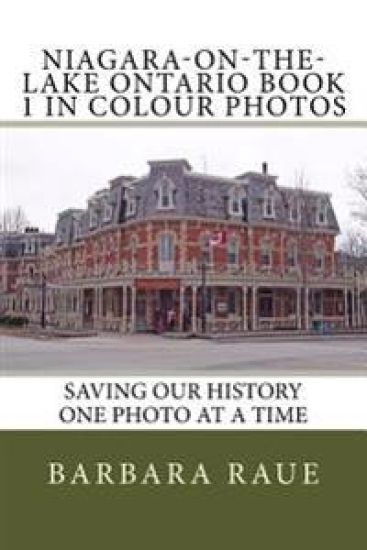
Niagara-on-the-Lake Ontario Book 1 in Colour Photos: Saving Our History One Photo at a Time
Known at various times as Butlersburg, West Niagara, and Newark, its first permanent settlers, Butlers Rangers and other Loyalist refugees arrived in 1778 when they began crossing from Fort Niagara to settle the west bank of the Niagara River. A town was laid out in a grid pattern of four-acre blocks and grew quickly, gaining prominence as the first capital of Upper Canada from 1792 to 1796. The town was captured by American forces on May 27, 1813; upon their withdrawal on December 13, 1813, the American forces burned the town.Following Niagara's destruction, the citizens rebuilt mainly in the British classical architectural tradition, creating a group of structures closely related in design, material and scale. Spared from redevelopment, the town's colonial buildings eventually became one of its greatest resources. Beginning in the 1950s, residents rehabilitated and restored old structures, demonstrating an exceptional commitment to the preservation of local heritage.The Prince of Wales Hotel is a historic Victorian hotel located at King Street and Picton Street. Built in 1864, the three storey 110 room hotel went by several names (Long's Hotel, Arcade Hotel, The Niagara House) and was renamed with the current name after famous guests The Duke of York (and Prince of Wales) and The Duchess of York in 1901. Queen Elizabeth II stayed at the hotel during her visit to the area in 1973.
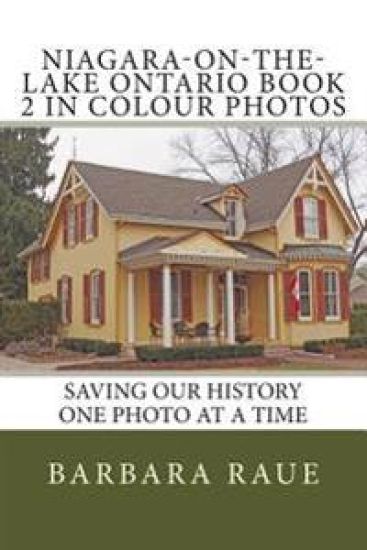
Niagara-on-the-Lake Ontario Book 2 in Colour Photos: Saving Our History One Photo at a Time
Known at various times as Butlersburg, West Niagara, and Newark, its first permanent settlers, Butlers Rangers and other Loyalist refugees arrived in 1778 when they began crossing from Fort Niagara to settle the west bank of the Niagara River. A town was laid out in a grid pattern of four-acre blocks and grew quickly, gaining prominence as the first capital of Upper Canada from 1792 to 1796. The town was captured by American forces on May 27, 1813; upon their withdrawal on December 13, 1813, the American forces burned the town.Following Niagara's destruction, the citizens rebuilt mainly in the British classical architectural tradition, creating a group of structures closely related in design, material and scale. Spared from redevelopment, the town's colonial buildings eventually became one of its greatest resources. Beginning in the 1950s, residents rehabilitated and restored old structures, demonstrating an exceptional commitment to the preservation of local heritage.The Prince of Wales Hotel is a historic Victorian hotel located at King Street and Picton Street. Built in 1864, the three storey 110 room hotel went by several names (Long's Hotel, Arcade Hotel, The Niagara House) and was renamed with the current name after famous guests The Duke of York (and Prince of Wales) and The Duchess of York in 1901. Queen Elizabeth II stayed at the hotel during her visit to the area in 1973.