Kirjojen hintavertailu. Mukana 11 469 912 kirjaa ja 12 kauppaa.

Kirjahaku

Etsi kirjoja tekijän nimen, kirjan nimen tai ISBN:n perusteella.

1000 tulosta hakusanalla Charles Hibbert Tupper

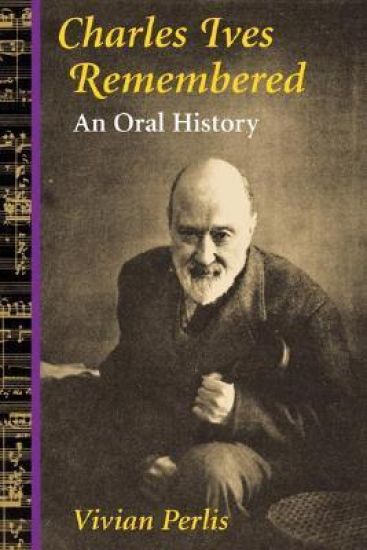
Charles Ives Remembered

Charles Ives Remembered

Vivian Perlis

University of Illinois Press
2002
nidottu
Interweaving photographs, concert programs, scores, and drawings with the texts of more than fifty interviews with family, friends, neighbors, and colleagues, Charles Ives Remembered is a vivid memory portrait of the enigmatic American composer, told in the voices of the people who knew him best. Charles Ives (1874-1954) was publicly an insurance executive but privately a composer whose eccentric works and paradoxical life would intrigue, perplex, and inspire generations to come after him. Moving from Ives's childhood and years at Yale to his business and musical careers, the memories and reflections assembled in this Kinkeldey Award-winning volume provide a multifaceted and humanizing view of an American musical icon.
Charles Ives Reconsidered

Charles Ives Reconsidered

Gayle Sherwood Magee

University of Illinois Press
2010
nidottu
Charles Ives Reconsidered reexamines a number of critical assumptions about the life and works of this significant American composer, drawing on many new sources to explore Ives's creative activities within broader historical, social, cultural, and musical perspectives. Gayle Sherwood Magee offers the first large-scale rethinking of Ives's musical development based on the controversial revised chronology of his music. Using as a guide Ives's own dictum that "the fabric of existence weaves itself whole," Charles Ives Reconsidered offers several new paths to understanding all of Ives's music as the integrated and cohesive work of a controversial composer who was very much a product of his time and place. Magee portrays Ives's life, career and posthumous legacy against the backdrop of his musical and social environments from the Gilded Age to the present. The book includes contemporary portraits of the composer, his peers, and his teachers, as seen through archival materials, published reviews, and both historical and modern critical assessments.
Charles Ives in the Mirror

Charles Ives in the Mirror

David C Paul

University of Illinois Press
2014
nidottu
American composer Charles Ives (1874–1954) has gone from being a virtual unknown to become one of the most respected and lauded composers in American music. In this sweeping survey of intellectual and musical history, David C. Paul tells the new story of how Ives's music was shaped by shifting conceptions of American identity within and outside of musical culture, charting the changes in the reception of Ives across the twentieth century and into the twenty-first century. Paul focuses on the critics, composers, performers, and scholars whose contributions were most influential in shaping the critical discourse on Ives, many of them marquee names of American musical culture themselves, including Henry Cowell, Aaron Copland, Elliott Carter, and Leonard Bernstein. Paul explores both how Ives positioned his music amid changing philosophical and aesthetic currents and how others interpreted his contributions to American music. Although Ives's initial efforts to find a public in the early twenties attracted a few devotees, the resurgence of interest in the American literary past during the thirties made a concert staple of his "Concord" Sonata, a work dedicated to nineteenth-century transcendentalist writers. Paul shows how Ives was subsequently deployed as an icon of American freedom during the early Cold War period and how he came to be instigated at the head of a line of "American maverick" composers. Paul also examines why a recent cadre of scholars has beset the composer with Gilded Age social anxieties. By embedding Ives' reception within the changing developments of a wide range of fields including intellectual history, American studies, literature, musicology, and American politics and society in general, Charles Ives in the Mirror: American Histories of an Iconic Composer greatly advances our understanding of Ives and his influence on nearly a century of American culture.
Charles Ives's Concord

Charles Ives's Concord

Kyle Gann

University of Illinois Press
2021
nidottu
In 1921, insurance executive Charles Ives sent out copies of a piano sonata to two hundred strangers. Laden with dissonant chords, complex rhythm, and a seemingly chaotic structure, the so-called Concord Sonata confounded the recipients, as did the accompanying book, Essays before a Sonata. Kyle Gann merges exhaustive research with his own experience as a composer to reveal the Concord Sonata and the essays in full. Diffracting the twinned works into their essential aspects, Gann lays out the historical context that produced Ives's masterpiece and illuminates the arguments Ives himself explored in the Essays. Gann also provides a movement-by-movement analysis of the work's harmonic structure and compositional technique; connects the sonata to Ives works that share parts of its material; and compares the 1921 version of the Concord with its 1947 revision to reveal important aspects of Ives's creative process.A tour de force of critical, theoretical, and historical thought, Charles Ives's Concord provides nothing less than the first comprehensive consideration of a work at the heart of twentieth century American music.
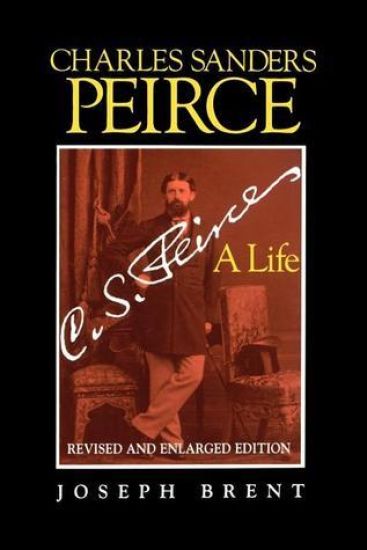
Charles Sanders Peirce (Enlarged Edition), Revised and Enlarged Edition
"[Brent] has produced a thoughtful, sometimes moving, and entirely accessible intellectual biography which is also, under the circumstances, indispensable." —The New York Review of Books " . . . a fine biography." —The New York Times Book Review ". . . an extraordinary, inspiring portrait of the largely forgotten Peirce, a progenitor of modern thought who devised a realist metaphysics and attempted to achieve direct knowledge of God by applying the logic of science." —Publishers Weekly In this expanded paperback edition of the critically acclaimed biography of a true American original, the philosopher-polymath Charles Sanders Peirce, Joseph Brent refines his interpretation of Peirce's thought and character based on new research, and has added a glossary and a detailed chronology.
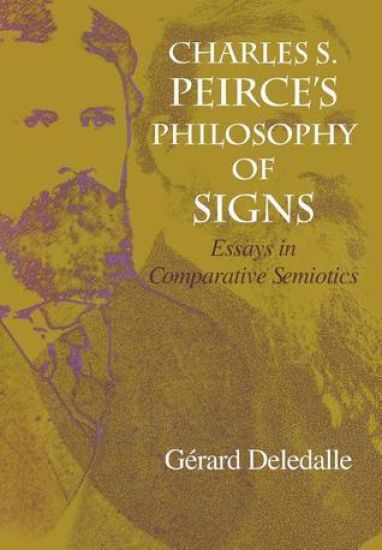
Charles S. Peirce's Philosophy of Signs

Charles S. Peirce's Philosophy of Signs

Gerard Deledalle

Indiana University Press
2001
sidottu
[Note: Picture of Peirce available] Charles S. Peirce's Philosophy of Signs Essays in Comparative Semiotics Gérard Deledalle Peirce's semiotics and metaphysics compared to the thought of other leading philosophers. "This is essential reading for anyone who wants to find common ground between the best of American semiotics and better-known European theories. Deledalle has done more than anyone else to introduce Peirce to European audiences, and now he sends Peirce home with some new flare."—Nathan Houser, Director, Peirce Edition Project Charles S. Peirce's Philosophy of Signs examines Peirce's philosophy and semiotic thought from a European perspective, comparing the American's unique views with a wide variety of work by thinkers from the ancients to moderns. Parts I and II deal with the philosophical paradigms which are at the root of Peirce's new theory of signs, pragmatic and social. The main concepts analyzed are those of "sign" and "semiosis" and their respective trichotomies; formally in the case of "sign," in time in the case of semiosis. Part III is devoted to comparing Peirce's theory of semiotics as a form of logic to the work of other philosophers, including Bertrand Russell, Wittgenstein, Frege, Philodemus, Lady Welby, Saussure, Morris, Jakobson, and Marshall McLuhan. Part IV compares Peirce's "scientific metaphysics" with European metaphysics. Gérard Deledalle holds the Doctorate in Philosophy from the Sorbonne. A research scholar at Columbia University and Attaché at the Centre National de la Recherche Scientifique, Paris, he has also been Professor of Philosophy and Head of the Philosophy Department of the universities of Tunis, Perpignan, and Libreville. In 1990 he received the Herbert W. Schneider Award "for distinguished contributions to the understanding and development of American philosophy. In 2001, he was appointed vice-president of the Charles S. Peirce Society. Contents Introduction—Peirce Compared: Directions for Use Part I—Semeiotic as Philosophy Peirce's New Philosophical Paradigms Peirce's Philosophy of Semeiotic Peirce's First Pragmatic Papers (1877-1878) The Postscriptum of 1893 Part II—Semeiotic as Semiotics Sign: Semiosis and Representamen—Semiosis and Time Sign: The Concept and Its Use—Reading as Translation Part III—Comparative Semiotics Semiotics and Logic: A Reply to Jerzy Pelc Semeiotic and Greek Logic: Peirce and Philodemus Semeiotic and Significs: Peirce and Lady Welby Semeiotic and Semiology: Peirce and Saussure Semeiotic and Semiotics: Peirce and Morris Semeiotic and Linguistics: Peirce and Jakobson Semeiotic and Communication: Peirce and McLuhan Semeiotic and Epistemology: Peirce, Frege, and Wittgenstein Part IV—Comparative Metaphysics Gnoseology—Perceiving and Knowing: Peirce, Wittgenstein, and Gestalttheorie Ontology—Transcendentals "of" or "without" Being: Peirce versus Aristotle and Thomas Aquinas Cosmology—Chaos and Chance within Order and Continuity: Peirce between Plato and Darwin Theology—The Reality of God: Peirce's Triune God and the Church's Trinity Conclusion—Peirce: A Lateral View
Charles Peirce's Guess at the Riddle

Charles Peirce's Guess at the Riddle

John K. Sheriff

Indiana University Press
1994
sidottu
"Sheriff's text moves the "guess" to a new level of understanding, while integrating much of Peirce's philosophy, and provokes many questions." —Society for the Advancement of American Philosophy Newletter "The purpose of Sheriff's work is to expound Peirce's unified theory of the universe—from cosmology to semiotic—and to discuss its ramifications for how we should live. He concludes that Peirce has given us a theory we can live with. The book makes an important contribution to philosophy of life and to the humanities in general." —Nathan Houser "In clear and concise prose, Sheriff describes Peirce's 'theory of everything,' a vision of cosmic and human meaning that offers a positive alternative to popular pessimistic and relativistic approaches to life and meaning." —Peirce Project Newsletter
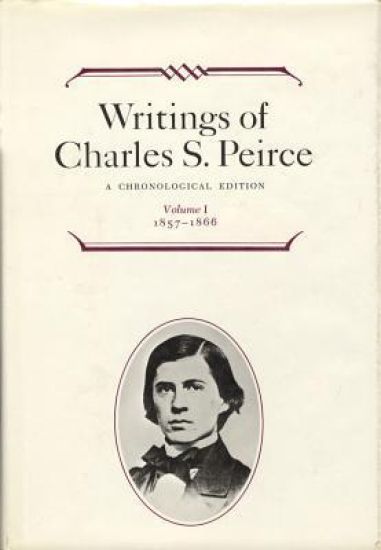
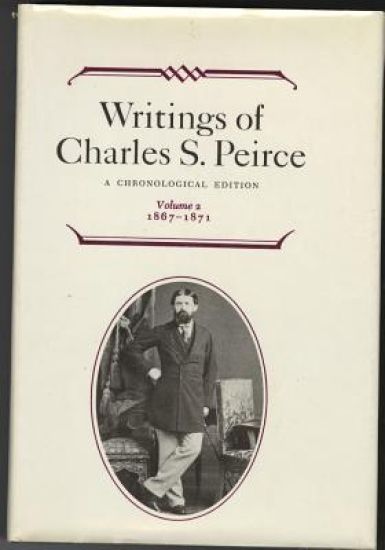
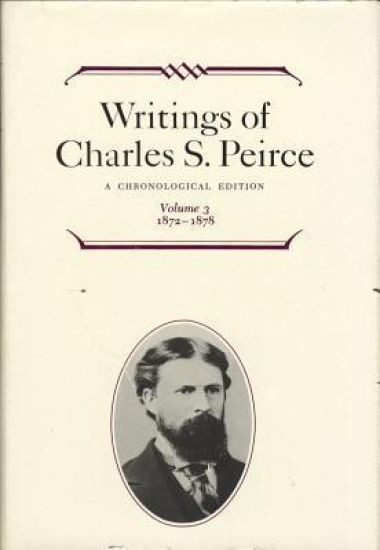
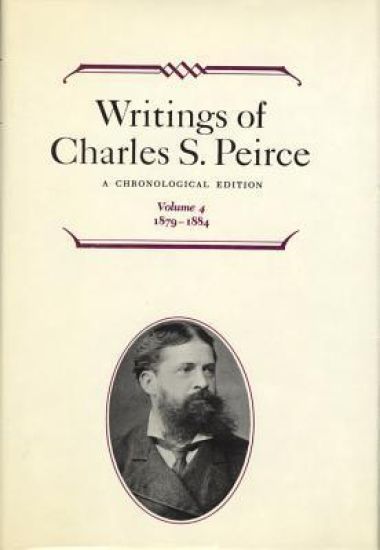
Writings of Charles S. Peirce: a Chronological Edition, Volume 4
"The volumes are handsomely produced and carefully edited, . . . For the first time we have available in an intelligible form the writings of one of the greatest philosophers of the past hundred years . . . " —The Times Literary Supplement " . . . an extremely handsome and impressive book; it is an equally impressive piece of scholarship and editing." —Man and World
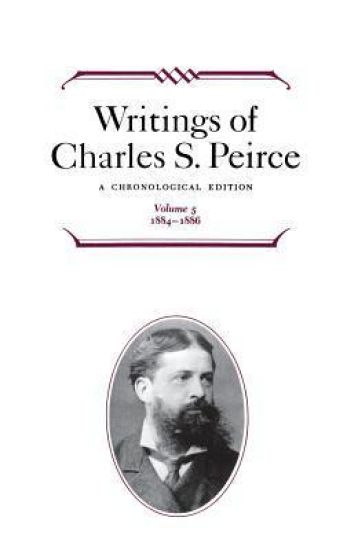
Writings of Charles S. Peirce: a Chronological Edition, Volume 5
"Highly recommended." —Choice " . . . an important event for the world of philosophy. For the first time we have available in an intelligible form the writings of one of the greatest philosophers of the past hundred years." —The Times Literary Supplement Volume 5 of this landmark edition covers an important transition in Peirce's life, marked by a rekindled enthusiasm for speculative philosophy. The writings include essays relating to his all-embracing theory of categories as well as papers on logic and mathematics.
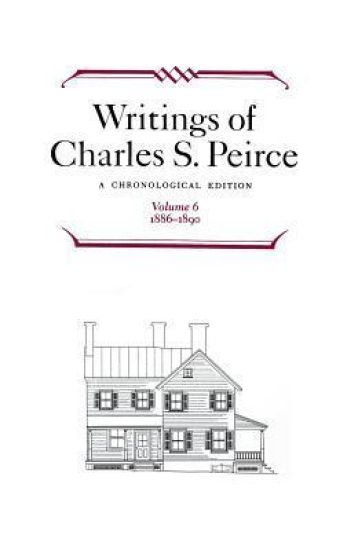
Writings of Charles S. Peirce: a Chronological Edition, Volume 6
Volume 6 of this landmark edition contains 66 writings mainly from the unsettled period in Peirce's life just after he moved from New York to Milford, Pennsylvania, followed shortly afterward by the death of his mother. The writings in this volume reveal Peirce's powerful mind probing into diverse issues, looking for an underlying unity, but, perhaps, also looking for direction.
Writings of Charles S. Peirce: a Chronological Edition, Volume 8
Volume 8 of this landmark edition follows Peirce from May 1890 through July 1892—a period of turmoil as his career unraveled at the U.S. Coast and Geodetic Survey. The loss of his principal source of income meant the beginning of permanent penury and a lifelong struggle to find gainful employment. His key achievement during these years is his celebrated Monist metaphysical project, which consists of five classic articles on evolutionary cosmology. Also included are reviews and essays from The Nation in which Peirce critiques Paul Carus, William James, Auguste Comte, Cesare Lombroso, and Karl Pearson, and takes part in a famous dispute between Francis E. Abbot and Josiah Royce. Peirce's short philosophical essays, studies in non-Euclidean geometry and number theory, and his only known experiment in prose fiction complete his production during these years. Peirce's 1883-1909 contributions to the Century Dictionary form the content of volume 7 which is forthcoming.
The Writings of Charles De Koninck

The Writings of Charles De Koninck

Charles De Koninck

University of Notre Dame Press
2008
sidottu
The Writings of Charles De Koninck, volumes 1 and 2, present the first English editions of collected works of the Catholic Thomist philosopher Charles De Koninck (1906–1965). Ralph McInerny (1929–2010) was the project editor and prepared the excellent translations. Volume 1 contains writings ranging from De Koninck's 1934 dissertation at the University of Louvain on the philosophy of Sir Arthur Eddington, to two remarkable early essays on indeterminism and the unpublished book The Cosmos. The short essay "Are the Experimental Sciences Distinct from the Philosophy of Nature?" demonstrates for the first time De Koninck's distinctive view on the relation between philosophy of nature and the experimental sciences. Volume 1 also includes a comprehensive introductory essay by Leslie Armour outlining the structure and themes of De Koninck's philosophy, and a biographical essay by De Koninck's son, Thomas.
The Writings of Charles De Koninck

The Writings of Charles De Koninck

Charles De Koninck

University of Notre Dame Press
2009
sidottu
Volume 2 of The Writings of Charles De Koninck carries on the project begun by volume 1 of presenting the first English edition of the collected works of the Catholic Thomist philosopher Charles De Koninck (1906–1965). Ralph McInerny (1929–2010) was the project editor and prepared the excellent translations. This volume begins with two works published in 1943: Ego Sapientia: The Wisdom That Is Mary, De Koninck's first study in Mariology, and The Primacy of the Common Good Against the Personalists (with The Principle of the New Order), which generated a strong critical reaction. Included in this volume are two reviews of The Primacy of the Common Good, by Yves R. Simon and I. Thomas Eschmann, O.P., and De Koninck's substantial response to Eschmann in his lengthy "In Defence of St. Thomas." The volume concludes with a group of short essays: "The Dialectic of Limits as Critique of Reason," "Notes on Marxism," "This Is a Hard Saying," "[Review of] Between Heaven and Earth," and "Concept, Process, and Reality."
The Writings of Charles De Koninck

The Writings of Charles De Koninck

Charles De Koninck

University of Notre Dame Press
2016
nidottu
The Writings of Charles De Koninck, volumes 1 and 2, present the first English editions of collected works of the Catholic Thomist philosopher Charles De Koninck (1906–1965). Ralph McInerny (1929–2010) was the project editor and prepared the excellent translations. Volume 1 contains writings ranging from De Koninck's 1934 dissertation at the University of Louvain on the philosophy of Sir Arthur Eddington, to two remarkable early essays on indeterminism and the unpublished book The Cosmos. The short essay "Are the Experimental Sciences Distinct from the Philosophy of Nature?" demonstrates for the first time De Koninck's distinctive view on the relation between philosophy of nature and the experimental sciences. Volume 1 also includes a comprehensive introductory essay by Leslie Armour outlining the structure and themes of De Koninck's philosophy, and a biographical essay by De Koninck's son, Thomas.
The Writings of Charles De Koninck

The Writings of Charles De Koninck

Charles De Koninck

University of Notre Dame Press
2016
nidottu
Volume 2 of The Writings of Charles De Koninck carries on the project begun by volume 1 of presenting the first English edition of the collected works of the Catholic Thomist philosopher Charles De Koninck (1906–1965). Ralph McInerny (1929–2010) was the project editor and prepared the excellent translations. This volume begins with two works published in 1943: Ego Sapientia: The Wisdom That Is Mary, De Koninck's first study in Mariology, and The Primacy of the Common Good Against the Personalists (with The Principle of the New Order), which generated a strong critical reaction. Included in this volume are two reviews of The Primacy of the Common Good, by Yves R. Simon and I. Thomas Eschmann, O.P., and De Koninck's substantial response to Eschmann in his lengthy "In Defence of St. Thomas." The volume concludes with a group of short essays: "The Dialectic of Limits as Critique of Reason," "Notes on Marxism," "This Is a Hard Saying," "[Review of] Between Heaven and Earth," and "Concept, Process, and Reality."