

Kirjahaku
Etsi kirjoja tekijän nimen, kirjan nimen tai ISBN:n perusteella.
1000 tulosta hakusanalla Daniel C. Morrison



Parish Communities and Religious Conflict in the Vale of Gloucester, 1590–1690
Daniel C. Beaver
Harvard University Press
1998
sidottu
Many historians have attempted to understand the violent religious conflicts of the seventeenth century from viewpoints dominated by concepts of class, gender, and demography. But few studies have explored the cultural process whereby religious symbolism created social cohesion and political allegiance. This book examines religious conflict in the parish communities of early modern England using an interdisciplinary approach that includes all these perspectives.Daniel Beaver studies the urban parish of Tewkesbury and six rural parishes in its hinterland over a period of one hundred years, drawing on local ecclesiastical court records, sermons, parish records, corporate minutes and charity books, and probate documents. He discusses the centrality of religious symbols and ceremonies in the ordering of local societies, particularly in local conceptions of place, personal identity, and the life cycle. Four phases in the transformation of parish communities emerge and are examined in this book.This exploration of the interrelationship of religion, politics, and society, and the transformation of local communities in civil war, has a value beyond the particular history of early modern England, contributing to a broader understanding of religious revivals, fundamentalisms, and the persistent link between religion, nationalism, and ethnic identity in the modern world.
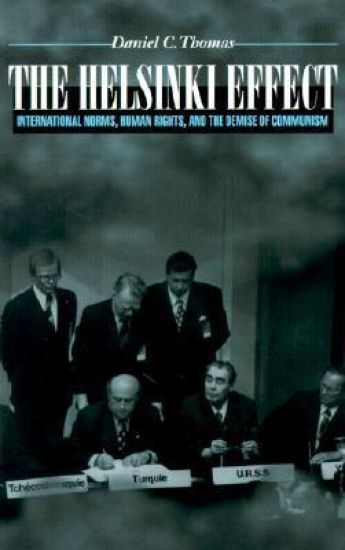
Human rights norms do matter. Those established by the Helsinki Final Act contributed directly to the demise of communism in the former East bloc, contends Daniel Thomas. This book counters those skeptics who doubt that such international norms substantially affect domestic political change, while explaining why, when, and how they matter most. Thomas argues that the Final Act, signed in 1975, transformed the agenda of East-West relations and provided a common platform around which opposition forces could mobilize. Without downplaying other factors, Thomas shows that the norms established at Helsinki undermined the viability of one-party Communist rule and thereby contributed significantly to the largely peaceful and democratic changes of 1989, as well as the end of the Cold War. Drawing on both governmental and nongovernmental sources, he offers a powerful Constructivist alternative to Realist theory's failure to anticipate or explain these crucial events. This study will fundamentally influence ongoing debates about the politics of international institutions, the socialization of states, the spread of democracy, and, not least, about the balance of factors that felled the Iron Curtain. It casts new light on Solidarity, Charter 77, and other democratic movements in Eastern Europe, the sources of Gorbachev's reforms, the evolution of the European Union, U.S. foreign policy, and East-West relations in the final decades of the Cold War. The Helsinki Effect will be essential reading for scholars and students of international relations, international law, European politics, human rights, and social movements.

The astonishing untold story of the author's father, the lone American on a 4-person SOE commando team dropped behind German lines in France, whose epic feats of irregular warfare proved vital in keeping Nazi tanks away from Normandy after D-Day. When Daniel Guiet was a child and his family moved country, as they frequently did, his father had one possession, a tin bread box, that always made the trip. Daniel was admonished never to touch the box, but one day he couldn't resist. What he found astonished him: a .45 automatic and five full clips; three slim knives; a length of wire with a wooden handle at each end; thin pieces of paper with random numbers on them; several passports with his father's photograph, each bearing a different name; and a large silk square with eight flags, with a message underneath each flag in the language corresponding to it. The one in English read: "I am an American. Help me. You will be well paid." Eventually Jean Claude Guiet revealed to his family that he had been in the CIA, but it was only at the very end of his life that he spoke of the mission during World War II that marked the beginning of his career in clandestine service. It is one of the last great untold stories of the war, and Daniel Guiet and his collaborator, the writer Tim Smith, have spent several years bringing it to life. Jean Claude was an American citizen but a child of France, and fluent in the language; he was also extremely bright. The American military was on the lookout for native French speakers to be seconded to a secret British special operations commando operation, dropping saboteurs behind German lines in France to coordinate aid to the French Resistance and lead missions wreaking havoc on Germany's military efforts across the entire country. Jean Claude was recruited, and his life was changed forever. Though the human cost was terrible, the mission succeeded beyond the Allies' wildest dreams.Scholars of Mayhem tells the story of Jean Claude and the other three agents in his "circuit," codenamed Salesman, a unit of Britain's Special Operations Executive, the secret service ordered by Churchill to "Set Europe ablaze." Parachuted into France the day after D-Day, the Salesman team organized, armed, and commanded a ghostly army of 10,000 French Resistance fighters. National pride has kept the story of SOE in France obscure, but of this there is no doubt: While the Resistance had plenty of heart, it was SOE that gave it teeth and claws. Scholars of Mayhem adds brilliantly to that picture, and further underscores what a close-run thing the success of the Allied breakout from the Normandy landings actually was.

"Riveting...A true-life mix of James Bond, Lawrence of Arabia and 'Casablanca.'" -The Wall Street Journal The astonishing untold story of the author's father, the lone American on a four-person team of Allied secret agents dropped into Nazi-occupied France, whose epic feats of irregular warfare proved vital in keeping German tanks away from Normandy after D-Day. When Daniel Guiet was a child and his family moved country, as they frequently did, his father had one possession, a tin bread box, that always made the trip. Daniel was admonished never to touch the box, but one day he couldn't resist. What he found astonished him: a .45 automatic and five full clips; three slim knives; a length of wire with a wooden handle at each end; thin pieces of paper with random numbers on them; several passports with his father's photograph, each bearing a different name; and silk squares imprinted with different countries' flags, bearing messages in unfamiliar alphabets. The messages, he discovered much later, were variations on a theme: I am an American. Take me to the nearest Allied military office. You will be paid. Eventually Jean Claude Guiet revealed to his family that he had been in the CIA, but it was only at the very end of his life that he spoke of the mission during World War II that marked the beginning of his career in clandestine service. It is one of the last great untold stories of the war, and Daniel Guiet and his collaborator, the writer Tim Smith, have spent several years bringing it to life. Jean Claude was an American citizen but a child of France, and fluent in the language; he was also extremely bright. The American military was on the lookout for native French speakers to be seconded to a secret British special operations commando operation, dropping clandestine agents behind German lines in France to coordinate aid to the French Resistance and lead missions wreaking havoc on Germany's military efforts across the entire country. Jean Claude was recruited, and his life was changed forever. Though the human cost was terrible, the mission succeeded beyond the Allies' wildest dreams. Scholars of Mayhem tells the story of Jean Claude and the other three agents in his "circuit," codenamed Salesman, a unit of Britain's Special Operations Executive, the secret service ordered by Churchill to "Set Europe ablaze." Parachuted into France the day after D-Day, the Salesman team organized, armed, and commanded an underground army of 10,000 French Resistance fighters. National pride has kept the story of SOE in France obscure, but of this there is no doubt: While the Resistance had plenty of heart, it was SOE that gave it teeth and claws. Scholars of Mayhem adds brilliantly to that picture, and further underscores what a close-run thing the success of the Allied breakout from the Normandy landings actually was.

Consisting of four illuminating case studies, Separate Agendas examines different aspects of the relationship between Winston Churchill's government and the Eisenhower administration in the years before the Suez crisis. By exploring Anglo-American relations in Europe, the Middle East, and East Asia, Daniel C. Williamson provides a detailed analysis of four distinct issues while at the same time offering more general conclusions about Britain's role in the world. In demonstrating how Britain was able to pursue foreign policy goals that were at odds with American wishes as well as exert influence on American diplomatic actions, Separate Agendas sheds new light on the extent of Britain's continued importance as a world power. This book will be valuable reading for scholars of Anglo-American relations, the early Cold War, and the post-war British Empire.

Consisting of four illuminating case studies, Separate Agendas examines different aspects of the relationship between Winston Churchill's government and the Eisenhower administration in the years before the Suez crisis. By exploring Anglo-American relations in Europe, the Middle East, and East Asia, Daniel C. Williamson provides a detailed analysis of four distinct issues while at the same time offering more general conclusions about Britain's role in the world. In demonstrating how Britain was able to pursue foreign policy goals that were at odds with American wishes as well as exert influence on American diplomatic actions, Separate Agendas sheds new light on the extent of Britain's continued importance as a world power. This book will be valuable reading for scholars of Anglo-American relations, the early Cold War, and the post-war British Empire.


Staten Island is New York City’s smallest yet fastest growing borough: a conservative, suburban community of nearly a half a million on the fringe of the nation’s most liberal, global city. Staten Island: Conservative Bastion in a Liberal City chronicles how this “forgotten borough” has grappled with its uneasy relationship with the rest of the City of New York since the 1920s. Daniel C. Kramer and Richard M. Flanagan analyze the politics behind events that have shaped the borough, such as the opening of the Verrazano Bridge and the closure of the Fresh Kills Landfill. Lost opportunities are discussed, including the failure to construct a rail link to the other boroughs of New York, to adequately plan for the explosive housing boom in recent decades and, some say, to create an independent City of Staten Island. Unlike much of New York City, Staten Island is a place with robust party competition and lively democratic politics with hard-fought campaigns, bitter feuds, and career-ending scandals. Staten Island’s two most successful politicians of the twentieth century—Republicans John Marchi and Guy Molinari—defended the borough’s interests while defining an urban conservativism that would influence politics elsewhere. In fact, Staten Island has played a pivotal role in the winning electoral coalitions of Republican mayors Rudy Giuliani and Michael Bloomberg and continues to spark the imaginations of New Yorkers on a scale that is disproportionate to the borough’s relatively small size. Staten Island: Conservative Bastion in a Liberal City will allow readers to gain access to the borough-based roots of New York City’s politics. This book will be of special interest to anyone who wishes to understand the dynamics of middle-class life and democratic representation in a global city.

In this important book a reasonable, biblically based epistemology is used to discuss the limits of argument and the role of religious knowing based on spirit. The book covers all major areas of apologetics, evaluating, critiquing, and reapplying the cultural apologetics of Schaeffer, Rookmaaker, and others.

Environmental Oceanography: Topics And Analysis
Daniel C Abel; Robert L McConnell
Jones and Bartlett Publishers, Inc
2009
nidottu
Environmental Oceanography: Towards a Sustainable Marine Environment is an interactive text and casebook designed to teach students about pressing marine environmental issues using critical thinking and basic math. The text uses an innovative approach to teaching environmental oceanography, consisting of marine environmental issues resented as self-contained analytical exercises, with information and questions on sustainability integrated throughout the text. Appropriate for a wide range of readers, Environmental Oceanography works well as a stand-alone text when supplemented with web-based activities, a lab-based course book, and as a supplement to main texts in oceanography and marine science for those instructors who would like to add an active learning focus to their course. Regardless of whether you are teaching a large or small course, Environmental Oceanography will engage and excite your students and prompt them to think critically about pressing environmental issues.
Maritime Calvinistic Baptist piety emerged from a fusion of revivalism and conversion, and introduced dramatic baptisms by immersion. Rapid Baptist growth was one force leading Anglicans, Methodists, and Presbyterians to initiate a spiritual polemical exchange over baptism. By examining the lives and work of six Baptist preachers and theologians, Into Deep Waters illuminates the ways in which the second generation of Baptist preachers not only defended their tradition in lively debates but argued for a broadly based understanding of their spirituality and ministry, rooted in the practice of the Fathers. In an age when denominational identities in North America are often portrayed as ineffectual, Into Deep Waters is a timely reminder that religious traditions can adapt, change, and inspire renewal.
Since 1985, Radio Marti, a Radio Free Europe-type station, has broadcast American news and propaganda in Cuba. Its sister station, TV Marti, debuted in 1990. Respected operations at the start, Radio and TV Marti fell under the influence of the Cuban American National Foundation--a group of hard-line Cuban exiles--who intensified the anti-Castro rhetoric the stations sent to the island and promoted its leaders as the heirs to a post-Castro Cuba. Though the initial goal of the two stations was to increase pro-American sentiment among the island nation's citizens, the stations have succeeded only in driving the two nations further apart. This history of American propaganda broadcasting in Cuba describes how Castro used radio to obtain power; explores the impact of Radio and TV Marti on U.S.-Cuba relations, including the phenomenon of Cuban rafters; and chronicles the domestic political struggles to keep the stations on the air.
Collection Development Policies
Daniel C Mack
Routledge Member of the Taylor and Francis Group
2003
sidottu
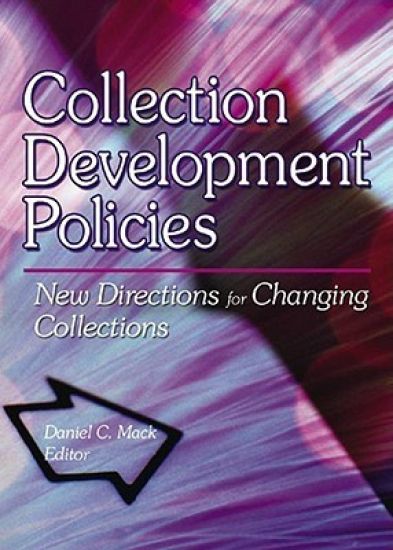
Get the tools you need to build a collection development policy that will help your library run efficientlytoday and in the future! Considering the amount and variety of topics being published, effectively organizing and guiding a library in today’s accelerated world is no easy task. Collection Development Policies: New Directions for Changing Collections is the contemporary librarians guide to building or revising a first-rate collection development policy. In this up-to-date book, experts in the field take you step-by-step through the publishing process from writing an initial draft to applying the official copy. Find out what did and did not work in their own practices and get the tools you’ll need to tackle any obstacles you may encounter. Collection Development Policies: New Directions for Changing Collection covers a variety of topicsincluding pricing policies and remote storage facilitieswithout leaving out the traditional concerns of space and funding. This valuable book also addresses the needs of specialized collections with information on acquisition policies for contemporary subjects collections and building subject specific policy statements. Experienced professionals examine the stability of the electronic resources market and explain how the impact of technical services is redefining the access, collection, and cataloging of libraries. Collection Development Policies also provides examples of collection policies currently in use. Read about: the subject specific policy statements of Schreyer Business Library and the women’s studies collection at Pennsylvania State University Berkeley’s Collection Development Policy (CDPS) and the factors hindering its revision the creation and revision of St. John’s University’s collection development policy Simmons College’s Graduate School of Library and Information Science’s term project and syllabusand how it can be applied to functioning libraries the Association of Research Libraries’ Web pagesand how they have been influenced by the electronic management revolution Collection Development Policies: New Directions for Changing Collection is a valuable resource for anyone selecting and acquiring library materials, maintaining a library collection, or building a collection development policy. The information in this book will help you organize your library collection in a manner that will be beneficial not only to you, but to your clients as well.
Collection Development Policies
Daniel C Mack
Routledge Member of the Taylor and Francis Group
2003
nidottu
Get the tools you need to build a collection development policy that will help your library run efficientlytoday and in the future! Considering the amount and variety of topics being published, effectively organizing and guiding a library in today’s accelerated world is no easy task. Collection Development Policies: New Directions for Changing Collections is the contemporary librarians guide to building or revising a first-rate collection development policy. In this up-to-date book, experts in the field take you step-by-step through the publishing process from writing an initial draft to applying the official copy. Find out what did and did not work in their own practices and get the tools you’ll need to tackle any obstacles you may encounter. Collection Development Policies: New Directions for Changing Collection covers a variety of topicsincluding pricing policies and remote storage facilitieswithout leaving out the traditional concerns of space and funding. This valuable book also addresses the needs of specialized collections with information on acquisition policies for contemporary subjects collections and building subject specific policy statements. Experienced professionals examine the stability of the electronic resources market and explain how the impact of technical services is redefining the access, collection, and cataloging of libraries. Collection Development Policies also provides examples of collection policies currently in use. Read about: the subject specific policy statements of Schreyer Business Library and the women’s studies collection at Pennsylvania State University Berkeley’s Collection Development Policy (CDPS) and the factors hindering its revision the creation and revision of St. John’s University’s collection development policy Simmons College’s Graduate School of Library and Information Science’s term project and syllabusand how it can be applied to functioning libraries the Association of Research Libraries’ Web pagesand how they have been influenced by the electronic management revolution Collection Development Policies: New Directions for Changing Collection is a valuable resource for anyone selecting and acquiring library materials, maintaining a library collection, or building a collection development policy. The information in this book will help you organize your library collection in a manner that will be beneficial not only to you, but to your clients as well.

Ethics for a Small Planet
Daniel C. Maguire; Larry L. Rasmussen
State University of New York Press
1998
pokkari
A radical new look at the religious, economic, and political roots of terracide and how things can change for the better.This book offers an original assessment of the crisis caused by the combined impact of overpopulation, overconsumption, and economic and political injustice. It summons religious scholarship into urgent dialogue with the other disciplines and with the world's policymakers. The authors seek a new understanding of religion and its power since, for good or for ill, the world's religions will be players in the crises relating to population and the threat of ecocide. Two-thirds of the world's people affiliate with these religions and the other third cannot escape the influence of these symbol-filled cultural powerhouses.Ethics for a Small Planet offers complementary studies by two major social ethicists on these issues. Daniel C. Maguire indicts our male-dominated religions for the problems they have caused for our ecology and reproductive ethics. He raises the controversial questions of whether the very concept of God is a problem and whether Christianity's notions of afterlife and a divinized male have done more harm than good. Larry L. Rasmussen also recognizes that the problems of our planet are largely male-made and rich-dominated. He writes that Europeans packaged a form of earth-unfriendly capitalism and shipped it all over the world with missionary zeal. He ably scans the long history that led to the current manic rush to push the earth beyond its limits, and goes on to suggest moral norms and policy guidelines for sustainable communities and genuinely shared power.Both authors argue that there are positive and renewable moral energies in the world's religions and that unless religion, understood as a response to the sanctity of life, animates our ethical debates, the prospects for the world are grim. The sense of the sacred is presented here as the nucleus of the good and the only force that can bring about the lifestyle changes and power reallocations that are necessary to prevent terracide.

Full Subtitle: When the World's Religions Sit Down to Talk about the Future of Human Life and the Plight of This Planet This short volume seeks to capture the energy and dynamism of these world religious traditions-a central force in human history and society-for illuminating and addressing major global issues: population growth, environmental destruction, freedom, the rights of women and minorities, the place of economics and work, issues of sexuality and the body. Based on consultations of leading scholars and religious leaders from a variety of traditions, and worked out in conjunction with international conferences sponsored by the Religious Consultation on Population, Reproductive Health, and Ethics, this book highlights the special insights and lessons each major religious tradition has to offer today.

Breaking the silence about choice As the world teeters on the edge of overpopulation, this new addition to the Sacred Energies series aims to show how ten major religious traditions in fact contain strong affirmations of the right to family planning, including contraception and even, when necessary, abortion. Maguire first shows how interrelated overpopulation is with poverty, ethnic injustice, gender injustice, and the maldistribution of economic resources. Often the world's religions (most notoriously perhaps, Roman Catholicism) are thought to contribute only to the problem, rather than solutions, through their hostility to sex, education and equal rights for women, and birth control. In fact, argues Maguire, the ten scholars who consulted for several years about how these traditions treat issues of contraception and abortion find in them a true religious awe at the sacredness of life, a genuine openness to sexuality as a dimension of the sacred, and "alongside the 'no choice' position . . . a 'pro-choice' position that is too little known, even by adherents to the religion. That is the key message of this book." About the Author: Daniel C. Maguire is Professor of Ethics in the Theology Department of Marquette University. He is also President of the Religious Consultation on Population, Reproductive Health and Ethics. Among his many books are Death by Choice (1974), The Moral Choice (1975), The Moral Revolution (1986), and The Moral Core of Judaism and Christianity (1993).