Kirjojen hintavertailu. Mukana 11 447 106 kirjaa ja 12 kauppaa.

Kirjahaku

Etsi kirjoja tekijän nimen, kirjan nimen tai ISBN:n perusteella.

1000 tulosta hakusanalla David E. Garland

Image Worlds

Image Worlds

David E. Nye

MIT Press
1985
pokkari
By viewing the corporation as a communicator, Image Worlds links the histories of labor, business, consumption, engineering, and photography, providing a new perspective on one of the largest and most representative corporations.General Electric was one of the first modern industrial corporations to use photographs and other media resources to create images of itself; and the GE archives, comprising well over a million images, form one of the largest privately held collections in the world. To produce this venturesome book, David Nye has used these vast archives to develop a new approach to corporate ideology through corporate iconography.Image Worlds embraces symbols, intentional signs, and photographs on the one hand and the history of institutional and technological development on the other. It views photography as a developing technology with a history of its own, and presents the corporation as a communicator as well as a producer and employer.Illustrated with nearly 60 photographs from the archives, the book identifies five "image markets" that GE sought to organize and address. Company engineers, workers, and managers received publications designed to appeal to their presumed interests. Some of these grew into public journals with a scientific-educational mission; others were restricted in circulation even within the company. At the same time, illustrated mass-media advertising was created to reach potential consumers of GE products. Advertising that presented an image of GE as a place where "progress was the most important product." While GE was promoting this enlightened image, the company was also using its resources to reach the voting public, hoping to gain their support for private electrification in the national debate over municipal power.
America's Assembly Line

America's Assembly Line

David E. Nye

MIT Press
2015
pokkari
From the Model T to today's "lean manufacturing": the assembly line as crucial, yet controversial, agent of social and economic transformation.The mechanized assembly line was invented in 1913 and has been in continuous operation ever since. It is the most familiar form of mass production. Both praised as a boon to workers and condemned for exploiting them, it has been celebrated and satirized. (We can still picture Chaplin's little tramp trying to keep up with a factory conveyor belt.) In America's Assembly Line, David Nye examines the industrial innovation that made the United States productive and wealthy in the twentieth century.The assembly line-developed at the Ford Motor Company in 1913 for the mass production of Model Ts-first created and then served an expanding mass market. It also transformed industrial labor. By 1980, Japan had reinvented the assembly line as a system of "lean manufacturing"; American industry reluctantly adopted the new approach. Nye describes this evolution and the new global landscape of increasingly automated factories, with fewer industrial jobs in America and questionable working conditions in developing countries. A century after Ford's pioneering innovation, the assembly line continues to evolve toward more sustainable manufacturing.
Conflicted American Landscapes

Conflicted American Landscapes

David E. Nye

MIT Press
2021
nidottu
How conflicting ideas of nature threaten to fracture America's identity.Amber waves of grain, purple mountain majesties: American invest much of their national identity in sites of natural beauty. And yet American lands today are torn by conflicts over science, religion, identity, and politics. Creationists believe that the Biblical flood carved American landscapes less than 10,000 years ago; environmentalists protest pipelines; Western states argue that the federal government's land policies throttle free enterprise; Native Americans demand protection for sacred sites. In this book, David Nye looks at Americans' irreconcilably conflicting ideas about nature.
Electrifying America

Electrifying America

David E. Nye

MIT Press
1992
pokkari
How did electricity enter everyday life in America? Using Muncie, Indiana-the Lynds' now iconic Middletown-as a touchstone, David Nye explores how electricity seeped into and redefined American culture. With an eye for telling details from archival sources and a broad understanding of cultural and social history, he creates a thought-provoking panorama of a technology fundamental to modern life. Emphasizing the experiences of ordinary men and women rather than the lives of inventors and entrepreneurs, Nye treats electrification as a set of technical possibilities that were selectively adopted to create the streetcar suburb, the amusement park, the "Great White Way," the assembly line, the electrified home, and the industrialized farm. He shows how electricity touched every part of American life, how it became an extension of political ideologies, how it virtually created the image of the modern city, and how it even pervaded colloquial speech, confirming the values of high energy and speed that have become hallmarks of the twentieth century. He also pursues the social meaning of electrification as expressed in utopian ideas and exhibits at world's fairs, and explores the evocation of electrical landscapes in painting, literature, and photography. Electrifying America combines chronology and topicality to examine the major forms of light and power as they came into general use. It shows that in the city electrification promoted a more varied landscape and made possible new art forms and new consumption environments. In the factory, electricity permitted a complete redesign of the size and scale of operations, shifting power away from the shop floor to managers. Electrical appliances redefined domestic work and transformed the landscape of the home, while on the farm electricity laid the foundation for today's agribusiness.
American Technological Sublime

American Technological Sublime

David E. Nye

MIT Press
1996
pokkari
American Technological Sublime continues the exploration of the social construction of technology that David Nye began in his award-winning book Electrifying America. Here Nye examines the continuing appeal of the "technological sublime" (a term coined by Perry Miller) as a key to the nation's history, using as examples the natural sites, architectural forms, and technological achievements that ordinary people have valued intensely.Technology has long played a central role in the formation of Americans' sense of selfhood. From the first canal systems through the moon landing, Americans have, for better or worse, derived unity from the common feeling of awe inspired by large-scale applications of technological prowess. American Technological Sublime continues the exploration of the social construction of technology that David Nye began in his award-winning book Electrifying America. Here Nye examines the continuing appeal of the "technological sublime" (a term coined by Perry Miller) as a key to the nation's history, using as examples the natural sites, architectural forms, and technological achievements that ordinary people have valued intensely.American Technological Sublime is a study of the politics of perception in industrial society. Arranged chronologically, it suggests that the sublime itself has a history - that sublime experiences are emotional configurations that emerge from new social and technological conditions, and that each new configuration to some extent undermines and displaces the older versions. After giving a short history of the sublime as an aesthetic category, Nye describes the reemergence and democratization of the concept in the early nineteenth century as an expression of the American sense of specialness.What has filled the American public with wonder, awe, even terror? David Nye selects the Grand Canyon, Niagara Falls, the eruption of Mt. St. Helens, the Erie Canal, the first transcontinental railroad, Eads Bridge, Brooklyn Bridge, the major international expositions, the Hudson-Fulton Celebration of 1909, the Empire State Building, and Boulder Dam. He then looks at the atom bomb tests and the Apollo mission as examples of the increasing ambivalence of the technological sublime in the postwar world. The festivities surrounding the rededication of the Statue of Liberty in 1986 become a touchstone reflecting the transformation of the American experience of the sublime over two centuries. Nye concludes with a vision of the modern-day "consumer sublime" as manifested in the fantasy world of Las Vegas.
Consuming Power

Consuming Power

David E. Nye

MIT Press
1999
pokkari
Nye uses energy as a touchstone to examine the lives of ordinary people engaged in normal activities.How did the United States become the world's largest consumer of energy? David Nye shows that this is less a question about the development of technology than it is a question about the development of culture. In Consuming Power, Nye uses energy as a touchstone to examine the lives of ordinary people engaged in normal activities. He looks at how these activities changed as new energy systems were constructed, from colonial times to recent years. He also shows how, as Americans incorporated new machines and processes into their lives, they became ensnared in power systems that were not easily changed: they made choices about the conduct of their lives, and those choices accumulated to produce a consuming culture. Nye examines a sequence of large systems that acquired and then lost technological momentum over the course of American history, including water power, steam power, electricity, the internal-combustion engine, atomic power, and computerization. He shows how each system became part of a larger set of social constructions through its links to the home, the factory, and the city. The result is a social history of America as seen through the lens of energy consumption.
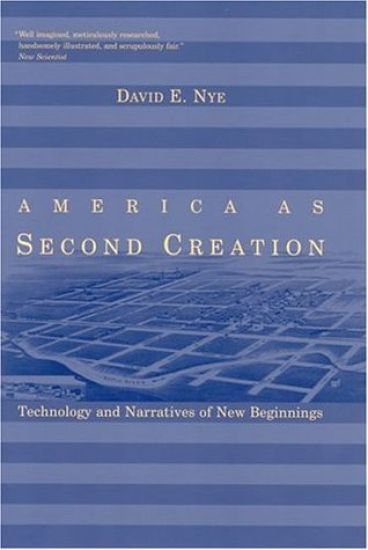
America as Second Creation

America as Second Creation

David E. Nye

MIT Press
2004
pokkari
An exploration of the dialogue that emerged after 1776 between different visions of what it meant to use new technologies to transform the land.After 1776, the former American colonies began to reimagine themselves as a unified, self-created community. Technologies had an important role in the resulting national narratives, and a few technologies assumed particular prominence. Among these were the axe, the mill, the canal, the railroad, and the irrigation dam. In this book David Nye explores the stories that clustered around these technologies. In doing so, he rediscovers an American story of origins, with America conceived as a second creation built in harmony with God's first creation.While mainstream Americans constructed technological foundation stories to explain their place in the New World, however, marginalized groups told other stories of destruction and loss. Native Americans protested the loss of their forests, fishermen resisted the construction of dams, and early environmentalists feared the exhaustionof resources. A water mill could be viewed as the kernel of a new community or as a new way to exploit labor. If passengers comprehended railways as part of a larger narrative about American expansion and progress, many farmers attacked railroad land grants. To explore these contradictions, Nye devotes alternating chapters to narratives of second creation and to narratives of those who rejected it.Nye draws on popular literature, speeches, advertisements, paintings, and many other media to create a history of American foundation stories. He shows how these stories were revised periodically, as social and economic conditions changed, without ever erasing the earlier stories entirely. The image of the isolated frontier family carving a homestead out of the wilderness with an axe persists to this day, alongside later images and narratives. In the book's conclusion, Nye considers the relation between these earlier stories and such later American developments as the conservation movement, narratives of environmental recovery, and the idealization of wilderness.
Technology Matters

Technology Matters

David E. Nye

MIT Press
2007
pokkari
Looks at ten central questions concerning humankind's relationship to technology, including "Does technology shape us, or do we shape it?" and "Are we using modern technology to create cultural uniformity or diversity?" Reprint.
From Vietnam to El Salvador

From Vietnam to El Salvador

David E. Spencer

Praeger Publishers Inc
1996
sidottu
Spencer provides a history of the FMLN guerrilla special forces—known collectively by the acronym FES—in El Salvador. Trained in Cuba and Vietnam and utilizing techniques taken from the Viet Cong and the North Vietnamese army, the FES terrorized the armed forces of El Salvador from 1981 to 1992. After reviewing their training, Spencer examines the major operations of the special forces and gives an in-depth discussion of their tactics and methods. He concludes with a look at the special forces groups in other Latin American countries. After reviewing their training, Spencer looks at the major operations of the special forces groups of three of the guerrilla factions—the FPL, ERP, and FAL—and provides an in-depth discussion of their major operation tactics and methods. He concludes with a look at the special forces groups in Argentina, Colombia, Cuba, Guatemala, Nicaragua, and Puerto Rico. This thorough examination of an often misunderstood approach to guerrilla warfare will be of great interest to researchers involved with contemporary low-intensity warfare and Latin American affairs.
Introducing Aesthetics

Introducing Aesthetics

David E. Fenner

Praeger Publishers Inc
2003
nidottu
This concise yet comprehensive introduction to the discipline of western aesthetical philosophy is focused directly on the central questions of aesthetics. Fenner arranges his analysis around four general themes—Experiences, Objects and Events, Meaning, and Judgment—that progress from issues of everyday experience to subjects of greater subtlety. Within these broader themes, Fenner explores such issues as The Aesthetic Attitude, Defining Art, and Reviewing Art Criticism.Although a historical organization is employed wherever a particular movement unfolds from earlier movements, the text's main organization is not motivated by an academic or historical treatment of the various topics. Instead, the topics themselves are of primary concern, in such a way that readers will come away with a complete overview of the canon of this highly significant area of western philosophy.
Native North American Armor, Shields, and Fortifications

Native North American Armor, Shields, and Fortifications

David E. Jones

University of Texas Press
2004
pokkari
From the Chickasaw fighting the Choctaw in the Southeast to the Sioux battling the Cheyenne on the Great Plains, warfare was endemic among the North American Indians when Europeans first arrived on this continent. An impressive array of offensive weaponry and battle tactics gave rise to an equally impressive range of defensive technology. Native Americans constructed very effective armor and shields using wood, bone, and leather. Their fortifications ranged from simple refuges to walled and moated stockades to multiple stockades linked in strategic defensive networks. In this book, David E. Jones offers the first systematic comparative study of the defensive armor and fortifications of aboriginal Native Americans. Drawing data from ethnohistorical accounts and archaeological evidence, he surveys the use of armor, shields, and fortifications both before European contact and during the historic period by American Indians from the Southeast to the Northwest Coast, from the Northeast Woodlands to the desert Southwest, and from the Sub-Arctic to the Great Plains. Jones also demonstrates the sociocultural factors that affected warfare and shaped the development of different types of armor and fortifications. Extensive eyewitness descriptions of warfare, armor, and fortifications, as well as photos and sketches of Indian armor from museum collections, add a visual dimension to the text.
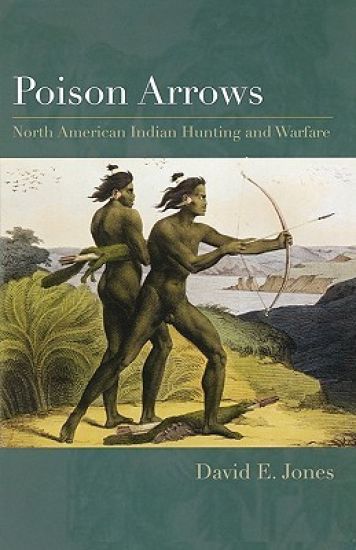
Poison Arrows

Poison Arrows

David E. Jones

University of Texas Press
2007
pokkari
Biological warfare is a menacing twenty-first-century issue, but its origins extend to antiquity. While the recorded use of toxins in warfare in some ancient populations is rarely disputed (the use of arsenical smoke in China, which dates to at least 1000 BC, for example) the use of "poison arrows" and other deadly substances by Native American groups has been fraught with contradiction. At last revealing clear documentation to support these theories, anthropologist David Jones transforms the realm of ethnobotany in Poison Arrows. Examining evidence within the few extant descriptive accounts of Native American warfare, along with grooved arrowheads and clues from botanical knowledge, Jones builds a solid case to indicate widespread and very effective use of many types of toxins. He argues that various groups applied them to not only warfare but also to hunting, and even as an early form of insect extermination. Culling extensive ethnological, historical, and archaeological data, Jones provides a thoroughly comprehensive survey of the use of ethnobotanical and entomological compounds applied in wide-ranging ways, including homicide and suicide. Although many narratives from the contact period in North America deny such uses, Jones now offers conclusive documentation to prove otherwise. A groundbreaking study of a subject that has been long overlooked, Poison Arrows imparts an extraordinary new perspective to the history of warfare, weaponry, and deadly human ingenuity.
American Indian Sovereignty and the U.S. Supreme Court

American Indian Sovereignty and the U.S. Supreme Court

David E. Wilkins

University of Texas Press
1997
pokkari
"Like the miner's canary, the Indian marks the shift from fresh air to poison gas in our political atmosphere; and our treatment of Indians, even more than our treatment of other minorities, reflects the rise and fall in our democratic faith," wrote Felix S. Cohen, an early expert in Indian legal affairs.In this book, David Wilkins charts the "fall in our democratic faith" through fifteen landmark cases in which the Supreme Court significantly curtailed Indian rights. He offers compelling evidence that Supreme Court justices selectively used precedents and facts, both historical and contemporary, to arrive at decisions that have undermined tribal sovereignty, legitimated massive tribal land losses, sanctioned the diminishment of Indian religious rights, and curtailed other rights as well.These case studies-and their implications for all minority groups-make important and troubling reading at a time when the Supreme Court is at the vortex of political and moral developments that are redefining the nature of American government, transforming the relationship between the legal and political branches, and altering the very meaning of federalism.
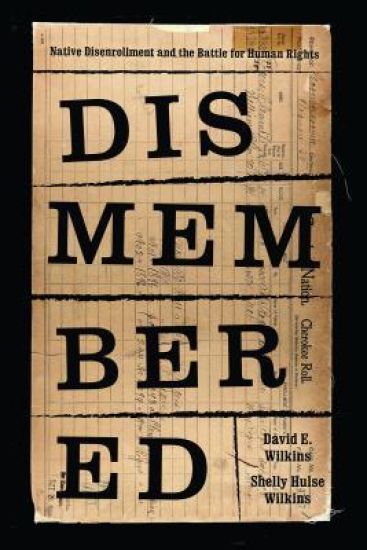
Dismembered

Dismembered

David E. Wilkins; Shelly Hulse Wilkins

University of Washington Press
2017
sidottu
While the number of federally recognized Native nations in the United States are increasing, the population figures for existing tribal nations are declining. This depopulation is not being perpetrated by the federal government, but by Native governments that are banishing, denying, or disenrolling Native citizens at an unprecedented rate. Since the 1990s, tribal belonging has become more of a privilege than a sacred right. Political and legal dismemberment has become a national phenomenon with nearly eighty Native nations, in at least twenty states, terminating the rights of indigenous citizens.The first comprehensive examination of the origins and significance of tribal disenrollment, Dismembered examines this disturbing trend, which often leaves the disenrolled tribal members with no recourse or appeal. At the center of the issue is how Native nations are defined today and who has the fundamental rights to belong. By looking at hundreds of tribal constitutions and talking with both disenrolled members and tribal officials, the authors demonstrate the damage this practice is having across Indian Country and ways to address the problem.
Dismembered

Dismembered

David E. Wilkins; Shelly Hulse Wilkins

University of Washington Press
2017
pokkari
While the number of federally recognized Native nations in the United States are increasing, the population figures for existing tribal nations are declining. This depopulation is not being perpetrated by the federal government, but by Native governments that are banishing, denying, or disenrolling Native citizens at an unprecedented rate. Since the 1990s, tribal belonging has become more of a privilege than a sacred right. Political and legal dismemberment has become a national phenomenon with nearly eighty Native nations, in at least twenty states, terminating the rights of indigenous citizens.The first comprehensive examination of the origins and significance of tribal disenrollment, Dismembered examines this disturbing trend, which often leaves the disenrolled tribal members with no recourse or appeal. At the center of the issue is how Native nations are defined today and who has the fundamental rights to belong. By looking at hundreds of tribal constitutions and talking with both disenrolled members and tribal officials, the authors demonstrate the damage this practice is having across Indian Country and ways to address the problem.
Battleground Berlin

Battleground Berlin

David E. Murphy; Sergei A. Kondrashev; George Bailey

Yale University Press
1999
pokkari
Battleground Berlin is the definitive, insider’s account of the espionage warfare in Berlin between CIA and KGB from 1945 to the construction of the Berlin Wall in 1961. Two intelligence veterans—major players on opposite sides of the Cold War—have joined in an unprecedented collaboration to tell the story. Basing their narrative on personal recollections, interviews with other CIA and KGB officers, and documents never before made public, the authors provide a vast number of new details of CIA’s infiltration of the new East German intelligence service; the construction, operation, and uncovering of the Berlin tunnel; and many other initiatives and countermoves dealing with the series of crises that racked Berlin and jeopardized an uneasy world peace during this period.Battleground Berlin illuminates some of the most compelling mysteries of the Cold War, including:· what really happened the night the Soviets "discovered" the Berlin Tunnel;· who ordered the building of the Berlin Wall—and why did the West seem so ill prepared;· how did infighting among Soviet leaders affect decisionmaking during the most critical moments of the Berlin crisis;· how did power struggles between KGB and its protégé, the dreaded East German security service, shape the political landscape of East Germany and heighten tension in West Berlin;· how much did the famous defector Otto John reveal to KGB—and why is he still unable to clear his name;· and much more.The book, an operational and organizational history of the world’s two most important secret service organizations during a critical time, unveils the vital connection between intelligence gathering and political decisionmaking at the highest levels. Full of intrigue and suspense, it is a story not to be forgotten.
Delinquency, Development, and Social Policy

Delinquency, Development, and Social Policy

David E. Brandt

Yale University Press
2005
sidottu
In this book, David E. Brandt examines the legal, psychological, and cultural issues relevant to understanding antisocial behavior in adolescence. Based on his own research and a broad analysis of recent work in the field, Brandt identifies the factors that are common in cases of delinquency.The discussion considers the long-term effects of social issues such as poverty as well as psychological issues such as the high levels of stress and anxiety suffered during childhood by many delinquents. He shows how a failure to meet the developmental needs of children—at both the family level and at a broader social and political level—is at the core of the problem of juvenile delinquency. Brandt concludes with an inquiry into how best to prevent delinquency. Programs that address the developmental needs of children, Brandt argues, are more effective than policing, juvenile courts, or incarceration.
Hollow Justice

Hollow Justice

David E. Wilkins

Yale University Press
2013
sidottu
This book, the first of its kind, comprehensively explores Native American claims against the United States government over the past two centuries. Despite the federal government’s multiple attempts to redress indigenous claims, a close examination reveals that even when compensatory programs were instituted, Native peoples never attained a genuine sense of justice. David E. Wilkins addresses the important question of what one nation owes another when the balance of rights, resources, and responsibilities have been negotiated through treaties. How does the United States assure that guarantees made to tribal nations, whether through a century old treaty or a modern day compact, remain viable and lasting?
What Stalin Knew

What Stalin Knew

David E. Murphy

Yale University Press
2007
pokkari
“A riveting account of one of history’s greatest blunders.”—William L. O’Neill, The New Leader This extensively researched book illuminates many of the enigmas that have surrounded the Nazi invasion of the Soviet Union, offering keen insights into Stalin’s thinking and the reasons for his catastrophic blunder. “If, after the war, the Soviet Union had somehow been capable of producing an official inquiry into the catastrophe of 6/22—comparable in its mandate to the 9/11 commission here—its report might have read a little like [this book]. . . . Murphy brings to his subject both knowledge of Russian history and an insider’s grasp of how intelligence is gathered, analyzed and used—or not.”—Niall Ferguson, New York Times Book Review"A fascinating and meticulously researched account of mistaken assumptions and errors of judgment that culminated in Hitler’s invasion of Russia in June 1941. Never before has this fateful period been so fully documented."—Henry A. Kissinger