Greatly revised, the Second Edition presents an extended survey of this rapidly growing field. The book reviews the effects of industrial and pharmaceutical chemicals on human behavior, cognitive function, and emotional status. Features include two new chapters addressing key forensic issues and recent views on multiple chemical sensitivity, sick building syndrome, and psychosomatic disorders; current data on NIOSH and OSHA exposure levels for industrial toxins; and enhanced coverage of testing methods; studies of PET, SPECT, and BEAM imaging applied to neurotoxic exposure.
Successfully correlate electrodiagnostic findings and neuromuscular ultrasound with key clinical findings with Electromyography and Neuromuscular Disorders, 4th Edition. This popular text is the go-to resource for clinicians at all levels of experience who have an interest in neuromuscular medicine, including those studying for the AANEM board exam. An easy-to-read writing style, abundant case studies, and online videos help you master the electrodiagnostic evaluation and improve safety and accuracy. Helps you diagnose neuromuscular disorders more quickly and accurately, and correlate electromyographic and clinical findings. Explains complex subject matter in an easy-to-understand, user-friendly manner. Includes dozens of detailed, cross-sectional anatomy drawings to ensure correct EMG needle placement and avoid neurovascular injuries. Features new chapters on Neuromuscular Ultrasound, as well as incorporating neuromuscular ultrasound in the evaluation of clinical neuromuscular disorders along with electrodiagnostic studies in many of the clinical chapters. Provides up-to-date information on iatrogenic complications of electrodiagnostic studies and newly defined genetic neuromuscular conditions. Includes online access to more than 70 videos that allow you to see and hear the EMG waveforms discussed in the text. Enhanced eBook version included with purchase. Your enhanced eBook allows you to access all of the text, figures, and references from the book on a variety of devices.
Fun, fast, and in full color, this portable resource is a perfect study tool covering everything you need to know for a solid foundation in neuroscience and neuroanatomy. This quick review tool allows you to test your knowledge on the go-when and where it’s convenient. More than 220 flash cards with Netter illustrations on the front and answers to labels and explanatory text on the back emphasize key neuroscience principles and clinical applications for an efficient yet in-depth review. Cards provide clinically important correlations in neuroanatomy, cell biology, and neurophysiology; extensive imaging, cross-sectional anatomy, and vascular information; and clinical pearls and helpful summaries of the results of neurological damage or injuries on the back of each card New neuropathology coverage from traumatic brain injury and coma to bipolar disorder and schizophrenia New access to cross-sectional anatomy cards online Coverage of timely topics such as cannabinoids, opioids, PTSD, OCD, and aging and the nervous system Pre-punched holes and convenient binding ring allow you to carry selected groups of flash cards with you anywhere A perfect study aid and complement to Dr. Felton’s related titles: Netter’s Atlas of Neuroscience, 3rd Edition (to which the cards are cross-referenced), and Netter’s Neuroscience Coloring Book Enhanced eBook version included with purchase. Your enhanced eBook allows you to access all of the text, figures, and references from the book on a variety of devices
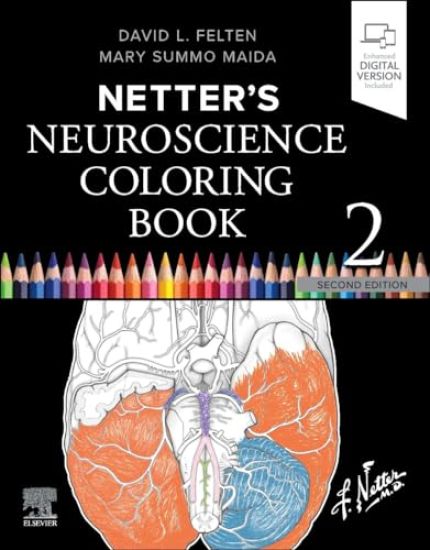
Reinforce your knowledge of neuroanatomy, neuroscience, and common neurologic disorders with this active, engaging, and relaxing review method! Netter’s Neuroscience Coloring Book, 2nd Edition, makes abstract concepts more concrete as you use color and tactile movement to reinforce your memory and understanding of the brain, spinal cord, and peripheral nervous system. It’s a fun and interactive way to learn and review a complex but fascinating subject-whether you’re taking a course in neuroscience, preparing for a neuroscience program, or planning a career in research, science, or medicine and healthcare. More than “just” a coloring book, this unique learning tool offers: More than 145 key topics in neuroscience and neuroanatomy, using bold, clear drawings based on classic Netter art Coloring exercises for visual and tactile learning as you trace pathways and tracts, reinforcing spatial, functional, and clinical concepts in this fascinating field A clear organization with 4 major sections: (1) Overview of the nervous system; (2) regional neuroscience; (3) systemic neuroscience; and (4) global neuroscience Three major components for each topic and accompanying illustrations: What is it and what does it do?; Color the most important structures; and What is the functional and clinical significance? Text revision based on extensive student feedback New coloring exercises on Endogenous Opioid Systems, Insular Cortex, Prefrontal Cortex, Dementias, Alzheimer’s Disease, Posttraumatic Stress, Traumatic Brain Injury (TBI), and Brain Substrates of Addictive Disorders Clinical Notes that bridge basic science with health care and medicine Expanded workbook review questions and bulleted lists throughout to reinforce comprehension and retention
This new edition of one of the books most closely identified with clinical psychology since 1965 will expose a new generation to Shapiro's stunningly defining conceptualizations of the Obsessive-Compulsive, Paranoid, Hysterical, and Impulsive ways of being.
Shapiro's keenness of observation and profound clinical wisdom are once again in evidence, as he brings to bear his brilliant ideas about neurotic character on the actual conduct of psychotherapy. The therapeutic material, argues Shapiro, consists not merely of what the patient provides but of the patient. Pay attention not only to the words, Shapiro says, but also to the speaker.Shapiro's highly original view of the dynamics of neurosis emphasizes subjective experience and revises classical conflict theory. The therapist's goal is to introduce the patient to himself and thus to end the self-estrangement that characterizes neurosis. In a series of eloquent chapters, richly illustrated with clinical vignettes, he elabourates this view, exploring such topics as the process of change, the psychology of raising consciousness," and the therapeutic relationship. No therapist, regardless of persuasion, will fail to be enlightened and inspired by this essential contribution to the field.
There has been an explosion of interest in the field of neuroendocrinology over the last twenty years with the discovery of neurohormones regulating virtually everything from growth and development to sexual and aggressive behavior. This book provides a much-needed introduction to neuroendocrinology from a zoological and evolutionary perspective. It covers the evolution, development and description of the neuroendocrine system throughout the animal kingdom. Specific topics covered include: The Evolution of early neuroendocrine systems in primitive animalsStructural characterisation, molecular biology and biochemistry of neuroendocrine agentsA profiles section on unusual aspects of neuroendocrine physiology written by leaders in the fieldA unique section on the actions of environmental chemicals effect neuroendocrine systems in various species
This textbook provides the first up-to-date, comprehensive introduction to the emerging fields of neurolinguistics and linguistic aphasiology, Reflecting the dramatic changes that have taken place in the study of language disorders over the last decade, David Caplan’s approach is firmly interdisciplinary. Yet at all times he introduces concepts from the main contributing disciplines - neurology, linguistics, psychology and speech pathology - in such a way that they will be clearly understood by all students, whatever their particular background. The topics covered have been carefully selected to demonstrate how the more sophisticated modern neurolinguistic approaches have developed from traditional clinical models. The critical and detailed discussion of all the main theoretical issues in the fields makes this a fundamental work not only for students but also for specialists.
This textbook provides a comprehensive introduction to the emerging fields of neurolinguistics and linguistic aphasiology. Reflecting the dramatic changes that have taken place in the study of language disorders over the last decade, David Caplan's approach is firmly interdisciplinary. He introduces concepts from the main contributing disciplines - neurology, linguistics, psychology and speech pathology - in such a way that they will be clearly understood by all students, whatever their particular background. The topics covered have been carefully selected to demonstrate how the more sophisticated topical neurolinguistic approaches have developed from traditional clinical models. The critical and detailed discussion of all the main theoretical issues in the fields makes this a fundamental work not only for students but also for specialists.
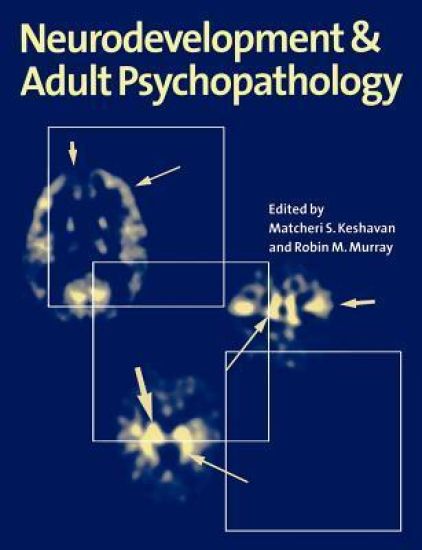
In this important 1997 book on the role of neurodevelopmental factors in the pathogenesis of the major psychiatric disorders, the fields of developmental neurobiology, clinical psychiatry and behavioural neuroscience are reviewed by an international group of experts, including many of those responsible for the ideas that have come to dominate current thinking. The first section, 'The Developing Brain', reviews neurodevelopment from the molecular to the behavioural level. Section Two, 'Development and Psychopathology', covers clinical applications of the basic principles of developmental neurobiology. The third and final section, 'Integrative Models', presents approaches toward a synthesis of neurodevelopmental and clinical findings in psychiatric disorder. For students, scientists and clinicians in psychiatry, psychology, and neurodevelopment, this is an essential reference.
Rabbinic documents of David, progenitor of the Messiah, carry forward the scriptural narrative of David the king. But he also is turned by Rabbinic writings of late antiquity—from the Mishnah through the Yerushalmi and the Bavli—into a sage. Consequently, the Rabbis’ Messiah is a rabbi. How did this transformation come about? Of what kinds of writings does it consist? What sequence of writings conveyed the transformation? And most important: what do we learn about the movement from one set of Israelite writings to take over, or submit to the values of, another set of writings? These are the questions answered here for David, king of Israel. Rabbi David proves that the first exposition of the figure of Rabbi David in a program of elaboration and of protracted exposition of law and Scripture is found in the Bavli. Prior to the closure of that document, that is, in the Rabbinic documents that came to closure before the Bavli, we do not find an elaborate exposition of the figure of David as a rabbi. By contrast, in the Bavli, ample canonical evidence attests to the sages’ transformation of David, king of Israel, into a rabbi. So while bits and pieces of Rabbi David find their way into most of the canonical documents, we find the elaborately spelled out Rabbi David to begin with in the Bavli, now represented as a disciple of sages and a devotee of study of the Torah. That usage attracts attention because when we encounter David in Rabbinic literature—as in all other Judaic canons, not only Rabbinic—this signals we are meeting the embodiment of the Messiah. The representation of the kings of Israel in the Davidic line as heirs of David forms a chapter in exposing the Messianic message of Rabbinic Judaism.
We would like to take this opportunity to thank all of those individ uals who helped us assemble this text, including the people of Lockheed Sanders and Nestor, Inc., whose encouragement and support were greatly appreciated. In addition, we would like to thank the members of the Lab oratory for Engineering Man-Machine Systems (LEMS) and the Center for Neural Science at Brown University for their frequent and helpful discussions on a number of topics discussed in this text. Although we both attended Brown from 1983 to 1985, and had offices in the same building, it is surprising that we did not meet until 1988. We also wish to thank Kluwer Academic Publishers for their profes sionalism and patience, and the reviewers for their constructive criticism. Thanks to John McCarthy for performing the final proof, and to John Adcock, Chip Bachmann, Deborah Farrow, Nathan Intrator, Michael Perrone, Ed Real, Lance Riek and Paul Zemany for their comments and assistance. We would also like to thank Khrisna Nathan, our most unbi ased and critical reviewer, for his suggestions for improving the content and accuracy of this text. A special thanks goes to Steve Hoffman, who was instrumental in helping us perform the experiments described in Chapter 9.
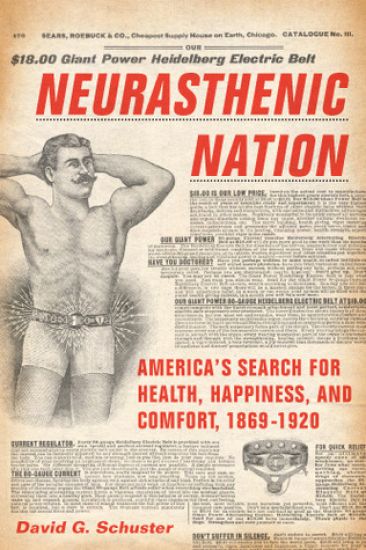
As the United States rushed toward industrial and technological modernization in the late nineteenth century, people worried that the workplace had become too competitive, the economy too turbulent, domestic chores too taxing, while new machines had created a fast-paced environment that sickened the nation. Physicians testified that, without a doubt, modern civilization was causing a host of ills—everything from irritability to insomnia, lethargy to weight loss, anxiety to lack of ambition, and indigestion to impotence. They called this condition neurasthenia.Neurasthenic Nation investigates how the concept of neurasthenia helped doctors and patients, men and women, and advertisers and consumers negotiate changes commonly associated with “modernity.” Combining a survey of medical and popular literature on neurasthenia with original research into rare archives of personal letters, patient records, and corporate files, David Schuster charts the emergence of a “neurasthenic nation”—a place where people saw their personal health as inextricably tied to the pitfalls and possibilities of a changing world.
Packed with contemporary dialogue, engaging readings, active vocabulary, and an assortment of hands-on activities, NEUE HORIZONTE, 8e skillfully instills both communicative and grammatical competency using a diversified methodology that adapts well to a variety of teaching and learning styles. The new edition combines a vibrant new four-color design with its signature clear grammar presentations, practical vocabulary lessons, beautiful prose and poetry, and more. Immersing readers into a complete language-learning experience, its unique integrated treatment stresses a balance of communicative competence, cultural awareness, and mastery of language structures.
In some cases in the US, offenders have been made to take anti-psychotic drugs in order to restore competence to stand trial, or even to receive punishment. If such neurointerventions can change a person's behaviour can they be used to treat and more controversially, predict and prevent crime? Once a fantasy portrayed in films such as Minority Report such questions are fast-becoming fundamental ones for policy, law and ethics. This is the first book to introduce and explain the fundamental concepts, problems and debates around neuroscience, ethics and crime. After a helpful introduction the authors examine the following topics: Criminal justice, harm and the problem of punishment: why punish? Cognitive and behavioural neuroscience: a short introductionReading minds: can brain scans replace lie detector tests and predict reoffending?Neuroscientific assessments of competency Compulsory neurointerventions: can changing the brain be used to increase empathy and reduce violent urges?Voluntary neurointervention: is it wrong to administer neurointerventions even if the offender agrees to receive the neurointervention?Neuroscience, free will and moral responsibilityBroader issues in criminal justice, including the justification of criminal punishment and the role of moral intuitions in decision-making.Additional features, such as chapter summaries, annotated further reading and a glossary make this an excellent resource for students of philosophy and those in related disciplines such as philosophy, criminology, law and criminal justice.