
Kirjahaku
Etsi kirjoja tekijän nimen, kirjan nimen tai ISBN:n perusteella.
1000 tulosta hakusanalla David O Scheiding
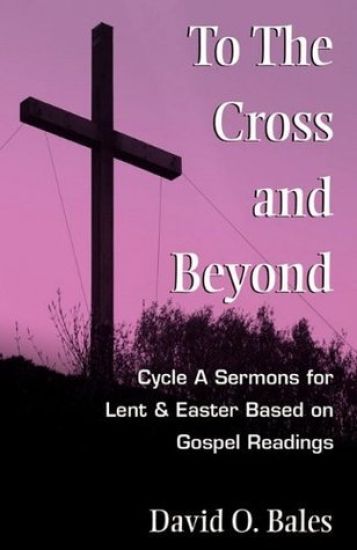
David O. Bales invites preachers of the word to work through the lectionary, allowing the Holy Spirit to inspire and enlighten the process along the way. Throughout the Lectionary Preaching Workbook, Bales urges pastors to discover many ways to deliver God's word, reminding them that a genuine acknowledgment of congregational diversity insists upon thoughtfully delivered sermons. Understanding that we learn in different ways and believing that God sets out to reach us in ways accommodated to our understanding, Bales has included a diverse set of sermon resources, incorporating styles such as narrative, exposition, imagistic, assertive, and apologetic. Creatively and intelligently, Bales explores critical themes throughout the scriptures including waiting, suffering, faithfulness, sovereignty, and patience, and he presents three decades of pastoral experience through poignant summaries, ideas, prayers, and stories. Above all else, he stresses a complete dependence upon the Holy Spirit -- a dependence that asks what God wants of us in this world and a dependence that remains patient long enough to hear God's response. Including sermon resources for Advent, Christmas, Epiphany, Lent, Easter, and Pentecost, the Lectionary Preaching Workbook is valuable for sermon starters, individual Bible study, and adult study groups. Each Sunday's material includes: - Revised Common Lectionary texts for the day - various themes and possible sermon titles from the scripture readings - commentary on the day's readings and Psalm - possible preaching approaches - a pastoral prayer - numerous illustrations to flesh out the message David O. Bales was a Presbyterian pastor for 33 years. After retiring he taught Introduction to Biblical Greek at College of Idaho for two years. Formerly he taught Greek at Miles Community College, Miles City, Montana, as well as World Religions, Biblical Hebrew, and Ethics. He has researched, written, and edited for Stephen Ministries. His stories, sermons, and articles have appeared in Preaching, Pulpit Digest, Lectionary Homiletics, Preaching Great Texts, Emphasis, Feasting on the Gospels, and StoryShare. He is author of Gospel Subplots: Story Sermons of God's Grace, To The Cross and Beyond, Scenes of Glory: Subplots of God's Long Story, and is co-author of Sermons on the Second Readings, Series II, Cycle A. Bales is a graduate of the University of Portland and San Francisco Theological Seminary.
Aging and Spirituality
David O. Moberg
Routledge Member of the Taylor and Francis Group
2001
sidottu
Explore the spiritual dimensions of aging through science, theory, and practice!During the later years of life, many people devote energy to a process of spiritual awakening and self-discovery. Yet their family, friends, clergy, and the helping professionals who work with them are not always prepared to understand or deal with the spiritual concerns of their clients. Aging and Spirituality provides a unique, far-reaching overview of this long-neglected field.Divided into four independent but interwoven sections, this landmark book covers the spiritual realm with scientific rigor and deep human understanding. Aging and Spirituality comprehensively surveys the issues of spirituality, from the groundwork of basic definitions to detailed assessments of the role spirituality plays in the lives of the elderly and suggested directions for further research. This book's unique approach combines scholarly research and practical nuts-and-bolts suggestions for service delivery. By drawing from many disciplines and professions, it offers fresh perspectives to even those practitioners already familiar with the most effective spiritual techniques their own field can offer. Aging and Spirituality answers such common questions as: What are the spiritual needs of people later in life? Is there any solid evidence that prayer changes things? How is spirituality related to physical and mental health? Does spirituality matter when people know they are dying? How can we measure spiritual wellness and assess the outcomes of activities intended to enhance it? Will attention to spirituality aggravate or alleviate the losses--of friends, family, health, youth--that so often occur during old age?Aging and Spirituality provides a much-needed resource for health care professionals, clergy, social workers, and counselors working with geriatric clients. By integrating spiritual issues into the theoretical framework of social gerontology, Aging and Spirituality will help you understand the scientific foundations, practical applications, and public policy implications of spirituality for older adults.
Aging and Spirituality
David O. Moberg
Routledge Member of the Taylor and Francis Group
2001
nidottu
Explore the spiritual dimensions of aging through science, theory, and practice!During the later years of life, many people devote energy to a process of spiritual awakening and self-discovery. Yet their family, friends, clergy, and the helping professionals who work with them are not always prepared to understand or deal with the spiritual concerns of their clients. Aging and Spirituality provides a unique, far-reaching overview of this long-neglected field.Divided into four independent but interwoven sections, this landmark book covers the spiritual realm with scientific rigor and deep human understanding. Aging and Spirituality comprehensively surveys the issues of spirituality, from the groundwork of basic definitions to detailed assessments of the role spirituality plays in the lives of the elderly and suggested directions for further research. This book's unique approach combines scholarly research and practical nuts-and-bolts suggestions for service delivery. By drawing from many disciplines and professions, it offers fresh perspectives to even those practitioners already familiar with the most effective spiritual techniques their own field can offer. Aging and Spirituality answers such common questions as: What are the spiritual needs of people later in life? Is there any solid evidence that prayer changes things? How is spirituality related to physical and mental health? Does spirituality matter when people know they are dying? How can we measure spiritual wellness and assess the outcomes of activities intended to enhance it? Will attention to spirituality aggravate or alleviate the losses--of friends, family, health, youth--that so often occur during old age?Aging and Spirituality provides a much-needed resource for health care professionals, clergy, social workers, and counselors working with geriatric clients. By integrating spiritual issues into the theoretical framework of social gerontology, Aging and Spirituality will help you understand the scientific foundations, practical applications, and public policy implications of spirituality for older adults.
The American College and the Culture of Aspiration, 1915–1940
David O. Levine
Cornell University Press
1988
pokkari
Is higher education a right or a privilege? Who should go to college? What should they study there? These questions were hotly debated between the world wars, when an unprecedented boom in college enrollments forced Americans to struggle between their belief in the importance of educational opportunity and their desire to preserve the existing social structure. In The American College and the Culture of Aspiration, 1915–1940, David O. Levine offers the first in-depth history of higher education during this era, a period when colleges and universities became arbiters of social and economic mobility and a hierarchy of schools evolved to meet growing demands for occupational training and socialization.
David O'Connell's study seeks to serve as the final word on which version of the Enseignements de saint Louis can claim ultimate authenticity. Through an analytical comparison of the three families of the Teachings and a historical overview of the critical controversy surrounding the texts, O'Connell argues for the authority and historicity of the Noster manuscript.In this study the author has consulted all the manuscripts pertinent to the problem, reviewed the critical controversy that has surrounded these texts since the end of the Middle Ages, and furnished a critical text of the long-neglected manuscript that reproduces both the spirit and the letter of Louis' holograph.
The Instructions are Saint Louis's second set of recommendations, which he addressed to his daughter Isabelle, who later became Queen of Navarre. O'Connell's critical text is, for the most part, based on the non-Latinized manuscript ms. G (ca. 1300) and incorporates variants from E (the printed version of the Latinized manuscripts) and KMN (non-Latinized manuscripts).
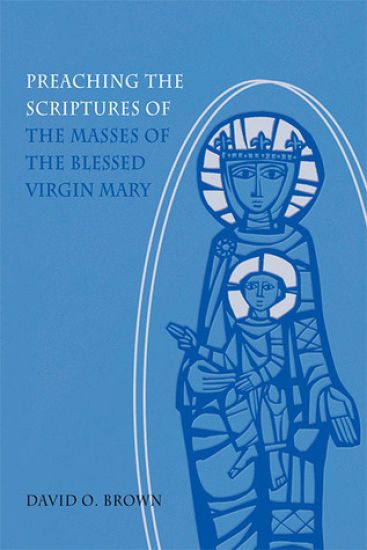
Preaching the Scriptures of the Masses of the Blessed Virgin Mary
David O. Brown
Liturgical Press
2013
pokkari
The Collection of Masses of the Blessed Virgin Mary offers more than 135 Scripture passages through which the faithful might deepen their devotion to Mary. While some texts are very familiar, others are not as well known to contemporary Catholics. In Preaching the Scriptures of the Masses of the Blessed Virgin Mary, Father David Brown examines each of the texts in detail, offering valuable insights for homily preparation.This helpful book includesinsightful exegesis of every Scripture passage of the Lectionary for these Masseshelpful summary statements about each readinga generous set of musings" on the readings for each Mass rich enough to prompt a variety of different homilies, making it useful year after yearsuggestions for further worthwhile readingHomilists will turn to this nourishing resource gratefully and repeatedly for inspiration and information.
Schooling for Humanity: When Big Brother Isn't Watching documents David O. Solmitz's thirty-year struggle as a controversial, anti-establishment teacher in a small, rural, central Maine high school. Using journal entries, accompanied by administrative reprimands, intertwined with historical documentation of the intensifying conflict between democratic pedagogy and capitalist domination in our public schools, the author gives a narrative account of his efforts to create a democratic classroom in a traditional secondary school setting. By incorporating theories of progressive educators into his practice, Solmitz demonstrates the possibility of achieving the ideals of democratic schooling in spite of an increasingly bureaucratic, rigid, and authoritarian system.
Highlighting activated charcoal's great effectiveness in treating drug overdoses and poisonings in both humans and animals, this comprehensive, single-source reference brings together vital information from every significant study on the use of activated charcoal for medical purposes-describing all available charcoal products and their characteristics. Details activated charcoal's ability to reduce the systemic absorption of a vast array of drugs, chemicals, and biochemical substances-including analgesics, antipyretics, sedatives, alkaloids, snake venoms, and bacterial and fungal toxins.
In this important new book, David O'Connor discusses both logical and empirical forms of the problem of inscrutable evil, perennially the most difficult philosophical problem confronting theism. Arguing that both a version of theism ('friendly theism') and a version of atheism ('friendly atheism') are justified on the evidence in the debate over God and evil, O'Connor concludes that a warranted outcome is a philosophical d_tente between those two positions. On the way to that conclusion he develops two arguments from evil, a reformed version of the logical argument and an indirect version of the empirical argument, and deploys both against a central formulation of theism that he describes as orthodox theism. God and Inscrutable Evil makes a valuable contribution to contemporary debates in the philosophy of religion.

Quantum Mechanics for Chemists is designed to provide chemistry undergraduates with a basic understanding of the principles of quantum mechanics. The text assumes some knowledge of chemical bonding and a familiarity with the qualitative aspects of molecular orbitals in molecules such as butadiene and benzene. Thus it is intended to follow a basic course in organic and/or inorganic chemistry. The approach is rather different from that adopted in most books on quantum chemistry in that the Schr÷dinger wave equation is introduced at a fairly late stage, after students have become familiar with the application of de Broglie-type wavefunctions to free particles and particles in a box. Likewise, the Hamiltonian operator and the concept of eigenfunctions and eigenvalues are not introduced until the last two chapters of the book, where approximate solutions to the wave equation for many-electron atoms and molecules are discussed. In this way, students receive a gradual introduction to the basic concepts of quantum mechanics. Ideal for the needs of undergraduate chemistry students, Tutorial Chemistry Texts is a major series consisting of short, single topic or modular texts concentrating on the fundamental areas of chemistry taught in undergraduate science courses. Each book provides a concise account of the basic principles underlying a given subject, embodying an independent-learning philosophy and including worked examples.
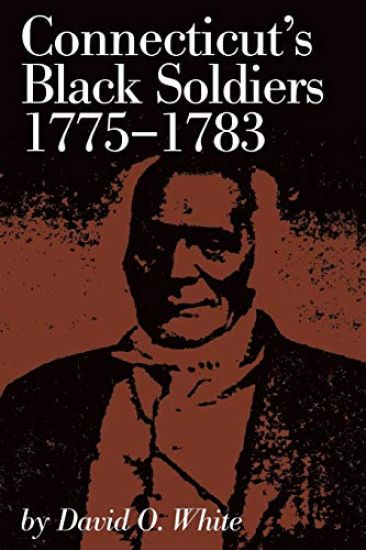
Black soldiers of the American Revolution? Not a credible statement in light of what most Americans have read about the Revolutionary War. We have heard of Casimir Pulaski the Pole, Marquis de Lafayette the Frenchman, and Baron von Steuben the German, but not black participants. Yet, close to 5,000 blacks did ?ght in the war against the British, and others served as laborers, spies, and guides. The absence in our general histories of their activities in this struggle lies with the misconception that the Afro-American has contributed little or nothing towards the creation of the United States and its subsequent development, for in most studies made of the Revolutionary era, there has been little impulse to search for evidences of service by blacks, except perhaps to note the existence of slavery. Histories of Connecticut have generally treated the Revolution in a similar manner. Few of them have acknowledged the contributions of the black soldier. This is partially true because the story of Connecticut's black participant is one about the regular foot soldier in the Revolution and not about the men who led him into battle or the political leaders who guided the nation. And it is these men who most often fill the pages of our history books. As one phase of the Bicentennial observation, The American Revolution Bicentennial Commission of Connecticut has authorized scholars in a wide range of study to write a series of monographs on the broadly defined Revolutionary Era of 1763 to 1787. These monographs [appeared] yearly beginning in 1973 through 1980. Emphasis is placed upon the birth of the nation, rather than on the winning of independence on the field of battle.
Marked by reflectiveness and mature insight, O'Meara's keen sense of lyric structure and subtle cadences explore in contexts both historical and personal the tension between established knowledge and discovery - the centre and horizon of our unfixed selves. These poems - ambitious, rooted, exuberant and controlled, informed by a certain restlessness - unfold in evocative tones of voice to propel a narrative at one intelligent and charismatic, far-ranging yet focussed. A remarkable debut.

Award-winning poet David O'Meara captures one family's precarious balance between misery and hope in his debut novel. Twenty-year-old Georgia is reeling from severe depression after the death of her best friend when she arrives in South Korea. Everyone teaching English is there for one of two reasons--adventure or escape--and she quickly falls in with a group of other foreigners. She eases into a life of late-night bars, riotous student protests and surfing until some unexpected news forces her to face the problems she has left behind. Hugo Walser is bound for Barcelona to publicly confront the man he's convinced is presenting a keynote speech about Hugo's controversial failure as an architect. Determined to drink away his pain until the big event, Hugo rambles through the city, distracted by thoughts of how he's failed his family. When the police call to investigate the disappearance of his ex-wife, Sarah Trimble, Hugo turns his attention to all he stands to lose. Meanwhile, Sarah, a high-end real estate agent, has been duped out of her life savings by a con man. En route to sell her last asset, the neglected family cottage in Gatineau, she's derailed when her car is caught in a flash flood. Alone and desperate, she seizes one last chance to right a wrong. Following a modern family's dysfunction, Chandelier is a three-part portrait of a young adult and her divorced parents as they navigate profound loss and disappointment and the crux between despair and optimism.

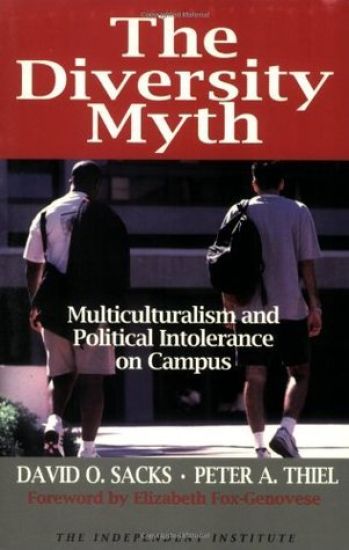
The Diversity Myth
David O. Sacks; Peter A. Thiel; Elizabeth Fox-Genovese
Independent Institute,U.S.
1999
pokkari
This is a powerful exploration of the debilitating impact that politically-correct “multiculturalism” has had upon higher education and academic freedom in the United States. In the name of diversity, many leading academic and cultural institutions are working to silence dissent and stifle intellectual life. This book exposes the real impact of multiculturalism on the institution most closely identified with the politically correct decline of higher education—Stanford University. Authored by two Stanford graduates, this book is a compelling insider’s tour of a world of speech codes, “dumbed-down” admissions standards and curricula, campus witch hunts, and anti-Western zealotry that masquerades as legitimate scholarly inquiry. Sacks and Thiel use numerous primary sources—the Stanford Daily, class readings, official university publications—to reveal a pattern of politicized classes, housing, budget priorities, and more. They trace the connections between such disparate trends as political correctness, the gender wars, Generation X nihilism, and culture wars, showing how these have played a role in shaping multiculturalism at institutions like Stanford. The authors convincingly show that multiculturalism is not about learning more; it is actually about learning less. They end their comprehensive study by detailing the changes necessary to reverse the tragic disintegration of American universities and restore true academic excellence.