Kirjojen hintavertailu. Mukana 12 586 062 kirjaa ja 12 kauppaa.

Kirjahaku

Etsi kirjoja tekijän nimen, kirjan nimen tai ISBN:n perusteella.

1000 tulosta hakusanalla David Peace

Peace Pact

Peace Pact

David C. Hendrickson

University Press of Kansas
2003
nidottu
That New England might invade Virginia is inconceivable today. But interstate rivalries and the possibility of intersectional war loomed large in the thinking of the Framers who convened in Philadelphia in 1787 to put on paper the ideas that would bind the federal union together. At the end of the Constitutional Convention, Benjamin Franklin rejoiced that the document would "astonish our enemies, who are waiting to hear with confidence . . . that our States are on the point of separation, only to meet hereafter for the purpose of cutting one another's throats." Usually dismissed as hyperbole, this and similar remarks by other Founders help us to understand the core concerns that shaped their conception of the Union. By reexamining the creation of the federal system of the United States from a perspective that yokes diplomacy with constitutionalism, Hendrickson's study, according to Karl Walling, "introduces a new way to think about what is familiar to us."This ground breaking book, then, takes a fresh look at the formative years of American constitutionalism and diplomacy. It tells the story of how thirteen colonies became independent states and found themselves grappling with the classic problems of international cooperation, and it explores the intellectual milieu within which that problem was considered. The founding generation, Hendrickson argues, developed a sophisticated science of international politics relevant both to the construction of their own union and to the foreign relations of "the several states in the union of the empire." The centrality of this discourse, he contends, must severely qualify conventional depictions of early American political thought as simply "liberal" or "republican."Hendrickson also takes issue with conventional accounts of early American foreign policy as "unilateralist" or "isolationist" and insists that the founding generation belonged to and made distinguished contributions to the constitutional tradition in diplomacy, the antecedent of twentieth-century internationalism. He describes an American system of states riven by deep sectional animosities and powerful loyalties to colonies and states (often themselves described as "nations") and explains why in such a milieu the creation of a durable union often appeared to be a quixotic enterprise. The book culminates in a consideration of the making of the federal Constitution, here styled as a peace pact or experiment in international cooperation.Peace Pact is an important book that promises to revolutionize our understanding of the era of revolution and constitution-making. Written in a lucid and accessible style, the book is an excellent introduction to the American founding and its larger significance in American and world history.
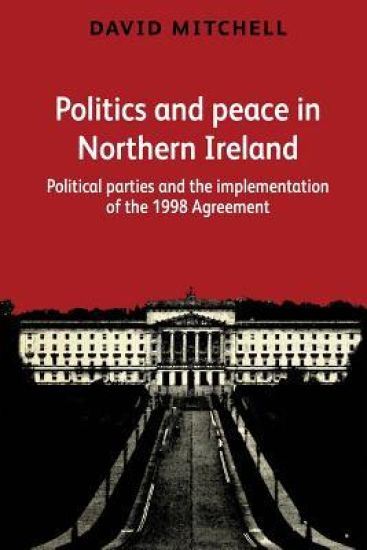
Politics and Peace in Northern Ireland

Politics and Peace in Northern Ireland

David Mitchell

Manchester University Press
2015
sidottu
Politics and peace in Northern Ireland analyses the complex and contradictory process of implementing the Good Friday Agreement. Using the lens of security dilemma theory, it begins with an original overview of the conflict, the Agreement and post-1998 politics. The book then explores post-Agreement Northern Ireland through the eyes of each of the four main political parties, showing how they tried to shape the course of peace implementation, and how implementation, in turn, shaped the fates and fortunes of the parties.Drawing on extensive original research, this book explains the promise and limits of the Agreement. It shows how and why the two sides' mutual insecurities repeatedly derailed peace implementation, and reflects on the likely direction of parties and politics in the future. This clearly written and up-to-date book will be of interest to scholars and students of recent Northern Irish history, ethnic conflict and peace-making.
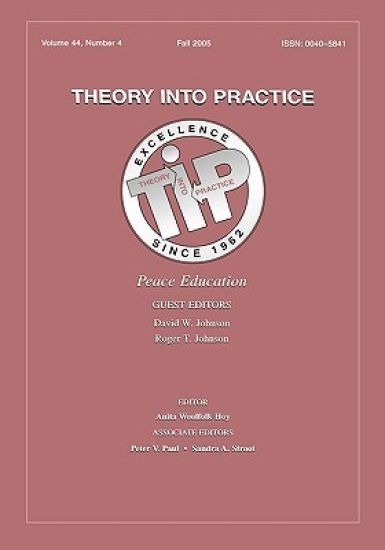
Peace Education Tip V44#4

Peace Education Tip V44#4

David Johnson

Routledge Member of the Taylor and Francis Group
2005
nidottu
Economics of the International Financial System offers an illuminating, engaging and lucid account of the working of 21st-century global political economy. From a macroeconomic perspective, it explores how major capitalist economies are closely integrated with each other in that none can remain unaffected by economic events around the globe.The book is one of the first in its genre to examine:the origin and relevance of international money as a concept and phenomenon;the structure of various money markets;the nature and functioning of major international financial institutions such as the World Bank, International Monetary Fund (IMF) and International Bank for Reconstruction and Development (IBRD); andthe dynamics of the new world financial system that emerged after the demise of Bretton Woods system.This will form an essential reading for students and scholars of international monetary economics, international corporate finance, researchers, policymakers, bankers and financial executives.
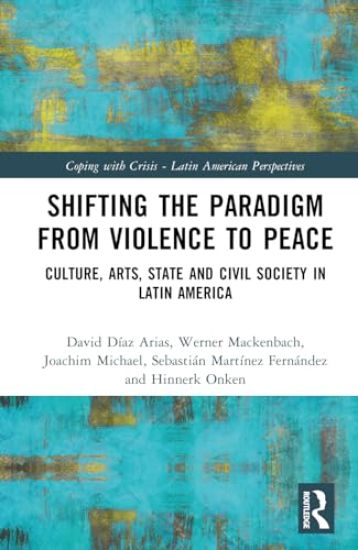
Peace in Latin America

Peace in Latin America

David Díaz Arias; Christine Hatzky; Werner Mackenbach; Sebastián Martínez Fernández; Joachim Michael; Hinnerk Onken

TAYLOR FRANCIS LTD
2024
sidottu
This volume shifts the focus from violence to peace studies in Latin America and sheds light on how social groups and individuals resist to violence and strive to create peaceful or at least less violent conditions of conviviality. Drawing on social sciences, history, and anthropology, but also on cultural, literary, and film studies, the book examines the role of social mobilizations, civic activism, and cultural/artistic initiatives as responses to the crisis of violence, which the state is unable or unwilling to address. In this sense, it debates what a culture of peace could mean in Latin America.Divided into four chapters, Chapter 1 discusses peace from an epistemological and philosophical perspective. In Chapter 2, the authors discuss the contours of a culture of peace with a particular focus on literary and cinematic narratives. Chapter 3 analyses the public debate about the role of the state in peace processes in the case of Costa Rica/Central America. Chapter 4 examines the importance of civil society activities in peace processes.Peace in Latin America is written for a wide and diverse audience that includes researchers, professors, specialists, students, civil society activists, and political actors not only from Latin America but from all over the world.
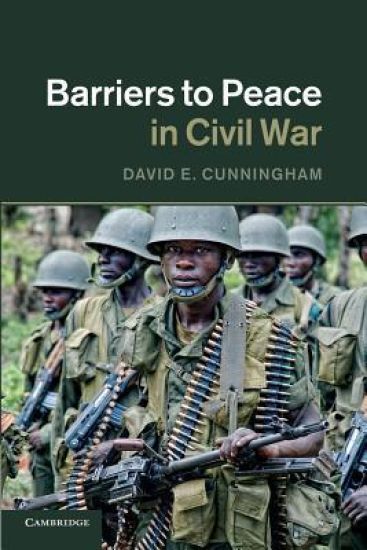
Barriers to Peace in Civil War

Barriers to Peace in Civil War

David E. Cunningham

Cambridge University Press
2014
pokkari
Civil wars vary greatly in their duration. This book argues that conflicts are longer when they involve more actors who can block agreement (veto players) and identifies specific problems that arise in multi-party bargaining. Quantitative analysis of over 200 civil wars since World War II reveals that conflicts with more of these actors last much longer than those with fewer. Detailed comparison of negotiations in Rwanda and Burundi demonstrates that multi-party negotiations present additional barriers to peace not found in two party conflicts. In addition, conflicts with more veto players produce more casualties, are more likely to involve genocide and are followed by shorter periods of peace. Because they present many barriers to peace, the international community has a poor track record of resolving multi-party conflicts. David Cunningham shows that resolution is possible in these wars if peace processes are designed to address the barriers that emerge in multi-party conflicts.
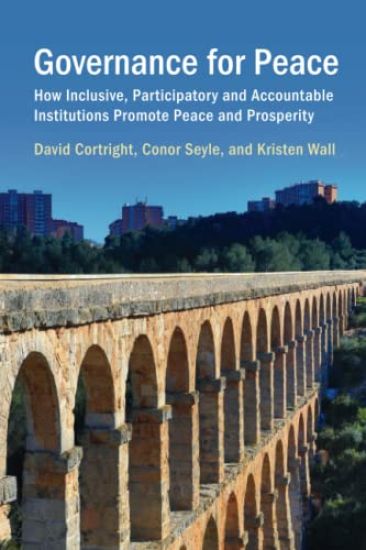
Governance for Peace

Governance for Peace

David Cortright; Conor Seyle; Kristen Wall

Cambridge University Press
2017
pokkari
Governance for Peace presents a comprehensive analysis of the dimensions of governance that are most likely to prevent armed conflict and foster sustainable peace. It is an accessible study written for the general reader that brings together the best empirical evidence across numerous disciplines showing how effective governance and inclusive, participatory, and accountable institutions help to reduce violence by addressing social needs and providing mechanisms for resolving disputes. This balanced and incisive book gives meaning to the term 'good governance' and identifies the specific features of political and economic institutions that are most likely to promote peace within and between states. Concepts and topics examined in the book include political legitimacy, human security, 'political goods', governance and power, inclusion, accountability, social cohesion, gender equality, countering corruption, the role of civil society, democratic participation, development as freedom, capitalism and economic growth, the governance of markets, China and the 'East Asian peace', the European Union, and global institutions.
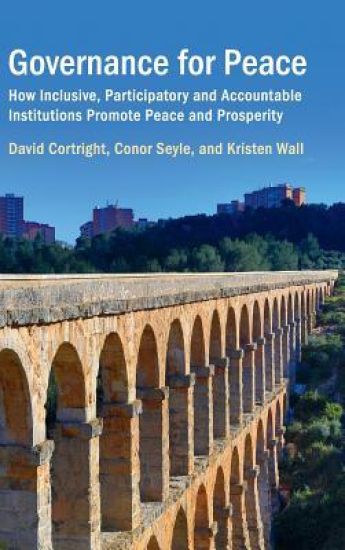
Governance for Peace

Governance for Peace

David Cortright; Conor Seyle; Kristen Wall

Cambridge University Press
2017
sidottu
Governance for Peace presents a comprehensive analysis of the dimensions of governance that are most likely to prevent armed conflict and foster sustainable peace. It is an accessible study written for the general reader that brings together the best empirical evidence across numerous disciplines showing how effective governance and inclusive, participatory, and accountable institutions help to reduce violence by addressing social needs and providing mechanisms for resolving disputes. This balanced and incisive book gives meaning to the term 'good governance' and identifies the specific features of political and economic institutions that are most likely to promote peace within and between states. Concepts and topics examined in the book include political legitimacy, human security, 'political goods', governance and power, inclusion, accountability, social cohesion, gender equality, countering corruption, the role of civil society, democratic participation, development as freedom, capitalism and economic growth, the governance of markets, China and the 'East Asian peace', the European Union, and global institutions.
Peace Education Tip V44#4

Peace Education Tip V44#4

David Johnson

Routledge
2017
sidottu
Economics of the International Financial System offers an illuminating, engaging and lucid account of the working of 21st-century global political economy. From a macroeconomic perspective, it explores how major capitalist economies are closely integrated with each other in that none can remain unaffected by economic events around the globe. The book is one of the first in its genre to examine: the origin and relevance of international money as a concept and phenomenon; the structure of various money markets; the nature and functioning of major international financial institutions such as the World Bank, International Monetary Fund (IMF) and International Bank for Reconstruction and Development (IBRD); and the dynamics of the new world financial system that emerged after the demise of Bretton Woods system. This will form an essential reading for students and scholars of international monetary economics, international corporate finance, researchers, policymakers, bankers and financial executives.
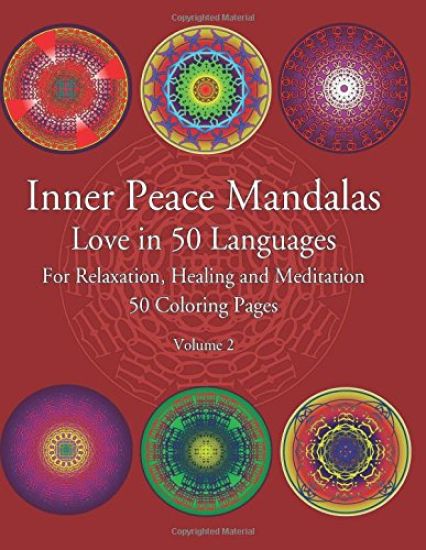
Inner Peace Mandalas Love in 50 Languages For Reflection, Healing and Meditation 50 Coloring Pages: Mandalas Coloring Book helps reduce stress and ach
Inner Peace Mandalas - Create your own works of art. All the mandalas in Volume 2 of Inner Peace Mandalas were created using the word Love in 50 languages to inspire your thoughts. The language used for the mandala is written below each mandala. On the page opposite each mandala there is space for you to write a few thoughts and if you wish set out any intention you might have in coloring the mandala. One of the easiest and most effective ways to experience the healing power of the mandala is by coloring the design. Mandala coloring is an effective tool for relaxation, healing and meditation primarily because coloring is a fun and relaxing activity. Coloring is a simple and enjoyable way to express your creativity. No matter what age you are, you can enjoy coloring. All you need are a few coloring pencils. What is important to remember is that you set the rules - there are no hard and fast, right or wrong ways to color a mandala. In fact you can do your coloring in any way you wish, almost anywhere you like, at your own pace. What's more you can be sure you are creating a unique work of art.
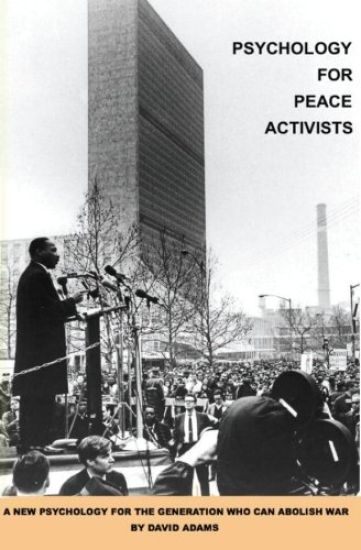
Psychology for Peace Activists: A new psychology for the generation who can abolish war
I believe that history is made by people like you and me. That means that "peace is in our hands", which was the slogan of the United Nations International Year for the Culture of Peace (2000), of which I was the director. To learn how this could be possible, I undertook the study presented here in Psychology for Peace Activists which examines the lives of great peace activists, based primarily on their own autobiographies, in terms of a theory of consciousness development. Being American, I chose to study activists from American history. This was later expanded to include the important example of Nelson Mandela from South Africa. From this, I draw the conclusion that while the task is difficult, it is also possible, and we have much to learn from those who have gone before us. For this reason, I have given this little book the sub-title of "A New Psychology for the Generation Who Can Abolish War."
Politics and Peace in Northern Ireland

Politics and Peace in Northern Ireland

David Mitchell

Manchester University Press
2017
nidottu
Politics and peace in Northern Ireland analyses the complex and contradictory process of implementing the Good Friday Agreement. Using the lens of security dilemma theory, it begins with an original overview of the conflict, the Agreement and post-1998 politics. The book then explores post-Agreement Northern Ireland through the eyes of each of the four main political parties, showing how they tried to shape the course of peace implementation, and how implementation, in turn, shaped the fates and fortunes of the parties.Drawing on extensive original research, this book explains the promise and limits of the Agreement. It shows how and why the two sides' mutual insecurities repeatedly derailed peace implementation, and reflects on the likely direction of parties and politics in the future. This clearly written and up-to-date book will be of interest to scholars and students of recent Northern Irish history, ethnic conflict and peace-making.