

Kirjahaku
Etsi kirjoja tekijän nimen, kirjan nimen tai ISBN:n perusteella.
1000 tulosta hakusanalla David T. Robison






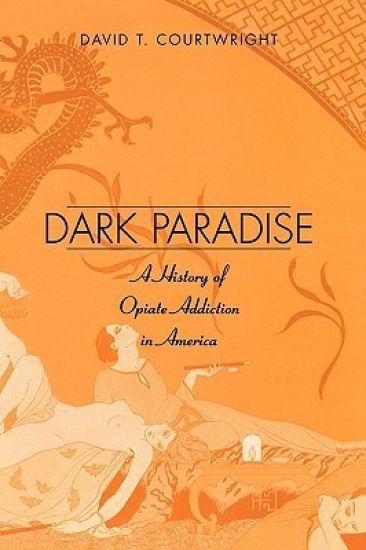
In a newly enlarged edition of this eye-opening book, David T. Courtwright offers an original interpretation of a puzzling chapter in American social and medical history: the dramatic change in the pattern of opiate addiction--from respectable upper-class matrons to lower-class urban males, often with a criminal record. Challenging the prevailing view that the shift resulted from harsh new laws, Courtwright shows that the crucial role was played by the medical rather than the legal profession. Dark Paradise tells the story not only from the standpoint of legal and medical sources, but also from the perspective of addicts themselves. With the addition of a new introduction and two new chapters on heroin addiction and treatment since 1940, Courtwright has updated this compelling work of social history for the present crisis of the Drug War.
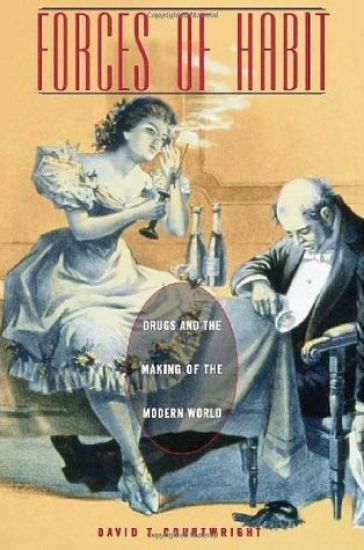
What drives the drug trade, and how has it come to be what it is today? A global history of the acquisition of progressively more potent means of altering ordinary waking consciousness, this book is the first to provide the big picture of the discovery, interchange, and exploitation of the planet’s psychoactive resources, from tea and kola to opiates and amphetamines.
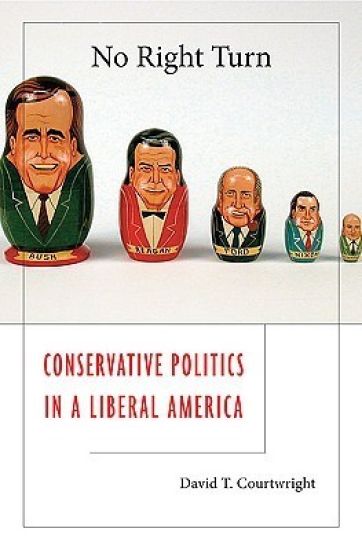
Few question the “right turn” America took after 1966, when liberal political power began to wane. But if they did, No Right Turn suggests, they might discover that all was not really “right” with the conservative golden age. A provocative overview of a half century of American politics, the book takes a hard look at the counterrevolutionary dreams of liberalism’s enemies—to overturn people’s reliance on expanding government, reverse the moral and sexual revolutions, and win the Culture War—and finds them largely unfulfilled. David Courtwright deftly profiles celebrated and controversial figures, from Clare Boothe Luce, Barry Goldwater, and the Kennedy brothers to Jerry Falwell, David Stockman, and Lee Atwater. He shows us Richard Nixon’s keen talent for turning popular anxieties about morality and federal meddling to Republican advantage—and his inability to translate this advantage into reactionary policies. Corporate interests, boomer lifestyles, and the media weighed heavily against Nixon and his successors, who placated their base with high-profile attacks on crime, drugs, and welfare dependency. Meanwhile, religious conservatives floundered on abortion and school prayer, obscenity, gay rights, and legalized vices like gambling, and fiscal conservatives watched in dismay as the bills mounted. We see how President Reagan’s mélange of big government, strong defense, lower taxes, higher deficits, mass imprisonment, and patriotic symbolism proved an illusory form of conservatism. Ultimately, conservatives themselves rebelled against George W. Bush’s profligate brand of Reaganism. Courtwright’s account is both surprising and compelling, a bracing argument against some of our most cherished clichés about recent American history.
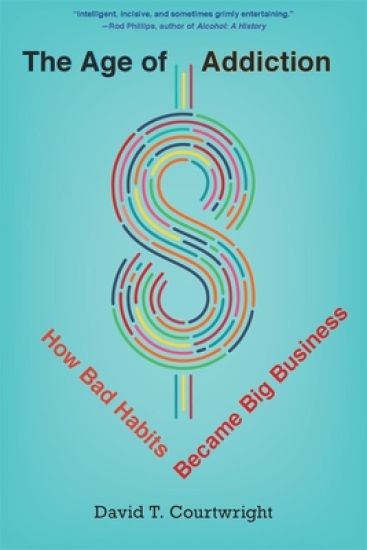
“A mind-blowing tour de force that unwraps the myriad objects of addiction that surround us…Intelligent, incisive, and sometimes grimly entertaining.”—Rod Phillips, author of Alcohol: A History“A fascinating history of corporate America’s efforts to shape our habits and desires.”—VoxWe live in an age of addiction, from compulsive gaming and shopping to binge eating and opioid abuse. Sugar can be as habit-forming as cocaine, researchers tell us, and social media apps are deliberately hooking our kids. But what can we do to resist temptations that insidiously rewire our brains? A renowned expert on addiction, David Courtwright reveals how global enterprises have both created and catered to our addictions. The Age of Addiction chronicles the triumph of what he calls “limbic capitalism,” the growing network of competitive businesses targeting the brain pathways responsible for feeling, motivation, and long-term memory.“Compulsively readable…In crisp and playful prose and with plenty of needed humor, Courtwright has written a fascinating history of what we like and why we like it, from the first taste of beer in the ancient Middle East to opioids in West Virginia.”—American Conservative“A sweeping, ambitious account of the evolution of addiction…This bold, thought-provoking synthesis will appeal to fans of ‘big history’ in the tradition of Guns, Germs, and Steel.”—Publishers Weekly
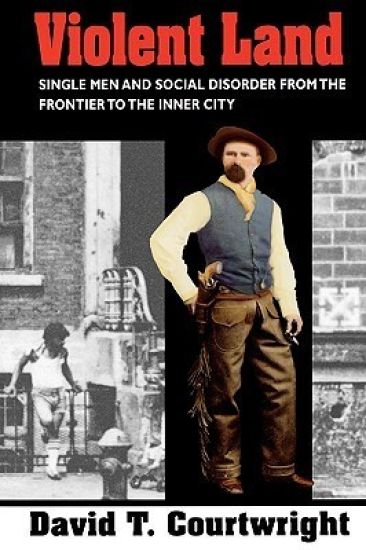
This book offers an explosive look at violence in America—why it is so prevalent, and what and who are responsible. David Courtwright takes the long view of his subject, developing the historical pattern of violence and disorder in this country. Where there is violent and disorderly behavior, he shows, there are plenty of men, largely young and single. What began in the mining camp and bunkhouse has simply continued in the urban world of today, where many young, armed, intoxicated, honor-conscious bachelors have reverted to frontier conditions.Violent Land combines social science with an engrossing narrative that spans and reinterprets the history of violence and social disorder in America. Courtwright focuses on the origins, consequences, and eventual decline of frontier brutality. Though these rough days have passed, he points out that the frontier experience still looms large in our national self-image—and continues to influence the extent and type of violence in America as well as our collective response to it.Broadly interdisciplinary, looking at the interplay of biological, social, and historical forces behind the dark side of American life, this book offers a disturbing diagnosis of violence in our society.

The French Book Trade in the Ancien Regime, 1500-1791
David T Pottinger
Harvard University Press
1958
sidottu



Christianity Matters.: How Over Two Millennia the Meek and the Merciful Revolutionized Civilization -- And Why It Needs to Happen Again
David T. Maloof
70X7 Publishing
2016
nidottu

In February, 1993, a gun battle erupted outside Waco, Texas, as federal agents attempted to search the communal residence of a religion known as the "Branch Davidians." The battle, and the following siege, was the greatest law enforcement debacle in American history, costing nearly a hundred lives. After a criminal trial, two Cabinet-level studies, and three sets of Congressional hearings, the truth appeared to be firmly settled. A cult led by a madman had shot at federal agents and had then set themselves aflame. The issue was settled. Then in 1999, the Waco issue exploded, with proof that the Federal agencies had lied to their own leadership, to Congress, and to the courts. "This Is Not An Assault" explores this remarkable turnabout. It is authored by someone who saw it from the inside, a former government attorney whose lawsuit forced ATF and FBI to divulge the incriminating documents and tapes. Author Biography: David T. Hardy is an attorney and a legal scholar. He holds a B.A. and Juris Doctorate from the University of Arizona, where he served as Associate Editor of the Arizona Law Review, a fellow of the Instiute for Humane Studies, and was given the ABA's Lewis M. Powell medallion for excellence in appellate advocacy. Mr. Hardy is the author of three books, portions of six anthologies, and thirteen law review articles. His writings on Federal firearms laws have been cited as authority by the U.S. Supreme Court and ten of the thirteen U.S. Courts of Appeals. He has testified before two Senate committees conducting oversight of the Bureau of Alcohol, Tobacco, and Firearms. Mr. Hardy spent eight years as a Federal agency attorney, representing the U.S. Department of theInterior and the Federal Deposit Insurance Corporation. Before and after his federal service, he practiced law in Tucson, Arizona.

In February, 1993, a gun battle erupted outside Waco, Texas, as federal agents attempted to search the communal residence of a religion known as the "Branch Davidians." The battle, and the following siege, was the greatest law enforcement debacle in American history, costing nearly a hundred lives. After a criminal trial, two Cabinet-level studies, and three sets of Congressional hearings, the truth appeared to be firmly settled. A cult led by a madman had shot at federal agents and had then set themselves aflame. The issue was settled. Then in 1999, the Waco issue exploded, with proof that the Federal agencies had lied to their own leadership, to Congress, and to the courts. "This Is Not An Assault" explores this remarkable turnabout. It is authored by someone who saw it from the inside, a former government attorney whose lawsuit forced ATF and FBI to divulge the incriminating documents and tapes. Author Biography: David T. Hardy is an attorney and a legal scholar. He holds a B.A. and Juris Doctorate from the University of Arizona, where he served as Associate Editor of the Arizona Law Review, a fellow of the Instiute for Humane Studies, and was given the ABA's Lewis M. Powell medallion for excellence in appellate advocacy. Mr. Hardy is the author of three books, portions of six anthologies, and thirteen law review articles. His writings on Federal firearms laws have been cited as authority by the U.S. Supreme Court and ten of the thirteen U.S. Courts of Appeals. He has testified before two Senate committees conducting oversight of the Bureau of Alcohol, Tobacco, and Firearms. Mr. Hardy spent eight years as a Federal agency attorney, representing the U.S. Department of theInterior and the Federal Deposit Insurance Corporation. Before and after his federal service, he practiced law in Tucson, Arizona.

Caught in the Crossfire presents a multifaceted explanation of why people participate in something as dangerous and uncertain as a revolutionary movement. Beginning with an analysis of the grievances that motivate peasant participation in political movements, the book also explores the additional factors_leadership, resources, and strategies_required to mobilize peasants for collective action. Collective action itself need not be violent, but a repressive state response can quickly transform a reformist movement into a revolution. Mason shows how different strategies on the part of various actors can result in a government victory, a rebel victory, or a negotiated settlement. The book concludes with a look to the future: Will the emerging trends toward political democratization and economic globalization make revolution in the countryside more or less likely?
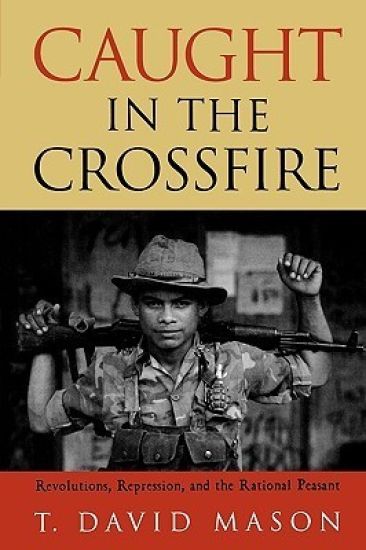
Caught in the Crossfire presents a multifaceted explanation of why people participate in something as dangerous and uncertain as a revolutionary movement. Beginning with an analysis of the grievances that motivate peasant participation in political movements, the book also explores the additional factors—leadership, resources, and strategies—required to mobilize peasants for collective action. Collective action itself need not be violent, but a repressive state response can quickly transform a reformist movement into a revolution. Mason shows how different strategies on the part of various actors can result in a government victory, a rebel victory, or a negotiated settlement. The book concludes with a look to the future: Will the emerging trends toward political democratization and economic globalization make revolution in the countryside more or less likely?