Kirjahaku
Etsi kirjoja tekijän nimen, kirjan nimen tai ISBN:n perusteella.
1000 tulosta hakusanalla Erasmus Wilson
Используя факторно-кластерный подход к сегментации рынка, в данном исследовании анализируются мотивы поездок прибывающих и выбывающих студентов Erasmus. На основе шести выделенных факторов мотивации, кластерный анализ был использован для выявления схожих респондентов на основе их мотивации. Результаты показывают, что существуют три отдельные группы социокультурные студенты-путешественники, синергетические студенты-путешественники и студенты-предприниматели-путешественники. Пол является переменной, которая статистически более значима среди трех групп. В заключении статьи приводятся предложения по интернационализации высших учебных заведений и маркетинговые последствия для туристических направлений в отношении студенческого рынка.
This book has been considered important throughout the human history, and so that this work is never forgotten Alpha Editions has made efforts in its preservation by republishing this book in a modern format for the present and future generations. This whole book has been re-formatted, re-typed and re-designed. These books are not made of scanned copies of their original work, and hence the text is clear and readable.
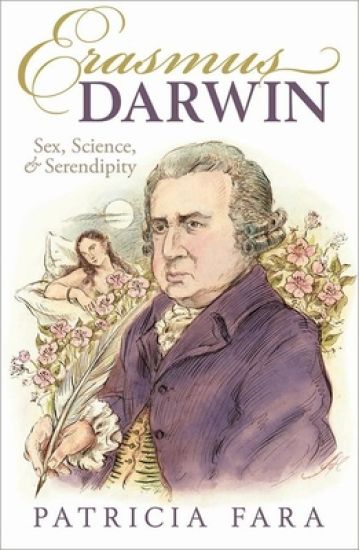
Dr Erasmus Darwin seemed an innocuous Midlands physician, a respectable stalwart of eighteenth-century society. But there was another side to him. Botanist, physician, Lunar inventor and popular poet, Darwin was internationally renowned for extraordinary poems explaining his theories about sex and science. Yet he became a target for the political classes, the victim of a sustained and vitriolic character assassination by London's most savage satirists. Intrigued, prize-winning historian Patricia Fara set out to investigate why Darwin had provoked such fierce intellectual and political reaction. Inviting her readers to accompany her, she embarked on what turned out to be a circuitous and serendipitous journey. Her research led her to discover a man who possessed, according to Samuel Taylor Coleridge, 'perhaps a greater range of knowledge than any other man in Europe.' His evolutionary ideas influenced his grandson Charles, were banned by the Vatican, and scandalized his reactionary critics. But for modern readers he shines out as an impassioned Enlightenment reformer who championed the abolition of slavery, the education of women, and the optimistic ideals of the French Revolution. As she tracks down her quarry, Patricia Fara uncovers a ferment of dangerous ideas that terrified the establishment, inspired the Romantics, and laid the ground for Victorian battles between faith and science.
Erasmus of Rotterdam was the greatest Christian humanist scholar of the Northern European Renaissance, a correspondent of Sir Thomas More and many other learned men of his time, known to his contemporaries and to posterity for subtlety of his thought and the depth of his learning. He was also, according to some modern writers, an anti-Semite. In this complete analysis of all of Erasmus' writings on Jews and Judaism, Shimon Markish asserts that the accusation cannot be sustained. For Markish, to ask whether Erasmus was a friend or enemy of the Jews is to ask a modern question of a sixteenth-century man, whose attitude can best be called "asemitism." Erasmus' chief preoccupation was with the future of "the true philosophy of Christ"; he had little interest in the Jewish community of his own time. Erasmus and the Jews discusses Erasmus' critique of Mosaic law and his view of the conflict between "Judaism" as legalistic morality and Jesus' teaching; his judgment on the Pharisees of Jesus' time; his emphasis on the importance of the study of Hebrew; and his opinions of sixteenth-century Jews. This meticulous analysis reveals an Erasmus who defended his vision of true piety by rejecting "Judaizing" Christians more than Jews and who saw the Old Testament as integral to the Christian worldview. As a Christian, he regretted nonbelief and pitied unbelievers, without vicious hostility toward any single people. His theological opposition to a form of religious thought which he identified with Judaism was not translated into crude prejudice against actual Jews. In general, his calm consideration of the strange and the foreign and his willingness to restrict his judgments to the philosophical realm were, Markish argues, early and significant steps toward enlightened toleration. Markish's discussion of Erasmus is supplemented with an Afterword by theologian and philosopher Arthur A. Cohen, who offers a variant interpretation of Erasmus' writings and attitudes. The juxtaposed arguments of the two scholars make this an especially illuminating work for any student of Erasmus and his influence. Erasmus and the Jews also gives a necessary clarity to our understanding of the meaning of anti-Semitism and the history of religious toleration. Markish's profound knowledge of Erasmus allows him to demonstrate the fundamental importance of putting arguments and terminology in the context of a thinker's work and his own time.

Erasmus Darwin (1731-1802) had the highest reputation among living English poets during much of the 1790s, through the great success of his long poem in rhyming couplets, The Botanic Garden, published complete in 1792. In this new book Desmond King-Hele shows in convincing detail how Darwin greatly influenced five major English Romantic poets, Blake, Wordsworth, Coleridge, Shelley and Keats, and many other poets of the time, such as Crabbe and Campbell (but not Byron).
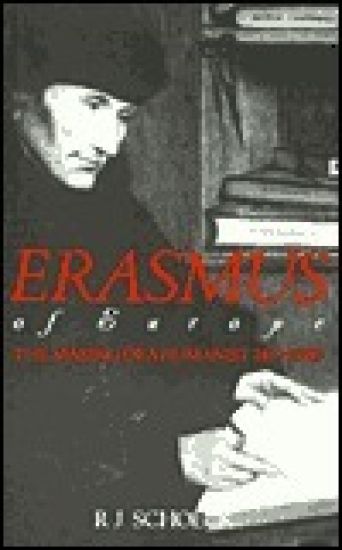
Erasmus of Europe
R. J. Schoeck
Barnes Noble Books-Imports, Div of Rowman Littlefield Pubs., Inc
1991
sidottu
This is an ambitious and wide-ranging biography of Erasmus of Rotterdam, one of the most famous Renaissance humanists. In part a riveting narrative account of the philosopher's journeys from his monastery to service with a great Burgundian bishop, and from there to Paris, England the Low Countries and Switzerland, this comprehensive and definitive biography also looks at the history of ideas in which Erasmus played a vital role. Covering the formative years of Erasmus the humanist, this new study makes full analyses of all his early writings, ncluding his Letters, his contributions to Renaissance dialogue and essay, and particularly his Adagia, the colloquies, and the Praise of Folly. After years of intensive research, and in an area which is essentially multidisciplinary, Professor Schoeck brings together serious historical, literary, theological and philosophical study in a unique way.
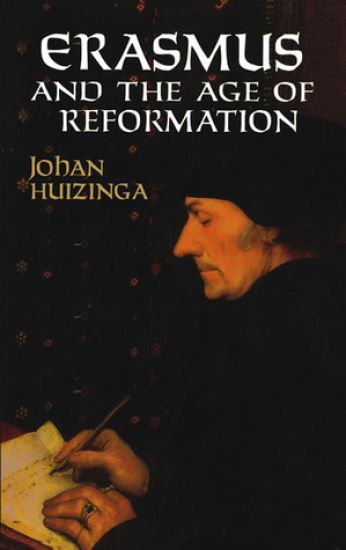
In this very readable biography, a noted scholar traces Erasmus's youth, his years as an itinerant scholar, sojourns in England, France, Switzerland, and Italy, friendship with Sir Thomas More, and disputes with Martin Luther. The author also probes Erasmus's mind and character and discusses his writings.
Few historical figures have been more important in modeling the ideal of impartial critical scholarship than Erasmus of Rotterdam (1469-1536). Yet his critical scholarship, though beholden to no one, was not dispassionate. James Tracy shows how Erasmus the scholar sought through his writings to promote the moral and religious renewal of Christian society. Tracy finds the genesis of the humanist's notion of a "Christian republic" of pious and learned individuals in his "Burgundian," or Low Countries, roots. Erasmus's vision of reform, Tracy argues, sprung from a humanist tradition focusing on the importance of teaching (doctrina), a tradition from which Erasmus departed in his optimism about human nature and his deep suspicion of the powers that be. Amid the storms of Reformation controversy, he pruned back the "dissimulation" by which he had thought to convey different meanings to different readers, yet in the end he could not control the way his words were read. If Erasmus's scholarly ideal carries an enduring fascination, so too does his dilemma as a man of circumspection who would also be a reformer. This title is part of UC Press's Voices Revived program, which commemorates University of California Press’s mission to seek out and cultivate the brightest minds and give them voice, reach, and impact. Drawing on a backlist dating to 1893, Voices Revived makes high-quality, peer-reviewed scholarship accessible once again using print-on-demand technology. This title was originally published in 1966.

Few historical figures have been more important in modeling the ideal of impartial critical scholarship than Erasmus of Rotterdam (1469-1536). Yet his critical scholarship, though beholden to no one, was not dispassionate. James Tracy shows how Erasmus the scholar sought through his writings to promote the moral and religious renewal of Christian society. Tracy finds the genesis of the humanist's notion of a "Christian republic" of pious and learned individuals in his "Burgundian," or Low Countries, roots. Erasmus's vision of reform, Tracy argues, sprung from a humanist tradition focusing on the importance of teaching (doctrina), a tradition from which Erasmus departed in his optimism about human nature and his deep suspicion of the powers that be. Amid the storms of Reformation controversy, he pruned back the "dissimulation" by which he had thought to convey different meanings to different readers, yet in the end he could not control the way his words were read. If Erasmus's scholarly ideal carries an enduring fascination, so too does his dilemma as a man of circumspection who would also be a reformer. This title is part of UC Press's Voices Revived program, which commemorates University of California Press’s mission to seek out and cultivate the brightest minds and give them voice, reach, and impact. Drawing on a backlist dating to 1893, Voices Revived makes high-quality, peer-reviewed scholarship accessible once again using print-on-demand technology. This title was originally published in 1966.
Erasmus, Contarini, and the Religious Republic of Letters
Constance M. Furey
Cambridge University Press
2008
pokkari
Though the paradigm of modernist progression has been challenged on many fronts, Erasmus and other sixteenth-century figures are still commonly viewed as people who led the transition from a religious Middle Ages to a more godless modern era. Erasmus, Contarini and the Religious Republic of Letters, published in 2005, complicates this transition by analysing a unique realm of spiritualised scholarship that cannot fit easily into any conventional intellectual chronology. By analysing the lives, work, and correspondence of Erasmus, Thomas More, Margaret More Roper, Reginald Pole, Gasparo Contarini, and Vittoria Colonna, this book demonstrates how these Catholic men and women of letters created a distinctive kind of religious community rooted in friendship and spiritualised scholarship. By spanning the too frequently respected gap between humanist reformers in northern and southern Europe, the book uncovers a widespread, if previously less visible, network that exhibited concerns we still grapple with today.
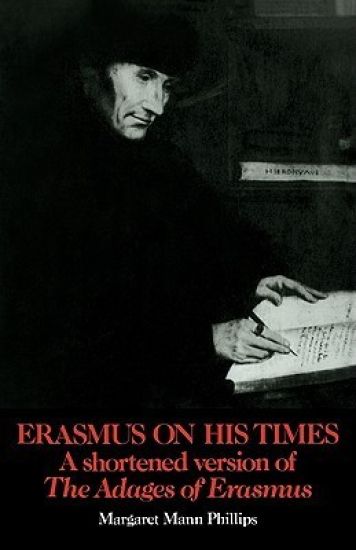
The Adagia of Erasmus (surely the original best-seller) was first published in 1500. It went through numerous impressions and ten major revisions in the course of Erasmus's life. Its influence was incalculable. It disseminated humanist learning and humanist attitudes among the new reading public to such an extent that it can be claimed as one of the books that contributed most to form the European mind. The adages were proverbs or popular sayings taken from classical literature. Many are part of the common stock of our speech today. A necessary evil, cupboard love, a rare bird, an iron in the fire, are all to be found in the Adagia. Erasmus refers each to its source; then follows with a commentary on the meaning and with whatever ideas and personal observations arose from it. The book's influence waned after his death.
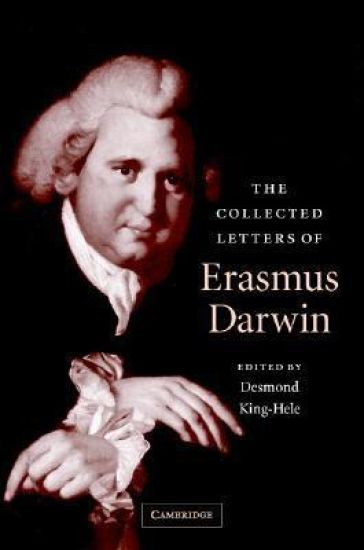
Erasmus Darwin has often been cited as the most widely talented man of the past 250 years. He excelled in medicine and poetry, was an inventor and wide ranging man of science, and founded several societies. This 2006 collection of 460 of his letters provides an insight into the life of this amazing man. Darwin was famous throughout Britain as a physician; his medical letters to patients and private letters to his physician son Robert are a rich source for historians of medicine. His lively letters to the 'Lunar Men', Boulton, Watt, Keir and Wedgwood, provide insight into the Industrial Revolution in England. In the 1790s Darwin propounded the idea of biological evolution, although it was his grandson Charles who persuaded people to take it seriously. This unique collection reveals the variety of Erasmus Darwin's talents, and his wide range of important friendships.

Erasmus, Contarini, and the Religious Republic of Letters
Constance M. Furey
Cambridge University Press
2005
sidottu
Though the paradigm of modernist progression has been challenged on many fronts, Erasmus and other sixteenth-century figures are still commonly viewed as people who led the transition from a religious Middle Ages to a more godless modern era. Erasmus, Contarini and the Religious Republic of Letters, published in 2005, complicates this transition by analysing a unique realm of spiritualised scholarship that cannot fit easily into any conventional intellectual chronology. By analysing the lives, work, and correspondence of Erasmus, Thomas More, Margaret More Roper, Reginald Pole, Gasparo Contarini, and Vittoria Colonna, this book demonstrates how these Catholic men and women of letters created a distinctive kind of religious community rooted in friendship and spiritualised scholarship. By spanning the too frequently respected gap between humanist reformers in northern and southern Europe, the book uncovers a widespread, if previously less visible, network that exhibited concerns we still grapple with today.
Erasmus V1: His Life And Character As Shown In His Correspondence And Works
Robert Blackley Drummond
KESSINGER PUBLISHING, LLC
2007
sidottu