Kirjojen hintavertailu. Mukana 12 459 402 kirjaa ja 12 kauppaa.

Kirjahaku

Etsi kirjoja tekijän nimen, kirjan nimen tai ISBN:n perusteella.

1000 tulosta hakusanalla Ferguson Barbara P.

The Young Gentleman and Lady's Astronomy, Familiarly Explained in ten Dialogues Between Neander and Eudosia. To Which is Added, The Description and use of the Globes and Armillary Sphere. By James Ferguson,
The 18th century was a wealth of knowledge, exploration and rapidly growing technology and expanding record-keeping made possible by advances in the printing press. In its determination to preserve the century of revolution, Gale initiated a revolution of its own: digitization of epic proportions to preserve these invaluable works in the largest archive of its kind. Now for the first time these high-quality digital copies of original 18th century manuscripts are available in print, making them highly accessible to libraries, undergraduate students, and independent scholars.Medical theory and practice of the 1700s developed rapidly, as is evidenced by the extensive collection, which includes descriptions of diseases, their conditions, and treatments. Books on science and technology, agriculture, military technology, natural philosophy, even cookbooks, are all contained here.++++The below data was compiled from various identification fields in the bibliographic record of this title. This data is provided as an additional tool in helping to insure edition identification: ++++British LibraryT131240In two parts, the second having a divisional titlepage and separate pagination; the register is continuous.Dublin: printed by Boulter Grierson, 1768. 4],146,91, 1]p., VIIIplates; 8
An Essay on the History of Civil Society. by Adam Ferguson, ... the Second Edition, Corrected
The 18th century was a wealth of knowledge, exploration and rapidly growing technology and expanding record-keeping made possible by advances in the printing press. In its determination to preserve the century of revolution, Gale initiated a revolution of its own: digitization of epic proportions to preserve these invaluable works in the largest archive of its kind. Now for the first time these high-quality digital copies of original 18th century manuscripts are available in print, making them highly accessible to libraries, undergraduate students, and independent scholars.Rich in titles on English life and social history, this collection spans the world as it was known to eighteenth-century historians and explorers. Titles include a wealth of travel accounts and diaries, histories of nations from throughout the world, and maps and charts of a world that was still being discovered. Students of the War of American Independence will find fascinating accounts from the British side of conflict. ++++The below data was compiled from various identification fields in the bibliographic record of this title. This data is provided as an additional tool in helping to insure edition identification: ++++British LibraryT134320London: printed for A. Millar and T. Cadell; and A. Kincaid and J. Bell, Edinburgh, 1768. vii, 1],430p.; 4
Principles of Moral and Political Science; Being Chiefly a Retrospect of Lectures Delivered in the College of Edinburgh. By Adam Ferguson, ... In two Volumes. ... of 2; Volume 1
The 18th century was a wealth of knowledge, exploration and rapidly growing technology and expanding record-keeping made possible by advances in the printing press. In its determination to preserve the century of revolution, Gale initiated a revolution of its own: digitization of epic proportions to preserve these invaluable works in the largest archive of its kind. Now for the first time these high-quality digital copies of original 18th century manuscripts are available in print, making them highly accessible to libraries, undergraduate students, and independent scholars.The Age of Enlightenment profoundly enriched religious and philosophical understanding and continues to influence present-day thinking. Works collected here include masterpieces by David Hume, Immanuel Kant, and Jean-Jacques Rousseau, as well as religious sermons and moral debates on the issues of the day, such as the slave trade. The Age of Reason saw conflict between Protestantism and Catholicism transformed into one between faith and logic -- a debate that continues in the twenty-first century.++++The below data was compiled from various identification fields in the bibliographic record of this title. This data is provided as an additional tool in helping to insure edition identification: ++++British LibraryT114601Edinburgh: printed for A. Strahan and T. Cadell, London; and W. Creech, Edinburgh, 1792. 2v.; 4
Principles of Moral and Political Science; Being Chiefly a Retrospect of Lectures Delivered in the College of Edinburgh. By Adam Ferguson, ... In two Volumes. ... of 2; Volume 2
The 18th century was a wealth of knowledge, exploration and rapidly growing technology and expanding record-keeping made possible by advances in the printing press. In its determination to preserve the century of revolution, Gale initiated a revolution of its own: digitization of epic proportions to preserve these invaluable works in the largest archive of its kind. Now for the first time these high-quality digital copies of original 18th century manuscripts are available in print, making them highly accessible to libraries, undergraduate students, and independent scholars.The Age of Enlightenment profoundly enriched religious and philosophical understanding and continues to influence present-day thinking. Works collected here include masterpieces by David Hume, Immanuel Kant, and Jean-Jacques Rousseau, as well as religious sermons and moral debates on the issues of the day, such as the slave trade. The Age of Reason saw conflict between Protestantism and Catholicism transformed into one between faith and logic -- a debate that continues in the twenty-first century.++++The below data was compiled from various identification fields in the bibliographic record of this title. This data is provided as an additional tool in helping to insure edition identification: ++++British LibraryT114601Edinburgh: printed for A. Strahan and T. Cadell, London; and W. Creech, Edinburgh, 1792. 2v.; 4
Astronomical Tables and Precepts, for Calculating the True Times of new and Full Moons, and ... Projecting Eclipses, From the Creation of the World to A.D. 7800. To Which is Prefixed, a Short Theory of the Solar and Lunar Motions. By James Ferguson
The 18th century was a wealth of knowledge, exploration and rapidly growing technology and expanding record-keeping made possible by advances in the printing press. In its determination to preserve the century of revolution, Gale initiated a revolution of its own: digitization of epic proportions to preserve these invaluable works in the largest archive of its kind. Now for the first time these high-quality digital copies of original 18th century manuscripts are available in print, making them highly accessible to libraries, undergraduate students, and independent scholars.Medical theory and practice of the 1700s developed rapidly, as is evidenced by the extensive collection, which includes descriptions of diseases, their conditions, and treatments. Books on science and technology, agriculture, military technology, natural philosophy, even cookbooks, are all contained here.++++The below data was compiled from various identification fields in the bibliographic record of this title. This data is provided as an additional tool in helping to insure edition identification: ++++British LibraryT018567With an errata slip pasted on p. 63.London: printed for the author, 1763. 63, 1]p., plate; 8
Institutes of Moral Philosophy. For the use of Students in the College of Edinburgh. By Adam Ferguson, LL.D
The 18th century was a wealth of knowledge, exploration and rapidly growing technology and expanding record-keeping made possible by advances in the printing press. In its determination to preserve the century of revolution, Gale initiated a revolution of its own: digitization of epic proportions to preserve these invaluable works in the largest archive of its kind. Now for the first time these high-quality digital copies of original 18th century manuscripts are available in print, making them highly accessible to libraries, undergraduate students, and independent scholars.The Age of Enlightenment profoundly enriched religious and philosophical understanding and continues to influence present-day thinking. Works collected here include masterpieces by David Hume, Immanuel Kant, and Jean-Jacques Rousseau, as well as religious sermons and moral debates on the issues of the day, such as the slave trade. The Age of Reason saw conflict between Protestantism and Catholicism transformed into one between faith and logic -- a debate that continues in the twenty-first century.++++The below data was compiled from various identification fields in the bibliographic record of this title. This data is provided as an additional tool in helping to insure edition identification: ++++British LibraryT076223With a half title.Edinburgh: printed for A. Kincaid & J. Bell, 1769. xvi,319, 1]p.; 12
Astronomy Explained Upon Sir Isaac Newton's Principles, and Made Easy to Those who Have not Studied Mathematics. By James Ferguson
The 18th century was a wealth of knowledge, exploration and rapidly growing technology and expanding record-keeping made possible by advances in the printing press. In its determination to preserve the century of revolution, Gale initiated a revolution of its own: digitization of epic proportions to preserve these invaluable works in the largest archive of its kind. Now for the first time these high-quality digital copies of original 18th century manuscripts are available in print, making them highly accessible to libraries, undergraduate students, and independent scholars.Medical theory and practice of the 1700s developed rapidly, as is evidenced by the extensive collection, which includes descriptions of diseases, their conditions, and treatments. Books on science and technology, agriculture, military technology, natural philosophy, even cookbooks, are all contained here.++++The below data was compiled from various identification fields in the bibliographic record of this title. This data is provided as an additional tool in helping to insure edition identification: ++++British LibraryT018586With an index.London: printed for, and sold by the author, 1756. 8],267, 9]p., plates; 4
Astronomy Explained Upon Sir Isaac Newton's Principles, and Made Easy to Those who Have not Studied Mathematics. By James Ferguson. The Second Edition
The 18th century was a wealth of knowledge, exploration and rapidly growing technology and expanding record-keeping made possible by advances in the printing press. In its determination to preserve the century of revolution, Gale initiated a revolution of its own: digitization of epic proportions to preserve these invaluable works in the largest archive of its kind. Now for the first time these high-quality digital copies of original 18th century manuscripts are available in print, making them highly accessible to libraries, undergraduate students, and independent scholars.Medical theory and practice of the 1700s developed rapidly, as is evidenced by the extensive collection, which includes descriptions of diseases, their conditions, and treatments. Books on science and technology, agriculture, military technology, natural philosophy, even cookbooks, are all contained here.++++The below data was compiled from various identification fields in the bibliographic record of this title. This data is provided as an additional tool in helping to insure edition identification: ++++British LibraryT018585With an index.London: printed for, and sold by the author, 1757. 8],283, 9]p., plates; 4
The History of the Progress and Termination of the Roman Republic. by Adam Ferguson, ... Illustrated with Maps. ... of 3; Volume 2
The 18th century was a wealth of knowledge, exploration and rapidly growing technology and expanding record-keeping made possible by advances in the printing press. In its determination to preserve the century of revolution, Gale initiated a revolution of its own: digitization of epic proportions to preserve these invaluable works in the largest archive of its kind. Now for the first time these high-quality digital copies of original 18th century manuscripts are available in print, making them highly accessible to libraries, undergraduate students, and independent scholars.Rich in titles on English life and social history, this collection spans the world as it was known to eighteenth-century historians and explorers. Titles include a wealth of travel accounts and diaries, histories of nations from throughout the world, and maps and charts of a world that was still being discovered. Students of the War of American Independence will find fascinating accounts from the British side of conflict. ++++The below data was compiled from various identification fields in the bibliographic record of this title. This data is provided as an additional tool in helping to insure edition identification: ++++British LibraryT077047Dedication dated: Edinburgh, February I, 1783. With a leaf of errata at the end of vol.3.London: printed for W. Strahan; T. Cadell; and W. Creech, in Edinburgh, 1783. 3v., plates: maps; 4
The History of the Progress and Termination of the Roman Republic. by Adam Ferguson, ... Illustrated with Maps. ... of 3; Volume 3
The 18th century was a wealth of knowledge, exploration and rapidly growing technology and expanding record-keeping made possible by advances in the printing press. In its determination to preserve the century of revolution, Gale initiated a revolution of its own: digitization of epic proportions to preserve these invaluable works in the largest archive of its kind. Now for the first time these high-quality digital copies of original 18th century manuscripts are available in print, making them highly accessible to libraries, undergraduate students, and independent scholars.Rich in titles on English life and social history, this collection spans the world as it was known to eighteenth-century historians and explorers. Titles include a wealth of travel accounts and diaries, histories of nations from throughout the world, and maps and charts of a world that was still being discovered. Students of the War of American Independence will find fascinating accounts from the British side of conflict. ++++The below data was compiled from various identification fields in the bibliographic record of this title. This data is provided as an additional tool in helping to insure edition identification: ++++British LibraryT077047Dedication dated: Edinburgh, February I, 1783. With a leaf of errata at the end of vol.3.London: printed for W. Strahan; T. Cadell; and W. Creech, in Edinburgh, 1783. 3v., plates: maps; 4
Institutes of Moral Philosophy. For the use of Students in the College of Edinburgh. By Adam Ferguson, LL.D. The Second Edition. Revised and Corrected
The 18th century was a wealth of knowledge, exploration and rapidly growing technology and expanding record-keeping made possible by advances in the printing press. In its determination to preserve the century of revolution, Gale initiated a revolution of its own: digitization of epic proportions to preserve these invaluable works in the largest archive of its kind. Now for the first time these high-quality digital copies of original 18th century manuscripts are available in print, making them highly accessible to libraries, undergraduate students, and independent scholars.The Age of Enlightenment profoundly enriched religious and philosophical understanding and continues to influence present-day thinking. Works collected here include masterpieces by David Hume, Immanuel Kant, and Jean-Jacques Rousseau, as well as religious sermons and moral debates on the issues of the day, such as the slave trade. The Age of Reason saw conflict between Protestantism and Catholicism transformed into one between faith and logic -- a debate that continues in the twenty-first century.++++The below data was compiled from various identification fields in the bibliographic record of this title. This data is provided as an additional tool in helping to insure edition identification: ++++British LibraryT076224With a final leaf of advertisements and a half-title.Edinburgh: printed for A. Kincaid & W. Creech, and J. Bell. Sold, in London, by S. Crowder, R. Baldwin, E.& C. Dillies, and T. Cadell, 1773. xvi,294, 2]p.; 12
Institutes of Moral Philosophy. By Adam Ferguson, ... A new Edition Enlarged
The 18th century was a wealth of knowledge, exploration and rapidly growing technology and expanding record-keeping made possible by advances in the printing press. In its determination to preserve the century of revolution, Gale initiated a revolution of its own: digitization of epic proportions to preserve these invaluable works in the largest archive of its kind. Now for the first time these high-quality digital copies of original 18th century manuscripts are available in print, making them highly accessible to libraries, undergraduate students, and independent scholars.The Age of Enlightenment profoundly enriched religious and philosophical understanding and continues to influence present-day thinking. Works collected here include masterpieces by David Hume, Immanuel Kant, and Jean-Jacques Rousseau, as well as religious sermons and moral debates on the issues of the day, such as the slave trade. The Age of Reason saw conflict between Protestantism and Catholicism transformed into one between faith and logic -- a debate that continues in the twenty-first century.++++The below data was compiled from various identification fields in the bibliographic record of this title. This data is provided as an additional tool in helping to insure edition identification: ++++British LibraryT076221Basil: printed and sold by James Decker. Paris, sold by Levrault freres, 1800. xii,242p.; 8
Institutes of Moral Philosophy. By Adam Ferguson, ... Third Edition, Enlarged
The 18th century was a wealth of knowledge, exploration and rapidly growing technology and expanding record-keeping made possible by advances in the printing press. In its determination to preserve the century of revolution, Gale initiated a revolution of its own: digitization of epic proportions to preserve these invaluable works in the largest archive of its kind. Now for the first time these high-quality digital copies of original 18th century manuscripts are available in print, making them highly accessible to libraries, undergraduate students, and independent scholars.The Age of Enlightenment profoundly enriched religious and philosophical understanding and continues to influence present-day thinking. Works collected here include masterpieces by David Hume, Immanuel Kant, and Jean-Jacques Rousseau, as well as religious sermons and moral debates on the issues of the day, such as the slave trade. The Age of Reason saw conflict between Protestantism and Catholicism transformed into one between faith and logic -- a debate that continues in the twenty-first century.++++The below data was compiled from various identification fields in the bibliographic record of this title. This data is provided as an additional tool in helping to insure edition identification: ++++British LibraryT076222With a half-title.Edinburgh: printed for John Bell & William Creech. Sold in London by T. Cadell and G. Robinson, 1785. xvi,317, 1]p.; 12
The Description and use of a new Machine, Called the Mechanical Paradox; Invented by James Ferguson,
The 18th century was a wealth of knowledge, exploration and rapidly growing technology and expanding record-keeping made possible by advances in the printing press. In its determination to preserve the century of revolution, Gale initiated a revolution of its own: digitization of epic proportions to preserve these invaluable works in the largest archive of its kind. Now for the first time these high-quality digital copies of original 18th century manuscripts are available in print, making them highly accessible to libraries, undergraduate students, and independent scholars.Medical theory and practice of the 1700s developed rapidly, as is evidenced by the extensive collection, which includes descriptions of diseases, their conditions, and treatments. Books on science and technology, agriculture, military technology, natural philosophy, even cookbooks, are all contained here.++++The below data was compiled from various identification fields in the bibliographic record of this title. This data is provided as an additional tool in helping to insure edition identification: ++++British LibraryT018561London: printed for the author; and sold by A. Millar, 1764. 16p., plate; 8
The use of a new Orrery, Made and Described by James Ferguson
The 18th century was a wealth of knowledge, exploration and rapidly growing technology and expanding record-keeping made possible by advances in the printing press. In its determination to preserve the century of revolution, Gale initiated a revolution of its own: digitization of epic proportions to preserve these invaluable works in the largest archive of its kind. Now for the first time these high-quality digital copies of original 18th century manuscripts are available in print, making them highly accessible to libraries, undergraduate students, and independent scholars.Medical theory and practice of the 1700s developed rapidly, as is evidenced by the extensive collection, which includes descriptions of diseases, their conditions, and treatments. Books on science and technology, agriculture, military technology, natural philosophy, even cookbooks, are all contained here.++++The below data was compiled from various identification fields in the bibliographic record of this title. This data is provided as an additional tool in helping to insure edition identification: ++++British LibraryT002065With an errata slip inserted.London: printed for the author, 1746. 42p., plate; 8
A Sermon Preached in the Ersh Language to His Majesty's First Highland Regiment of Foot, ... at Their Cantonment at Camberwell, on the 18th day of December, 1745. ... By ... Adam Ferguson, ... and Translated by him Into English,
The 18th century was a wealth of knowledge, exploration and rapidly growing technology and expanding record-keeping made possible by advances in the printing press. In its determination to preserve the century of revolution, Gale initiated a revolution of its own: digitization of epic proportions to preserve these invaluable works in the largest archive of its kind. Now for the first time these high-quality digital copies of original 18th century manuscripts are available in print, making them highly accessible to libraries, undergraduate students, and independent scholars.The Age of Enlightenment profoundly enriched religious and philosophical understanding and continues to influence present-day thinking. Works collected here include masterpieces by David Hume, Immanuel Kant, and Jean-Jacques Rousseau, as well as religious sermons and moral debates on the issues of the day, such as the slave trade. The Age of Reason saw conflict between Protestantism and Catholicism transformed into one between faith and logic -- a debate that continues in the twenty-first century.++++The below data was compiled from various identification fields in the bibliographic record of this title. This data is provided as an additional tool in helping to insure edition identification: ++++British LibraryT003049London: printed for A. Millar, 1746. 23, 1]p.; 8
Lectures on Select Subjects in Mechanics, Hydrostatics, Pneumatics, and Optics. With the use of the Globes, the art of Dialing, ... With the Supplement. By James Ferguson, ... A new Edition
The 18th century was a wealth of knowledge, exploration and rapidly growing technology and expanding record-keeping made possible by advances in the printing press. In its determination to preserve the century of revolution, Gale initiated a revolution of its own: digitization of epic proportions to preserve these invaluable works in the largest archive of its kind. Now for the first time these high-quality digital copies of original 18th century manuscripts are available in print, making them highly accessible to libraries, undergraduate students, and independent scholars.Medical theory and practice of the 1700s developed rapidly, as is evidenced by the extensive collection, which includes descriptions of diseases, their conditions, and treatments. Books on science and technology, agriculture, military technology, natural philosophy, even cookbooks, are all contained here.++++The below data was compiled from various identification fields in the bibliographic record of this title. This data is provided as an additional tool in helping to insure edition identification: ++++National Library of ScotlandN019867The supplement to the lectures has separate pagination, but the register is continuous.London: printed for W. Strahan, J. and F. Rivington, J. Hinton, L. Hawes and Co. W. Johnston, and 5 others in London], 1773. vii, 1],252, 4],40p., plates; 4
Adam Ferguson

Adam Ferguson

David Kettler

AldineTransaction
2005
nidottu
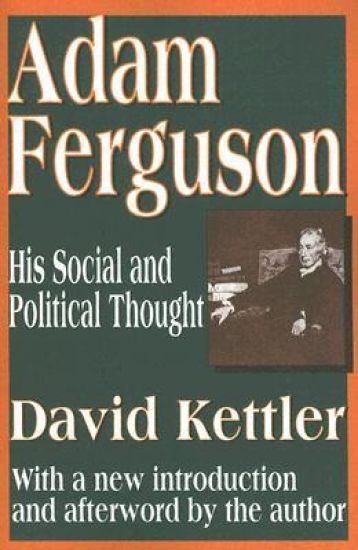
The thought of Adam Ferguson generated great excitement among many of his philosophic contemporaries in the late eighteenth century, and it continues to inspire the modern reader. This major study by David Kettler is an ideal introduction to Ferguson's life and thought. The new introduction to this first paperback edition discusses Ferguson's work in relation to his better-known contemporaries David Hume and Adam Smith, while the afterword offers an in-depth reconsideration of Ferguson's most renowned work, An Essay on the History of Civil Society, with emphasis on present-day disputes about the concept of civil society. Ferguson welcomed the advent of critical and analytical philosophy as an ally against superstitious credulity and confused obscurantism, but he was afraid that it might also dissolve into incomprehensible technical complexity and ethical relativism. He was attracted by the manifest practical accomplishments of modern science, as well as by its masterful ordering of natural phenomena into a unified theoretical structure, but he feared that its adherents would debase the notion of man to that of a machine at the mercy of mechanical forces. Ferguson thought well of ambition, but he also believed that a frenzy of ambition and frustration might tear at man's self-respect and peace of mind. The decisive phenomenon manifested by Ferguson's writing is the emergence of an intellectual's point of view toward the conditions of modern society. Many of the questions that he posed have been restated in more profound ways, some of the questions and most of the answers have been eliminated or transformed beyond recognition; and all of the issues he raises are now expressed by others in harsh, new words. But, however formulated, Ferguson's concerns clearly foreshadow the problems of over-rationalization, dehumanization, atomization, alienation, and bureaucratization that have been repeatedly canvassed by intellectuals in our time.