Kirjojen hintavertailu. Mukana 11 244 527 kirjaa ja 12 kauppaa.

Kirjahaku

Etsi kirjoja tekijän nimen, kirjan nimen tai ISBN:n perusteella.

1000 tulosta hakusanalla French Hacking

French Cinema

French Cinema

Dudley Andrew

Oxford University Press
2023
nidottu
It is often claimed that the French invented cinema. Dominating the production and distribution of cinema until World War 1, when they were supplanted by Hollywood, the French cinema industry encompassed all genres, from popular entertainment to avant-garde practice. The French invented the "auteur" and the "ciné-club"; they incubated criticism from the 1920s to our own day that is unrivalled; and they boast more film journals, fan magazines, TV shows, and festivals devoted to film than anywhere else. This Very Short Introduction opens up French cinema through focusing on some of its most notable works, using the lens of the New Wave decade (1958-1968) that changed cinema worldwide. Exploring the entire French cinematic oeuvre, Dudley Andrew teases out distinguishing themes, tendencies, and lineages, to bring what is most crucial about French Cinema into alignment. He discusses how style has shaped the look of female stars and film form alike, analysing the "made up" aesthetic of many films, and the paradoxical penchant for French cinema to cruelly unmask surface beauty in quests for authenticity. Discussing how French cinema as a whole pits strong-willed characters against auteurs with high-minded ideas of film art, funded by French cinema's close rapport to literature, painting, and music, Dudley considers how the New Wave emerged from these struggles, becoming an emblem of ambition for cinema that persists today. He goes on to show how the values promulgated by the New Wave directors brought the three decades that preceded it into focus, and explores the deep resonance of those values today, fifty years later. ABOUT THE SERIES: The Very Short Introductions series from Oxford University Press contains hundreds of titles in almost every subject area. These pocket-sized books are the perfect way to get ahead in a new subject quickly. Our expert authors combine facts, analysis, perspective, new ideas, and enthusiasm to make interesting and challenging topics highly readable.

French Philosophy, 1572-1675

French Philosophy, 1572-1675

Desmond M. Clarke

Oxford University Press
2016
sidottu
Desmond M. Clarke presents a thematic history of French philosophy from the middle of the sixteenth century to the beginning of Louis XIV's reign. While the traditional philosophy of the schools was taught throughout this period by authors who have faded into permanent obscurity, a whole generation of writers who were not professional philosophers--some of whom never even attended a school or college--addressed issues that were prominent in French public life. Clarke explores such topics as the novel political theory espoused by monarchomachs, such as Bèze and Hotman, against Bodin's account of absolute sovereignty; the scepticism of Montaigne, Charron, and Sanches; the ethical discussions of Du Vair, Gassendi, and Pascal; innovations in natural philosophy that were inspired by Mersenne and Descartes and implemened by members of the Académie royale des sciences; theories of the human mind from Jean de Silhon to Cureau de la Chambre and Descartes; and the novel arguments in support of women's education and equality that were launched by De Gournay, Du Bosc, Van Schurman and Poulain de la Barre. The writers involved were lawyers, political leaders, theologians, and independent scholars and they acknowledged, almost unanimously, the authority of the Bible as a source of knowledge that was claimed to be more reliable than the fragile powers of human understanding. Since they could not agree, however, on which books of the Bible were canonical or how that should be understood, their discussions raised questions about faith and reason that mirrored those involved in the infamous Galileo affair.
French Revolutionaries in the Ottoman Empire

French Revolutionaries in the Ottoman Empire

Pascal Firges

Oxford University Press
2017
sidottu
The effects of the French Revolution reached far beyond the confines of France itself. The Ottoman Empire, ancient ally and major trading partner of France, was not immune from the repercussions of the 'Age of Revolutions', especially since it was home to permanent French communities with a certain legal autonomy. French Revolutionaries in the Ottoman Empire examines, for the first time, the political and cultural impact of the French Revolution on Franco-Ottoman relations, as well as on the French communities of the Ottoman Empire. The modern interpretation of revolutionary ideological expansionism is strongly influenced by the famous propaganda decree of 19 November 1792 which promised 'fraternity and help to all peoples who wish to recover their liberty', as well as the well-studied efforts to export the Revolution into the territories conquered by the revolutionary armies and to the various Sister Republics. Against all expectations, however, French revolutionaries in the Ottoman Empire exhibited neither a 'crusading mentality' nor a heightened readiness to use force in order to achieve ideological goals. Instead, as this volume shows, in matters of diplomacy as well as in the administration of French expatriate communities, revolutionary policies were applied in an extremely circumspect fashion. The focus on the effects of the French regime change outside of France offers valuable new insights into the revolutionary process itself, which will revise common assumptions about French revolutionary diplomacy. In addition, Pascal Firges takes a close look at the establishment of the new political culture of the French Revolution within the transcultural context of the French expatriate communities of the Ottoman Empire, which serves as a thought-provoking point of comparison for the emergence and development of French revolutionary political culture.
French Administrative Law

French Administrative Law

Neville Brown; John Bell

Oxford University Press
1998
sidottu
As the bicentenary of the Conseil d'État approaches, this new edition of the leading English-language text provides a detailed profile of the Conseil and offers an up-to-date overview of le droit administratif, which is regarded, alongside the Code Napoléon, as the most notable achievement of French legal science. The Conseil d'État is taken as a model for many administrative systems in Europe and beyond, and it continues to exercise a strong influence upon the emerging democracies of Eastern Europe and the Third World. The eleven expanded appendices, including statistics, model pleadings and other illustrations, provide an invaluable and accessible source of information on the French administrative courts, their procedure and case-load. Throughout the approach is comparative, with frequent references to developments in United Kingdom administrative law and in the EC institutions. The book will be an invaluable guide to all students of French law and comparative public law.
French Law

French Law

Eva Steiner

Oxford University Press
2018
sidottu
The second edition of French Law: A Comparative Approach provides an authoritative, comprehensive, and up to date account of the French legal system and its internal workings. It sets out the institutional frameworks, substantive law, and methodologies that underpin the system, and provides expert insight into the civil law way of thinking and an explanation of how law is made and enforced in France. It offers detailed case studies of how French law is shaped in practice in key areas, including commentary on landmark cases that have shaped modern French law. Illuminating and insightful comparisons to other legal jurisdictions are made throughout, helping readers appreciate the distinguishing features and unique nature of the French legal landscape.
French Law

French Law

Eva Steiner

Oxford University Press
2018
nidottu
The second edition of French Law: A Comparative Approach provides an authoritative, comprehensive, and up to date account of the French legal system and its internal workings. It sets out the institutional frameworks, substantive law, and methodologies that underpin the system, and provides expert insight into the civil law way of thinking and an explanation of how law is made and enforced in France. It offers detailed case studies of how French law is shaped in practice in key areas, including commentary on landmark cases that have shaped modern French law. Illuminating and insightful comparisons to other legal jurisdictions are made throughout, helping readers appreciate the distinguishing features and unique nature of the French legal landscape.
French Philosophy, 1572-1675

French Philosophy, 1572-1675

Desmond M. Clarke

Oxford University Press
2018
nidottu
Desmond M. Clarke presents a thematic history of French philosophy from the middle of the sixteenth century to the beginning of Louis XIV's reign. While the traditional philosophy of the schools was taught throughout this period by authors who have faded into permanent obscurity, a whole generation of writers who were not professional philosophers—some of whom never even attended a school or college—addressed issues that were prominent in French public life. Clarke explores such topics as the novel political theory espoused by monarchomachs, such as Bèze and Hotman, against Bodin's account of absolute sovereignty; the scepticism of Montaigne, Charron, and Sanches; the ethical discussions of Du Vair, Gassendi, and Pascal; innovations in natural philosophy that were inspired by Mersenne and Descartes and implemened by members of the Académie royale des sciences; theories of the human mind from Jean de Silhon to Cureau de la Chambre and Descartes; and the novel arguments in support of women's education and equality that were launched by De Gournay, Du Bosc, Van Schurman and Poulain de la Barre. The writers involved were lawyers, political leaders, theologians, and independent scholars and they acknowledged, almost unanimously, the authority of the Bible as a source of knowledge that was claimed to be more reliable than the fragile powers of human understanding. Since they could not agree, however, on which books of the Bible were canonical or how that should be understood, their discussions raised questions about faith and reason that mirrored those involved in the infamous Galileo affair.
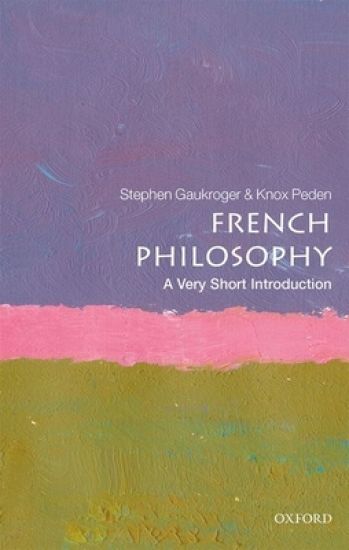
French Philosophy

French Philosophy

Stephen Gaukroger; Knox Peden

Oxford University Press
2020
nidottu
French culture is unique in that philosophy has played a significant role from the early-modern period onwards, intimately associated with political, religious, and literary debates, as well as with epistemological and scientific ones. While Latin was the language of learning there was a universal philosophical literature, but with the rise of vernacular literatures things changed and a distinctive national form of philosophy arose in France. This Very Short Introduction covers French philosophy from its origins in the sixteenth century up to the present, analysing it within its social, political, and cultural context. Beginning with psychology and epistemology, Stephen Gaukroger and Knox Peden then move onto the emergence of radical philosophy in the eighteenth century, before considering post-revolutionary philosophy in the nineteenth century, philosophy in the world wars, the radical thought of the 1960s, and finally French philosophy today. Throughout, they explore the dilemma sustained by the markedly national conception of French philosophy, and its history of speaking out on matters of universal concern. ABOUT THE SERIES: The Very Short Introductions series from Oxford University Press contains hundreds of titles in almost every subject area. These pocket-sized books are the perfect way to get ahead in a new subject quickly. Our expert authors combine facts, analysis, perspective, new ideas, and enthusiasm to make interesting and challenging topics highly readable.

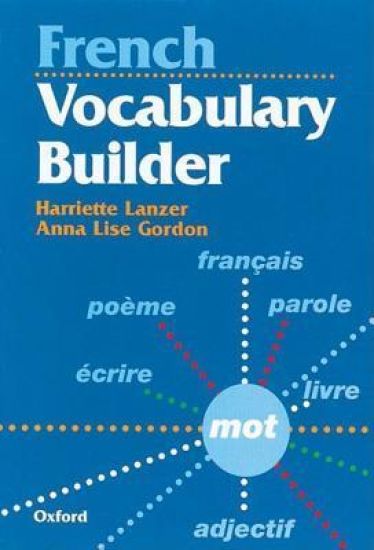
French Vocabulary Builder

French Vocabulary Builder

Harriette Lanzer; Anne Lise Gordon

Oxford University Press
1995
nidottu
The French Vocabulary Builder is an excellent guide for students, helping them to build up their French vocabulary, as well as preparing them for written and oral examinations. · Over 3,000 words and phrases covering all curriculum topics, including home, animals, hobbies, food, travel, weather, work, media, currant affairs, environment · Special sections on adjectives and verbs · Activities, helpful tips, and cartoon strips in each section make learning fun · Striking examples, illustrations, and strategies to help students grasp and remember new words · Answers to all exercises are at the back making it suitable for self-study
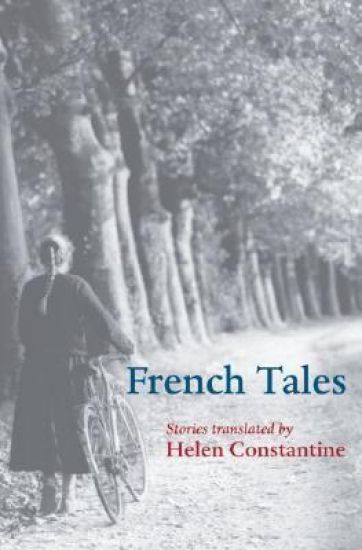
French Tales

French Tales

Oxford University Press
2008
nidottu
French Tales is a collection of twenty-two translated stories associated with the twenty-two regions of France. The book, which includes both well-known and little-known writers, for example Prosper Mérimée in the nineteenth century and Anne-Marie Garat in the twenty-first, affords readers a panoramic view of French society and culture, reflecting, as it does, its variety and diversity from Brittany to Corsica. Writers include among others Maupassant, Zola, Annie Saumont, Marcel Aymé, Didier Daeninckx and Stephane Émond. The subject-matter ranges from stories about marriage, the First World War and homelessness to house-buying, childhood and honour-killing. Following the model of Paris Tales, also translated by Helen Constantine, each story is illustrated with a striking photograph and there is a map indicating the position of the French regions. There is an introduction and notes to accompany the stories and a selection of Further Reading. The book will appeal to people who love travelling or are armchair travellers, as much as to those who love France and things French.
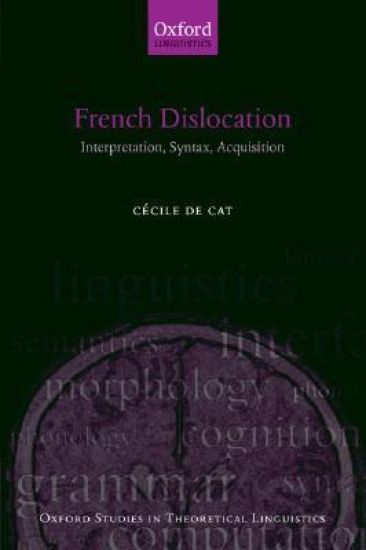
French Dislocation

French Dislocation

Cécile de Cat

Oxford University Press
2007
sidottu
The pervasive use of dislocations (as in Le chocolat, c'est bon) is a key characteristic of spoken French. This book offers various new and well-motivated insights, based on tests conducted by the author, on the syntactic analysis, prosody, and the interpretation of dislocation in spoken French. It also considers important aspects of the acquisition of dislocation by monolingual children learning different French dialects. The author argues that spoken French is a discourse-configurational language, in which topics are obligatorily dislocated. She develops a syntactically parsimonious account, which maximizes the import of interfaces involved with discourse and prosody. She proposes clear diagnostics, following a reexamination of the status of subject clitics and a reevaluation of the characteristic prosody of dislocated constituents. The theoretical arguments throughout the book rest on data that comes from corpora of spontaneous production and from various elitication experiments. This book throws new light on French syntax and prosody and makes an important and original contribution to the study of linguistic interfaces. Clearly expressed and tightly argued it will interest scholars and advanced students of French and of its acquisition as a first language as well as linguistic theorists interested in the interfaces between syntax, discourse, and phonology.
French Dislocation

French Dislocation

Cécile de Cat

Oxford University Press
2009
nidottu
The pervasive use of dislocations (as in Le chocolat, c'est bon) is a key characteristic of spoken French. This book offers various new and well-motivated insights, based on tests conducted by the author, on the syntactic analysis, prosody, and the interpretation of dislocation in spoken French. It also considers important aspects of the acquisition of dislocation by monolingual children learning different French dialects. The author argues that spoken French is a discourse-configurational language, in which topics are obligatorily dislocated. She develops a syntactically parsimonious account, which maximizes the import of interfaces involved with discourse and prosody. She proposes clear diagnostics, following a reexamination of the status of subject clitics and a reevaluation of the characteristic prosody of dislocated constituents. The theoretical arguments throughout the book rest on data that comes from corpora of spontaneous production and from various elitication experiments. This book throws new light on French syntax and prosody and makes an important and original contribution to the study of linguistic interfaces. Clearly expressed and tightly argued, it will interest scholars and advanced students of French and of its acquisition as a first language as well as linguistic theorists interested in the interfaces between syntax, discourse, and phonology.
French Romantic Travel Writing

French Romantic Travel Writing

C. W. Thompson

Oxford University Press
2011
sidottu
In the first half of the nineteenth century most leading French Romantic authors wrote travel books. French Romantic Travel Writing is the first study exclusively devoted to surveying the travelogues they produced and the reasons for, and significance of, this trend. Whilst 'the journey' was one of Romanticism's central images, suggesting as it did a dynamic, expanding, and evermore complex world in which artists' lives were increasingly experienced as wanderings and endless quests, the fashion for Romantic travel books was more marked in France than in Germany or England. Chateaubriand, Staël, Stendhal, Nodier, Hugo, Lamartine, Nerval, Gautier, Sand, Custine, Quinet, Mérimée, Dumas, and Tristan all wrote one or more travelogues, including at least four masterpieces-Hugo's Le Rhin (1842), Nerval's Voyage en Orient (1851), and Stendhal's two Rome, Naples et Florence (1817 and 1826). The book explores the reasons for this difference from England and Germany. These include French foreign and cultural policies, as well as the particular needs of Parisian publishers. It puts forward the case for the collective achievement of these Romantic travel books, compared to those of most later writers in nineteenth-century France. A distinctive feature of the survey is its belief in the value of concentrating on the text of these books as published by their authors, as opposed to manuscript and peripheral material.
French Laughter

French Laughter

Walter Redfern

Oxford University Press
2008
sidottu
The culmination of a lifetime's fascination with humour in all its forms, this book is the first in any language to embrace such an impressive span of authors and such a broad range of topics in French literary humour. In nine wide-ranging chapters Walter Redfern considers diverse writers and topics, including: Diderot, viewed as a laughing philosopher, mainly through his fiction (Les Bijoux indiscrets, Le Neeu de Rameau, and Jacques le fataliste); humourlessness, corraling Rousseau, Sade, the Christian God, and Jean-Pierre Brisset; the aesthete Huysmans, in both his avatars, Symbolist and Naturalist (A Rebours, Sac au dos, and other texts); the dramatic use of parrots by Flaubert, Queneau, and Beckett; Vallès and la blague; exaggeration in Vallès and Céline (Mort à credit and L'Enfant); the fiction, plays, and autobiography of Sartre; bad jokes in Beckett; wordplay in Tournier's fiction (especially Roi des aulnes and Les Météores). Five interleaved 'riffs' on laughter, dreams, black humour, politics, and taste, carry the enquiry into questions of humour outside of the purely French context, enhancing a book that impresses as much with its vivacity of style as with the breadth and depth of its scholarship.
French Property and Inheritance Law

French Property and Inheritance Law

Henry Dyson

Oxford University Press
2003
nidottu
The growing trend for purchasing property in France, either as a main or second home, has led to a corresponding need for a book which explains the French conveyancing system for lawyers trained in other legal systems. French Property and Inheritance Law offers practical guidance to lawyers and other professionals advising clients on property transactions and related matters in France including: buying, selling, and mortgaging land; the ownership of flats and leases; and the establishment of companies to own land as a means of avoiding French inheritance rules and to mitigate French inheritance tax. It unravels the mysteries of many features of the French system such as the marriage régime, the PACS, and sales en viager which can often be advantageous to non-French clients. The book also covers all aspects of French inheritance law, including the rules of intestacy, the making of wills, and the inheritance rights of the surviving spouse and the rights of other members of the family. The author offers advice on how beneficiaries can avoid personal liability for the debts of a deceased and provides practical guidance on the administration of estates. A glossary and relevant legal precedents are also included. The author also writes regular updates on new key developments in French property law - please see the publication Solicitors' Journal for details of his articles on the subject.
French Romance of the Later Middle Ages

French Romance of the Later Middle Ages

Rosalind Brown-Grant

Oxford University Press
2008
sidottu
Whilst French romances of the twelfth and thirteenth centuries have long enjoyed a privileged place in the literary history of France, romances from the later middle ages have been largely neglected by modern scholars, despite their central role in the chivalric culture of the day. In particular, although this genre has been seen as providing a forum within which ideas about masculine and feminine roles were debated and prescribed, little work has been done on the gender ideology of texts from the fourteenth and fifteenth centuries. This study seeks to fill this gap in the scholarship by analysing how the views of gender found in earlier romances were reassessed and reshaped in the texts produced in the moralising intellectual environment of the later medieval period. In order to explore these topics, this book discusses fifteen historico-realist prose romances written in the century from 1390, many of which were commissioned at the court of Burgundy. It addresses key issues in recent studies of gender in medieval culture including the construction of chivalric masculinity, the representation of adolescent desire, and the social and sexual roles of husbands and wives. In addition to offering close readings of these texts, it shows how the romances of the period were informed by ideas about gender which circulated in contemporary works such as manuals of chivalry, moral treatises, and marriage sermons. It thus aims not only to provide the first in-depth study of this little-known area of French literary history, but also to question the critical consensus on the role of gender in medieval romance that has arisen from an exclusive focus on earlier works in the genre.
French Literature

French Literature

John D. Lyons

Oxford University Press
2010
nidottu
The heritage of literature in the French language is rich, varied, and extensive in time and space; appealing both to its immediate public, readers of French, and also to a global audience reached through translations and film adaptations. The first great works of this repertory were written in the twelfth century in northern France, and now, at the beginning of the twenty-first century, include authors writing in many parts of the world, ranging from the Caribbean to Western Africa. French Literature: A Very Short Introduction introduces this lively literary world by focusing on texts - epics, novels, plays, poems, and screenplays - that concern protagonists whose adventures and conflicts reveal shifts in literary and social practices. From the hero of the medieval Song of Roland to the Caribbean heroines of I, Tituba, Black Witch of Salem or the European expatriate in Japan in Fear and Trembling, these problematic protagonists allow us to understand what interests writers and readers across the wide world of French. ABOUT THE SERIES: The Very Short Introductions series from Oxford University Press contains hundreds of titles in almost every subject area. These pocket-sized books are the perfect way to get ahead in a new subject quickly. Our expert authors combine facts, analysis, perspective, new ideas, and enthusiasm to make interesting and challenging topics highly readable.

French Decadent Tales

French Decadent Tales

Oxford University Press
2013
nidottu
'He had become the dandy of the unpredictable.' A quest for new sensations, and an avowed desire to shock possessed the Decadent writers of fin-de-siècle Paris. The years 1880-1900 saw an extraordinary, hothouse flowering of talent, that produced some of the most exotic, stylized, and cerebral literature in the French language. While 'Decadence' was a European movement, its epicentre was the French capital. On the eve of Freud's early discoveries, writers such as Gourmont, Lorrain, Maupassant, Mirbeau, Richepin, Schwob, and Villiers engaged in a species of wild analysis of their own, perfecting the art of short fiction as they did so. Death and Eros haunt these pages, and a polymorphous perversity by turns hilarious and horrifying. Their stories teem with addicts, maniacs, and murderers as they strive to outdo each other. This newly translated selection brings together the very best writing of the period, from lesser known figures as well as famous names. Provocative and unsettling, these extraordinary, corrosive little tales continue to cast a cold eye on the modern world. ABOUT THE SERIES: For over 100 years Oxford World's Classics has made available the widest range of literature from around the globe. Each affordable volume reflects Oxford's commitment to scholarship, providing the most accurate text plus a wealth of other valuable features, including expert introductions by leading authorities, helpful notes to clarify the text, up-to-date bibliographies for further study, and much more.
French Women and the Empire

French Women and the Empire

Marie-Paule Ha

Oxford University Press
2014
sidottu
French Women and the Empire is the first book-length investigation of colonial gender politics in Third Republic France, using Indochina as a case study. Its departure point is the interrogation of the dramatic change in the French colonialist view of the empire as an exclusively male preserve where women feared to tread. At the turn of the century, a reverse discourse emerged in the metropole, forcefully arguing that colonial female emigration was essential to "true " colonisation. The study begins by analysing the highly complex web of interconnected factors underlying this radical transformation in the representation of the empire from being a "no woman's land " into a "woman's haven. " Then, drawing on a large body of hitherto little examined sources, the study continues by reconstructing the experiences and activities of French women in Indochina from the fin-de-siècle to the interwar era. The most significant finding from this study is that contrary to the image propagated by promotional literature of the colonial woman as essentially a bourgeois homemaker, the class and ethnic make-up of the French female population in the Asian colony was in fact remarkably heterogeneous, with a sizeable contingent of them, married or single, actively engaging in a variety of paid employment outside the home. By thus foregrounding the diversity and complexity of colonial female experiences, French Women and the Empire seeks to move the story of French women and the empire beyond the narrow confines of the imperial family romance to the wider arena of the colonial public sphere.
French Moves

French Moves

McCarren Felicia

Oxford University Press Inc
2013
sidottu
For more than two decades, le hip hop has shown France's "other" face: danced by minorities associated with immigration and the suburbs, it has channeled rage against racism and unequal opportunity and offered a movement vocabulary for the expression of the multicultural difference that challenges the universalist discourse of the Republic. French hip-hoppers subscribe to black U.S. culture to articulate their own difference but their mouv' developed differently, championed by a Socialist cultural policy as part of the patrimoine culturel, instituted as a pedagogy and supported as an art of the banlieue. In the multicultural mix of "Arabic" North African, African and Asian forms circulating with classical and contemporary dance performance in France, if hip hop is positioned as a civic discourse, and hip hop dancer as legitimate employment, it is because beyond this political recuperation, it is a figural language in which dancers express themselves differently, figure themselves as something or someone else. French hip hop develops into concert dance not through the familiar model of a culture industry, but within a Republic of Culture; it nuances an "Anglo-Saxon" model of identity politics with a "francophone" post-colonial identity poetics and grants its dancers the statut civil of artists, technicians who develop and transmit body-based knowledge. This book— the first in English to introduce readers to the French mouv' —analyzes the choreographic development of hip hop into la danse urbaine, touring on national and international stages, as hip hoppeurs move beyond the banlieue, figuring new forms within the mobility brought by new media and global migration.