Die neue Röntgenfibel dient dem angehenden Radiologen als Einführung und Hilfestellung für die verschiedenen Disziplinen seines Fachgebiets. Sie informiert schnell und umfassend über alles, was für die radiologische Untersuchung wichtig ist: von der Indikation über Instrumentarium/Apparaturen und deren praktische Anwendung bis hin zur Medikation. Die konventionellen radiologischen Verfahren werden ebenso dargestellt wie Computertomographie, Dopplersonographie, spezifische Techniken in der Neuro- und der Kinderradiologie sowie die Grundprinzipien der minimal-invasiven therapeutischen Verfahren. Dabei halten sich die einzelnen Kapitel eng an den chronologischen Ablauf der jeweiligen Untersuchung; vorangestellt sind ihnen Entscheidungshilfen zur Prüfung der Indikation (Röntgenverordnung!) und die nötigen vorbereitenden Maßnahmen.
The concepts of rationality that are used by social scientists in the formation of hypotheses, models and explanations are explored in this collection of original papers by a number of distinguished philosophers and social scientists. The aim of the book is to display the variety of the concepts used, to show the different roles they play in theories of very different kinds over a wide range of disciplines, including economics, sociology, psychology, political science and anthropology, and to assess the explanatory and predictive power that a theory can draw from such concepts.
The concepts of rationality that are used by social scientists in the formation of hypotheses, models and explanations are explored in this collection of original papers by a number of distinguished philosophers and social scientists. The aim of the book is to display the variety of the concepts used, to show the different roles they play in theories of very different kinds over a wide range of disciplines, including economics, sociology, psychology, political science and anthropology, and to assess the explanatory and predictive power that a theory can draw from such concepts.
Optically Stimulated Luminescence (OSL) has become the technique of choice for many areas of radiation dosimetry. The technique is finding widespread application in a variety of radiation dosimetry fields, including personal monitoring, environmental monitoring, retrospective dosimetry (including geological dating and accident dosimetry), space dosimetry, and many more. In this book we have attempted to synthesize the major advances in the field, covering both fundamental understanding and the many applications. The latter serve to demonstrate the success and popularity of OSL as a dosimetry method. The book is designed for researchers and radiation dosimetry practitioners alike. It delves into the detailed theory of the process from the point of view of stimulated relaxation phenomena, describing the energy storage and release processes phenomenologically and developing detailed mathematical descriptions to enable a quantitative understanding of the observed phenomena. The various stimulation modes (continuous wave, pulsed, or linear modulation) are introduced and compared. The properties of the most important synthetic OSL materials beginning with the dominant carbon-doped Al2O3, and moving through discussions of other, less-well studied but nevertheless important, or potentially important, materials. The OSL properties of the two most important natural OSL dosimetry material types, namely quartz and feldspars are discussed in depth. The applications chapters deal with the use of OSL in personal, environmental, medical and UV dosimetry, geological dating and retrospective dosimetry (accident dosimetry and dating). Finally the developments in instrumentation that have occurred over the past decade or more are described. The book will find use in those laboratories within academia, national institutes and the private sector where research and applications in radiation dosimetry using luminescence are being conducted. Potential readers include personnel involved in radiation protection practice and research, hospitals, nuclear power stations, radiation clean-up and remediation, food irradiation and materials processing, security monitoring, geological and archaeological dating, luminescence studies of minerals, etc.
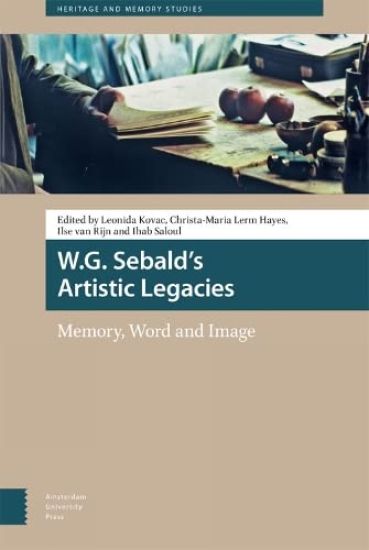
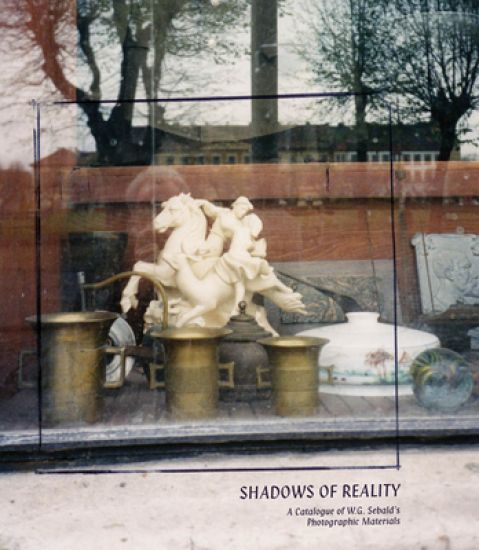
When the mind turns more than one would wish towards questions of – as W.G. Sebald puts it – the “natural history of destruction”, comparative consideration by artists and interdisciplinary scholars is directed to the interstices between images, novel, essay, (auto)biography, memorial and travelogue. Artists have been among Sebald’s most prolific interpreters – as they are among the more fearless and holistic researchers on questions concerning what it means never to be able to fix an identity, to tell a migrant’s story, or to know where a historical trauma ends. Sebald has – as this book attests – also given artists and scholars a means to write with images, to embrace ambiguity, and to turn to today’s migrants with empathy and responsibility; as well as to let academic research, creation and institutional engagement blend into or substantially inform one another in order to account for and enable such necessary work in the most diverse contexts.
M.G & Me is the author's memoires of his life with Wegener's Granulomatosis. The author recounts his days with this disease and carrying the affliction that he is going to die within 4 to 5 years. What was he going to do with this infliction that pranced on him out of the blue. In 2009 there wasn't much information about this disease and all that were out there were very raw. Mayar lost all hopes and left behind everyhting to be ready for death from this painful vasculitis, autoimmune disease. It is this journey that turned around his fate, this emotional and mental roller coaster ride, has thrown many twists and turns that inadvertantly became a spiritual one. In those moments of decisions and choices that Mayar found his salvation, saviour the healing power which Mayar present in this book so that readers and people with the same affliction can find some hope, like he did.
This book offers a new critical perspective on the perpetual problem of literature's relationship to reality and in particular on the sustained tension between literature and historiography. The scholarly and literary works of W.G. Sebald (1944–2001) serve as striking examples for this discussion, for the way in which they demonstrate the emergence of a new hybrid discourse of literature as historiography. This book critically reconsiders the claims and aims of historiography by re-evaluating core questions of the literary discourse and by assessing the ethical imperative of literature in the 20th and 21st centuries. Guided by an inherently interdisciplinary framework, this book elucidates the interplay of epistemological, aesthetic, and ethical concerns that define Sebald's criticism and fiction. Appropriate to the way in which Sebald's works challenge us to rethink the boundaries between discourses, genres, disciplines, and media, this work proceeds in a methodologically non-dogmatic way, drawing on hermeneutics, semiotics, narratology, and discourse theory. In addition to contextualizing Sebald within postwar literature in German, the book is the first English-language study to consider Sebald's œuvre as a whole. Of interest for Sebald experts and enthusiasts, literary scholars and historians concerned with the problematic of representing the past.
This book offers a new critical perspective on the perpetual problem of literature's relationship to reality and in particular on the sustained tension between literature and historiography. The scholarly and literary works of W.G. Sebald (1944–2001) serve as striking examples for this discussion, for the way in which they demonstrate the emergence of a new hybrid discourse of literature as historiography. This book critically reconsiders the claims and aims of historiography by re-evaluating core questions of the literary discourse and by assessing the ethical imperative of literature in the 20th and 21st centuries. Guided by an inherently interdisciplinary framework, this book elucidates the interplay of epistemological, aesthetic, and ethical concerns that define Sebald's criticism and fiction. Appropriate to the way in which Sebald's works challenge us to rethink the boundaries between discourses, genres, disciplines, and media, this work proceeds in a methodologically non-dogmatic way, drawing on hermeneutics, semiotics, narratology, and discourse theory. In addition to contextualizing Sebald within postwar literature in German, the book is the first English-language study to consider Sebald's œuvre as a whole. Of interest for Sebald experts and enthusiasts, literary scholars and historians concerned with the problematic of representing the past.
When the mind turns more than one would wish towards questions of – as W.G. Sebald puts it – the “natural history of destruction”, comparative consideration by artists and interdisciplinary scholars is directed to the interstices between images, novel, essay, (auto)biography, memorial and travelogue. Artists have been among Sebald’s most prolific interpreters – as they are among the more fearless and holistic researchers on questions concerning what it means never to be able to fix an identity, to tell a migrant’s story, or to know where a historical trauma ends. Sebald has – as this book attests – also given artists and scholars a means to write with images, to embrace ambiguity, and to turn to today’s migrants with empathy and responsibility; as well as to let academic research, creation and institutional engagement blend into or substantially inform one another in order to account for and enable such necessary work in the most diverse contexts.
These poems reveal a passionate concreteness of imagery and a rich allusiveness. All the poetic qualities that touch the human heart are here. Liveliness is the most characteristic quality of these poems that show intense emotion and vivid imagination.
The distinguished British scholar-diplomat Ernest Mason Satow (1843-1929) was one of the most prominent and pre-eminent Japanologists in the Victorian era when the subject was newly created as Japan began to open its doors to foreigners from the mid-1850s. He shared this honour with Basil Hall Chamberlain (1850-1935) and the two addressees of the letters reproduced here by permission of the U.K. National Archives: co-worker William George Aston (1841-1911) and Frederick Victor Dickins (1838-1915). This book is part of a series in which Ian Ruxton is making some of the extensive Satow Papers publicly available for the first time. It includes an introduction by Professor Peter Kornicki of the East Asia Institute at the University of Cambridge, eight black & white illustrations, 166 annotations, two appendices, a select bibliography and a full index for ease of reference. (xvi + 330 pp.) Reasonably priced for students and researchers. Library of Congress Control Number: 2008901176