Kirjojen hintavertailu. Mukana 11 627 380 kirjaa ja 12 kauppaa.

Kirjahaku

Etsi kirjoja tekijän nimen, kirjan nimen tai ISBN:n perusteella.

1000 tulosta hakusanalla Georg Muffat

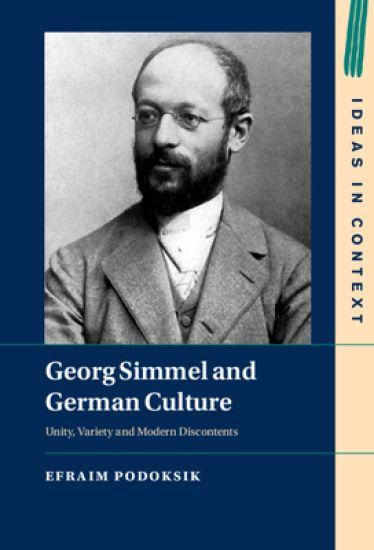
Georg Simmel and German Culture

Georg Simmel and German Culture

Efraim Podoksik

Cambridge University Press
2021
sidottu
The significance of the German philosopher and social thinker, Georg Simmel (1858–1918), is only now being recognised by intellectual historians. Through penetrating readings of Simmel's thought, taken as a series of reflections on the essence of modernity and modern civilisation, Efraim Podoksik places his ideas within the context of intellectual life in Germany, and especially Berlin, under the Kaiserreich. Modernity, characterised by the growing differentiation and fragmentation of culture and society, was a fundamental issue during Simmel's life, underpinning central intellectual debates in Imperial Germany. Simmel's thought is depicted here as an attempt at transforming the complexity of these debates into a coherent worldview that can serve as an effective guide to understanding their main parameters. Paying particular attention to the genealogy and usage of the concepts of Bildung, culture and civilisation in Germany, this study offers contextual analyses of Simmel's philosophies of culture, society, art, religion and the feminine, as well as his interpretations of Dante, Kant, Nietzsche, Schopenhauer, Goethe and Rembrandt.
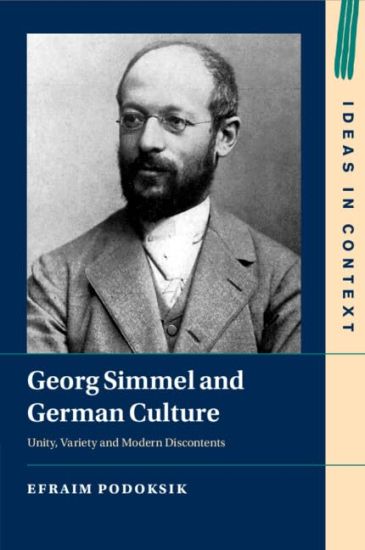
Georg Simmel and German Culture

Georg Simmel and German Culture

Efraim Podoksik

Cambridge University Press
2023
pokkari
The significance of the German philosopher and social thinker, Georg Simmel (1858–1918), is only now being recognised by intellectual historians. Through penetrating readings of Simmel's thought, taken as a series of reflections on the essence of modernity and modern civilisation, Efraim Podoksik places his ideas within the context of intellectual life in Germany, and especially Berlin, under the Kaiserreich. Modernity, characterised by the growing differentiation and fragmentation of culture and society, was a fundamental issue during Simmel's life, underpinning central intellectual debates in Imperial Germany. Simmel's thought is depicted here as an attempt at transforming the complexity of these debates into a coherent worldview that can serve as an effective guide to understanding their main parameters. Paying particular attention to the genealogy and usage of the concepts of Bildung, culture and civilisation in Germany, this study offers contextual analyses of Simmel's philosophies of culture, society, art, religion and the feminine, as well as his interpretations of Dante, Kant, Nietzsche, Schopenhauer, Goethe and Rembrandt.
Georg Kerschensteiner

Georg Kerschensteiner

Diane Simons

Routledge
2016
sidottu
This book, first published in 1966, is an introduction to the life and work of Georg Kerschensteiner, the pioneer of the modern German system of vocational education, a system which is largely responsible for Germany’s remarkable industrial recovery and advancement after the Second World War. This title will be of interest to students of education and history.
Georg Kerschensteiner

Georg Kerschensteiner

Diane Simons

Routledge
2018
nidottu
This book, first published in 1966, is an introduction to the life and work of Georg Kerschensteiner, the pioneer of the modern German system of vocational education, a system which is largely responsible for Germany’s remarkable industrial recovery and advancement after the Second World War. This title will be of interest to students of education and history.
Georg Büchner's Woyzeck

Georg Büchner's Woyzeck

Karoline Gritzner

Routledge
2019
nidottu
'Everyone's an abyss. You get dizzy if you look down.' -- WoyzeckGeorg Büchner’s Woyzeck was left unfinished at the time of its author’s death in 1837, but the play is now widely recognised as the first ‘modern’ drama in the history of European theatre. Its fragmentary form and critical socio-political content have had a lasting influence on artists, readers and audiences to this day. The abuse, exploitation, and disenfranchisement that Woyzeck’s titular protagonist endures find their mirror in his own murderous outburst. But beyond that, they also echo in the flux and confusion of the various drafts and versions in which the play has been presented since its emergence.In this fresh engagement with a modern classic, Gritzner examines the revolutionary dimensions of Büchner’s political and creative practice, as well as modern approaches to the play in performance.