
Kirjahaku
Etsi kirjoja tekijän nimen, kirjan nimen tai ISBN:n perusteella.
1000 tulosta hakusanalla George Perry
God-Man: The Word Made Flesh is a book written by George W. Carey that explores the concept of the divine and human nature of Jesus Christ. The author argues that Jesus was not only a human being but also a divine being, and that this duality is essential to understanding his teachings and his role as the savior of humanity. The book examines various biblical passages and theological concepts to support this argument, and also delves into the history of Christian thought on this topic. Ultimately, God-Man: The Word Made Flesh is a thought-provoking and insightful exploration of one of the most central and complex aspects of Christian theology.This Is A New Release Of The Original 1920 Edition.This scarce antiquarian book is a facsimile reprint of the old original and may contain some imperfections such as library marks and notations. Because we believe this work is culturally important, we have made it available as part of our commitment for protecting, preserving, and promoting the world's literature in affordable, high quality, modern editions, that are true to their original work.
God-Man: The Word Made Flesh (1920) is a book of mysticism exploring how the allegories of scripture relate to the truths of the cosmos and the human body. Within many of the Biblical parables, George W. Carey and Inez Eudora Perry find that many of the people described were in fact personifications of the wisdom needed to reach spiritual enlightenment.George Washington Carey (1845-1924) and Inez Eudora Perry (1871-1961) were collaborators on topics of astrology, homeopathy, and biochemistry. Combining Christianity, ancient religions, physiology, anatomy, and more, Dr. Carey and Ms. Perry sought the answers to the nature of humanity and God.One of the pair's lasting contributions was to the field of biochemistry. Influenced by Dr. Wilhelm Heinrich Sch ler who identified cell-salts-naturally occurring minerals that could supplement deficiencies in the human body-Dr. Carey went further, associating the signs of the zodiac to a natural deficiency in these minerals. Through careful supplementation, he believed that one could cure a host of physical and psychological ailments.Astrologer Inez Eudora Perry was an adherent to Dr. Carey's ideas. The pair wrote several works together, including The Tree of Life and Relation of the Mineral Salts of the Body to the Signs of the Zodiac. In 1923, Dr. Carey made Ms. Perry a partner in his biochemical foundation, which was renamed The Carey-Perry School of The Chemistry of Life.God-Man: The Word Made Flesh explores the allegory within scripture. Rather than taking each parable as literal truth, their interpretation draws on knowledge of the human body, astrology, world religions, and symbolism to find the real meaning behind the Biblical text.In the story of Sara and Abram, for example, they explain that rather than a literal story in which a 90-year-old woman (Sara) and 100-year-old man (Abram) give birth to a son (Isaac), their real "child" is happiness-the meaning of the word Isaac in Hebrew. The true lesson is that "...age imposes no limit or barrier to the birth of the 'Incorruptible Seed' (Peter) for it is eternal life.""Abraham, Isaac, Jacob, Noah, David, Solomon, Isaiah, etc., etc., are not historical characters," he writes. Nor are Pontius Pilate, Pharaoh, or Herod, which are names of offices or functions rather than individuals. Through exploring the meanings of these names, down to the letters that create them in the original Hebrew, the writers find new truth in the stories that have been misinterpreted for so long.At the center of this truth is the idea that the parables in the Bible were meant to describe the human body as a microcosm of the universe. But at the council of Nicea, it was voted that "...the symbols of the human body were persons; that Jesus was a certain historical man, a contention utterly and indubitably without foundation, in fact, and that all who believed (?) the story would be saved and forgiven here and now." From this vote, the true meaning of the scriptures was hidden from us, preventing us from reaching our highest physical and spiritual wellness.Further complicating these misunderstandings are the myriad translations of the Biblical text. By revisiting and retranslating the original Greek and Hebrew, the authors seek to return to the original meaning of the words rather than relying on another's interpretation of them.For the seeker of truth and the student of mysticism, God-Man: The Word Made Flesh is a valuable contribution to your studies.
God-Man: The Word Made Flesh (1920) is a book of mysticism exploring how the allegories of scripture relate to the truths of the cosmos and the human body. Within many of the Biblical parables, George W. Carey and Inez Eudora Perry find that many of the people described were in fact personifications of the wisdom needed to reach spiritual enlightenment.George Washington Carey (1845-1924) and Inez Eudora Perry (1871-1961) were collaborators on topics of astrology, homeopathy, and biochemistry. Combining Christianity, ancient religions, physiology, anatomy, and more, Dr. Carey and Ms. Perry sought the answers to the nature of humanity and God.One of the pair's lasting contributions was to the field of biochemistry. Influenced by Dr. Wilhelm Heinrich Sch ler who identified cell-salts-naturally occurring minerals that could supplement deficiencies in the human body-Dr. Carey went further, associating the signs of the zodiac to a natural deficiency in these minerals. Through careful supplementation, he believed that one could cure a host of physical and psychological ailments.Astrologer Inez Eudora Perry was an adherent to Dr. Carey's ideas. The pair wrote several works together, including The Tree of Life and Relation of the Mineral Salts of the Body to the Signs of the Zodiac. In 1923, Dr. Carey made Ms. Perry a partner in his biochemical foundation, which was renamed The Carey-Perry School of The Chemistry of Life.God-Man: The Word Made Flesh explores the allegory within scripture. Rather than taking each parable as literal truth, their interpretation draws on knowledge of the human body, astrology, world religions, and symbolism to find the real meaning behind the Biblical text.In the story of Sara and Abram, for example, they explain that rather than a literal story in which a 90-year-old woman (Sara) and 100-year-old man (Abram) give birth to a son (Isaac), their real "child" is happiness-the meaning of the word Isaac in Hebrew. The true lesson is that "...age imposes no limit or barrier to the birth of the 'Incorruptible Seed' (Peter) for it is eternal life.""Abraham, Isaac, Jacob, Noah, David, Solomon, Isaiah, etc., etc., are not historical characters," he writes. Nor are Pontius Pilate, Pharaoh, or Herod, which are names of offices or functions rather than individuals. Through exploring the meanings of these names, down to the letters that create them in the original Hebrew, the writers find new truth in the stories that have been misinterpreted for so long.At the center of this truth is the idea that the parables in the Bible were meant to describe the human body as a microcosm of the universe. But at the council of Nicea, it was voted that "...the symbols of the human body were persons; that Jesus was a certain historical man, a contention utterly and indubitably without foundation, in fact, and that all who believed (?) the story would be saved and forgiven here and now." From this vote, the true meaning of the scriptures was hidden from us, preventing us from reaching our highest physical and spiritual wellness.Further complicating these misunderstandings are the myriad translations of the Biblical text. By revisiting and retranslating the original Greek and Hebrew, the authors seek to return to the original meaning of the words rather than relying on another's interpretation of them.For the seeker of truth and the student of mysticism, God-Man: The Word Made Flesh is a valuable contribution to your studies.
The Zodiac and the Salts of Salvation: Parts One and Two
George W. Carey; Inez E. Perry
Mockingbird Press
2021
nidottu
The Zodiac and the Salts of Salvation: Parts One and Two
George W. Carey; Inez E. Perry
Mockingbird Press
2021
sidottu
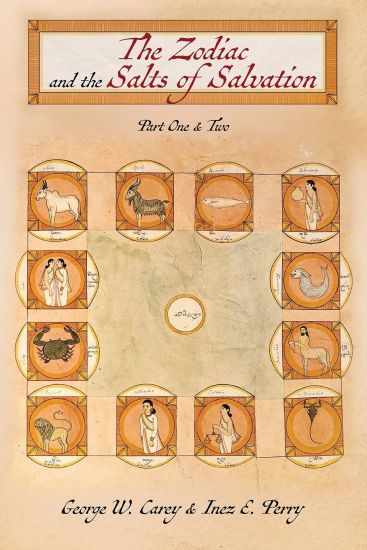
The Zodiac and the Salts of Salvation is a two-part work by frequent collaborators Dr. George Washington Carey (1845-1924) and Inez Eudora Perry (1871-1961). This book explores the use of certain minerals called "cell-salts" to cure disease and how one's Zodiac sign impacts their cell-salt deficiencies. Dr. Carey was a homeopath whose theories of biochemistry had their foundation in the work of Dr. Wilhelm Heinrich Schubler. Dr. Schubler and his predecessors had developed the concept of cell-salts - naturally occurring minerals - to supplement deficiencies in the human body, thus curing disease and ailments. Carey agreed with this idea. He proposed that illness cannot be cured by removal of some poison, but can only be remedied by adding some necessary element, some food, to the human body to restore balance. Dr. Carey's unique contribution to the field of biochemistry was to connect each of the twelve cell-salts with a particular sign of the Zodiac. In his pamphlet The Relation of Mineral Salts to the Body and to the Signs of the Zodiac, Carey describes the characteristics of each Zodiac sign, their Biblical connection through a corresponding son of Jacob and disciple of Christ, and the cell salt in which they are often deficient. Those born under the sign of Aries, for example, "are natural doubters until they figure a thing out for themselves." The associated cell-salt is potassium phosphate, "the greatest healing agent known to man, because it is the chemical base of material expression and understanding." While Dr. Carey's work on mineral salts and the Zodiac is foundational, it is also largely theoretical. After Dr. Carey's death in 1924, collaborator Inez Eudora Perry republished The Relation of Mineral Salts to the Body and to the Signs of the Zodiac, and supplemented it with an additional work of her own that expounded on Dr. Carey's ideas. The resulting work was published in 1932 as The Zodiac and the Salts of Salvation. Perry's contribution is titled An Esoteric Analysis and Synthesis of the Zodiacal Signs and their Physiochemical Allocations. Part two is much longer than part one, with thorough explanations of both the symbolism and practical uses of each cell-salt. She also explores more thoroughly the connection of the Zodiac to the body of man - comparing the macrocosm of the universe to the microcosm of the human body. Aries, the Ram, is associated with the human head. As the highest part of the body, the head is the place of ascension and elevation. It contains the brain, the organ that separates man from beast. Carey and Perry work through the entire Zodiac, explaining the symbolism of each sign and relating it to the greater universe, different cultural traditions including Christianity and eastern philosophy, the human body, and the human mind. The combination of the two parts is of enormous value - Dr. Carey's Relation of Mineral Salts as an introduction, and Ms. Perry's Esoteric Analysis for a more thorough and comprehensible explanation. This book is still popular among homeopathic circles, and the cell-salts, sometimes called tissue salts, are used frequently in alternative medicine.

Stories of New York
Annie Eliot Trumbull; George A (George Abiah) Hibbard; Bliss Perry
Anson Street Press
2025
pokkari

A ground-up approach to explaining dynamic spatial modelling for an interdisciplinary audience. Across broad areas of the environmental and social sciences, simulation models are an important way to study systems inaccessible to scientific experimental and observational methods, and also an essential complement to those more conventional approaches. The contemporary research literature is teeming with abstract simulation models whose presentation is mathematically demanding and requires a high level of knowledge of quantitative and computational methods and approaches. Furthermore, simulation models designed to represent specific systems and phenomena are often complicated, and, as a result, difficult to reconstruct from their descriptions in the literature. This book aims to provide a practical and accessible account of dynamic spatial modelling, while also equipping readers with a sound conceptual foundation in the subject, and a useful introduction to the wide-ranging literature. Spatial Simulation: Exploring Pattern and Process is organised around the idea that a small number of spatial processes underlie the wide variety of dynamic spatial models. Its central focus on three ‘building-blocks’ of dynamic spatial models – forces of attraction and segregation, individual mobile entities, and processes of spread – guides the reader to an understanding of the basis of many of the complicated models found in the research literature. The three building block models are presented in their simplest form and are progressively elaborated and related to real world process that can be represented using them. Introductory chapters cover essential background topics, particularly the relationships between pattern, process and spatiotemporal scale. Additional chapters consider how time and space can be represented in more complicated models, and methods for the analysis and evaluation of models. Finally, the three building block models are woven together in a more elaborate example to show how a complicated model can be assembled from relatively simple components. To aid understanding, more than 50 specific models described in the book are available online at patternandprocess.org for exploration in the freely available Netlogo platform. This book encourages readers to develop intuition for the abstract types of model that are likely to be appropriate for application in any specific context. Spatial Simulation: Exploring Pattern and Process will be of interest to undergraduate and graduate students taking courses in environmental, social, ecological and geographical disciplines. Researchers and professionals who require a non-specialist introduction will also find this book an invaluable guide to dynamic spatial simulation.

Becoming an Evocative Coach
Jeanie M. Cash; Donnita Davis-Perry; George E. Manthey
SAGE Publications Inc
2020
nidottu
Coaching Teachers and Leaders to Greatness Research shows that coaching is the best way to bring about robust change in both instructional and leadership practices. Coaching becomes evocative when it is a person-centered, strengths-based model grounded in adult learning theory, focused on growth. Designed as a companion to both Evocative Coaching: Transforming Schools One Conversation at a Time, 2nd Edition and Evoking Greatness: Coaching to Bring Out the Best in Educational Leaders, this guide will allow coaches to reflect on their learning and put evocative coaching strategies into practice. Readers will learn how to: • Follow the LEAD (listen, emphasize, appreciate, design) process to become a partner in professional learning • Engage in coaching conversations as they develop evocative coaching skills through various activities that invite reflection • Develop instructional coaching and leadership skills that foster innovation This interactive guide is meant to be used by participants of an evocative coaching workshop, members of a book study group or PLC, a self-study reader, or anyone who wants to coach teachers and leaders to greatness.
Solstice Shorts
David Mathews; Dizz Tate; Tannith Perry; Andrew Gepp; Cindy George; David Turnbull; Emma Timpany; Sarah Evans; William Davidson; Pippa Gladhill; Helen Morris; Jayne Pickering
Arachne Press
2014
pokkari
Sixteen short stories that chart the meaning of time, and explore what it can do to us, and for us.Broken hearts, lives lived on fastforward, missed chances, and catastrophic meetings on the road. Time stolen, time wasted, time captured and time lost. A warning from the past, a second that changes a life, a failed glimpse into the future and a study of funeral rites. Ready-made families, weekly liaisons, and an all-night radio show.From the First ever Solstice Shorts Festival originally read live in 2014 on the Greenwich Meridian, on the shortest day of the year, from sunrise to sunset.

The Routledge Handbook of Landscape Ecology
Robert A. Francis; James D.A. Millington; George L.W. Perry; Emily S. Minor
Routledge
2021
sidottu
The Handbook provides a supporting guide to key aspects and applications of landscape ecology to underpin its research and teaching. A wide range of contributions written by expert researchers in the field summarize the latest knowledge on landscape ecology theory and concepts, landscape processes, methods and tools, and emerging frontiers.Landscape ecology is an interdisciplinary and holistic discipline, and this is reflected in the chapters contained in this Handbook. Authors from varying disciplinary backgrounds tackle key concepts such as landscape structure and function, scale and connectivity; landscape processes such as disturbance, flows, and fragmentation; methods such as remote sensing and mapping, fieldwork, pattern analysis, modelling, and participation and engagement in landscape planning; and emerging frontiers such as ecosystem services, landscape approaches to biodiversity conservation, and climate change. Each chapter provides a blend of the latest scientific understanding of its focal topics along with considerations and examples of their application from around the world.An invaluable guide to the concepts, methods, and applications of landscape ecology, this book will be an important reference text for a wide range of students and academics in ecology, geography, biology, and interdisciplinary environmental studies.
Greater Westminster. Illustrated. Reprinted from "The London Argus.."
George Percy Warner Terry
British Library, Historical Print Editions
2011
pokkari
Title: Greater Westminster ... Illustrated ... Reprinted from "The London Argus.."Publisher: British Library, Historical Print EditionsThe British Library is the national library of the United Kingdom. It is one of the world's largest research libraries holding over 150 million items in all known languages and formats: books, journals, newspapers, sound recordings, patents, maps, stamps, prints and much more. Its collections include around 14 million books, along with substantial additional collections of manuscripts and historical items dating back as far as 300 BC.The HISTORY OF BRITAIN & IRELAND collection includes books from the British Library digitised by Microsoft. As well as historical works, this collection includes geographies, travelogues, and titles covering periods of competition and cooperation among the people of Great Britain and Ireland. Works also explore the countries' relations with France, Germany, the Low Countries, Denmark, and Scandinavia. ++++The below data was compiled from various identification fields in the bibliographic record of this title. This data is provided as an additional tool in helping to insure edition identification: ++++ British Library Terry, George Percy Warner; 1899. 63 p.; 8 . 10349.g.33.
An Inquiry into the Religious Tenets of the Yezeedees
George Percy Badger
Left of Brain Books
2024
pokkari
Delve into the heart of this mysterious community, which Badger painstakingly documented during his time in Mosul between 1842 and 1850. This book is a remarkable exploration of the Yezidis' beliefs, rituals, and history, offering a rare glimpse into their complex religious system that borrows elements from Christianity, Islam, and ancient Magism.Badger provides an in-depth analysis of the Yezeedees, examining their worship of both the Supreme Being and the Evil Principle, represented symbolically by the Melek Taoos. He also delves into their sacred festivities, sacerdotal castes, and the intricate relationship with their temporal chief.This insightful work not only uncovers the religious practices of the Yezeedees but also contemplates the challenges they faced in a region dominated by other religious groups. "An Inquiry into the Religious Tenets of the Yezeedees" is a compelling read for anyone interested in religious studies, Middle Eastern history, or cultural anthropology, offering a profound understanding of a community shrouded in mystery and misconception.
The Nestorians And Their Rituals With The Narrative Of A Mission To Mesopotamia And Coordistan In 1842 To 1844
George Percy Badger
Kessinger Pub
2004
pokkari

Nestorians and Their Rituals: With the Narrative of A Mission to Mesopotamia and Coordistan in 1842-1844, and a Late Visit to Those Countries in 1850; Also, Researches into the Present Condition of the Syrian Jacobites, Papal Syrians, and Chaldeans, and an Inquiry into the Religious Tenets of the Yezeedees
George Percy Badger
DARF PUBLISHERS LTD
1987
sidottu
This present work, first published in 1852 in two volumes and here reproduced in facsimile, contains a unique and detailed account of the rituals and practices of the Nestorian church and other significant religious groups in that region.