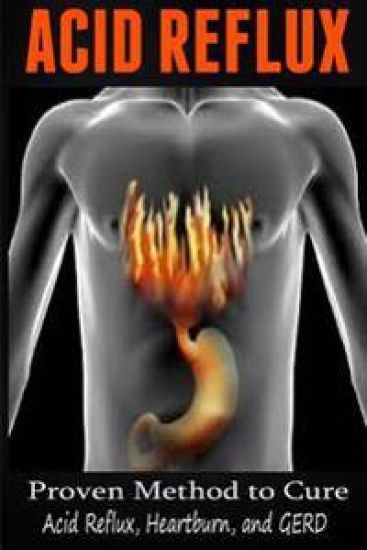
This book will give you a clear understanding of what acid reflux is - a health condition experienced by almost half of the American population. It explains how and why acid reflux occurs as well as discusses in detail why the common health remedies prescribed by health professionals do not eradicate the condition and worsen it instead. Much more than that, the book contains proven non-drug and non-surgical alternatives to effectively cure acid reflux, heartburn, and GERD.Acid Reflux is a health condition where acidic stomach fluid leaks back up the food pipe (the esophagus) causing heartburn - a burning pain felt internally around the lower chest area. It is quite common for people to experience occasional heartburn since acid reflux usually results from eating or drinking certain types of food or drink for some people. However, the frequent occurrence of heartburn may indicate a more severe form of acid reflux condition called GERD (Gastro- Esophageal Reflux Disease). Although the condition may not be life threatening, it may lead to more serious health conditions in the future such as cancer if left unattended or uncared for. The book will help you eradicate the condition for good and prevent it from recurring without resorting to medication or surgery. I hope you find the information and recommendations truly valuable.
☆★☆Read for FREE with Kindle Unlimited ☆★☆ SIBO cookbook: MAIN COURSE - 80+ Recipes designed to heal gastritis, intestinal candida and other GUT health issues (GERD & IBS effective approach) Do you want to learn about SIBO recipes? Do you want to know how to prepare the most delicious meals that fit your diet? This book is the answer to your questions In this cookbook, you will find: BREAKFAST recipes like: JALAPENO SCRAMBLED EGGS HAM AND BROCCOLI EGG BREAFAST HONEY CANDIED BACON DESSERT recipes like: COCONUT PANCAKES CHOCOLATE COCONUT BITE PUDDDING WITH WARM CUSTARD And many other recipes Here Is A Preview Of What You'll Learn... How to cook healthy mealsComprehensive Dietary Advice & GuidanceRecipes with detailed instructionsEach recipe contains the exact amount of calories, protein, carbohydrates and fat Fast and easy prep that requires no additional steps to prepare your mealTips and Tricks Much, much more Don't miss out on SIBO Cookbook Click the orange BUY button at the top of this page Then you can begin readingSIBO cookbook: MAIN COURSE - 80+ Recipes designed to heal gastritis, intestinal candida and other GUT health issues (GERD & IBS effective approach) on your Kindle device, computer, tablet or smartphone.
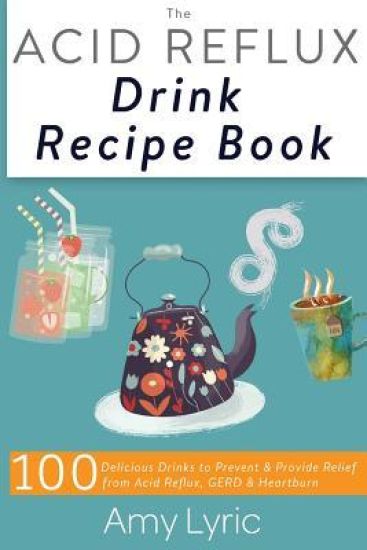
Enjoy delicious drinks and say goodbye to discomfort caused by acid reflux Just because you have been diagnosed with GERD or acid reflux doesn't mean that you should stop taking pleasure in the beverages and food you consume. If you think that there will only be bland tea and tasteless greens on your table from now on, I've got good news for you Offering you delicious drink recipes that not only your doctor would approve of, but that are also alkalizing enough to soothe and eventually prevent your heartburn, this book is something your recipe folder craves.100 Delicious drink RecipesEnergizing Morning SmoothiesBefore-Meal JuicesCold Afternoon RefreshmentsSpecial-Event DrinksWarming & Relieving TeasWant to see how a satisfied tummy and balanced gut can go hand-in-hand even if heartburn is a common guest? This book has all the answers. Join me on this nourishing ride for a replenished gut and happy taste buds
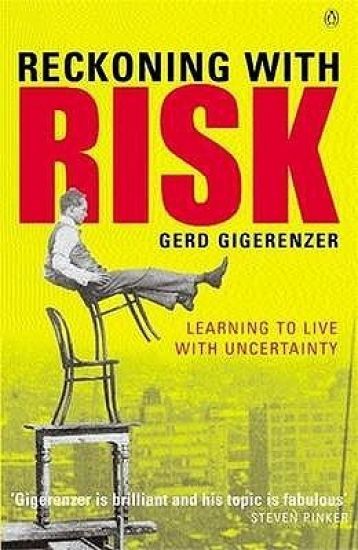
Gerd Gigerenzer's Reckoning with Risk: Learning to Live with Uncertainty illustrates how we can learn to make sense of statistics and turn ignorance into insight. However much we want certainty in our lives, it feels as if we live in an uncertain and dangerous world. But are we guilty of wildly exaggerating the chances of some unwanted event happening to us? Are we misled by our ignorance of the reality of risk? Far too many of us, argues Gerd Gigerenzer, are hampered by our own innumeracy, while statistics are often presented to us in highly confusing ways. With real world examples, such as the incidence of errors in tests for breast cancer or HIV, or in DNA fingerprinting, and the manipulation of statistics for evidence in court, he shows that our difficulty in thinking about numbers can easily be overcome. 'Indispensable ... The book will change the attentive reader's way of looking at the world' Sunday Telegraph 'An important book ... the reader is presented with a powerful set of tools for understanding statistics ... anyone who wants to take responsibility for their own medical choices should read it' New Scientist 'Gigerenzer makes clear thinking easier' Evening Standard 'More than ever, citizens need to know how to evaluate risk ... This book should be pressed into the palms of ' Independent Gerd Gigerenzer is Director of the Center for Adaptive Behavior and Cognition at the Max Planck Institute for Human Development in Berlin and former Professor of Psychology at the University of Chicago. He has published two academic books on heuristics, Simple Heuristics That Make Us Smart and Bounded Rationality: The Adaptive Toolbox as well as a popular science book, Gut Feelings: Short Cuts to Better Decision Making.
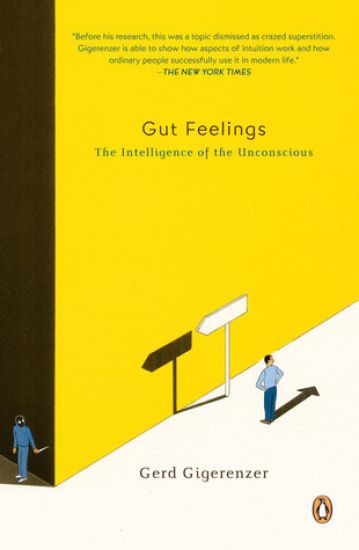
In Gut Feelings: Short Cuts to Better Decision Making psychologist and behavioural expert Gerd Gigerenzer reveals the secrets of fast and effective decision-making. A sportsman can catch a ball without calculating its speed or distance. A group of amateurs beat the experts at playing the stock market. A man falls for the right woman even though she's 'wrong' on paper. All these people succeeded by trusting their instincts - but how does it work? As Gerd Gigerenzer explains, in an uncertain world, sometimes we have to ignore too much information and rely on our brain's 'short cut', or heuristic. By explaining how intuition works and analyzing the techniques that people use to make good decisions - whether it's in personnel selection or heart surgery - Gigerenzer will show you the hidden intelligence of the unconscious mind. 'Fascinating and provocative ... Gut Feelings may well be the recipe for a simpler, less stressful life' Sunday Times 'Gigerenzer's writing is catchily optimistic and slyly funny ... Devilish' Steven Poole, Guardian 'The science behind the phenomenon cited in the bestseller Blink ... useful and clearly written' Business Week 'Gigerenzer is brilliant' Stephen Pinker Gerd Gigerenzer is Director of the Center for Adaptive Behavior and Cognition at the Max Planck Institute for Human Development in Berlin and former Professor of Psychology at the University of Chicago. He has published two academic books on heuristics, Simple Heuristics That Make Us Smart and Bounded Rationality: The Adaptive Toolbox as well as a popular science book, Reckoning with Risk.
Why is split second decision-making superior to deliberation? Gut Feelings delivers the science behind Malcolm Gladwell's Blink Reflection and reason are overrated, according to renowned psychologist Gerd Gigerenzer. Much better qualified to help us make decisions is the cognitive, emotional, and social repertoire we call intuition?a suite of gut feelings that have evolved over the millennia specifically for making decisions. ?Gladwell drew heavily on Gigerenzer's research. But Gigerenzer goes a step further by explaining just why our gut instincts are so often right. Intuition, it seems, is not some sort of mystical chemical reaction but a neurologically based behavior that evolved to ensure that we humans respond quickly when faced with a dilemma? (BusinessWeek).
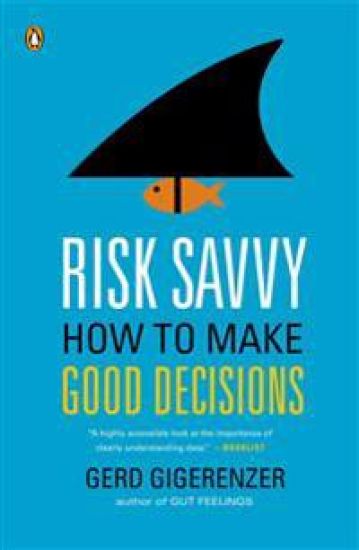
A new eye-opener on how we can make better decisions--by the author of Gut Feelings In this age of big data we often trust that expert analysis--whether it's about next year's stock market or a person's risk of getting cancer--is accurate. But, as risk expert Gerd Gigerenzer reveals in his latest book, Risk Savvy, most of us, including doctors, lawyers, and financial advisors, often misunderstand statistics, leaving us misinformed and vulnerable to exploitation. Yet there's hope. In Risk Savvy, Gigerenzer gives us an essential guide to the science of good decision making, showing how ordinary people can make better decisions for their money, their health, and their families. Here, Gigerenzer delivers the surprising conclusion that the best results often come from considering less information and listening to your gut.
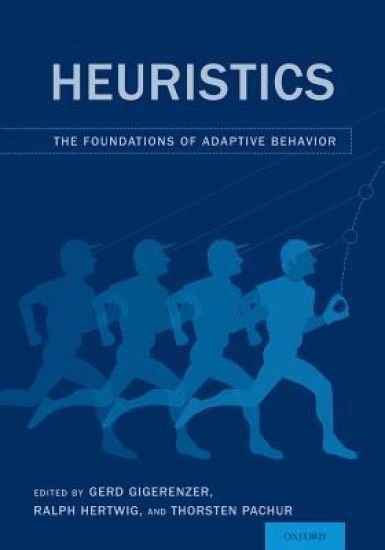
How do people make decisions when time is limited, information unreliable, and the future uncertain? Based on the work of Nobel laureate Herbert Simon and with the help of colleagues around the world, the Adaptive Behavior and Cognition (ABC) Group at the Max Planck Institute for Human Development in Berlin has developed a research program on simple heuristics, also known as fast and frugal heuristics. In the social sciences, heuristics have been believed to be generally inferior to complex methods for inference, or even irrational. Although this may be true in "small worlds " where everything is known for certain, we show that in the actual world in which we live, full of uncertainties and surprises, heuristics are indispensable and often more accurate than complex methods. Contrary to a deeply entrenched belief, complex problems do not necessitate complex computations. Less can be more. Simple heuristics exploit the information structure of the environment, and thus embody ecological rather than logical rationality. Simon (1999) applauded this new program as a "revolution in cognitive science, striking a great blow for sanity in the approach to human rationality. " By providing a fresh look at how the mind works as well as the nature of rationality, the simple heuristics program has stimulated a large body of research, led to fascinating applications in diverse fields from law to medicine to business to sports, and instigated controversial debates in psychology, philosophy, and economics. In a single volume, the present reader compiles key articles that have been published in journals across many disciplines. These articles present theory, real-world applications, and a sample of the large number of existing experimental studies that provide evidence for people's adaptive use of heuristics.
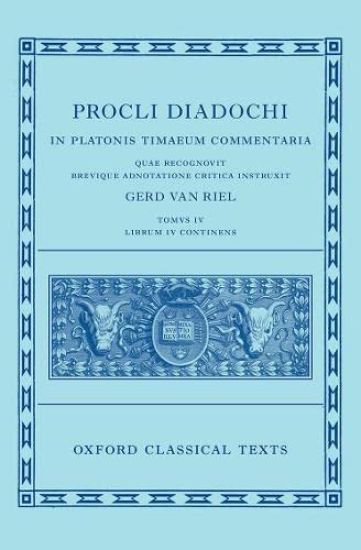
Oxford Classical Texts, also known as Scriptorum Classicorum Bibliotheca Oxoniensis, provide authoritative, clear, and reliable editions of ancient texts, with apparatus criticus on each page. This five volume work is a new critical text edition of the only surviving ancient commentary on Plato's Timaeus, in which Proclus encompasses seven centuries of philosophical reflection on Plato's cosmology. For many authors belonging to the Platonic tradition, Proclus' commentary is the only extant source. For late Neoplatonic authors such as Proclus, writing commentaries on works by Plato and others was in fact a way to present their own highly original philosophical doctrines. Apart from being an important source text for the historiography of philosophy, this commentary on the Timaeus thus also provides a unique access way to Proclus' own Neoplatonic views on cosmology, theology, physics, and metaphysics. This new edition is based on a thorough re-examination of the entire manuscript tradition, which has led to a complete understanding of the relation between all extant manuscripts, including the Paris palimpsest BNF Supplément grec 921, belonging to the so-called 'collection philosophique' (9th century). On the basis of digitally enhanced UV photos, the scriptio inferior of this palimpsest (containing parts of books IV and V) was made nearly fully accessible. The study of the manuscript tradition and the apparatus fontium take stock of more than 100 years of study of this circumstantial text. The edition of the text is preceded by a substantial introduction, and followed, for each book, by the edition of the scholia to the text. The final volume also comprises an edition of the remaining fragments of the lost part of the text, including an Arabic fragment, edited by Rüdiger Arnzen.
Oxford Classical Texts, also known as Scriptorum Classicorum Bibliotheca Oxoniensis, provide authoritative, clear, and reliable editions of ancient texts, with apparatus criticus on each page. This five volume work is a new critical text edition of the only surviving ancient commentary on Plato's Timaeus, in which Proclus encompasses seven centuries of philosophical reflection on Plato's cosmology. For many authors belonging to the Platonic tradition, Proclus' commentary is the only extant source. For late Neoplatonic authors such as Proclus, writing commentaries on works by Plato and others was in fact a way to present their own highly original philosophical doctrines. Apart from being an important source text for the historiography of philosophy, this commentary on the Timaeus thus also provides a unique access way to Proclus' own Neoplatonic views on cosmology, theology, physics, and metaphysics. This new edition is based on a thorough re-examination of the entire manuscript tradition, which has led to a complete understanding of the relation between all extant manuscripts, including the Paris palimpsest BNF Supplément grec 921, belonging to the so-called 'collection philosophique' (9th century). On the basis of digitally enhanced UV photos, the scriptio inferior of this palimpsest (containing parts of books IV and V) was made nearly fully accessible. The study of the manuscript tradition and the apparatus fontium take stock of more than 100 years of study of this circumstantial text. The edition of the text is preceded by a substantial introduction, and followed, for each book, by the edition of the scholia to the text. The final volume also comprises an edition of the remaining fragments of the lost part of the text, including an Arabic fragment, edited by Rüdiger Arnzen.
Oxford Classical Texts, also known as Scriptorum Classicorum Bibliotheca Oxoniensis, provide authoritative, clear, and reliable editions of ancient texts, with apparatus criticus on each page. This five volume work is a new critical text edition of the only surviving ancient commentary on Plato's Timaeus, in which Proclus encompasses seven centuries of philosophical reflection on Plato's cosmology. For many authors belonging to the Platonic tradition, Proclus' commentary is the only extant source. For late Neoplatonic authors such as Proclus, writing commentaries on works by Plato and others was in fact a way to present their own highly original philosophical doctrines. Apart from being an important source text for the historiography of philosophy, this commentary on the Timaeus thus also provides a unique access way to Proclus' own Neoplatonic views on cosmology, theology, physics, and metaphysics. This new edition is based on a thorough re-examination of the entire manuscript tradition, which has led to a complete understanding of the relation between all extant manuscripts, including the Paris palimpsest BNF Supplément grec 921, belonging to the so-called 'collection philosophique' (9th century). On the basis of digitally enhanced UV photos, the scriptio inferior of this palimpsest (containing parts of books IV and V) was made nearly fully accessible. The study of the manuscript tradition and the apparatus fontium take stock of more than 100 years of study of this circumstantial text. The edition of the text is preceded by a substantial introduction, and followed, for each book, by the edition of the scholia to the text. The final volume also comprises an edition of the remaining fragments of the lost part of the text, including an Arabic fragment, edited by Rüdiger Arnzen.