Kirjojen hintavertailu. Mukana 12 423 584 kirjaa ja 12 kauppaa.

Kirjahaku

Etsi kirjoja tekijän nimen, kirjan nimen tai ISBN:n perusteella.

1000 tulosta hakusanalla Giulia Friedrich

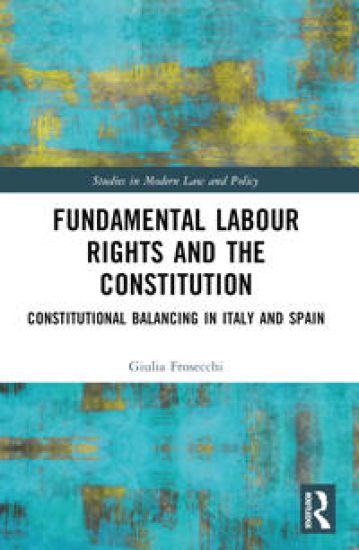
Fundamental Labour Rights and the Constitution

Fundamental Labour Rights and the Constitution

Giulia Frosecchi

TAYLOR FRANCIS LTD
2024
nidottu
The book reflects on constitutional balancing from the perspective of fundamental labour rights. It draws on neo-constitutional theories and builds on the assumption that fundamental labour rights, understood as rights aimed at protecting workers during their working life or after retirement, are the normative expression of founding values and can be balanced against equally axiological constitutional principles. The balancing of constitutional labour rights can be conducted by various institutional actors and by applying different techniques. This volume reviews the theoretical debates on judicial balancing and the approaches adopted by the Court of Justice of the European Union and the European Court of Human Rights, to proceed with a closer assessment of Italian and Spanish judicial traditions. In particular, it addresses the main profiles of the case law of the Italian and Spanish Constitutional Courts on labour and social law reforms adopted in the aftermath of the 2008 crisis, where balancing takes place between labour rights and economic principles. The analysis is focused on four main aspects: the fundamental labour rights in the balance; the role of the Courts; the technique applied by the Judges; and the constitutional interests subject to the balancing. It ultimately reveals that the axiological nature of fundamental labour rights is preserved and the economic and financial contingencies confirm their factual character, although they are occasionally recognised a prominent role in the ratio decidendi. The book will be a valuable resource for academics and researchers working in the areas of labour law, social security law, legal theory and constitutional law.
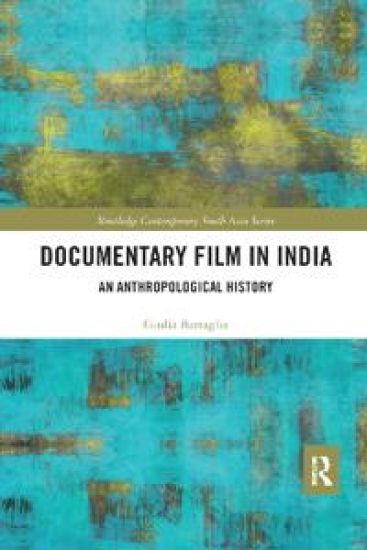
Documentary Film in India

Documentary Film in India

Giulia Battaglia

Routledge
2019
nidottu
This book maps a hundred years of documentary film practices in India. It demonstrates that in order to study the development of a film practice, it is necessary to go beyond the classic analysis of films and filmmakers and focus on the discourses created around and about the practice in question. The book navigates different historical moments of the growth of documentary filmmaking in India from the colonial period to the present day. In the process, it touches upon questions concerning practices and discourses about colonial films, postcolonial institutions, independent films, filmmakers and filmmaking, the influence of feminism and the articulation of concepts of performance and performativity in various films practices. It also reflects on the centrality of technological change in different historical moments and that of film festivals and film screenings across time and space.Grounded in anthropological fieldwork and archival research and adopting Foucault’s concept of ‘effective history’, this work searches for points of origin that creates ruptures and deviations taking distance from conventional ways of writing film histories. Rather than presenting a univocal set of arguments and conclusions about changes or new developments of film techniques, the originality of the book is in offering an open structure (or an open archive) to enable the reader to engage with mechanisms of creation, engagement and participation in film and art practices at large. In adopting this form, the book conceptualises ‘Anthropology’ as also an art practice, interested, through its theoretico-methodological approach, in creating an open archive of engagement rather than a representation of a distant ‘other’. Similarly, documentary filmmaking in India is seen as primarily a process of creation based on engagement and participation rather than a practice interested in representing an objective reality.Proposing an innovative way of perceiving the growth of the do
Women, Reconciliation and the Israeli-Palestinian Conflict
Women, Reconciliation and the Israeli-Palestinian Conflict explores the most prominent instances of women’s political activism in the occupied Palestinian territories and in Israel, focussing primarily on the last decade. By taking account of the heterogeneous narrative identities existing in such a context, the author questions the effectiveness of the contributions of Palestinian and Israeli Jewish women activists towards a feasible renewal of the ‘peace process’, founded on mutual recognition and reconciliation. Based on feminist literature and field research, this book re-problematises the controversial liaison between ethno-national narratives, feminist backgrounds and women’s activism in Palestine/Israel. In detail, the most relevant salience of this study is the provision of an additional contribution to the recent debate on the process of making Palestinian and Israeli women activists more visible, and the importance of this process as one of the most meaningful ways to open up areas of enquiry around major prospects for the end of the Israeli-Palestinian conflict. Tackling topical issues relating to alternative resolutions to the Israeli-Palestinian conflict, this book will be a valuable resource for both academics and activists with an interest in Middle East Politics, Gender Studies, and Conflict Resolution.
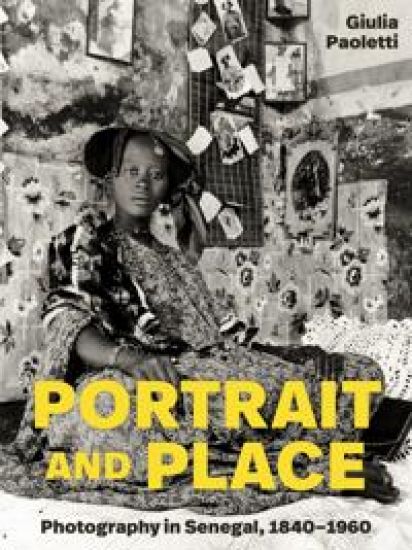
Portrait and Place

Portrait and Place

Giulia Paoletti

PRINCETON UNIVERSITY PRESS
2024
sidottu
A richly illustrated history of photography in one of the epicenters of African modernityWhen the daguerreotype first arrived in sub-Saharan Africa in the early nineteenth century, local kingdoms still held power in Senegal and the French presence was limited to trading outposts along the coast. The pioneers of photography in Senegal worked within, across, and beyond the borders of colonial empire, expanding the medium’s possibilities and contributing to a global visual language. Portrait and Place explores these unique encounters, providing an in-depth and nuanced look at the images made at the intersection of Black Atlantic, Islamic, and African cultures.Giulia Paoletti takes readers on a visual journey from the 1840s, when the oldest-surviving daguerreotype from West Africa was made, to the 1960s, when photography became the most popular medium as Senegal achieved its independence. She discusses some of Africa’s most celebrated modernists, such as Mama Casset, and also offers insights into lesser-known photographers like Oumar Ka and once-anonymous figures such as Macky Kane. Paoletti examines both professional and amateur artists in genres ranging from portraiture to landscape and across media such as glass painting and lithography.Featuring a wealth of breathtaking images published here for the first time, Portrait and Place brings to life the important histories of photography on the African continent.
Dürer

Dürer

Giulia Bartrum

British Museum Press
2014
nidottu
Albrecht Dürer (1471–1528) is arguably the first truly international artist, a celebrity both during his own lifetime and since. A major artist of the northern Renaissance, he was praised by his contemporaries and described shortly after his death as ‘the prince among German painters’. Dürer’s achievements as a painter were matched by his remarkable manipulation of the traditional techniques of woodcut and engraving, which altered the history of printmaking and ensured that his works were admired and collected throughout Europe. The British Museum holds one of the finest collections of Dürer’s graphic art in the world, with superlative prints and drawings from all phases of his career. Beginning with an introduction to the life of the artist, the book presents a selection of Dürer’s best-known works including early figure studies, landscape watercolours, animal studies drawn from nature and his imaginative famous prints such as Adam and Eve, Rhinoceros and Melancholia. As well as demonstrating Dürer’s astonishing range of subject matter, the book explores his working method and the versatile, spontaneous nature of his draughtsmanship. The development of Dürer’s ideas from drawings to related woodcuts and engravings is also investigated, making the book a perfect concise introduction to this fascinating and much-admired artist.
Golden Art Nouveau Tarot Grand Trumps

Golden Art Nouveau Tarot Grand Trumps

Giulia Francesca Massaglia

Llewellyn Publications
2023
muu
Featuring all 22 cards of the major arcana, this grand trumps deck brings to life classic Rider-Waite-Smith symbology in glittering glory. Gold foil details and delicately curving lines dance across each stunning illustration by artist Giulia Francesca Massaglia, capturing the spirit of the art noveau movement with dazzling elegance. This gilded deck will be a powerful standout in any collection.
After Tarot Mini

After Tarot Mini

Giulia Francesca Massaglia

Llewellyn Publications
2025
muu
Find out what the Rider-Waite-Smith cards would look like just moments after their traditional scenes in this mini deck. This mini edition of the After Tarot explores what the cards would look like just moments after the scenes with which we are most familiar. For instance, what would happen to The Fool moments after putting his foot over the cliff? Find out in this mini deck from accomplished artist Giulia Francesca Massaglia.
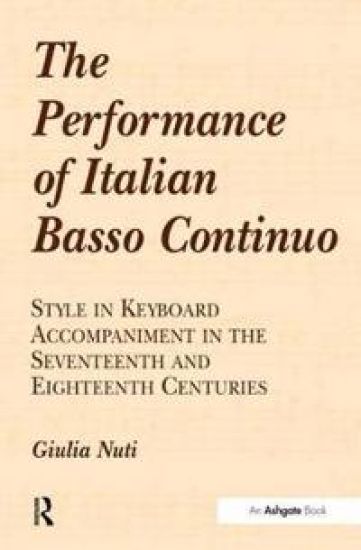
The Performance of Italian Basso Continuo

The Performance of Italian Basso Continuo

Giulia Nuti

Ashgate Publishing Limited
2007
sidottu
Basso continuo accompaniment calls upon a complex tapestry of harmonic, rhythmic, compositional, analytical and improvisational skills. The evolving knowledge that underpinned the performance of basso continuo was built up and transmitted from the late 1500s to the second half of the eighteenth century, when changes in instruments together with the assertion of control by composers over their works brought about its demise. By tracing the development of basso continuo over time and across the regions of Italy where differing practices emerged, Giulia Nuti accesses this body of musical usage. Sources include the music itself, introductions and specific instructions and requirements in song books and operas, contemporary accounts of performances and, in the later period of basso continuo, description and instruction offered in theoretical treatises. Changes in instruments and instrumental usage and the resulting sounds available to composers and performers are considered, as well as the altering relationship between the improvising continuo player and the composer. Extensive documentation from both manuscript and printed sources, some very rare and others better known, in the original language, followed by a precise English translation, is offered in support of the arguments. There are also many musical examples, transcribed and in facsimile. Giulia Nuti provides both a scholarly account of the history of basso continuo and a performance-driven interpretation of how this music might be played.
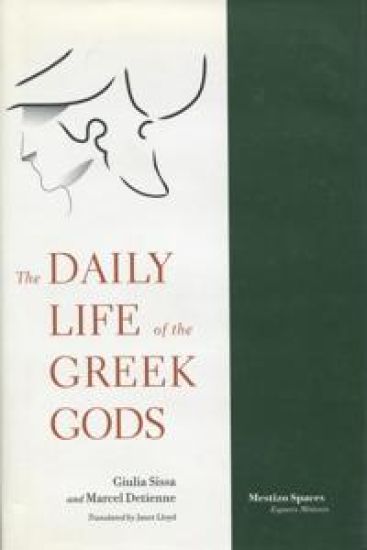
The Daily Life of the Greek Gods

The Daily Life of the Greek Gods

Giulia Sissa; Marcel Detienne

Stanford University Press
2000
sidottu
Despite the rousing stories of male heroism in battles, the Trojan War transcended the activities of its human participants. For Homer, it was the gods who conducted and accounted for what happened. In the first part of this book, the authors find in Homer's Iliad material for exploring the everyday life of the Greek gods: what their bodies were made of and how they were nourished, the organization of their society, and the sort of life they led both in Olympus and in the human world. The gods are divided in their human nature: at once a fantasized model of infinite joys and an edifying example of engagement in the world, they have loves, festivities, and quarrels. In the second part, the authors show how citizens carried on everyday relations with the gods and those who would become the Olympians, inviting them to reside with humans organized in cities. At the heart of rituals and of social life, the gods were omnipresent: in sacrifices, at meals, in political assemblies, in war, in sexuality. In brief, the authors show how the gods were indispensable to the everyday social organization of Greek cities. To set on stage a number of gods implicated in the world of human beings, the authors give precedence to the feminine over the masculine, choosing to show how such great powers as Hera and Athena wielded their sovereignty over cities, reigning over not only the activities of women but also the moulding of future citizens. Equally important, the authors turn to Dionysus and follow the evolution of one of his forms, that of the phallus paraded in processions. Under this god, so attentive to all things feminine, the authors explore the typically civic ways of thinking about the relations between natural fecundity and the sexuality of daily life.
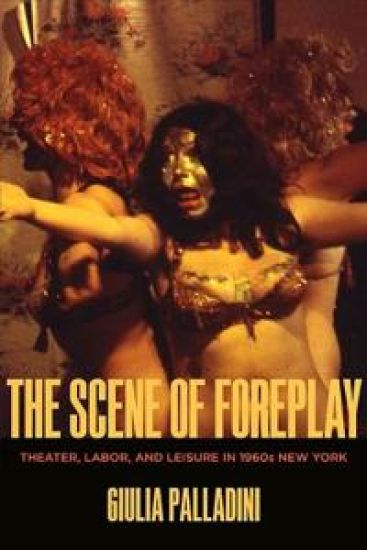
The Scene of Foreplay

The Scene of Foreplay

Giulia Palladini

Northwestern University Press
2017
nidottu
In a study that spans the fields of theater history, performance studies, and cultural studies, Giulia Palladini analyzes artistic performances, social performances, archival remains, and memoirs of the underground theater scene in 1960s New York. She employs foreplay as a theoretical term that refers to a form of labor that both anticipates and postpones theater production proper. Informed by queer theory and materialist theories of production, Palladini's theory of foreplay subverts any teleological conception of work, devaluing mastery and progression in favor of desire and pleasure. Her engagement with artistic performances such as Tom Eyen's play Why Hanna's Skirt Won't Stay Down, Paul Foster's Hurrah for the Bridge, Andy Warhol's Screen Tests and Jack Smith's 1970s midnight performances, as well as social performances such as Jackie Curtis's wedding performances and Ellen Stewart's founding of La Mama, illuminates an era of radical experimentation and seismic change in ideas of what constitutes theater and performance.
J. M. Synge and Travel Writing of the Irish Revival

J. M. Synge and Travel Writing of the Irish Revival

Giulia Bruna

Syracuse University Press
2017
nidottu
Between the late 1890s and the early 1900s, the young Irish writer John Millington Synge journeyed across his home country, documenting his travels intermittently for ten years. His body of travel writing includes the travel book The Aran Islands, his literary journalism about West Kerry and Wicklow published in various periodicals, and his articles for the Manchester Guardian about rural poverty in Connemara and Mayo. Although Synge’s nonfiction is often considered of minor weight compared with his drama, Bruna argues persuasively that his travel narratives are instances of a pioneering ethnographic and journalistic imagination. J. M. Synge and Travel Writing of the Irish Revival is the first comprehensive study of Synge’s travel writing about Ireland, compiled during the zeitgeist of the preindependence Revival movement. Bruna argues that Synge’s nonfiction subverts inherited modes of travel writing that put an emphasis on Empire and Nation. Synge’s writing challenges these grand narratives by expressing a more complex idea of Irishness grounded in his empathetic observation of the local rural communities he traveled amongst. Drawing from critically neglected revivalist travel literature, newspapers and periodicals, and visual and archival documents, Bruna sketches a new portrait of a seminal Irish Literary Renaissance figure and sheds new light on the itineraries of activism and literary engagement of the broader Revival movement.
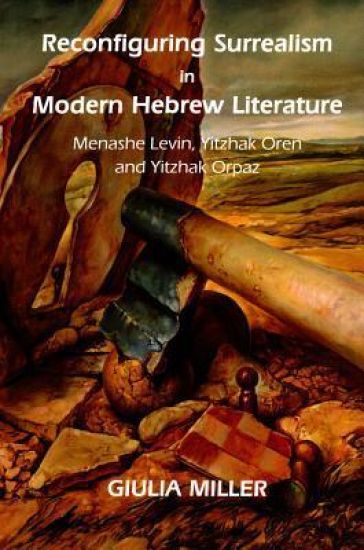
Reconfiguring Surrealism in Modern Hebrew Literature

Reconfiguring Surrealism in Modern Hebrew Literature

Giulia Miller

Vallentine Mitchell Co Ltd
2013
sidottu
This book challenges the popular notion that there is no Modern Hebrew Surrealist literature. It focuses upon the writings of three lesser-known Hebrew authors - Menashe Levin, Yitzhak Oren, and Yitzhak Orpaz - and considers the nature and function of their particular strands of Hebrew Surrealism. The book takes as its departure the alleged absence of Surrealism in Modern Hebrew literature, an absence that suggests that Surrealism has made little impact upon Hebrew and Israeli culture. It suggests that the relationship is more complex. In so doing, the book moves beyond the conception of Surrealism as a regimented artistic movement and proposes instead that we broaden our definition to encompass the multifarious guises in which it appears.
Structural Priming in Sentence Production

Structural Priming in Sentence Production

Giulia M. L. Bencini

Cambridge University Press
2025
pokkari
This Element provides an overview of structural priming research across the three main populations on which experimental priming studies have concentrated: adult monolingual speakers, first language learners, second language learners, and bilinguals. Priming studies with monolingual adults were originally designed to inform psycholinguistic models of grammatical encoding in language production. Thanks to the the implicit nature of the task, priming has turned out to be suitable for experimentally addressing questions about linguistic representation and use at the sentence level in speakers of any age. The view that priming is a form of implicit learning has sparked an interest in exploring continuity and life-long learning in language, opening up rich research areas in second language acquisition and bilingualism. Priming rightly deserves to be a part of every language scientist's tool kit.
Ambiguity in Organization Theory

Ambiguity in Organization Theory

Giulia Cappellaro; Amelia Compagni; Eero Vaara

Cambridge University Press
2023
pokkari
This Element presents and discusses the main trajectories in the evolution of the concept of ambiguity and the most relevant theoretical contributions developed around it. It specifically elaborates on both the intrinsic perspectives on ambiguity as an inherent part of organizational decision-making processes and the more recent strategic perspectives on discursively constructed strategic ambiguity. It helps illuminate the path ahead of organizational scholars and offers new avenues for future research. This is important given the ever more pervasive presence of ambiguity in and around organizations and societies.
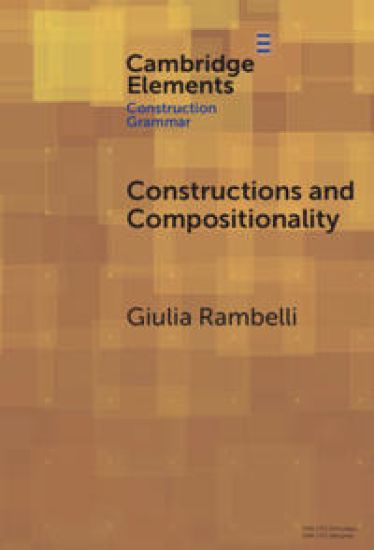
Constructions and Compositionality

Constructions and Compositionality

Giulia Rambelli

Cambridge University Press
2025
pokkari
How do we understand any sentence, from the most ordinary to the most creative? The traditional assumption is that we rely on formal rules combining words (compositionality). However, psycho- and neuro-linguistic studies point to a linguistic representation model that aligns with the assumptions of Construction Grammar: there is no sharp boundary between stored sequences and productive patterns. Evidence suggests that interpretation alternates compositional (incremental) and noncompositional (global) strategies. Accordingly, systematic processes of language productivity are explainable by analogical inferences rather than compositional operations: novel expressions are understood 'on the fly' by analogy with familiar ones. This Element discusses compositionality, alternative mechanisms in language processing, and explains why Construction Grammar is the most suitable approach for formalizing language comprehension.
Structural Priming in Sentence Production

Structural Priming in Sentence Production

Giulia M. L. Bencini

Cambridge University Press
2025
sidottu
This Element provides an overview of structural priming research across the three main populations on which experimental priming studies have concentrated: adult monolingual speakers, first language learners, second language learners, and bilinguals. Priming studies with monolingual adults were originally designed to inform psycholinguistic models of grammatical encoding in language production. Thanks to the the implicit nature of the task, priming has turned out to be suitable for experimentally addressing questions about linguistic representation and use at the sentence level in speakers of any age. The view that priming is a form of implicit learning has sparked an interest in exploring continuity and life-long learning in language, opening up rich research areas in second language acquisition and bilingualism. Priming rightly deserves to be a part of every language scientist's tool kit.
Constructions and Compositionality

Constructions and Compositionality

Giulia Rambelli

Cambridge University Press
2025
sidottu
How do we understand any sentence, from the most ordinary to the most creative? The traditional assumption is that we rely on formal rules combining words (compositionality). However, psycho- and neuro-linguistic studies point to a linguistic representation model that aligns with the assumptions of Construction Grammar: there is no sharp boundary between stored sequences and productive patterns. Evidence suggests that interpretation alternates compositional (incremental) and noncompositional (global) strategies. Accordingly, systematic processes of language productivity are explainable by analogical inferences rather than compositional operations: novel expressions are understood 'on the fly' by analogy with familiar ones. This Element discusses compositionality, alternative mechanisms in language processing, and explains why Construction Grammar is the most suitable approach for formalizing language comprehension.