Kirjojen hintavertailu. Mukana 11 516 371 kirjaa ja 12 kauppaa.

Kirjahaku

Etsi kirjoja tekijän nimen, kirjan nimen tai ISBN:n perusteella.

1000 tulosta hakusanalla Hannah Campling

Hannah Arendt and the Challenge of Modernity
Hannah Arendt and the Challenge of Modernity explores the theme of human rights in the work of Hannah Arendt. Parekh argues that Arendt's contribution to this debate has been largely ignored because she does not speak in the same terms as contemporary theoreticians of human rights. Beginning by examining Arendt’s critique of human rights, and the concept of "a right to have rights" with which she contrasts the traditional understanding of human rights, Parekh goes on to analyze some of the tensions and paradoxes within the modern conception of human rights that Arendt brings to light, arguing that Arendt’s perspective must be understood as phenomenological and grounded in a notion of intersubjectivity that she develops in her readings of Kant and Socrates.
Hannah's Joy

Hannah's Joy

Marta Perry

Penguin USA
2012
pokkari
Returning to Pleasant Valley gives a widow a much-needed chance at a new life. But now she must decide if she truly belongs in the Amish world...Unexpected tragedy has left Hannah without her soldier husband and a home for her baby son, Jamie. Seeking refuge, she comes to live with her aunt in Pleasant Valley, a place she hasn’t seen since childhood, when her parents left the Mennonite faith. Working in her aunt’s bakery is a way for Hannah to get back on her feet, but she isn’t sure if she can live by tradition—or if she and Jamie should stay for good. She finds an unexpected sympathetic listener in furniture maker William Brand. His stutter makes him feel like a permanent outsider in his Amish community, and he understands her loneliness. Hannah is irresistibly drawn to the shy, caring William, and her education in speech therapy makes it natural for her to want to help him speak more easily. But how can she encourage his attention when she might someday leave Pleasant Valley, and when her father-in-law, a military officer, is scheming to take Jamie away from her? As William seeks the courage to stand up for the woman who believes in him, Hannah must decide where her true home lies—in the free, ever-changing world she knows, or in the simpler, loving community she’s found...
Hannah's Hope

Hannah's Hope

Karen Kingsbury

FaithWords
2005
sidottu
15-year-old Hannah Roberts remembers when her father was her closest friend. The image is hazy, though, pulled from her distant childhood memories, and her father is now very cold and distant. Her mother is not much better. Feeling orphaned, Hannah lives a lonely life with her wealthy, ailing grandmother. As Christmas nears, Hannah learns a shocking truth: the man she believed was her father is not her parent after all. In an effort to find answers, she begins a desperate search for her real father, Air Force pilot Mike Conner. A local politician and a newspaper catch wind of her quest, a national TV station posts a letter from her, and soon everyone is caught up in Hannah's hope--that she'll find her father before the holidays.
Hannah's Joy

Hannah's Joy

Perry Marta

Berkley Publishing Corporation,U.S.
2019
pokkari
Returning to Pleasant Valley gives a widow a much-needed chance at a new life. But now she must decide if she truly belongs in the Amish world... Unexpected tragedy has left Hannah without her soldier husband and a home for her baby son, Jamie. Seeking refuge, she comes to live with her aunt in Pleasant Valley, a place she hasn't seen since childhood, when her parents left the Mennonite faith. Working in her aunt's bakery is a way for Hannah to get back on her feet, but she isn't sure if she can live by tradition--or if she and Jamie should stay for good. She finds an unexpected sympathetic listener in furniture maker William Brand. His stutter makes him feel like a permanent outsider in his Amish community, and he understands her loneliness. Hannah is irresistibly drawn to the shy, caring William, and her education in speech therapy makes it natural for her to want to help him speak more easily. But how can she encourage his attention when she might someday leave Pleasant Valley, and when her father-in-law, a military officer, is scheming to take Jamie away from her? As William seeks the courage to stand up for the woman who believes in him, Hannah must decide where her true home lies--in the free, ever-changing world she knows, or in the simpler, loving community she's found...
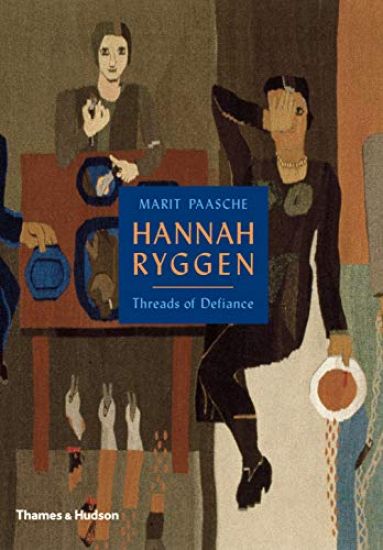
Hannah Ryggen

Hannah Ryggen

Marit Paasche

Thames Hudson Ltd
2019
sidottu
The significance of Hannah Ryggen (1894–1970) as one of the most important figures in the history of Scandinavian art has only recently been recognized internationally. Beloved and renowned for her original contributions to modernist tapestry, Ryggen made radical political statements against Fascism and Nazism before and during the Second World War. Using primary sources, Ryggen expert Marit Paasche brings us a much fuller knowledge of the artist, weaving her life and work into a story that illuminates not only the artist herself, but also 20th-century art history in general. Hannah Ryggen’s visually spellbinding tapestries, made on a homemade handloom in her small farm on the remote Norwegian coast, depict a wealth of subjects: Mussolini’s Abyssinian campaign, her husband’s internment in a Nazi camp in occupied Norway, the post-war growth of nuclear power, and media coverage of the Vietnam War. At once hard-hitting and humorous, her works combine personal candour, social and political engagement and visual majesty. Paasche explores both the artist’s bold subject matter and particular balance of abstraction and figuration within the context of her life and beliefs. Including a comprehensive selection of works, this book provides an enthralling account of a remarkable, and unjustly overlooked, artist.
Hannah Arendt in Jerusalem

Hannah Arendt in Jerusalem

University of California Press
2001
pokkari
For many years Hannah Arendt (1906--1975) has been the object of intense debate. After her bitter critiques of Zionism, which seemed to nullify her early involvement with that movement, and her extremely controversial Eichmann in Jerusalem (1963), Arendt became virtually a taboo figure in Israeli and Jewish circles. Challenging the "curse" of her own title, Hannah Arendt in Jerusalem carries the scholarly investigation of this much-discussed writer to the very place where her ideas have been most conspicuously ignored. Sometimes sympathetically, sometimes critically, these distinguished contributors reexamine crucial aspects of Arendt's life and thought: her complex identity as a German Jew; her commitment to and critique of Zionism and the state of Israel; her works on "totalitarianism," Nazism, and the Eichmann trial; her relationship to key twentieth-century intellectuals; her intimate and tense connections to German culture; and her reworkings of political thought and philosophy in the light of the experience of the twentieth century.
Hannah Arendt

Hannah Arendt

Margaret Canovan

Cambridge University Press
1994
pokkari
Hannah Arendt is one of the most original and controversial political thinkers of the twentieth century. Margaret Canovan argues that much of the published work on Arendt has been flawed by serious misunderstandings, arising from a failure to see her work in its proper context. This reinterpretation will surely strengthen Arendt’s status as one of the most significant political thinkers of the twentieth century.
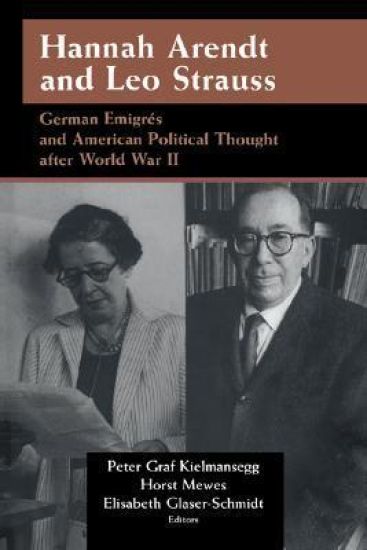
Hannah Arendt and Leo Strauss

Hannah Arendt and Leo Strauss

Cambridge University Press
1997
pokkari
This volume on Hannah Arendt’s and Leo Strauss’ impact on American political science after 1933 contains essays presented at an international conference held at the University of Colorado at Boulder in 1991. The book explores the influence that Arendt’s and Strauss’ experiences of inter-war Germany had on their perception of democracy and their judgment of American liberal democracy. Although they represented different political attitudes, both thinkers interpreted the modern American political system as a response to totalitarianism. The contributors analyse how their émigré experience both influenced their American work and also had an impact on the formation of the discipline of political science in postwar Germany. Arendt’s and Strauss’ experiences thus aptly illustrate the transfer and transformation of political ideas in the World War II era.