Kirjojen hintavertailu. Mukana 11 699 587 kirjaa ja 12 kauppaa.

Kirjahaku

Etsi kirjoja tekijän nimen, kirjan nimen tai ISBN:n perusteella.

1000 tulosta hakusanalla Herbert Workman

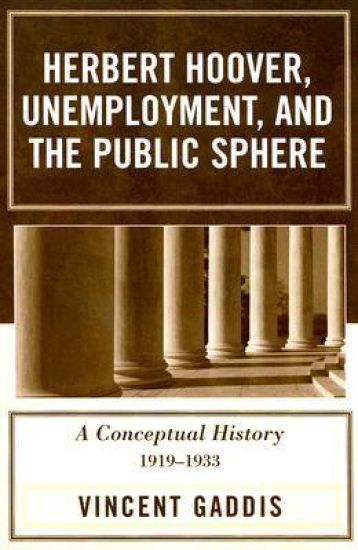
Herbert Hoover, Unemployment, and the Public Sphere

Herbert Hoover, Unemployment, and the Public Sphere

Vincent Gaddis; Mary O. Furner

University Press of America
2005
nidottu
Herbert Hoover, Unemployment, and the Public Sphere examines the fulfillment of Hoover's ideas in the area of unemployment between 1919 and 1933. The economic system Herbert Hoover envisioned, one based on cooperation and individual initiative with limited government, and the language he used to promote this system defined New Era discourse. His American Individualism, printed in 1923, served as the political philosophy of the administrations of the 1920s. In his discourse from 1919-1921, Hoover expanded the criteria- the conceptual definitions of virtue and liberty. The book includes a foreword by Mary O. Furner.
Herbert Hoover and World Peace

Herbert Hoover and World Peace

Lee Nash

University Press of America
2010
nidottu
Herbert Hoover and World Peace summarizes Hoover's career-long efforts to preserve peace in the world and to help America avoid unnecessary wars, from his opposition to our entry into World War I to his proposed — and rejected — Cold War strategy, which would have avoided the Vietnam War. Personal experiences in the Boxer Rebellion in China and helping to feed Belgium during World War I, coupled with his early Quaker nurture, that sensitized him to war-related tragedies. These essays illustrate the varied ways in which Hoover expressed and implemented his commitment to world peace, as humanitarian, advisor, cabinet member, president, citizen, and writer. No other president was so consistent and thoughtful on matters of world peace.
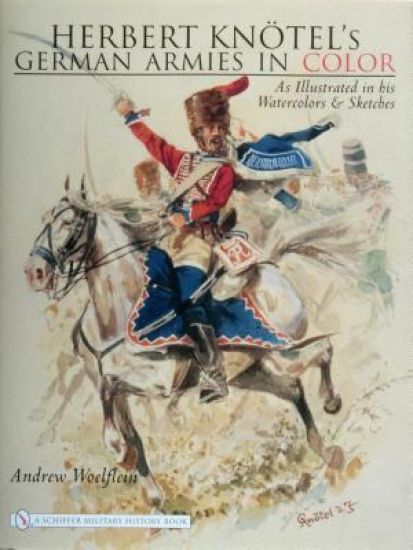
Herbert Knotel's German Armies in Color

Herbert Knotel's German Armies in Color

Andrew Woelflein

Schiffer Publishing Ltd
2007
sidottu
Herbert Knötel adroitly brings soldiers of every age and every nationality to life with his detailed sketches and masterful watercolors. "Herbert Knötel's German Armies" includes 137 never-before-published sketches and watercolors of German military figures from the 18th-20th centuries. This unique art, from the Anne S.K. Brown Military Collection at Brown University and the private collection of Alfred and Roland Umhey, offers vivid insight into one of the 20th century's most accomplished military artists. A superb biographical essay from Knötel's only child provides personal context for the artist's life and brilliant work.
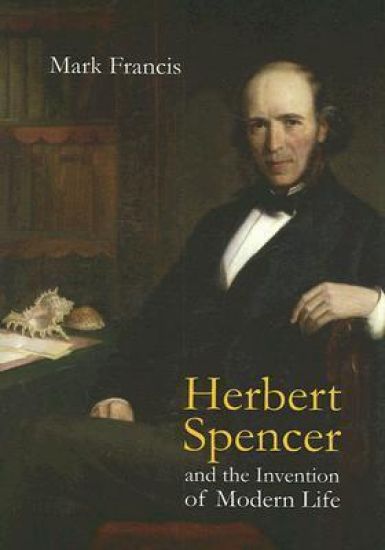
Herbert Spencer and the Invention of Modern Life

Herbert Spencer and the Invention of Modern Life

Mark Francis

Cornell University Press
2007
sidottu
The ideas of the English philosopher Herbert Spencer (1820-1903) profoundly shaped Victorian thought regarding evolutionary theory, the philosophy of science, sociology, and politics. In his day, Spencer's works ranked alongside those of Darwin and Marx in their importance to the development of disciplines as wide-ranging as sociology, anthropology, political theory, philosophy, and psychology. Yet during his lifetime—and certainly in the decades that followed—Spencer has been widely misunderstood. Both lauded and disparaged as the father of Social Darwinism (it was Spencer who coined the phrase "survival of the fittest"), and as an apologist for individualism and unrestrained capitalism, he was, in fact, none of these; he was instead a subtle and complex thinker.In his major new intellectual biography of Spencer, Mark Francis uses archival material and contemporary printed sources to create a fascinating portrait of a man who attempted to explain modern life in all its biological, psychological, and sociological forms through a unique philosophical and scientific system that bridged the gap between empiricism and metaphysics. Vastly influential in England and beyond—particularly the United States and Asia—his philosophy was, as Francis shows, systematic and rigorous. Despite the success he found in the realm of ideas, Spencer was an unhappy man. Francis reveals how Spencer felt permanently crippled by the Christian values he had absorbed during childhood, and was incapable of romantic love, as became clear during his relationship with the novelist George Eliot. Elegantly written, provocative, and rich in insight, Herbert Spencer and the Invention of Modern Life is an exceptional work of scholarship that not only dispels the misinformation surrounding Spencer but also illuminates the broader cultural and intellectual history of the nineteenth century.
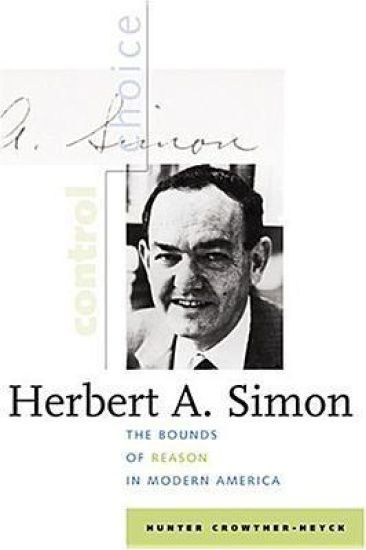
Herbert A. Simon

Herbert A. Simon

Hunter Crowther-Heyck

Johns Hopkins University Press
2005
sidottu
Rarely does the world see as versatile a figure as Herbert Simon. A Nobel laureate in economics, he was an accomplished political scientist, winner of a lifetime achievement award from the American Psychological Association, and founder of the Department of Computer Science at Carnegie Mellon University. In all his work in all these fields, he pursued a single goal: to create a science that could map the bounds of human reason and so enlarge its role in human affairs. Hunter Crowther-Heyck uses the career of this unique individual to examine the evolution of the social sciences after World War II, particularly Simon's creation of a new field, systems science, which joined together two distinct, powerful approaches to human behavior, the sciences of choice and control. Simon sought to develop methods by which human behavior, specifically human problem-solving, could be modeled and simulated. Regarding mind and machine as synonymous, Simon applied his models of human behavior to many other areas, from public administration and business management to artificial intelligence and the design of complex social and technical systems. In this informed and discerning study, Crowther-Heyck explores Simon's contributions to science and their influences on modern life and thought. For historians of science, social science, and technology, and for scholars of twentieth-century American intellectual and cultural history, this account of Herbert Simon's life and work provides a rich and valuable perspective.
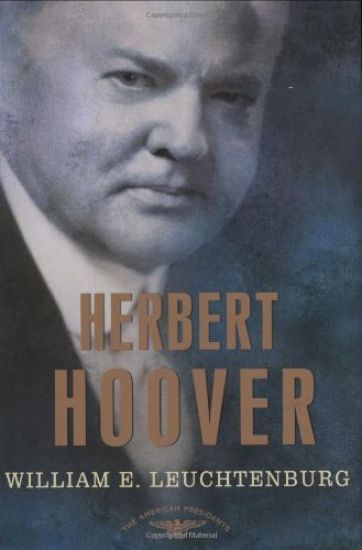
Herbert Hoover

Herbert Hoover

William E. Leuchtenburg

Times Books
2009
sidottu
Catapulted into national politics by his heroic campaigns to feed Europe during and after World War I, Herbert Hoover - an engineer by training - exemplified the economic optimism of the 1920s. As president, however, Hoover was sorely tested by America's first crisis of the twentieth century: the Great Depression. Renowned New Deal historian William E. Leuchtenburg demonstrates how Hoover was blinkered by his distrust of government and his belief that volunteer ism would solve all social ills. As Leuchtenburg shows, Hoover's attempts to enlist the aid of private sector leaders did little to mitigate the Depression, and he was routed from office by Franklin D. Roosevelt in 1932. From his retirement at Stanford University, Hoover remained a vocal critic of the New Deal and big government until the end of his long life. Leuchtenburg offers a frank, thoughtful portrait of this lifelong public servant, and shrewdly assesses Hoover's policies and legacy in the face of one of the darkest periods of American history.
The Essential Marcuse: Selected Writings of Philosopher and Social Critic Herbert Marcuse
The Essential Marcuse provides an overview of Herbert Marcuse's political and philosophical writing over four decades, with excerpts from his major books as well as essays from various academic journals. The most influential radical philosopher of the 1960s, Marcuse's writings are noteworthy for their uncompromising opposition to both capitalism and communism. His words are as relevant to today's society as they were at the time they were written.
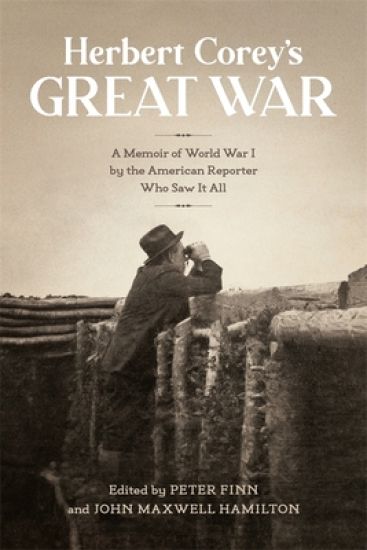
Herbert Corey's Great War

Herbert Corey's Great War

Peter Finn

LOUISIANA STATE UNIVERSITY PRESS
2022
sidottu
In 1914, the Associated Newspapers sent correspondent Herbert Corey to Europe on the day Great Britain declared war on Germany. During the Great War that followed, Corey reported from France, Britain, and Germany, visiting the German lines on both the western and eastern fronts. He also reported from Greece, Italy, Switzerland, Holland, Belgium, and Serbia. When the Armistice was signed in November 1918, Corey defied the rules of the American Expeditionary Forces and crossed into Germany. He covered the Paris Peace Conference the following year. No other foreign correspondent matched the longevity of his reporting during World War I. Until recently, however, his unpublished memoir lay largely unnoticed among his papers in the Library of Congress.With publication of Herbert Corey's Great War, coeditors Peter Finn and John Maxwell Hamilton reestablish Corey's name in the annals of American war reporting. As a correspondent, he defies easy comparison. He approximates Ernie Pyle in his sympathetic interest in the American foot soldier, but he also told stories about troops on the other side and about noncombatants. He is especially illuminating on the obstacles reporters faced in conveying the story of the Great War to Americans. As his memoir makes clear, Corey didn't believe he was in Europe to serve the Allies. He viewed himself as an outsider, one who was deeply ambivalent about the entry of the United States into the war. His idiosyncratic, opinionated, and very American voice makes for compelling reading.
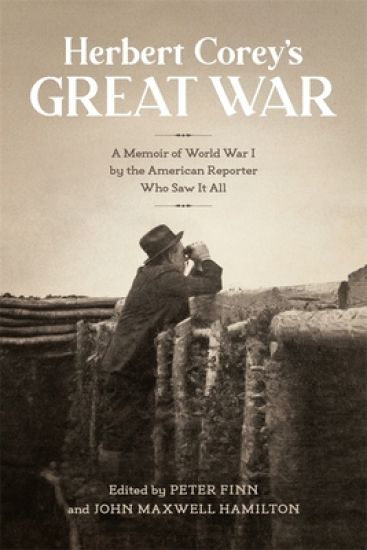
Herbert Corey's Great War

Herbert Corey's Great War

Peter Finn

LOUISIANA STATE UNIVERSITY PRESS
2022
pokkari
In 1914, the Associated Newspapers sent correspondent Herbert Corey to Europe on the day Great Britain declared war on Germany. During the Great War that followed, Corey reported from France, Britain, and Germany, visiting the German lines on both the western and eastern fronts. He also reported from Greece, Italy, Switzerland, Holland, Belgium, and Serbia. When the Armistice was signed in November 1918, Corey defied the rules of the American Expeditionary Forces and crossed into Germany. He covered the Paris Peace Conference the following year. No other foreign correspondent matched the longevity of his reporting during World War I. Until recently, however, his unpublished memoir lay largely unnoticed among his papers in the Library of Congress.With publication of Herbert Corey's Great War, coeditors Peter Finn and John Maxwell Hamilton reestablish Corey's name in the annals of American war reporting. As a correspondent, he defies easy comparison. He approximates Ernie Pyle in his sympathetic interest in the American foot soldier, but he also told stories about troops on the other side and about noncombatants. He is especially illuminating on the obstacles reporters faced in conveying the story of the Great War to Americans. As his memoir makes clear, Corey didn't believe he was in Europe to serve the Allies. He viewed himself as an outsider, one who was deeply ambivalent about the entry of the United States into the war. His idiosyncratic, opinionated, and very American voice makes for compelling reading.
Herbert Spencer

Herbert Spencer

Robert G. Perrin

Garland Publishing Inc
1993
sidottu
First published in 1993. Including a primary and secondary bibliography which consists of indexes, book catalogues, articles, reviews and Ph.D dissertations. With annotated notes form the author to convey the items’ main idea, argument, purpose or general substance and cross-references where relevant.
Herbert Spencer

Herbert Spencer

Alberto Mingardi

Continuum Publishing Corporation
2011
sidottu
This is volume 18 in the "Major Conservative and Libertarian Thinkers" series. Herbert Spencer (1820-1904) was one of the foremost philosophers of the Victorian age. For the most of his life, he was engaged in building a 'synthetic philosophy' that ranged from biology to aesthetics to politics. Spencer was a defender of the doctrine of classical liberalism, akin to contemporary libertarianism, which he elaborated to a higher degree of synthesis and internal consistency. Though a friend and admirer of John Stuart Mill, he was far from an adherent to some of the principles that Mill held dear. In particular, in the dawn of democracy Spencer found not just the dangerous illusions of the masses overcoming the rights of the individual, but a new 'divine right of parliaments', an equal enemy to individual freedom as the divine right of kings. "Major Conservative and Libertarian Thinkers" provides comprehensive accounts of the works of seminal conservative thinkers from a variety of periods, disciplines, and traditions - the first series of its kind. Even the selection of thinkers adds another aspect to conservative thinking, including not only theorists but also writers and practitioners. The series comprises twenty volumes, each including an intellectual biography, historical context, critical exposition of the thinker's work, reception and influence, contemporary relevance, bibliography including references to electronic resources, and an index.
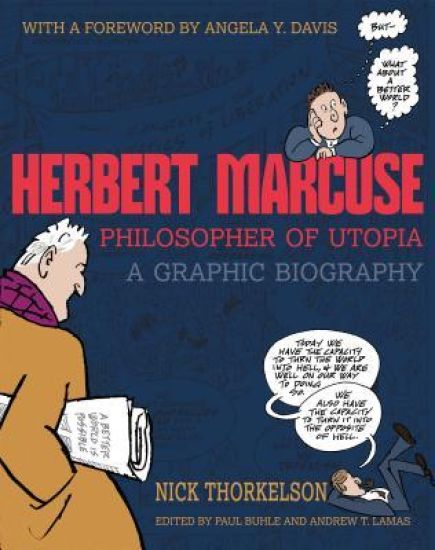
Herbert Marcuse, Philosopher of Utopia

Herbert Marcuse, Philosopher of Utopia

Angela Y. Davis; Angela Davis

City Lights Books
2019
pokkari
“I believe that Marcuse’s ideas can be as valuable today as they were fifty years ago.”—Angela Y. Davis, from the forewordHerbert Marcuse was one of the twentieth century’s most unlikely pop stars: a celebrity philosopher. In the 1960s, his argument for a “principled utopianism” catalyzed the idealism of a rebellious generation, and Marcuse became an intellectual guide for activists and revolutionaries around the world.From his early studies with Martin Heidegger, to his flight from Nazi Germany with Frankfurt School colleagues, to his status as a countercultural icon, readers are introduced to the development of Marcuse's philosophical theories and the political realities that shaped his work.Marcuse's advocacy for a more humane, sustainable world was grounded in a personal knowledge of authoritarianism's violence, and the risk of its resurgence. Perennially relevant, radical, and inspiring, Marcuse’s concept of a "Great Refusal"—the protest against that which is—is a guide for our times.Praise for Herbert Marcuse, Philosopher of Utopia:"Nick Thorkelson's exploration of the ideas and personality of Herbert Marcuse is exactly the sort of comic book I have longed to read. It is engaging, artful, and explores the world of revolutionary ideas. Books like this keep the fire going inside."—Joe Sacco, author of Footnotes in Gaza"A warm, funny, richly detailed biography. Thorkelson has found a powerful graphic style and narrative voice that animate Marcuse's life and his theory of rebellion. As both personal saga and primer on radical political philosophy, it could not be more relevant to today's resistance movement."—Dan Wasserman, editorial cartoonist for The Boston Globe"Marcuse's energizing sense of critique, hope, politics, and utopian vision are more necessary than ever, especially for the emerging generations of young activists."—Henry A. Giroux, author of American Nightmare: Facing the Challenge of Fascism"A riotous romp through 20th-century philosophy. The story of a man who exists at the eye of storm of ideas, of movements and of social strategies. With workers and students on the streets of Paris once more, Marcuse's life and work has never been more relevant."—Kate Evans, author of Red Rosa: A Graphic Biography"Philosopher of Utopia is art on the attack! A perfect celebration of this unique public intellectual done through a fusion of skill and imagination, Thorkelson's book provides access to the genius and the grit of this master of the dialectic."—Lowell Bergman, Winner of the Pulitzer Prize and Distinguished Chair in Investigative Reporting at UC Berkeley"[This book] confirms my belief that our medium can convey the most complex ideas while being witty and entertaining at the same time."—Sharon Rudahl, author of A Dangerous Woman: A Graphic Biography of Emma Goldman
Herbert Woodward Martin and the African American Tradition in Poetry
Herbert Woodward Martin is a prize-winning poet and performer, an actor and playwright, a singer and opera librettist, a professor, and a scholar. Born in Alabama in 1933 and educated in Toledo and New York, Martin has lived and worked most of his life in Ohio. His parents appreciated literature and music and saw to it that their young son was immersed in the arts. The family moved to Toledo, Ohio, when Herbert was twelve years old. He began to write poetry during his undergraduate years at the University of Toledo, from which he graduated in 1964. Herbert Woodward Martin and the African American Tradition in Poetry chronicles the writing and performing career of Herbert W. Martin, focusing on the way his life has informed his art and situating his creative work within the context of the African American tradition in poetry. Author Ronald Primeau examines Martin's place in American literature with particular emphasis on his multidisciplinary talents and his contributions to the arts through his highly regarded performances of poetry (especially that of Paul Laurence Dunbar) and his acting, playwriting, and composing. Even though Martin's work is highly regarded, has been anthologized and taught, and has received numerous awards, Primeau's study is a longoverdue discussion and assessment of this poet-scholar's considerable achievements.
Herbert Woodward Martin and the African American Tradition in Poetry
Herbert Woodward Martin is a prize-winning poet and performer, an actor and playwright, a singer and opera librettist, a professor, and a scholar. Born in Alabama in 1933 and educated in Toledo and New York, Martin has lived and worked most of his life in Ohio. His parents appreciated literature and music and saw to it that their young son was immersed in the arts. The family moved to Toledo, Ohio, when Herbert was twelve years old. He began to write poetry during his undergraduate years at the University of Toledo, from which he graduated in 1964. Herbert Woodward Martin and the African American Tradition in Poetry chronicles the writing and performing career of Herbert W. Martin, focusing on the way his life has informed his art and situating his creative work within the context of the African American tradition in poetry. Author Ronald Primeau examines Martin's place in American literature with particular emphasis on his multidisciplinary talents and his contributions to the arts through his highly regarded performances of poetry (especially that of Paul Laurence Dunbar) and his acting, playwriting, and composing.