Kirjojen hintavertailu. Mukana 11 342 296 kirjaa ja 12 kauppaa.

Kirjahaku

Etsi kirjoja tekijän nimen, kirjan nimen tai ISBN:n perusteella.

1000 tulosta hakusanalla Herman Tester

Herman Melville

Herman Melville

D. E. S. Maxwell

Routledge
2019
nidottu
In this fascinating and revealing book, first published in 1968, Maxwell examines the life and work of Herman Melville. By dividing extracts of Melville’s work in chronological order, the sections clearly illustrate the various facets of Melville’s technique and thought as it evolves. This title is essential reading for students of American Literature.
Herman Wouk

Herman Wouk

Arnold Beichman

Routledge
2017
sidottu
Arnold Beichman's comprehensive study of the writings of Herman Wouk, one of America's leading writers, shows how Wouk's plays and novels exemplify an extraordinary and often highly perceptive preoccupation with American society in war and in peace. Situating Wouk in the same literary tradition as Cervantes, Richardson, Balzac, and Dickens, Beichman demonstrates that Wouk's novels have strong plots, moralist outcomes, and active--essentially positive--characters. The new introduction serves to bring Wouk's work over the past two decades into the reckoning.Making extensive use of Wouk's personal papers and manuscripts as well as personal interviews with him, Beichman's focus is on the social and literary qualities of Wouk's work. In particular, he examines eight novels including War and Remembrance and The Winds of War; The Traitor, one of his three plays; and two moral tracts on Judaism. Wouk has written four more novels, including his latest, A Hole in Texas, his twelfth.Beichman portrays Wouk as one of the few living novelists concerned with virtue, and sees his work as against the mainstream of contemporary American novelists. These, he argues, have eschewed such elements of the traditional novel as invention, coincidences, surprises, suspense, and a moral perspective more presumed than examined.
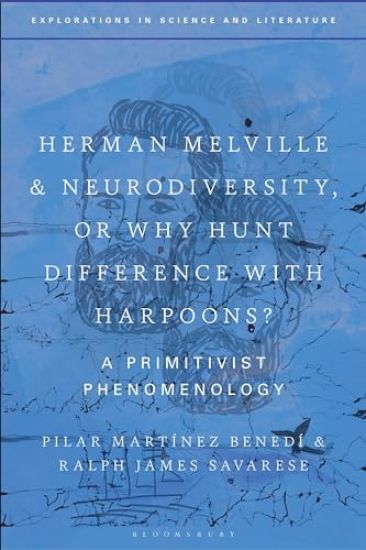
Herman Melville and Neurodiversity, or Why Hunt Difference with Harpoons?

Herman Melville and Neurodiversity, or Why Hunt Difference with Harpoons?

Pilar Martinez Benedi; Ralph James Savarese

BLOOMSBURY PUBLISHING PLC
2024
sidottu
Focusing on the difference between lower-level perceptual processes in the “neural unconscious” and higher-order thought in the frontal lobes, this open access book shows how Herman Melville sought to reclaim the fluid world of the sensory, with its precategorical and radically egalitarian impulses. By studying this previously underexamined facet of Melville’s work, this book offers an essential corrective to the “pathology paradigm,” which demonizes departures from a neurological norm and feasts on pejorative categorization. The neurodiversity movement arose precisely as a response to how so-called “mental disorders” have been described, understood, and treated. Unlike standard neuroscientific or psychiatric investigation, Melville’s work doesn’t strive to explain typical functioning through the negative and, in the process, to shore up a regime of normalcy. To the contrary, it exploits the lack of congealed diagnoses in the 19th Century, much more neutrally asking the question: what can an atypical body-mind do? Steeped in current studies about autism, Alzheimer’s, Capgras and Fregoli syndromes, Mirror-touch synesthesia, phantom limb syndrome, stuttering, and tinnitus, and fully conversant with Melville scholarship, Phenomenological Primitives demonstrates what the humanities can contribute to the sciences and what the sciences can contribute to the humanities.The ebook editions of this book are available open access under a CC BY-NC-ND 4.0 licence on bloomsburycollections.com. Open access was funded in part by Grinnell College.
Herman Melville and Neurodiversity, or Why Hunt Difference with Harpoons?

Herman Melville and Neurodiversity, or Why Hunt Difference with Harpoons?

Pilar Martinez Benedi; Ralph James Savarese

BLOOMSBURY PUBLISHING PLC
2026
pokkari
Focusing on the difference between lower-level perceptual processes in the "neural unconscious" and higher-order thought in the frontal lobes, this open access book shows how Herman Melville sought to reclaim the fluid world of the sensory, with its precategorical and radically egalitarian impulses. By studying this previously underexamined facet of Melville's work, this book offers an essential corrective to the "pathology paradigm," which demonizes departures from a neurological norm and feasts on pejorative categorization. The neurodiversity movement arose precisely as a response to how so-called "mental disorders" have been described, understood, and treated. Unlike standard neuroscientific or psychiatric investigation, Melville's work doesn't strive to explain typical functioning through the negative and, in the process, to shore up a regime of normalcy. To the contrary, it exploits the lack of congealed diagnoses in the 19th Century, much more neutrally asking the question: what can an atypical body-mind do? Steeped in current studies about autism, Alzheimer's, Capgras and Fregoli syndromes, Mirror-touch synesthesia, phantom limb syndrome, stuttering, and tinnitus, and fully conversant with Melville scholarship, Phenomenological Primitives demonstrates what the humanities can contribute to the sciences and what the sciences can contribute to the humanities. The ebook editions of this book are available open access under a CC BY-NC-ND 4.0 licence on bloomsburycollections.com. Open access was funded in part by Grinnell College.