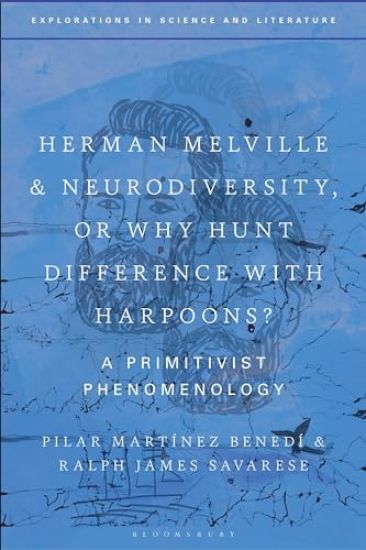
Focusing on the difference between lower-level perceptual processes in the “neural unconscious” and higher-order thought in the frontal lobes, this open access book shows how Herman Melville sought to reclaim the fluid world of the sensory, with its precategorical and radically egalitarian impulses. By studying this previously underexamined facet of Melville’s work, this book offers an essential corrective to the “pathology paradigm,” which demonizes departures from a neurological norm and feasts on pejorative categorization. The neurodiversity movement arose precisely as a response to how so-called “mental disorders” have been described, understood, and treated. Unlike standard neuroscientific or psychiatric investigation, Melville’s work doesn’t strive to explain typical functioning through the negative and, in the process, to shore up a regime of normalcy. To the contrary, it exploits the lack of congealed diagnoses in the 19th Century, much more neutrally asking the question: what can an atypical body-mind do? Steeped in current studies about autism, Alzheimer’s, Capgras and Fregoli syndromes, Mirror-touch synesthesia, phantom limb syndrome, stuttering, and tinnitus, and fully conversant with Melville scholarship, Phenomenological Primitives demonstrates what the humanities can contribute to the sciences and what the sciences can contribute to the humanities.The ebook editions of this book are available open access under a CC BY-NC-ND 4.0 licence on bloomsburycollections.com. Open access was funded in part by Grinnell College.
Focusing on the difference between lower-level perceptual processes in the "neural unconscious" and higher-order thought in the frontal lobes, this open access book shows how Herman Melville sought to reclaim the fluid world of the sensory, with its precategorical and radically egalitarian impulses. By studying this previously underexamined facet of Melville's work, this book offers an essential corrective to the "pathology paradigm," which demonizes departures from a neurological norm and feasts on pejorative categorization. The neurodiversity movement arose precisely as a response to how so-called "mental disorders" have been described, understood, and treated. Unlike standard neuroscientific or psychiatric investigation, Melville's work doesn't strive to explain typical functioning through the negative and, in the process, to shore up a regime of normalcy. To the contrary, it exploits the lack of congealed diagnoses in the 19th Century, much more neutrally asking the question: what can an atypical body-mind do? Steeped in current studies about autism, Alzheimer's, Capgras and Fregoli syndromes, Mirror-touch synesthesia, phantom limb syndrome, stuttering, and tinnitus, and fully conversant with Melville scholarship, Phenomenological Primitives demonstrates what the humanities can contribute to the sciences and what the sciences can contribute to the humanities. The ebook editions of this book are available open access under a CC BY-NC-ND 4.0 licence on bloomsburycollections.com. Open access was funded in part by Grinnell College.
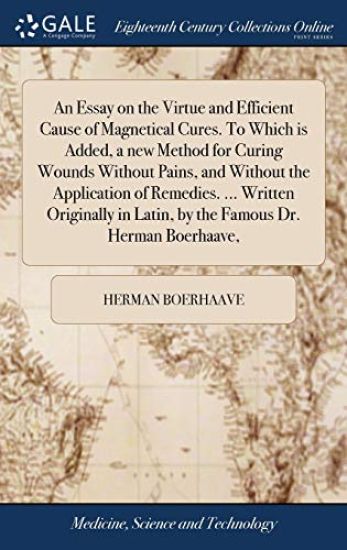
The 18th century was a wealth of knowledge, exploration and rapidly growing technology and expanding record-keeping made possible by advances in the printing press. In its determination to preserve the century of revolution, Gale initiated a revolution of its own: digitization of epic proportions to preserve these invaluable works in the largest archive of its kind. Now for the first time these high-quality digital copies of original 18th century manuscripts are available in print, making them highly accessible to libraries, undergraduate students, and independent scholars.Medical theory and practice of the 1700s developed rapidly, as is evidenced by the extensive collection, which includes descriptions of diseases, their conditions, and treatments. Books on science and technology, agriculture, military technology, natural philosophy, even cookbooks, are all contained here.++++The below data was compiled from various identification fields in the bibliographic record of this title. This data is provided as an additional tool in helping to insure edition identification: ++++British LibraryT084422Doubtfully by Herman Boerhaave.London: printed in the year, 1743. 56p.; 8
The 18th century was a wealth of knowledge, exploration and rapidly growing technology and expanding record-keeping made possible by advances in the printing press. In its determination to preserve the century of revolution, Gale initiated a revolution of its own: digitization of epic proportions to preserve these invaluable works in the largest archive of its kind. Now for the first time these high-quality digital copies of original 18th century manuscripts are available in print, making them highly accessible to libraries, undergraduate students, and independent scholars.Rich in titles on English life and social history, this collection spans the world as it was known to eighteenth-century historians and explorers. Titles include a wealth of travel accounts and diaries, histories of nations from throughout the world, and maps and charts of a world that was still being discovered. Students of the War of American Independence will find fascinating accounts from the British side of conflict. ++++The below data was compiled from various identification fields in the bibliographic record of this title. This data is provided as an additional tool in helping to insure edition identification: ++++Cambridge University LibraryT178138London: printed for, and sold by Tho. Bowles; and J. Bowles, 1739. 2]p., plates: maps; obl.2