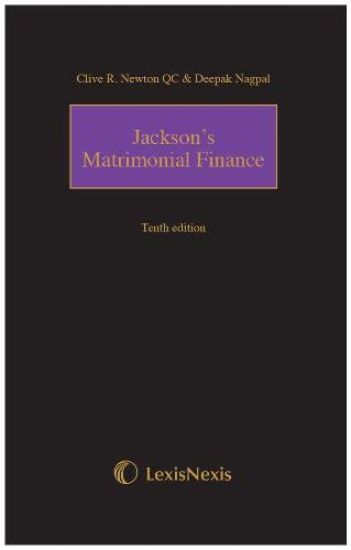
Jackson's Matrimonial Finance is an authoritative specialist text covering all aspects of financial problems arising from the breakdown of a marriage. The new tenth edition brings the content fully up to date with recent developments following reforms and changes to family law procedure including: * Introduction of the single family court provided by the Crime and Courts Act 2013, * Children and Families Act 2014 including support for those whose parents are separating, * Introduction of child arrangement orders (FPR 2010, PD 12) to replace residency and contact orders, * Impact of ante-and post-nuptial settlements following Radmacher v Granatino 2 and Luckwell v Limata 3 * The effect of pensions reform
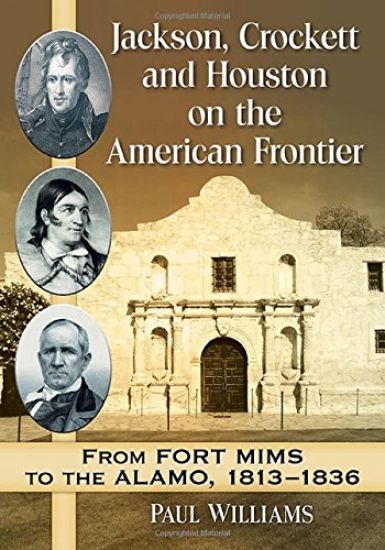
The 1813 storming of Fort Mims by Creek Indians brought to light the careers of Andrew Jackson, David Crockett and Sam Houston. All three fought the Creeks and each would have his part to play two decades later when the Alamo was stormed during the fight for Texan independence from Mexico. President Jackson was the first head of state to recognize the fledgling Republic of Texas. Colonel Crockett would be enshrined as a folk hero for his stand at the Alamo. General Houston won Texan independence at San Jacinto in 1836. This book tells the stories of the two landmark battles--at Fort Mims and the Alamo--and the interwoven lives of Jackson, Crockett and Houston, three of the most fascinating men in American history.
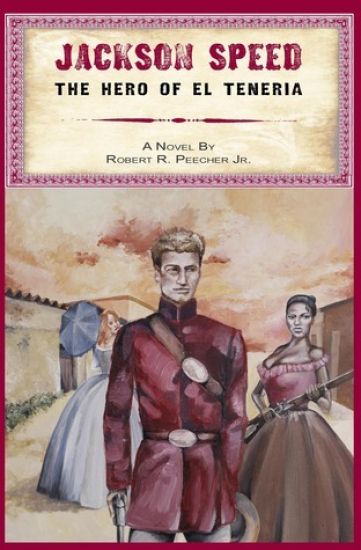
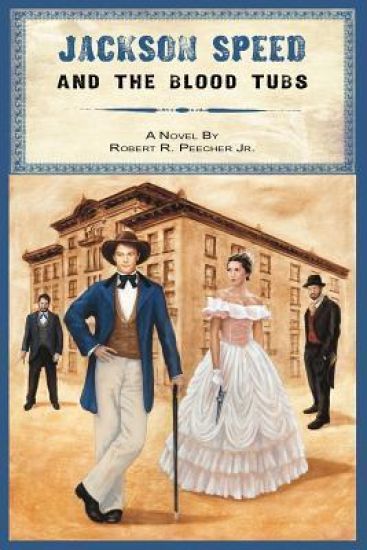
Scoundrels are not born, they are made. When Ashley Franks uses her peach cobbler to seduce a young Jackson Speed in the 1840s, she makes a scoundrel. In "The Hero of El Teneria," a young Jackson Speed must flee an enraged and cuckolded brute who seeks vengeance after he catches Speedy with his wife. To escape this madman, Speed will run all the way to Mexico where he joins up with General Zachary Taylor's army seeking to prove America's "Manifest Destiny." In Mexico, Speed unwillingly storms the battlements at Monterrey, reluctantly joins up with the Texas Rangers for a midnight ride through Santa Anna's camp, and dodges rancheros determined to drag him to his death. If Jackson Speed is able to get out of the Mexican-American War unscathed, it won't be through manly courage but by hiding behind the skirts of his Spanish se orita. If you love historical fiction where the history is true but the story is a picaresque romp, then you'll love Jackson Speed. Even if you hate him. AUTHOR INTERVIEW: What can you tell us about the character Jackson Speed? On the outside, Jackson Speed is one of these 19th Century adventurers who live through some of the most interesting and turbulent times of America's history. His exploits carry him from the Mexican-American War to the California Gold Rush to the hills of Gettysburg, and finally into the history books where he is remembered as one of America's greatest legends. "The Hero of El Teneria" who discovers gold and wears the Congressional Medal of Honor and rode with Billy the Kid and the Regulators. But for those of us reading his memoirs, we discover that the real Jackson Speed is a rascal, an adulterer, and a confessed coward. The novels, held out to be Speed's recently discovered memoirs, unveil the true character of a man who bluffed his way into the history books. Why write about a scoundrel? When I was a kid, I wanted to grow up to be Han Solo. In Westerns, I loved James Garner as Maveric and Latigo. I'm a huge fan of the Flashman novels by George MacDonald Fraser. For me, the trope of the "loveable rogue" was always most appealing. And when I first decided that I wanted to write historical fiction that married my interets in history with my enjoyment of writing, it just made sense that the character I created would fall into that category. Jackson Speed is an unpleasant character. He's a womanizer. He's a coward. And because I set him in actual events of the 1800s, he's juxtaposed against men who were truly courageous, and that just seems to make him even more unpleasant. But I think readers find as they move along through the series - maybe even in the first book - that he really is the "lovable rogue." A scoundrel and a coward, sure, but you kind of like him anyway. Tell me about the history. I've read where you've talked about how important it is to get the history correct. That's absolutely right. I'm the guy that sits in the movie theater in films set during real events and mutters under his breath, "That never happened." I consume history like some people drink water or breathe air. My dad is a huge history buff, and from a very young age I had this intense interest in history. So when I decided to put a fictional character in actual events, it was important to me that I write those events as factually correct as possible. I footnote all the novels so that readers get the context (sometimes the joke of the story is found in the context of the footnote), and I also use the footnotes to let the readers know when I've taken liberties with the facts. Historical accuracy is hugely important to me. How many books will there be in the series? I don't know the answer to that. I hope to be writing Jackson Speed novels when I'm old and gray, so I hope the series doesn't end until I do. I love writing these novels. I love the research, and I love the complexity of dropping my character into historical events and letting him muck about a little.
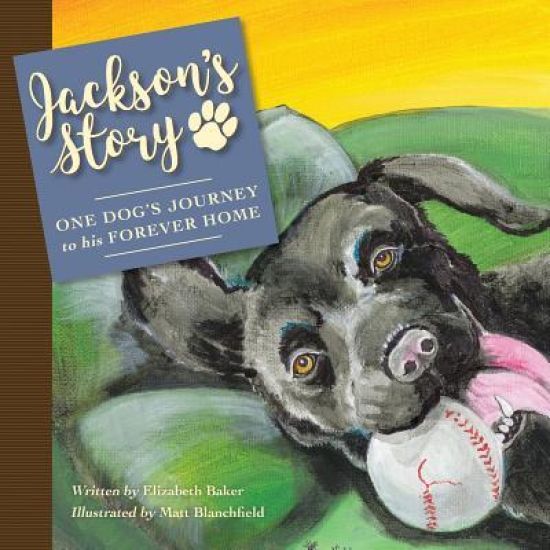
I had never felt so much pain and sadness in my life Everything that had ever make me happy was gone Toby, Jill, my home and now here I was in a cage in a dark truck.Oh, WHY was this happening? This book, written from the dogs perspective, is the heart-rending story of his abandonment and journey to his forever home. Young readers will learn that dogs feel pain, fear, confusion and sadness, just as we do, and will realize the importance of responsible, loving dog ownership.