Kirjojen hintavertailu. Mukana 12 083 983 kirjaa ja 12 kauppaa.

Kirjahaku

Etsi kirjoja tekijän nimen, kirjan nimen tai ISBN:n perusteella.

1000 tulosta hakusanalla James C. Blocker

Wittgenstein in Exile

Wittgenstein in Exile

James C. Klagge

MIT Press
2014
pokkari
A new way of looking at Wittgenstein: as an exile from an earlier cultural era.Ludwig Wittgenstein's Tractatus Logico-Philosophicus (1922) and Philosophical Investigations (1953) are among the most influential philosophical books of the twentieth century, and also among the most perplexing. Wittgenstein warned again and again that he was not and would not be understood. Moreover, Wittgenstein's work seems to have little relevance to the way philosophy is done today. In Wittgenstein in Exile, James Klagge proposes a new way of looking at Wittgenstein-as an exile-that helps make sense of this. Wittgenstein's exile was not, despite his wanderings from Vienna to Cambridge to Norway to Ireland, strictly geographical; rather, Klagge argues, Wittgenstein was never at home in the twentieth century. He was in exile from an earlier era-Oswald Spengler's culture of the early nineteenth century.Klagge draws on the full range of evidence, including Wittgenstein's published work, the complete Nachlass, correspondence, lectures, and conversations. He places Wittgenstein's work in a broad context, along a trajectory of thought that includes Job, Goethe, and Dostoyevsky. Yet Klagge also writes from an analytic philosophical perspective, discussing such topics as essentialism, private experience, relativism, causation, and eliminativism. Once we see Wittgenstein's exile, Klagge argues, we will gain a better appreciation of the difficulty of understanding Wittgenstein and his work.
The Hub's Metropolis

The Hub's Metropolis

James C. O'Connell

MIT PRESS LTD
2022
pokkari
The evolution of the Boston metropolitan area, from country villages and streetcar suburbs to exurban sprawl and "smart growth." Boston's metropolitan landscape has been two hundred years in the making. From its proto-suburban village centers of 1800 to its far-flung, automobile-centric exurbs of today, Boston has been a national pacesetter for suburbanization. In The Hub's Metropolis, James O'Connell charts the evolution of Boston's suburban development.The city of Boston is compact and consolidated--famously, "the Hub." Greater Boston, however, stretches over 1,736 square miles and ranks as the world's sixth largest metropolitan area. Boston suburbs began to develop after 1820, when wealthy city dwellers built country estates that were just a short carriage ride away from their homes in the city. Then, as transportation became more efficient and affordable, the map of the suburbs expanded. The Metropolitan Park Commission's park-and-parkway system, developed in the 1890s, created a template for suburbanization that represents the country's first example of regional planning.O'Connell identifies nine layers of Boston's suburban development, each of which has left its imprint on the landscape: traditional villages; country retreats; railroad suburbs; streetcar suburbs (the first electric streetcar boulevard, Beacon Street in Brookline, was designed by Frederic Law Olmsted); parkway suburbs, which emphasized public greenspace but also encouraged commuting by automobile; mill towns, with housing for workers; upscale and middle-class suburbs accessible by outer-belt highways like Route 128; exurban, McMansion-dotted sprawl; and smart growth. Still a pacesetter, Greater Boston has pioneered antisprawl initiatives that encourage compact, mixed-use development in existing neighborhoods near railroad and transit stations.O'Connell reminds us that these nine layers of suburban infrastructure are still woven into the fabric of the metropolis. Each chapter suggests sites to visit, from Waltham country estates to Cambridge triple-deckers.
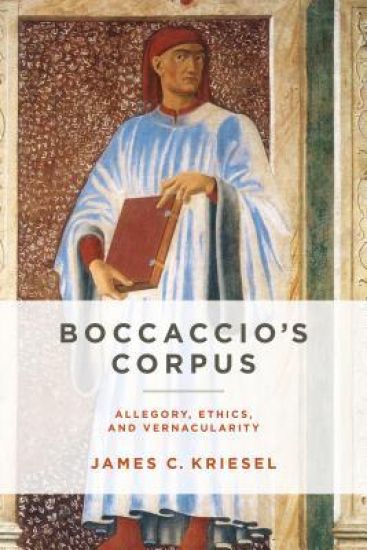
Boccaccio's Corpus

Boccaccio's Corpus

James C. Kriesel

University of Notre Dame Press
2018
sidottu
In Boccaccio's Corpus, James C. Kriesel explores how medieval ideas about the body and gender inspired Boccaccio's vernacular and Latin writings. Scholars have observed that Boccaccio distinguished himself from Dante and Petrarch by writing about women, erotic acts, and the sexualized body. On account of these facets of his texts, Boccaccio has often been heralded as a protorealist author who invented new literatures by eschewing medieval modes of writing. This study revises modern scholarship by showing that Boccaccio's texts were informed by contemporary ideas about allegory, gender, and theology. Kriesel proposes that Boccaccio wrote about women to engage with debates concerning the dignity of what was coded as female in the Middle Ages. This encompassed varieties of mundane experiences, somatic spiritual expressions, and vernacular texts. Boccaccio championed the feminine to counter the diverse writers who thought that men, ascetic experiences, and Latin works had more dignity than women and female cultures. Emboldened by literary and religious ideas about the body, Boccaccio asserted that his "feminine" texts could signify as efficaciously as Dante's Divine Comedy and Petrarch's classicizing writings. Indeed, he claimed that they could even be more effective in moving an audience because of their affective nature— namely, their capacity to attract, entertain, and stimulate readers. Kriesel argues that Boccaccio drew on medieval traditions to highlight the symbolic utility of erotic literatures and to promote cultures associated with women.
The Plain Sense of Things

The Plain Sense of Things

James C. Edwards

Pennsylvania State University Press
1997
pokkari
What could it mean to be religious in a world where religion no longer retains its former authority? Posing this question for his fellow Western intellectuals who inhabit just such a world, James C. Edwards investigates the loss of religion's traditional power in a culture characterized by what he calls "normal nihilism"—a situation in which one's commitment to a particular set of values is all one really has, and in which traditional religion is only a means of interpretation used to preserve what one most cares about. Recognizing the important historical role of religion in making us the people we are, he seeks to establish a viable understanding of religion without traditional beliefs and within the context of contemporary skepticism. The Plain Sense of Things is a book more interested in the power of religion that in its truth and in what happens to that power when the claims to truth slacken their grip.
My Fellow Americans

My Fellow Americans

James C. Humes

Praeger Publishers Inc
1992
sidottu
The presidency, in Theodore Roosevelt's famous words, is a Bully Pulpit. No one has studied the presidency from this vantage point. This book, in a sense, is a study of American political history seen through the prism of selected presidential addresses. It reveals how presidents used major addresses to create a theme for their administrations, to introduce history-making legislation or programs, or to rally successfully a majority of the nation behind their policies. No other book has examined the major presidential addresses--their construction and their impact--as history. No other book examines, in such detail, the background of the speechwriters who drafted the addresses. James C. Humes, a former White House speechwriter, has a unique understanding of the process of presidential speech-drafting.A single speech can be a defining point in American history, such as the Kennedy inaugural (Ask not what your country can do for you, ask what you can do for your country), or a rallying cry, such as Franklin Roosevelt's inaugural (The only thing we have to fear is fear itself). It can become an American creed as did the Gettysburg Address or a prophecy like the Reagan address to the Houses of Parliament in 1982. Washington's Farewell Address would prescribe our conduct in foreign policy for a century, as did the Monroe Doctrine in 1823. Sometimes the message is a declaration for war, such as Wilson's speech in 1917, or a war against an economic elite like Jackson's Bank veto in 1832 or Cleveland's Tariff message in 1887. This book is of great interest not only to historians and political scientists but also to students of the presidency and government.
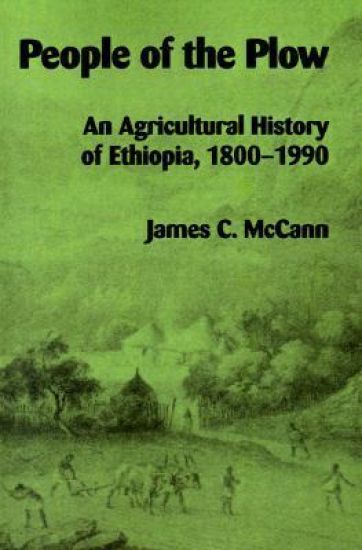
People of the Plow

People of the Plow

James C. McCann

University of Wisconsin Press
1995
nidottu
For more than two thousand years, Ethiopia’s ox-plow agricultural system was the most efficient and innovative in Africa, but has been afflicted in the recent past by a series of crises: famine, declining productivity, and losses in biodiversity. James C. McCann analyzes the last two hundred years of agricultural history in Ethiopia to determine whether the ox-plow agricultural system has adapted to population growth, new crops, and the challenges of a modern political economy based in urban centers.This agricultural history is set in the context of the larger environmental and landscape history of Ethiopia, showing how farmers have integrated crops, tools, and labor with natural cycles of rainfall and soil fertility, as well as with the social vagaries of changing political systems. McCann traces characteristic features of Ethiopian farming, such as the single-tine scratch plow, which has retained a remarkably consistent design over two millennia, and a crop repertoire that is among the most genetically diverse in the world.People of the Plow provides detailed documentation of Ethiopian agricultural practices since the early nineteenth century by examining travel narratives, early agricultural surveys, photographs and engravings, modern farming systems research, and the testimony of farmers themselves, collected during McCann’s five years of fieldwork. He then traces the ways those practices have evolved in the twentieth century in response to population growth, urban markets, and the presence of new technologies.
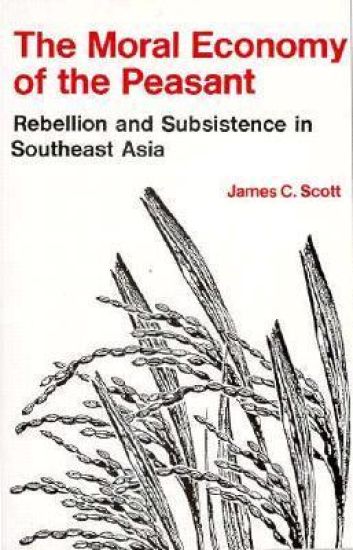
The Moral Economy of the Peasant

The Moral Economy of the Peasant

James C. Scott

Yale University Press
1977
pokkari
“This work is a profound and fundamental contribution to the issues addressed.”—Sociology “Vital to an understanding of peasant politics.”—Library Journal James C. Scott places the critical problem of the peasant household—subsistence—at the center of this study. The fear of food shortages, he argues persuasively, explains many otherwise puzzling technical, social, and moral arrangements in peasant society, such as resistance to innovation, the desire to own land even at some cost in terms of income, relationships with other people, and relationships with institutions, including the state. Once the centrality of the subsistence problem is recognized, its effects on notions of economic and political justice can also be seen. Scott draws from the history of agrarian society in lower Burma and Vietnam to show how the transformations of the colonial era systematically violated the peasants’ “moral economy” and created a situation of potential rebellion and revolution. Demonstrating keen insights into the behavior of people in other cultures and a rare ability to generalize soundly from case studies, Scott offers a different perspective on peasant behavior that will be of interest particularly to political scientists, anthropologists, sociologists, and Southeast Asianists.
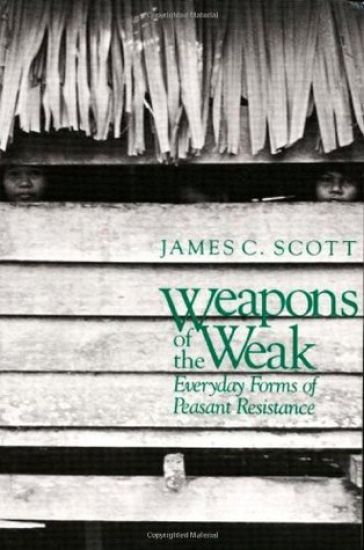
Weapons of the Weak

Weapons of the Weak

James C. Scott

Yale University Press
1987
pokkari
“Splendid. . . . Combines the readability of Akenfield or Pig Earth with an accessible and illuminating theoretical commentary.”—A. F. Robertson, Times Higher Education Supplement “Weapons of the Weak is a brilliant book, combining a sure feel for the subjective side of struggle with a deft handling of economic and political trends.”—John R. Bowen, Journal of Peasant Studies “No one who wants to understand peasant society, in or out of Southeast Asia, or theories of change, should fail to read [this book].”—Daniel S. Lev, Journal of Asian Studies This sensitive picture of the constant and circumspect struggle waged by peasants materially and ideologically against their oppressors shows that techniques of evasion and resistance may represent the most significant and effective means of class struggle in the long run.
Coleridge's Philosophy of Language

Coleridge's Philosophy of Language

James C. McKusick

Yale University Press
1986
pokkari
This book traces the development of Coleridge's philosophy of language, situating it in the intellectual climate of his era. James C. McKusick offers the persuasive and original argument that Coleridge's linguistic theories for a coherent body of thought underlying his poetry, criticism, and aesthetics.
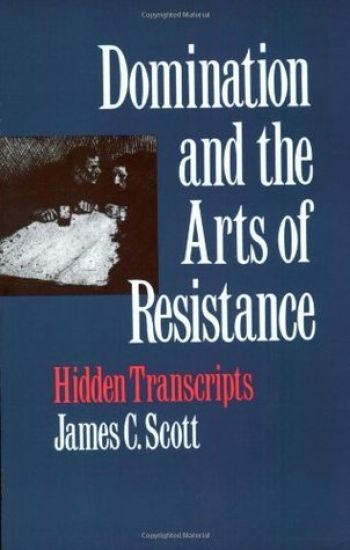
Domination and the Arts of Resistance

Domination and the Arts of Resistance

James C. Scott

Yale University Press
1992
pokkari
“A splendid study, surely one of the most important that has appeared on the whole matter of power and resistance.”—Natalie Zemon Davis Confrontations between the powerless and powerful are laden with deception—the powerless feign deference and the powerful subtly assert their mastery. Peasants, serfs, untouchables, slaves, laborers, and prisoners are not free to speak their minds in the presence of power. These subordinate groups instead create a secret discourse that represents a critique of power spoken behind the backs of the dominant. At the same time, the powerful also develop a private dialogue about practices and goals of their rule that cannot be openly avowed. In this book, renowned social scientist James C. Scott offers a penetrating discussion both of the public roles played by the powerful and powerless and the mocking, vengeful tone they display off stage—what he terms their public and hidden transcripts. Using examples from the literature, history, and politics of cultures around the world, Scott examines the many guises this interaction has taken throughout history and the tensions and contradictions it reflects.
Agrarian Studies

Agrarian Studies

James C. Scott

Yale University Press
2001
pokkari
A fresh interdisciplinary analysis of rural society and agrarian issues This book presents an account of an intellectual breakthrough in the study of rural society and agriculture. Its ten chapters, selected for their originality and synthesis from the colloquia of the Program in Agrarian Studies at Yale University, encompass various disciplines, diverse historical periods, and several regions of the world. The contributors’ fresh analyses will broaden the perspectives of readers with interests as wide-ranging as rural sociology, environmentalism, political science, history, anthropology, economics, and art history. The ten studies recast and expand what is known about rural society and agrarian issues, examining such topics as poverty, subsistence, cultivation, ecology, justice, art, custom, law, ritual life, cooperation, and state action. Each contribution provides a point of departure for new study, encouraging deeper thinking across disciplinary boundaries and frontiers.
The Art of Not Being Governed

The Art of Not Being Governed

James C. Scott

Yale University Press
2010
pokkari
From the acclaimed author and scholar James C. Scott, the compelling tale of Asian peoples who until recently have stemmed the vast tide of state-making to live at arm’s length from any organized state society For two thousand years, the disparate groups that now reside in Zomia (a mountainous region the size of Europe that consists of portions of seven Asian countries) have fled the projects of the organized state societies that surround them—slavery, conscription, taxes, corvée labor, epidemics, and warfare. This book, essentially an “anarchist history,” is the first-ever examination of the huge literature on state-making whose author evaluates why people would deliberately and reactively remain stateless. Among the strategies employed by the people of Zomia to remain stateless are physical dispersion in rugged terrain; agricultural practices that enhance mobility; pliable ethnic identities; devotion to prophetic, millenarian leaders; and maintenance of a largely oral culture that allows them to reinvent their histories and genealogies as they move between and around states. In accessible language, James Scott, recognized worldwide as an eminent authority in Southeast Asian, peasant, and agrarian studies, tells the story of the peoples of Zomia and their unlikely odyssey in search of self-determination. He redefines our views on Asian politics, history, demographics, and even our fundamental ideas about what constitutes civilization, and challenges us with a radically different approach to history that presents events from the perspective of stateless peoples and redefines state-making as a form of “internal colonialism.” This new perspective requires a radical reevaluation of the civilizational narratives of the lowland states. Scott’s work on Zomia represents a new way to think of area studies that will be applicable to other runaway, fugitive, and marooned communities, be they Gypsies, Cossacks, tribes fleeing slave raiders, Marsh Arabs, or San-Bushmen.
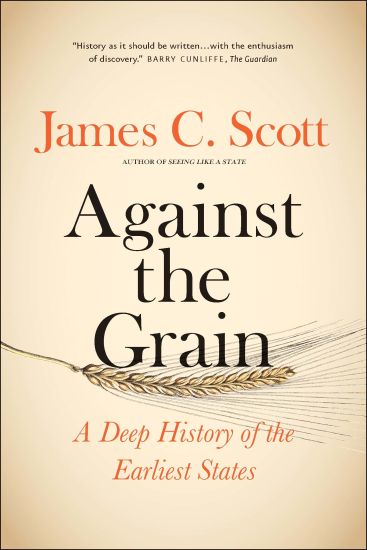
Against the Grain

Against the Grain

James C. Scott

Yale University Press
2018
pokkari
An account of all the new and surprising evidence now available that contradicts the standard narrative for the beginnings of the earliest civilizations An Economist Best History Book 2017 “Scott is one of those rare academics whose writing is a thing of beauty.”—Rana Dasgupta, The Week “Scott hits the nail squarely on the head by exposing the staggering price our ancestors paid for civilization and political order.”—Walter Scheidel, Financial Times Why did humans abandon hunting and gathering for sedentary communities dependent on livestock and cereal grains, and governed by precursors of today’s states? Most people believe that plant and animal domestication allowed humans, finally, to settle down and form agricultural villages, towns, and states, which made possible civilization, law, public order, and a presumably secure way of living. But archaeological and historical evidence challenges this narrative. The first agrarian states, says James C. Scott, were born of accumulations of domestications: first fire, then plants, livestock, subjects of the state, captives, and finally women in the patriarchal family—all of which can be viewed as a way of gaining control over reproduction. Scott explores why we avoided sedentism and plow agriculture, the advantages of mobile subsistence, the unforeseeable disease epidemics arising from crowding plants, animals, and grain, and why all early states are based on millets and cereal grains and unfree labor. He also discusses the “barbarians” who long evaded state control, as a way of understanding continuing tension between states and nonsubject peoples.
Seeing Like a State

Seeing Like a State

James C. Scott

Yale University Press
2020
pokkari
“One of the most profound and illuminating studies of this century to have been published in recent decades.”—John Gray, New York Times Book Review “A powerful, and in many [ways] insightful, explanation as to why grandiose programs of social reform, not to mention revolution, so often end in tragedy. . . . An important critique of visionary state planning.”—Robert Heilbroner, Lingua Franca Hailed as “a magisterial critique of top-down social planning” by the New York Times, this essential work analyzes disasters from Russia to Tanzania to uncover why states so often fail—sometimes catastrophically—in grand efforts to engineer their society or their environment, and uncovers the conditions common to all such planning disasters. “Beautifully written, this book calls into sharp relief the nature of the world we now inhabit.”—New Yorker “A tour de force.”—Charles Tilly, Columbia University The Institution for Social and Policy Studies
In Praise of Floods

In Praise of Floods

James C. Scott

YALE UNIVERSITY PRESS
2025
sidottu
James C. Scott reframes rivers as alive and dynamic, revealing the consequences of treating them as resources for our profit “Informative, enjoyable, and provocative. . . . Scott’s [prose] is dry, clear, and scalding with moral purpose.”—Becca Rothfeld, Washington Post Rivers, on a long view, are alive. They are born; they change; they shift their channels; they forge new routes to the sea; they move both gradually and violently; they can teem (usually) with life; they may die a quasi-natural death; they are frequently maimed and even murdered. It is the annual flood pulse—the brief time when the river occupies the floodplain—that gives a river its vitality, but it is human engineering that kills it, suppressing the flood pulse with dams, irrigation, siltation, dikes, and levees. In demonstrating these threats to the riverine world, award-winning author James C. Scott examines the life history of a particular river, the Ayeyarwady (Irrawaddy) of Burma, the heartland and superhighway of Burman culture. Scott opens our understanding of rivers to encompass their entirety—tributaries, wetlands, floodplains, backwaters, eddies, periodic marshlands, and the assemblage of life forms dependent on rivers for their existence and well-being. For anyone interested in the Anthropocene and the Great Acceleration, rivers offer a striking example of the consequences of human intervention in trying to control and domesticate a natural process, the complexity and variability of which we barely understand.
In Praise of Floods: The Untamed River and the Life It Brings
James C. Scott reframes rivers as alive and dynamic, revealing the consequences of treating them as resources for our profit A New Yorker Best Book of the Year "Informative, enjoyable, and provocative. . . . Scott's prose] is dry, clear, and scalding with moral purpose."--Becca Rothfeld, Washington Post Rivers, on a long view, are alive. They are born; they change; they shift their channels; they forge new routes to the sea; they move both gradually and violently; they can teem (usually) with life; they may die a quasi-natural death; they are frequently maimed and even murdered. It is the annual flood pulse--the brief time when the river occupies the floodplain--that gives a river its vitality, but it is human engineering that kills it, suppressing the flood pulse with dams, irrigation, siltation, dikes, and levees. In demonstrating these threats to the riverine world, award-winning author James C. Scott examines the life history of a particular river, the Ayeyarwady (Irrawaddy) of Burma, the heartland and superhighway of Burman culture. Scott opens our understanding of rivers to encompass their entirety--tributaries, wetlands, floodplains, backwaters, eddies, periodic marshlands, and the assemblage of life forms dependent on rivers for their existence and well-being. For anyone interested in the Anthropocene and the Great Acceleration, rivers offer a striking example of the consequences of human intervention in trying to control and domesticate a natural process, the complexity and variability of which we barely understand.
Biological Effects and Health Implications of Radiofrequency Radiation

Biological Effects and Health Implications of Radiofrequency Radiation

James C. Lin; Sol M. Michaelson

Kluwer Academic/Plenum Publishers
1987
sidottu
The study of electromagnetic bioeffects is multidisciplinary; it draws heavily from the disciplines of physics, engineering, mathematics, biol­ ogy, chemistry, medicine, and environmental health. This book is about these disciplines and how they mutually integrate in the study of electromagnetic pathophysiology. Over aperiod of years, the authors have become increasingly aware of the difficulty in locating information concerning interaction of electro­ magnetic energy and biological tissues. There are numerous reports and publications, but no single comprehensive source in the American literature where such information is readily accessible. Regrettably, much of the importantinformation is contained in government documents and reports, some of which are inaccessible, or spread through many diverse journals, making retrieval and analysis of the material difficult. Although this book is primarily clinically oriented, it also focuses on those biophysical, biochemical, and fundamental molecular studies and findings that provide the basis for understanding the presence or absence of pathophysiological manifestations of exposure to radiofrequency, including microwave, energies. Detailed discussion and analysis of the relevant comprehensive physics, engineering, and biophysics are con­ tained in Chapters 2-5. Because the treatment is multidisciplinary, wherever possible analy­ sis is begun with basic background information that may appear elementary to some readers but is essential to understanding for those from a different discipline. Most confusion and controversies that exist in the field today arise from individuals of one discipline not appreciating basic facts or theories from another.
Eisenhower and Churchill: The Partnership That Saved the World

Eisenhower and Churchill: The Partnership That Saved the World

James C. Humes

Crown Publishing Group (NY)
2001
nidottu
Although born and raised more than an ocean apart, Dwight Eisenhower and Winston Churchill--the two titans of the greatest generation--led remarkably parallel lives whose paths would intersect during history's most harrowing days. Through their youth, education, and military training, both men experienced similar triumphs and failures that shaped their lives, though they met only for the first time upon the eve of war in 1941.Eisenhower and Churchill tells the magnificent story of these two great leaders and their exemplary partnership in war and peace. Through enlivened pages and fascinating anecdotes, author James C. Humes illuminates the human side of each man, who had more in common with each other than a world war. You'll discover the extraordinary stories of how both were born to domineering mothers and failed fathers, both did not qualify for the military academy on the first try, both were traumatized by experiences in World War I, both were talented writers, and both lost a child in the very same year (1921). Remarkably, each man did not warm to the other at first; but as they worked together, their respect for one another grew to become a powerful friendship that lived long after the echoes of war had receded into the past.As allies, they shared a hatred for tyranny and led the world through the greatest war of the twentieth century. As friends, they shared a sense of trust and cooperation that should be raised as a standard. Containing new research and memorable insights, Eisenhower and Churchill brings to life the two lions of the twentieth centruy."Who would not welcome an intimate book about Churchill and Eisenhower, and who is better situated to write it than Professor Humes, who knew them both, and studiously--and ardently--records their careers and their friendship?"--William F. Buckley Jr."James C. Humes's Eisenhower and Churchill is a wonderful dual biography laced with lively anecdotes, engaging prose, and shrewd analysis. A truly welcome addition to our growing literature on the Second World War."--Douglas Brinkley, professor of history and director of the Eisenhower Center, University of New Orleans
Handbook on Ocean Politics and Law

Handbook on Ocean Politics and Law

James C. F. Wang

Greenwood Press
1992
sidottu
The first single-volume reference of its kind, this comprehensive handbook provides background information and analysis on the full range of contemporary ocean use issues. Coverage includes the development of ocean law, the evolving uses of oceans, data on living and non-living ocean resources, the environmental impact of pollution, and competing national claims over ocean exploration. The volume also summarizes the most current research available on the uses of oceans, incorporates the salient portions of the 1982 Law of the Sea Convention in the topical surveys and analyses presented, and discusses all of the other major international conventions that have dealt with global ocean or marine affairs. Students, researchers, and agency staff concerned with the political and legal dimensions of ocean use will find this an indispensable source.The handbook begins with an overview of the world's oceans and their physical and geographic features. The next two chapters survey the international conferences that have been held on ocean use and explore the historical development of international principles on the law of the sea. Ocean resources and their economic and political management form the focus of the following four chapters, with separate chapters on living and non-living resources and deep seabed mining. The final chapters address ocean environmental protection and pollution prevention and the implications of various uses of the ocean: military, navigation and transport, and marine scientific research. The text is accompanied by numerous charts and tables, end-of-chapter references, and seven appendixes which contain valuable supplemental information such as a chronological list of conventions and treaties on the law of the sea, national legislation on exclusive economic zones, bilateral fishery agreements, and more.
Ocean Politics and Law

Ocean Politics and Law

James C. F. Wang

Greenwood Press
1991
sidottu
This bibliography is a convenient one-volume research guide that covers the most important scholarly literature to date on ocean policies, law, and public policy. Prepared alongside the Handbook on Ocean Politics and Law (1992) published by Greenwood Press, this bibliography gives a succinct summary of the basic sources of information on the subject and then arranges 2081 entries into twelve chapters on the following subjects: the physical features of the world's oceans, international conferences on the uses of the oceans, development of international principles, living resources, non-living resources, deep seabed mining, marine pollution and environmental protection, regional arrangements for environmental protection, military uses of the oceans, navigation and shipping, scientific research and technology transfer, and the major players at UNCLOS III and their positions on key issues.Entries selected for annotation include the most significant studies of ocean law and politics, the most timely material, works that represent different authors and viewpoints broadly, and discussions with different perspectives from a historical standpoint. The bibliography covers the major works on the subject for college, university, institutional, and public libraries, and is easily accessible with author and subject indexes for use by students, experts, and the general public.