Kirjojen hintavertailu. Mukana 11 717 486 kirjaa ja 12 kauppaa.

Kirjahaku

Etsi kirjoja tekijän nimen, kirjan nimen tai ISBN:n perusteella.

1000 tulosta hakusanalla Jefferson Hack

The Papers of Jefferson Davis

The Papers of Jefferson Davis

Jefferson Davis

Louisiana State University Press
1985
sidottu
The fifth volume of The Papers of Jefferson Davis presents 9,000 of the approximately 21,000 known Davis letters, papers, and speeches from the years 1853 through 1855, when Davis served as secretary of war under President Franklin Pierce. Most of the documents are included in summary form in an extensive calendar; 93 are published in full with annotation.Well prepared for the War Department position by his military education and experience, Davis was already known as a champion of the army and West Point from his years in Congress. As secretary, Davis administered a department of eight bureaus and a military establishment spread thinly from coast to coast. An increase and reorganisation of the army along with the establishment of new posts became top priorities as a tide of settlers encroached in Indian lands in the Mexican cession and Far West. Davis also supervised army engineering projects as varied as the Capitol extension, military roads, and river and harbor improvements. The curriculum of the Military Academy, new weapons and armaments development, the activities of the Crimea commission, the Pacific railroad surveys, and the camel expedition - all commanded his minute attention.Despite the burdens of office, Davis maintained a lively interest in the issues of the day, among them Latin American filibustering, the purchase of Cuba, states' rights, slavery, and the conflict in Kansas. The wide attention accorded his travels and speeches brought national prominence to him and speculation about his future candidacy for governor, a return to the Senate, the vice-presidency, and even the presidency. Personal correspondence includes letters that touch on Davis' long estrangement from his brother, the death of his first child, persistent health problems, and relationships with friends and family. Much of hiss official correspondence, especially several angry exchanges with army officers, reveals even more about Davis' personality. In addition to the documents published in full and calendared, an appendix includes over one hundred recently discovered personal and political items dates from 1838 through 1852, before Davis' selection as secretary of war.
The Papers of Jefferson Davis

The Papers of Jefferson Davis

Jefferson Davis

Louisiana State University Press
1989
sidottu
Volume 6 of The Papers of Jefferson Davis, spanning the five crucial years before 1861, chronicles Davis' last year as secretary of war and his return to the Senate, capstone of his long career of public service to the United States. Volume 6 includes 116 letters printed in full with annotation, a calendar of over 6,000 items, and summaries of 53 recently discovered documents dating from 1845 through 1855, as well as illustrations and maps prepared especially for the volume.Davis' correspondence and his final report to Franklin Pierce mirror the concerns of his last months as head of the War Department, turmoil in Kansas, protection of western settlements, construction of the Washington Aqueduct, the Capitol extension and new dome, surveys for the Pacific Railroad, Indian relations, the camel experiment, army reorganisation, and advances in weaponry.All these issues followed Davis to the Senate in March, 1857, but other questions soon claimed equal attention. As debates on abolition, state rights, fugitive slaves, and slavery in the territories became more frequent and more divisive, Davis found himself a major spokesman for his region. He was caught up in the momentous events testing the nation during James Buchanan's administration: ""bleeding Kansas,"" Preston Brook's attack on Charles Sumner, John Brown's raid on Harpers Ferry, the 1860 Democratic conventions, the election of a Republican president, and the secession of South Carolina. He debated at length with Stephen A. Douglas and others over ""squatter sovereignty"" and offered his own resolutions on the relations of states as the basis for the Democratic platform in 1860.Personal correspondence gives revealing word pictures of Varina Davis and the children, the family's sojourn in New England during the Summer of 1858, disastrous flooding at Brierfield in 1859, and Davis' persistent, debilitating illnesses.Volume 6 covers fateful years for the nation and for Jefferson Davis, a man moving toward a destiny that he is both creating and hoping to avoid.
The Papers of Jefferson Davis

The Papers of Jefferson Davis

Jefferson Davis

Louisiana State University Press
1992
sidottu
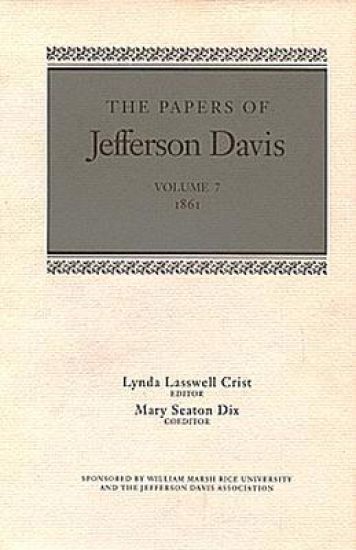
Volume 7 of The Papers of Jefferson Davis offers a unique view of 1861, the first year of the Confederacy, Davis' presidency, and the Civil War. On January 21 Davis made his affecting farewell speech before a hushed Senate, then left for Mississippi. His uncertainty over a military or political course vanished when he received news of his unanimous election as president of the Confederate States of America. Inaugurated at Montgomery, Alabama, on February 18, Davis quickly set to work to forge a government, in a race with events to select a cabinet, establish departments, and plan for the common defense. Hopes for a peaceful separation from the North ended with the firing on Fort Sumter; subsequent documents reveal a president absorbed by the problems of waging a war that soon stretched from the Atlantic Coast to the Gulf of Mexico. Victory at Manassas produced euphoria among southerners but plunged the president into the first of several unfortunate controversies with his generals, this one over the failure to pursue the enemy and capitalize on success. Throughout 1861 the Confederate commissioners in Europe reported to Davis on their expectations of recognition, convinced that the demand for cotton would induce Great Britain and France to break the North's blockade of southern ports and help supply arms for the defense of the fledgling nation. Volume 7 provides a rare opportunity to assess anew Davis' strengths and weaknesses as executive, to reexamine his relationship with generals, governors, congressmen, cabinet officers, the press, and the public. Davis ended the year as he begun, aware of the difficulties of the course the South had adopted and confident that its cause would ultimately triumph. Containing illustrations, maps, and more than 2,500 documents drawn from numerous printed sources and more than seventy repositories and private collections, Volume 7 covers a year of paramount importance in our country's history.
The Papers of Jefferson Davis

The Papers of Jefferson Davis

Jefferson Davis

Louisiana State University Press
1995
sidottu
Volume 8 of The Papers of Jefferson Davis brings the Confederate president to the second year of the War Between the States and shows that during 1862 Davis was almost completely overwhelmed by military matters. Indeed, early that year, in an address to the Confederate Congress, he admitted that in trying to defend every part of its far-flung territory, the ""Government had attempted more than it had power successfully to achieve.""During 1862, Judah P. Benjamin was replaced as secretary of war by George W. Randolph, who was then succeeded by James A. Seddon. As the year advanced, Davis' relationships with certain key generals continued to sour. Chief among them were P.G.T. Beauregard, who was finally removed from his last significant command, and Joseph E. Johnston, whose fall from grace precipitated Robert E. Lee's rise to influence as commander of the Army of Northern Virginia. Lee proved to be as adept in communicating and coordinating plans with the president as Johnston had been inept.At the inconclusive Battle of Shiloh, Davis lost Albert Sidney Johnston, a trusted friend and the general he had most admired. Like Shiloh, many other campaigns of 1862 ended in stalemate and withdrawal, including Henry H. Sibley's New Mexico campaign, Braxton Bragg's Kentucky campaign, Earl Van Dorn's battle at Elkhorn Tavern, and the Confederacy's greatest gamble, Lee's Invasion of Maryland.Correspondence with Davis' brother, Joseph E. Davis, reveals the ever-worsening situation in Mississippi. The Federal occupation of New Orleans, the fall of new Madrid and Island No. 10, and Grants repeated attempts to capture Vicksburg heightened anxiety about the area and persuaded the president to tour the western theater in December.Because the Union's springtime invasion of Richmond prompted Davis to send his wife and children away, Volume 8 contains an unusually rich collection of letters exchanged during their separation. This correspondence offers a rare glimpse into the minds and hearts of Davis and his wife.Altogether, more than 2,000 documents, many never before published, are included in Volume 8; 133 are printed in full. Culled from fifty-nine repositories, twenty-one private collections, and numerous printed sources, they reveal that despite the many setbacks he suffered in 1862, Davis maintained a deep devotion to duty and an unbending will to win.
The Papers of Jefferson Davis

The Papers of Jefferson Davis

Jefferson Davis

Louisiana State University Press
1997
sidottu
The New Year . . . comes in auspiciously for us, Jefferson Davis proclaimed in January, 1863, and indeed there were grounds for optimism within the Confederacy. By September, however, various hopes for ending the confi‚ict with the North had given way to the harsh realities of a prolonged war, increasingly confined to southern soil. Although Davis suffered poor health during much of the nine-month period, he remained an active and vital leader. Volume 9 of The Papers of Jefferson Davis gives a vivid picture of the tasks he faced.Military matters consumed most of Davis' time. Already strained relations with Joseph E. Johnston worsened in the spring, and he was eventually relieved of his overall command of the western armies. Surrenders at Vicksburg and Port Hudson ended Confederate access to the Mississippi River, and in the East, Robert E. Lee's stunning victory at Chancellorsville was blotted out by bloody repulse south of Gettysburg. Correspondence from Europe reveals what Davis knew of the Erlanger loan and the diminishing chances of French and British intervention.As problems for the Confederacy mounted, discontent grew. Davis received complaints from across the young country, the conscription system being of particular concern. In April he saw firsthand the unhappiness over limited resources as he took to the streets to help calm the Richmond bread riot.Over 2,000 documents, many never before published, are included in Volume 9. Eighty-one are printed with annotation, 242 more in full text, and about 1,750 others are calendared in summary form. They show Davis fighting to maintain morale and military cohesion during one of the Confederacy's most difficult periods.
The Papers of Jefferson Davis

The Papers of Jefferson Davis

Jefferson Davis

Louisiana State University Press
1999
sidottu
The autumn of 1863 was a trying time for Jefferson Davis. Even as he expressed unwavering confidence about the eventual success of the Confederate movement, he had to realise that mounting economic problems, low morale, and rotating army leadership were threatening the welfare of the new nation. Less than a year after the October 1863 Confederate victory at Chickamauga, the South relinquished Atlanta to Sherman. During the tumultuous eleven months chronicled in Volume 10, Davis retained his fervor for southern nationalism as he struggled furiously to command a war and maintain a government. As the letters contained here illustrate, he soldiered bravely on.
The Papers of Jefferson Davis

The Papers of Jefferson Davis

Jefferson Davis

Louisiana State University Press
2003
sidottu
During the last nine months of the Civil War, virtually all of the news reports and President Jefferson Davis's correspondence confirmed the imminent demise of the Confederate States, the nation Davis had striven to uphold since 1861. But despite defeat after defeat on the battlefield, a recalcitrant Congress, nay-sayers in the press, disastrous financial conditions, failures in foreign policy and peace efforts, and plummeting national morale, Davis remained in office and tried to maintain the government, even after the fall of Richmond on April 2, until his capture by Union forces on May 10, 1865.The eleventh volume of The Papers of Jefferson Davis follows these tumultuous last months of the Confederacy and illuminates Davis's policies, feelings, ideas, and relationships, as well as the viewpoints of hundreds of southerners, critics and supporters, who asked favours, pointed out abuses, and offered advice on myriad topics. Printed here for the first time are many speeches and a number of new letters and telegrams. In the course of the volume, Robert E. Lee officially becomes general in chief, Joseph E. Johnston is given a final command, legislation is enacted to place slaves in the army as soldiers, and peace negotiations are opened at the highest levels. The closing pages chronicle Davis's dramatic flight from Richmond, including emotional correspondence with his wife as the two endeavor to find each other en route and make plans for the future in the wreckage of their lives.The holdings of seventy different manuscript repositories and private collections in addition to numerous published sources contribute to Volume 11, the fifth in the Civil War period.
Jefferson Davis in Blue

Jefferson Davis in Blue

Nathaniel Cheairs Hughes Jr; Gordon D. Whitney

Louisiana State University Press
2006
nidottu
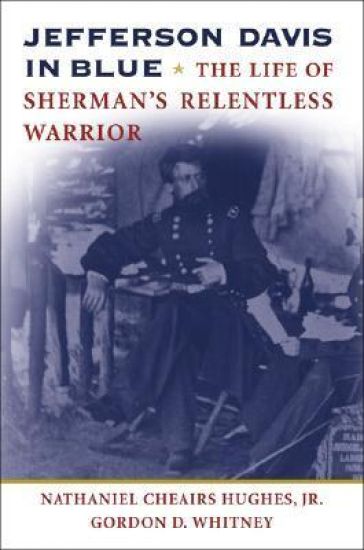
Besides his illustrious name, the Union general Jefferson Columbus Davis is best known for two appalling actions: the September 1862 murder of General William ""Bull"" Nelson -- his former commanding officer -- and the abandonment of hundreds of African American refugees to the mercy of Confederate cavalry at Ebenezer Creek during Sherman's march through Georgia in 1864. Historians have generally dismissed Davis (1828--1879) as a reckless assassin, a racist, a journeyman soldier at best, and an embarrassment to the Lincoln war effort. But Nathaniel Cheairs Hughes, Jr., and Gordon D. Whitney shatter the collective memory of ""Jef"" Davis as a grim, destructive child of war and replace it with a more rounded portrait of a complex military leader. They bring order to the muddle of contradictions that was Davis's life and offer an impartial profile of the soldier and the man, who must be remembered for his splendid contributions as well as his startling failures.
The Papers of Jefferson Davis

The Papers of Jefferson Davis

Jefferson Davis

Louisiana State University Press
2008
sidottu
Being powerless to direct the current, I can only wait to see whither it runs, wrote Jefferson Davis to his wife, Varina, on October 11, 1865, five months after the victorious United States Army took him prisoner. Indeed, in the tumultuous years immediately after the Civil War, Davis found himself more acted upon than active, a dramatic change from his previous twenty years of public service to the United States as a major political figure and then to the Confederacy as its president and commander in chief. Volume 12 of The Papers of Jefferson Davis follows the former president of the Confederacy as he and his family fight to find their place in the world after the Civil War. A federal prisoner, incarcerated in a ""living tomb"" at Fort Monroe while the government decided whether, where, and by whom he should be tried for treason, Davis was initially allowed to correspond only with his wife and counsel. Released from prison after two hard years, he was not free from legal proceedings until 1869. Stateless, homeless, and without means to support himself and his young family, Davis lived in Canada and then Europe, searching for a new career in a congenial atmosphere. Finally, in November 1869, he settled in Memphis as president of a life insurance company and, for the first time in four years, had the means to build a new life. Throughout this difficult period, Varina Howell Davis demonstrated strength and courage, especially when her husband was in prison. She fought tirelessly for his release and to ensure their children's education and safety. Their letters clearly demonstrate the Davises' love and their dependence on each other. They both worried over the fate of the South and of family members and friends who had suffered during the war. Though disfranchised, Davis remained careful but not totally silent on the subject of politics. Even while in prison, he wrote without regret of his decision to follow Mississippi out of the Union and of his unswerving belief in the constitutionality of state rights and secession. Likewise, he praised all who supported the Confederacy with their blood and who, like himself, had lost everything.
Jefferson Davis and the Civil War Era

Jefferson Davis and the Civil War Era

William J. Cooper Jr

Louisiana State University Press
2008
sidottu
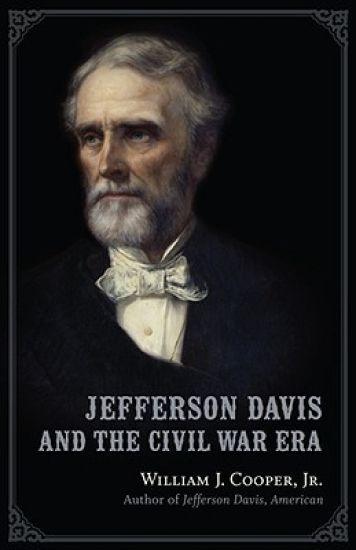
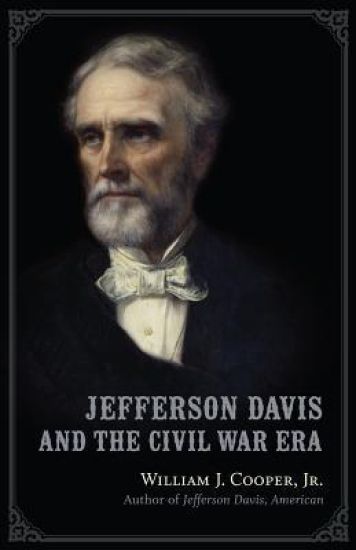
In his masterpiece, Jefferson Davis, American, William J. Cooper, Jr., crafted a sweeping, definitive biography and established himself as the foremost scholar on the intriguing Confederate president. Cooper narrows his focus considerably in Jefferson Davis and the Civil War Era, training his expert eye specifically on Davis's participation in and influence on events central to the American Civil War. Nine self-contained essays address how Davis reacted to and dealt with a variety of issues that were key to the coming of the war, the war itself, or in memorializing the war, sharply illuminating Davis's role during those turbulent years.Cooper opens with an analysis of Davis as an antebellum politician, challenging the standard view of Davis as either a dogmatic priest of principle or an inept bureaucrat. Next, he looks closely at Davis's complex association with secession, which included, surprisingly, a profound devotion to the Union. Six studies explore Davis and the Confederate experience, with topics including states' rights, the politics of command and strategic decisions, Davis in the role of war leader, the war in the West, and the meaning of the war. The final essay compares and contrasts Davis's first inauguration in Montgomery, Alabama, in 1861 with a little-known dedication of a monument to Confederate soldiers in the same city twenty-five years later. In 1886, Davis -- an old man of seventy-eight and in poor health -- had himself become a living monument, Cooper explains, and was an essential element in the formation of the Lost Cause ideology.Cooper's succinct interpretations provide straightforward, compact, and deceptively deep new approaches to understanding Davis during the most critical time in his life. Certain to stimulate further thought and spark debate, Jefferson Davis and the Civil War Era offers rare insight into one of American history's most complicated and provocative figures.
The Papers of Jefferson Davis

The Papers of Jefferson Davis

Jefferson Davis

Louisiana State University Press
2012
sidottu
Volume 13 of The Papers of Jefferson Davis follows the former president of the Confederacy as he becomes head of the Carolina Life Insurance Company of Memphis and attempts to gain a financial foothold for his newly reunited family. Having lost everything in the Civil War and spent two years immediately afterwards in federal prison, Davis faced a mounting array of financial woes, health problems, and family illnesses and tragedies in the 1870s. Despite setbacks during this decade, Davis also began a quest to rehabilitate his image and protect his historical legacy. Although his position with the insurance company provided temporary financial stability, Davis resigned after the Panic of 1873 forced the sale of the company and its new owners canceled payments to Carolina policyholders. He left for England the following year in search of employment and to recuperate from ongoing illnesses. In 1876, Davis became president of the London-based Mississippi Valley Society and relocated to New Orleans to run the company. Throughout the 1870s, Davis waged an expensive and seemingly endless legal battle to regain his prewar Mississippi plantation, Brierfield. He also began working on his memoirs at Beauvoir, the Gulf Coast estate of a family friend. Though disfranchised, Davis addressed the subject of politics with more frequency during this decade, criticizing the Reconstruction policies of the federal government while defending the South and the former Confederacy. The volume ends with Davis's inheritance of Beauvoir, which was his last home. The editors have drawn from over one hundred manuscript repositories and private collections in addition to numerous published sources in compiling Volume 13.
Jefferson Davis and the Civil War Era

Jefferson Davis and the Civil War Era

William J. Cooper Jr

Louisiana State University Press
2013
nidottu
In his masterpiece, Jefferson Davis, American, William J. Cooper, Jr., crafted a sweeping, definitive biography and established himself as the foremost scholar on the intriguing Confederate president. Cooper narrows his focus considerably in Jefferson Davis and the Civil War Era, training his expert eye specifically on Davis's participation in and influence on events central to the American Civil War. Nine self-contained essays address how Davis reacted to and dealt with a variety of issues that were key to the coming of the war, the war itself, or in memorializing the war, sharply illuminating Davis's role during those turbulent years.Cooper opens with an analysis of Davis as an antebellum politician, challenging the standard view of Davis as either a dogmatic priest of principle or an inept bureaucrat. Next, he looks closely at Davis's complex association with secession, which included, surprisingly, a profound devotion to the Union. Six studies explore Davis and the Confederate experience, with topics including states' rights, the politics of command and strategic decisions, Davis in the role of war leader, the war in the West, and the meaning of the war. The final essay compares and contrasts Davis's first inauguration in Montgomery, Alabama, in 1861 with a little-known dedication of a monument to Confederate soldiers in the same city twenty-five years later. In 1886, Davis -- an old man of seventy-eight and in poor health -- had himself become a living monument, Cooper explains, and was an essential element in the formation of the Lost Cause ideology.Cooper's succinct interpretations provide straightforward, compact, and deceptively deep new approaches to understanding Davis during the most critical time in his life. Certain to stimulate further thought and spark debate, Jefferson Davis and the Civil War Era offers rare insight into one of American history's most complicated and provocative figures.
The Papers of Jefferson Davis

The Papers of Jefferson Davis

Jefferson Davis

Louisiana State University Press
2015
sidottu
The final volume of The Papers of Jefferson Davis follows the former president of the Confederacy through the completion of his two monumental works on the history of the Confederate States of America. In the first, The Rise and Fall of the Confederate Government (1881), Davis sought to recast the Confederacy as a just and moral nation that was constitutionally correct in standing up for its rights. Himself the subject of heated debates about why the Confederacy lost, Davis also used the book to castigate Confederate government and military officials who he believed had failed the cause. Later, A Short History of the Confederate States (1890) attempted to burnish the image of the former Confederacy and to refute accusations of intentional mistreatment of Union prisoners. While completing these books, Davis attended and spoke at numerous Confederate memorial services and monument dedications, all the while waging a bitter feud with two of his former top generals-Joseph E. Johnston and P. G. T. Beauregard-over the reasons for the fall of the Confederacy. In late 1889, having returned to New Orleans from a trip to his plantation, Brierfield, Davis succumbed to pneumonia. His funeral procession attracted an estimated 150,000 mourners, a testament to the lasting popularity of the Confederacy's only president. In volume 14 of The Papers of Jefferson Davis, the editors have drawn from over one hundred manuscript repositories and private collections, in addition to numerous published sources, to offer a compelling portrait of Davis over the last decade of his life.
Jefferson and the Virginians

Jefferson and the Virginians

Peter Onuf

Louisiana State University Press
2018
sidottu
In Jefferson and the Virginians, renowned scholar Peter S. Onuf examines the ways in which Thomas Jefferson and his fellow Virginians, George Washington, James Madison, and Patrick Henry, both conceptualized their home state from a political and cultural perspective, and understood its position in the new American union. The conversations Onuf reconstructs offer glimpses into the struggle to define Virginia, and America, within the context of the upheaval of the Revolutionary War. Onuf also demonstrates why Jefferson's identity as a Virginian obscures more than it illuminates about his ideology and career.Onuf contends that Jefferson and his interlocutors sought to define Virginia's character as a self-constituted commonwealth and to determine the state's place in the American union during an era of constitutional change and political polarization. Thus, the outcome of the American Revolution led to ongoing controversies over the identity of Virginians and Americans as a ""people"" or ""peoples""; over Virginia's boundaries and jurisdiction within the union; and over the system of government in Virginia and for the states collectively. Each debate required a balanced consideration of corporate identity and collective interests, which inevitably raised broader questions about the character of the Articles of Confederation and the newly formed federal union. Onuf's well-researched study reveals how this indeterminacy demanded definition and, likewise, how the need for definition prompted further controversy.
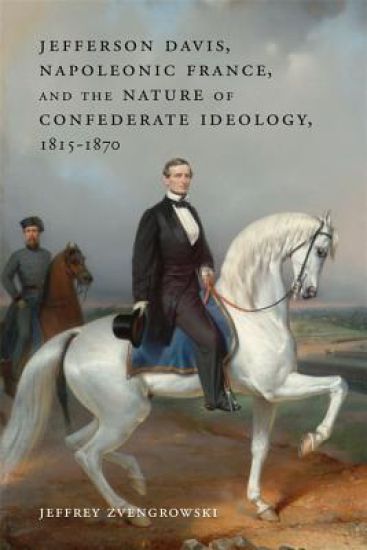
Jefferson Davis, Napoleonic France, and the Nature of Confederate Ideology, 1815-1870
In this highly original study of Confederate ideology and politics, Jeffrey Zvengrowski suggests that Confederate president Jefferson Davis and his supporters saw Bonapartist France as a model for the Confederate States of America. They viewed themselves as struggling not so much for the preservation of slavery but for antebellum Democratic ideals of equality and white supremacy. The faction dominated the Confederate government and deemed Republicans a coalition controlled by pro-British abolitionists championing inequality among whites. Like Napoleon I and Napoleon III, pro-Davis Confederates desired to build an industrial nation-state capable of waging Napoleonic-style warfare with large conscripted armies. States' rights, they believed, should not preclude the national government from exercising power. Anglophile anti-Davis Confederates, in contrast, advocated inequality among whites, favoured radical states' rights, and supported slavery-in-the-abstract theories that were dismissive of white supremacy. Having opposed pro-Davis Democrats before the war, they preferred decentralised guerrilla warfare to Napoleonic campaigns and hoped for support from Britain. The Confederacy, they avowed, would willingly become a de facto British agricultural colony upon achieving independence. Pro-Davis Confederates, wanted the Confederacy to become an ally of France and protector of sympathetic northern states.Zvengrowski traces the origins of the pro-Davis Confederate ideology to Jeffersonian Democrats and their faction of War Hawks, who lost power on the national level in the 1820s but regained it during Davis' term as secretary of war. Davis used this position to cultivate friendly relations with France and later warned northerners that the South would secede if Republicans captured the White House. When Lincoln won the 1860 election, Davis endorsed secession. The ideological heirs of the pro-British faction soon came to loathe Davis for antagonizing Britain and for offering to accept gradual emancipation in exchange for direct assistance from French soldiers in Mexico.Zvengrowski's important new interpretation of Confederate ideology situates the Civil War in a global context of imperial competition. It also shows how anti-Davis ex-Confederates came to dominate the postwar South and obscure the true nature of Confederate ideology. Furthermore, it updates the biographies of familiar characters: John C. Calhoun, who befriended Bonapartist officers; Davis, who was as much a Francophile as his namesake, Thomas Jefferson; and Robert E. Lee, who as West Point's superintendent mentored a grand-nephew of Napoleon I.
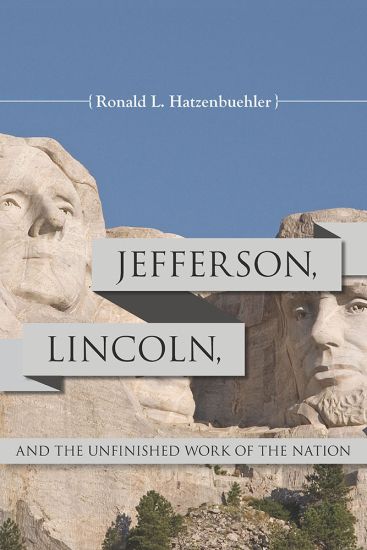
Jefferson, Lincoln, and the Unfinished Work of the Nation

Jefferson, Lincoln, and the Unfinished Work of the Nation

Ronald L. Hatzenbuehler

Southern Illinois University Press
2016
nidottu
Although the nation changed quite a bit between the presidential terms of Thomas Jefferson and Abraham Lincoln, these two leaders shared common interests and held remarkably similar opinions on important issues. In Jefferson, Lincoln, and the Unfinished Work of the Nation, Ronald L. Hatzenbuehler describes the views of two of our nation’s greatest presidents and explains how these views provide valuable insight into modern-day debates. In this groundbreaking new study—the first extended examination of the ideas of both Lincoln and Jefferson—Hatzenbuehler provides readers with a succinct guide to their opinions that still resonate today, comparing and contrasting their reasoned judgments on America’s republican form of government. Each chapter is devoted to one key area of common interest: race and slavery, the pros and cons of political parties, state rights versus federal authority, religion and the presidency, presidential powers under the Constitution, or the proper political economy for a republic. Relying on the pair’s own words in their letters, writings, and speeches, Hatzenbuehler explores similarities and differences between the two men on contentious issues. Both, for instance, wrote that they were antislavery, but Jefferson never acted on this belief, while Lincoln moved toward a constitutional amendment banning slavery. The book’s title, taken from the Gettysburg Address, builds on both presidents’ expectations that Americans should dedicate themselves to the unfinished work of returning the nation to its founding principles.Jefferson and Lincoln wrestled with many of the same ideas that intrigue and divide Americans today. In his thought-provoking work, Hatzenbuehler details how the two presidents addressed these ideas, which are essential to understanding not only America’s history but also the continuing influence of the past on the present.
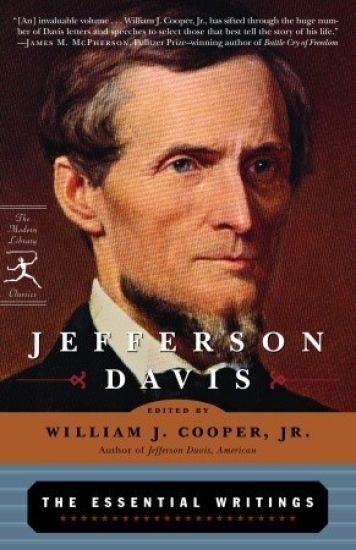
Jefferson Davis: The Essential Writings

Jefferson Davis: The Essential Writings

Jefferson Davis

RANDOM HOUSE USA INC
2004
pokkari
A definitive anthology of the writings by the president of the Confederacy presents a diverse array of letters, his inaugural address as Confederate president, writings from prison to his wife, and speeches on the Constitution, slavery, and other topics. Reprint. 12,500 first printing.
Jefferson's Poplar Forest

Jefferson's Poplar Forest

University Press of Florida
2016
nidottu
Thomas Jefferson once called his plantation Poplar Forest, the most valuable of my possessions. For Jefferson, Poplar Forest was a private retreat for him to escape the hoards of visitors and everyday pressures of his iconic estate, Monticello."Jefferson s Poplar Forest" uses the knowledge gained from long-term and interdisciplinary research to explore the experiences of a wide range of people who lived and worked there between the American Revolution and the Civil War. Multiple archaeological digs reveal details about the lives of Jefferson, subsequent owners and their families, and the slaves (and descendants) who laboured and toiled at the site. From the plantation house to the weeds in the garden, Barbara Heath, Jack Gary, and numerous contributors examine the landscapes of the property, investigating the relationships between the people, objects, and places of Poplar Forest. As the first book-length study of the archaeology of a president s estate, Jefferson's Poplar Forest offers a compelling and uniquely specific look into the lives of those who called Poplar Forest home.
Jefferson's Poplar Forest

Jefferson's Poplar Forest

University Press of Florida
2018
sidottu
One hundred years in the life of a founding father's 5,000 acre ""retreat"".Thomas Jefferson once called his plantation Poplar Forest, ""the most valuable of my possessions."" For Jefferson, Poplar Forest was a private retreat for him to escape the hoards of visitors and everyday pressures of his iconic estate, Monticello.Jefferson's Poplar Forest uses the knowledge gained from long-term and interdisciplinary research to explore the experiences of a wide range of people who lived and worked there between the American Revolution and the Civil War. Multiple archaeological digs reveal details about the lives of Jefferson, subsequent owners and their families, and the slaves (and descendants) who labored and toiled at the site. From the plantation house to the weeds in the garden, Barbara Heath, Jack Gary, and numerous contributors examine the landscapes of the property, investigating the relationships between the people, objects, and places of Poplar Forest. As the first book-length study of the archaeology of a president's estate, Jefferson's Poplar Forest offers a compelling and uniquely specific look into the lives of those who called Poplar Forest home.
Jefferson at Monticello

Jefferson at Monticello

University of Virginia Press
1967
nidottu
Covering the years from 1781 into the 1820s, these valuable accounts remain the chief source of information about Thomas Jefferson's domestic and personal life, interests, habits, appearance, and day-to-day activities at Monticello.Isaac Jefferson and Edmund Bacon were each sixty-five years old when their recollections were recorded. What they remember best, of course, are scenes from the past made vivid and immediate by details involving their own experience. Although their recollections of Jefferson differ in a number of ways, apparent in both accounts is a concern for the master whose involvement in national affairs made his life so different from their own.