Kirjojen hintavertailu. Mukana 11 244 527 kirjaa ja 12 kauppaa.

Kirjahaku

Etsi kirjoja tekijän nimen, kirjan nimen tai ISBN:n perusteella.

1000 tulosta hakusanalla Job

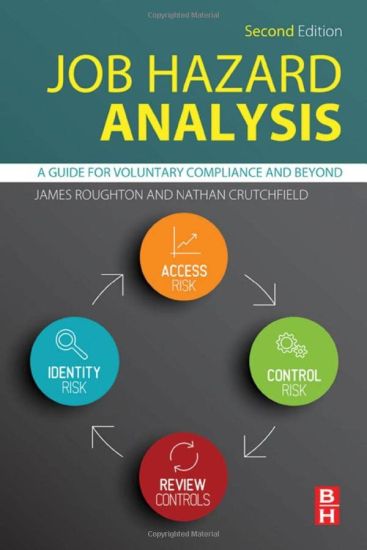
Job Hazard Analysis

Job Hazard Analysis

James Roughton; Nathan Crutchfield

Butterworth-Heinemann Inc
2015
nidottu
Job Hazard Analysis: A Guide for Voluntary Compliance and Beyond, Second Edition, provides a complete reference for performing JHA and setting up a JHA program. The book identifies the basic job steps and tasks, their associated hazards and risks, and safe operating procedures and hazard controls based on this analysis. Authors James Roughton and Nathan Crutchfield argue that the JHA should be the centerpiece of any risk control and occupational safety and health program. However, the traditional JHA has potential problems in gathering and analysis of task data and, with its focus on the sequence of steps, can miss the behavioral effects and the systems interactions between tools, equipment, materials, work environment, management and the individual worker. The concepts are presented for the JHA, incorporating elements from Behavior-Based Safety and Six Sigma. Readers are taken through the whole process of developing tools for identifying workplace hazards, developing systems that support hazard recognition, developing an effective JHA, and managing a JHA based program that can be easily incorporated into occupational safety and health management systems, thus allowing businesses to move from mere compliance to a pro-active safety management. The book is supported by numerous examples of JHAs, end of chapter review questions, sample checklists, action plans, and forms.
Job Searcher's Handbook, The

Job Searcher's Handbook, The

Carolyn Robbins

Pearson
2009
nidottu
This book is designed to provide simple, step by step instructions to help the student through the entire job searching process. Completely up-to-date, the book offers more information on the global workplace environment, electronic resumes, and Internet resources than any other text on the market. Its easy to follow, direct approach makes this book an effective tool for the job search. Hands-on exercises allow students to determine their individual needs, skills, and direction for securing the job that is right for them; sequentially-arranged chapters guide instructors in a logical process to the successful completion of a course.
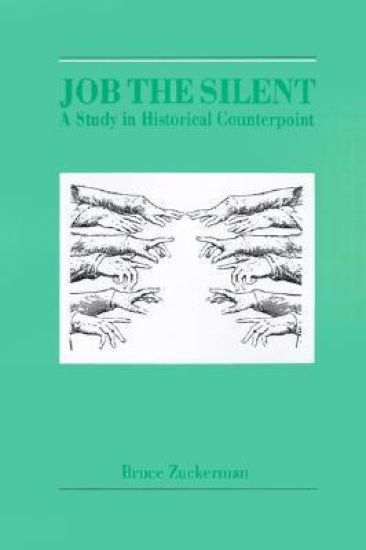
Job the Silent

Job the Silent

Bruce Zuckerman

Oxford University Press Inc
1991
sidottu
This remarkable work offers a brilliantly original reading of the book of Job, one of the great classics of biblical literature, and in the process develops a new formula for understanding how biblical texts evolve in the process of transmission. Zuckerman presents the thesis that the book of Job was intended as a parody the stereotypical righteous sufferer. In his most extended analogy, Zuckerman compares the book of Job and its fate to that of a famous Yiddish short story, `Bontshe Shvayg', another covert parody whose protagonist has come to be revered as a paradigm of innocent Jewish suffering. The history of this story is used to show how a literary text becomes separated from the intention of its author, and comes to have a quite different meaning for a specific community of readers.
Job the Silent

Job the Silent

Bruce Zuckerman

Oxford University Press Inc
1998
nidottu
This remarkable work offers a brilliantly original reading of the book of Job, one of the great classics of biblical literature, and in the process develops a new formula for understanding how biblical texts evolve in the process of transmission. Zuckerman presents the thesis that the book of Job was intended as a parody the stereotypical righteous sufferer. In his most extended analogy, Zuckerman compares the book of Job and its fate to that of a famous Yiddish short story, `Bontshe Shvayg', another covert parody whose protagonist has come to be revered as a paradigm of innocent Jewish suffering. The history of this story is used to show how a literary text becomes separated from the intention of its author, and comes to have a quite different meaning for a specific community of readers.
Job Matching, Wage Dispersion, and Unemployment

Job Matching, Wage Dispersion, and Unemployment

Dale T. Mortensen; Christopher A. Pissarides

Oxford University Press
2016
nidottu
Dale T. Mortensen and Christopher A. Pissarides are the recipients (with Peter Diamond) of the Nobel memorial Prize in Economics 2010. They have made path-breaking contributions to the analysis of markets with search and matching frictions, which account for much of the success of job search theory and the flows approach in becoming a leading tool for microeconomic and macroeconomic analysis of labor markets. Both scientists have gained groundbreaking insights through individual as well as joint research. Consequently, this volume not only features several papers which helped shape the equilibrium search model, including some early contributions which have initiated the research on what is known today as the search and matching model of the labor market, but it also presents a joint paper by the IZA Prize Laureates, which is a complete statement of the equilibrium search and matching model with endogenous job creation and job destruction. As part of the IZA Prize Series, the book presents a selection of their most important work which has highly enriched research on unemployment as an equilibrium phenomenon, on labor market dynamics, and on cyclical adjustment.
Job Matching, Wage Dispersion, and Unemployment

Job Matching, Wage Dispersion, and Unemployment

Dale T. Mortensen; Christopher A. Pissarides

Oxford University Press
2011
sidottu
Dale T. Mortensen and Christopher A. Pissarides are the recipients (with Peter Diamond) of the Nobel memorial Prize in Economics 2010. They have made path-breaking contributions to the analysis of markets with search and matching frictions, which account for much of the success of job search theory and the flows approach in becoming a leading tool for microeconomic and macroeconomic analysis of labor markets. Both scientists have gained groundbreaking insights through individual as well as joint research. Consequently, this volume not only features several papers which helped shape the equilibrium search model, including some early contributions which have initiated the research on what is known today as the search and matching model of the labor market, but it also presents a joint paper by the IZA Prize Laureates, which is a complete statement of the equilibrium search and matching model with endogenous job creation and job destruction. As part of the IZA Prize Series, the book presents a selection of their most important work which has highly enriched research on unemployment as an equilibrium phenomenon, on labor market dynamics, and on cyclical adjustment.
Job for You and Me

Job for You and Me

John Iles

Lulu.com
2019
pokkari
The story of Job in an easy to read form. The question of the reason for undeserved suffering. The attempts to explain. Ultimately there may be no answer except to accept it from God's hands. Suffering may test the genuineness of a Christian's faith and may be God's discipline.
Job/Security

Job/Security

Danny Goodwin; Edward Schwarzschild

MIT PRESS LTD
2024
sidottu
An illuminating collection of candid interviews and photographs with workers in America’s burgeoning security state.In a world increasingly under surveillance, this cutting-edge documentary collaboration turns the camera on the ever-expanding American security state. Job/Security bears photographic and narrative witness to the people tasked with safeguarding our modern world. In these uniquely revealing interviews and photographs, authors Danny Goodwin and Edward Schwarzschild assemble a multifaceted portrait of the labor of security. They offer a close-up, in-depth look at what the near-ubiquitous business of monitoring, guarding, and protecting life and property in the United States means for the individuals who do the work, and for the society they ostensibly serve. Representing a wide range of perspectives from inside this vast field, Job/Security features men and women who work in homeland security, border patrol, the secret service, and emergency management, among other fields. In candid terms, these enforcers, critics, and targets of security regimes describe their working lives—their jobs, routines, backgrounds, and families—as well as their feelings about what they do. Their stories offer a rare glimpse into the internal complexities of security work and fresh insight into what the encroaching security state is doing to America’s hearts and minds, one worker at a time, and to society at large, on an intimately human scale.
Job Crafting

Job Crafting

Benjamin Laker; Lebene Soga

MIT PRESS LTD
2024
sidottu
A practical and timely guide that shows employees how to craft the jobs they want and managers how to shape their organizations in ways that are conducive to such job crafting.Job Crafting is a rigorous, modern take on job redesign that empowers workers to transform the jobs they have into the ones they want. Through the process of job crafting, a worker proactively alters their job to emphasize tasks that better align with their skills or that allow opportunities to learn new skills, with the help of executives who are willing to transform their organizations into supportive work environments. Offering practical guidance grounded in empirical evidence, British researcher Benjamin Laker and coauthors Lebene Soga, Yemisi Bolade-Ogunfodun, and Adeyinka Adewale describe the steps necessary for businesses and organizations to facilitate that support.Rather than passively receive job titles and role descriptions, job crafters harness meaning at work through three primary avenues:exercising greater control over tasks,determining the way tasks are perceived, andshaping social context.Based on data from a previous study in which structured interviews were conducted with one thousand business leaders and two thousand of their workers around the world, the authors’ clear, four-step framework shows managers how to maximize staff engagement and productivity by building the systems, structures, and processes that empower workers to job craft. As new principles of stewardship, authenticity, and empowerment redefine the old command-and-control leadership approach, and generations Y and Z seek autonomy and purpose at work, job crafting offers a potential silver bullet to many workforce problems. Aimed at managers, executives, scholars, and executive education students, Job Crafting rejuvenates discussions of job design, leaving readers informed and ready to discuss how to improve their performance and satisfaction in all sectors.
Job For Everyone

Job For Everyone

John Goldingay

SPCK Publishing
2013
nidottu
Using personal anecdote, a witty and lively style, and drawing on his considerable theological knowledge, John Goldingay takes us deep into the unfolding story of the Old Testament.
Job 1-20, Volume 17

Job 1-20, Volume 17

David J. A. Clines

Zondervan
2015
sidottu
The Word Biblical Commentary delivers the best in biblical scholarship, from the leading scholars of our day who share a commitment to Scripture as divine revelation. This series emphasizes a thorough analysis of textual, linguistic, structural, and theological evidence. The result is judicious and balanced insight into the meanings of the text in the framework of biblical theology. These widely acclaimed commentaries serve as exceptional resources for the professional theologian and instructor, the seminary or university student, the working minister, and everyone concerned with building theological understanding from a solid base of biblical scholarship.Overview of Commentary OrganizationIntroduction—covers issues pertaining to the whole book, including context, date, authorship, composition, interpretive issues, purpose, and theology.Each section of the commentary includes:Pericope Bibliography—a helpful resource containing the most important works that pertain to each particular pericope.Translation—the author’s own translation of the biblical text, reflecting the end result of exegesis and attending to Hebrew and Greek idiomatic usage of words, phrases, and tenses, yet in reasonably good English.Notes—the author’s notes to the translation that address any textual variants, grammatical forms, syntactical constructions, basic meanings of words, and problems of translation.Form/Structure/Setting—a discussion of redaction, genre, sources, and tradition as they concern the origin of the pericope, its canonical form, and its relation to the biblical and extra-biblical contexts in order to illuminate the structure and character of the pericope. Rhetorical or compositional features important to understanding the passage are also introduced here.Comment—verse-by-verse interpretation of the text and dialogue with other interpreters, engaging with current opinion and scholarly research.Explanation—brings together all the results of the discussion in previous sections to expose the meaning and intention of the text at several levels: (1) within the context of the book itself; (2) its meaning in the OT or NT; (3) its place in the entire canon; (4) theological relevance to broader OT or NT issues.General Bibliography—occurring at the end of each volume, this extensive bibliographycontains all sources used anywhere in the commentary.
Job 21-37, Volume 18A

Job 21-37, Volume 18A

David J. A. Clines

Zondervan
2015
sidottu
The Word Biblical Commentary delivers the best in biblical scholarship, from the leading scholars of our day who share a commitment to Scripture as divine revelation. This series emphasizes a thorough analysis of textual, linguistic, structural, and theological evidence. The result is judicious and balanced insight into the meanings of the text in the framework of biblical theology. These widely acclaimed commentaries serve as exceptional resources for the professional theologian and instructor, the seminary or university student, the working minister, and everyone concerned with building theological understanding from a solid base of biblical scholarship.Overview of Commentary OrganizationIntroduction—covers issues pertaining to the whole book, including context, date, authorship, composition, interpretive issues, purpose, and theology.Each section of the commentary includes:Pericope Bibliography—a helpful resource containing the most important works that pertain to each particular pericope.Translation—the author’s own translation of the biblical text, reflecting the end result of exegesis and attending to Hebrew and Greek idiomatic usage of words, phrases, and tenses, yet in reasonably good English.Notes—the author’s notes to the translation that address any textual variants, grammatical forms, syntactical constructions, basic meanings of words, and problems of translation.Form/Structure/Setting—a discussion of redaction, genre, sources, and tradition as they concern the origin of the pericope, its canonical form, and its relation to the biblical and extra-biblical contexts in order to illuminate the structure and character of the pericope. Rhetorical or compositional features important to understanding the passage are also introduced here.Comment—verse-by-verse interpretation of the text and dialogue with other interpreters, engaging with current opinion and scholarly research.Explanation—brings together all the results of the discussion in previous sections to expose the meaning and intention of the text at several levels: (1) within the context of the book itself; (2) its meaning in the OT or NT; (3) its place in the entire canon; (4) theological relevance to broader OT or NT issues.General Bibliography—occurring at the end of each volume, this extensive bibliographycontains all sources used anywhere in the commentary.
Job 38-42, Volume 18B

Job 38-42, Volume 18B

David J. A. Clines

Zondervan
2015
sidottu
The Word Biblical Commentary delivers the best in biblical scholarship, from the leading scholars of our day who share a commitment to Scripture as divine revelation. This series emphasizes a thorough analysis of textual, linguistic, structural, and theological evidence. The result is judicious and balanced insight into the meanings of the text in the framework of biblical theology. These widely acclaimed commentaries serve as exceptional resources for the professional theologian and instructor, the seminary or university student, the working minister, and everyone concerned with building theological understanding from a solid base of biblical scholarship.Overview of Commentary OrganizationIntroduction—covers issues pertaining to the whole book, including context, date, authorship, composition, interpretive issues, purpose, and theology.Each section of the commentary includes:Pericope Bibliography—a helpful resource containing the most important works that pertain to each particular pericope.Translation—the author’s own translation of the biblical text, reflecting the end result of exegesis and attending to Hebrew and Greek idiomatic usage of words, phrases, and tenses, yet in reasonably good English.Notes—the author’s notes to the translation that address any textual variants, grammatical forms, syntactical constructions, basic meanings of words, and problems of translation.Form/Structure/Setting—a discussion of redaction, genre, sources, and tradition as they concern the origin of the pericope, its canonical form, and its relation to the biblical and extra-biblical contexts in order to illuminate the structure and character of the pericope. Rhetorical or compositional features important to understanding the passage are also introduced here.Comment—verse-by-verse interpretation of the text and dialogue with other interpreters, engaging with current opinion and scholarly research.Explanation—brings together all the results of the discussion in previous sections to expose the meaning and intention of the text at several levels: (1) within the context of the book itself; (2) its meaning in the OT or NT; (3) its place in the entire canon; (4) theological relevance to broader OT or NT issues.General Bibliography—occurring at the end of each volume, this extensive bibliographycontains all sources used anywhere in the commentary.
Job (3-Volume Set---17, 18A, and 18B)

Job (3-Volume Set---17, 18A, and 18B)

David J. A. Clines

Zondervan Academic
2017
sidottu
The Word Biblical Commentary delivers the best in biblical scholarship, from the leading scholars of our day who share a commitment to Scripture as divine revelation. This series emphasizes a thorough analysis of textual, linguistic, structural, and theological evidence. The result is judicious and balanced insight into the meanings of the text in the framework of biblical theology. These widely acclaimed commentaries serve as exceptional resources for the professional theologian and instructor, the seminary or university student, the working minister, and everyone concerned with building theological understanding from a solid base of biblical scholarship. Overview of Commentary Organization Introduction—covers issues pertaining to the whole book, including context, date, authorship, composition, interpretive issues, purpose, and theology. Each section of the commentary includes: Pericope Bibliography—a helpful resource containing the most important works that pertain to each particular pericope. Translation—the author’s own translation of the biblical text, reflecting the end result of exegesis and attending to Hebrew and Greek idiomatic usage of words, phrases, and tenses, yet in reasonably good English. Notes—the author’s notes to the translation that address any textual variants, grammatical forms, syntactical constructions, basic meanings of words, and problems of translation. Form/Structure/Setting—a discussion of redaction, genre, sources, and tradition as they concern the origin of the pericope, its canonical form, and its relation to the biblical and extra-biblical contexts in order to illuminate the structure and character of the pericope. Rhetorical or compositional features important to understanding the passage are also introduced here. Comment—verse-by-verse interpretation of the text and dialogue with other interpreters, engaging with current opinion and scholarly research. Explanation—brings together all the results of the discussion in previous sections to expose the meaning and intention of the text at several levels: (1) within the context of the book itself; (2) its meaning in the OT or NT; (3) its place in the entire canon; (4) theological relevance to broader OT or NT issues. General Bibliography—occurring at the end of each volume, this extensive bibliographycontains all sources used anywhere in the commentary.
Job of the Planning Commissioner

Job of the Planning Commissioner

Albert Solnit

Routledge
2019
sidottu
A popular and practical guide on how to be an effective planning commissioner. Filled with checklists and outlines, it's both a good introduction and a handy reference. Includes a training checklist for new commissioners, criteria for keeping a master plan in working order, lists of tools to guide growth, advice on how to deal with professional staff, and dos and don'ts for conducting successful public meetings. This edition sharpens the focus on how commissioners and their staffs can operate under four core principles for planning commissioners: citizen involvement, smaller is better, living in a market-driven system, and orderly growth.
Job of the Practicing Planner

Job of the Practicing Planner

Albert Solnit

Routledge
2019
sidottu
This practical handbook demystifies development review. It explains the tools of local regulation and the technical, bureaucratic, and organizational skills planners need to be effective. Solnit shows how to work with developers, evaluate projects, and use fiscal impact analysis. Includes a section on planning ethics, checklists, and tips on negotiating. Chapters by contributing authors cover subdivision plats, site plans, appearance codes, and writing zoning reports. The Job of the Practicing Planner is a perfect introductory textbook in classes for planners and a practical handbook for people already on the job.
Job's Body and the Dramatised Comedy of Moralising
This book focuses on the expressions used to describe Job’s body in pain and on the reactions of his friends to explore the moral and social world reflected in the language and the values that their speeches betray.A key contribution of this monograph is to highlight how the perspective of illness as retribution is powerfully refuted in Job’s speeches and, in particular, to show how this is achieved through comedy. Comedy in Job is a powerful weapon used to expose and ridicule the idea of retribution. Rejecting the approach of retrospective diagnosis, this monograph carefully analyses the expression of pain in Job focusing specifically on somatic language used in the deity attack metaphors, in the deity surveillance metaphors and in the language connected to the body and social status. These metaphors are analysed in a comparative way using research from medical anthropology and sociology which focuses on illness narratives and expressions of pain.Job's Body and the Dramatised Comedy of Moralising will be of interest to anyone working on the Book of Job, as well as those with an interest in suffering and pain in the Hebrew Bible more broadly.
Job Shop Lean

Job Shop Lean

Shahrukh A. Irani

CRC Press
2020
sidottu
In the 1950’s, the design and implementation of the Toyota Production System (TPS) within Toyota had begun. In the 1960’s, Group Technology (GT) and Cellular Manufacturing (CM) were used by Serck Audco Valves, a high-mix low-volume (HMLV) manufacturer in the United Kingdom, to guide enterprise-wide transformation. In 1996, the publication of the book Lean Thinking introduced the entire world to Lean. Job Shop Lean integrates Lean with GT and CM by using the five Principles of Lean to guide its implementation: (1) identify value, (2) map the value stream, (3) create flow, (4) establish pull, and (5) seek perfection. Unfortunately, the tools typically used to implement the Principles of Lean are incapable of solving the three Industrial Engineering problems that HMLV manufacturers face when implementing Lean: (1) finding the product families in a product mix with hundreds of different products, (2) designing a flexible factory layout that "fits" hundreds of different product routings, and (3) scheduling a multi-product multi-machine production system subject to finite capacity constraints.Based on the Author’s 20+ years of learning, teaching, researching, and implementing Job Shop Lean since 1999, this book Describes the concepts, tools, software, implementation methodology, and barriers to successful implementation of Lean in HMLV production systems Utilizes Production Flow Analysis instead of Value Stream Mapping to eliminate waste in different levels of any HMLV manufacturing enterprise Solves the three Industrial Engineering problems that were mentioned earlier using software like PFAST (Production Flow Analysis and Simplification Toolkit), Sgetti and Schedlyzer Explains how the one-at-a-time implementation of manufacturing cells constitutes a long-term strategy for Continuous Improvement Explains how product families and manufacturing cells are the basis for implementing flexible automation, machine monitoring, virtual cells, Manufacturing Execution Systems, and other elements of Industry 4.0 Teaches a new method, Value Network Mapping, to visualize large multi-product multi-machine production systems whose Value Streams share many processes Includes real success stories of Job Shop Lean implementation in a variety of production systems such as a forge shop, a machine shop, a fabrication facility and a shipping department Encourages any HMLV manufacturer planning to implement Job Shop Lean to leverage the co-curricular and extracurricular programs of an Industrial Engineering department