Kirjojen hintavertailu. Mukana 11 244 527 kirjaa ja 12 kauppaa.

Kirjahaku

Etsi kirjoja tekijän nimen, kirjan nimen tai ISBN:n perusteella.

1000 tulosta hakusanalla John R. Howe

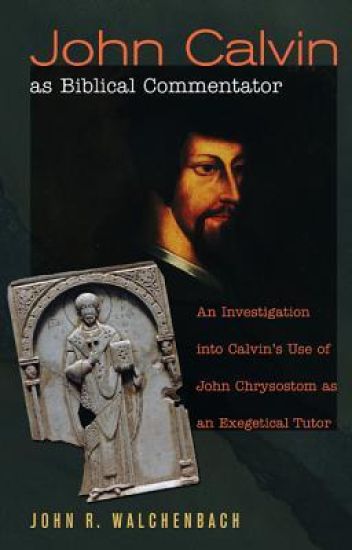
John Calvin as Biblical Commentator

John Calvin as Biblical Commentator

John R Jack Walchenbach

Wipf Stock Publishers
2010
sidottu
The year 2009 brought with it the 500th anniversary of the birth of John Calvin, a global celebration. With this commemorative event came a new and renewed appreciation for the life and thought of the French Reformer and his profound impact on the world. Scholars universally have acknowledged that while ""The Theologian of Geneva"" is mostly appreciated for his Institutes of the Christian Religion, it is Calvin as a biblical commentator that needs to be taken with revised interest. When Calvin first set out to write a commentary on virtually every book of the Bible, he was drawn to the exegetical work of the great Greek Patriarch of the fourth century, John Chrysostom, because of his ""straightforward, non-allegorical approach to the genuine, simple sense of the text."" It was also the method of Chrysostom to which Calvin was attracted, ""a continuous exposition"" that explains each verse. Calvin, in his life long work to produce commentaries on sacred Scripture, sought to emulate the approach and method of the amazing early church theologian, John Chrysostom. This book celebrates Calvin as Biblical commentator, and what he saw in the literary work of the Greek Father that was so influential on Calvin's immense contribution to our understanding the Bible. ""The publication of John Calvin as Biblical Commentator will at last bring the wide recognition that John Walchenbach's groundbreaking dissertation has always deserved. In one remarkable work he advanced two areas of Calvin research that were both in their infancy at the time: Calvin as biblical interpreter, and Calvin as a student of the early church teachers. Though both areas of Calvin research have grown considerably in recent years, Walchenbach's work is a benchmark to which we all return."" --Randall C. Zachman University of Notre Dame ""One of the first dissertations I ever bought was John Walchenbach's study of Calvin's use of Chrysostom, which was regarded as a kind of classic for the way it framed the history of exegesis questions in Calvin studies in terms of Calvin's use of this influential church father. Appearing in 1974, it was largely ahead of the pack in its field and served as a model for many of us who were cutting our teeth on Calvin and exegesis in the decade that followed. Students today can still benefit from studying Walchenbach's approach, arguments, and conclusions."" --John L. Thompson Fuller Theological Seminary ""John Calvin is best known as a reformer and theologian. However, biblical scholars as well as Calvin specialists point out the riches of his biblical expositions found in his sermons and commentaries as well as 'The Institutes.' What is frequently overlooked, however, is Calvin's indebtedness to Chrysostom, the greatest expositor of the early church. This outstanding study of Jack Walchenbach makes a distinctive contribution to our understanding of Calvin's exegetical approach."" --John Hesselink Western Theological Seminary, Emeritus John R. Walchenbach earned both the ThM and PhD under Ford Lewis Battles at Pittsburgh Theological Seminary and the University of Pittsburgh. He has served as a pastor in both the Reformed Church in America and the Presbyterian Church (USA). He is the author of a new curriculum on John Calvin for Congregational Ministries Publishing of the Presbyterian Church.
The Disciple Whom Jesus Loved: A Study of John

The Disciple Whom Jesus Loved: A Study of John

John R. Hargrove Th D.

Createspace Independent Publishing Platform
2016
nidottu
The Apostle John referred to himself as "The Disciple Whom Jesus Loved." That is because he was the best friends with out Lord. John knew so much about the love of God, and the power of that love. He wanted us to experience it as well. Bible teacher John R. Hargrove shows that all we really have to do is live God's way if we want to be successful. And, oh, what an experience it is to live the love of God through Jesus Christ God loved you enough to give His son to die in your place. Jesus took your sin and gave you His righteousness. The Apostle John wrote his gospel much later than the other three, because he had something to say about the love of God that had not yet been said. His is the most profound and deepest of Gospels. John, the Disciple Whom Jesus Loved, set out to prove the Messiahship and Godhood of Jesus Christ by the irrefutable proof of His miraculous signs. John wished to convince the Jews that the historical Jesus was the "Christ," the Jewish Messiah, the Savior of mankind. Bible scholar, John R. Hargrove takes you through the Gospel of John, verse by verse, in a comprehensive and enlightening study that we hope you will find rewarding.
The Other John

The Other John

John R Spencer

DeerVale Publishing
2024
pokkari
Five Books of the New Testament bear the name John. But which John? That apparently simple question has puzzled readers and commentators since the earliest centuries of the Christian Church. Some insist they know the answer. Others are skeptical. Some writers raise deep doubts about the author of the Fourth Gospel and dismiss it as the invention of a group of well-meaning disciples who really knew little of Jesus' life, or ministry. This Gospel's long discourses, they claim, are simply lovely theological make-believe. Others wonder if the same man - or someone else - wrote the three letters of the one who calls himself the Presbyter.Then there is The Apocalypse of John, known in translations as The Book of Revelation. Did the same man write this too? In The Other John, John R. Spencer takes a fresh, comprehensive look at the actual evidence within the books themselves, and from some of the earliest writers of the Christian Church. His conclusions will surprise you.
John Grote, Cambridge University and the Development of Victorian Thought
John Grote struggled to construct an intelligible account of philosophy at a time when radical change and sectarian conflict made understanding and clarity a rarity. This book answers three questions:* How did John Grote develop and contribute to modern Cambridge and British philosophy?* What is the significance of these contributions to modern philosophy in general and British Idealism and language philosophy in particular?* How were his ideas and his idealism incorporated into the modern philosophical tradition?Grote influenced his contemporaries, such as his students Henry Sidgwick and John Venn, in both style and content; he forged a brilliantly original philosophy of knowledge, ethics, politics and language, from a synthesis of the major British and European philosophies of his day; his social and political theory provide the origins of the 'new liberal' ideas later to reach their zenith in the writings of Green, Sidgwick, and Collingwood; he founded the 'Cambridge style' associated with Moore, Russell, Broad, McTaggart and Wittgenstein; and he was also a major influence on Oakeshott.
Life of the Most Reverend John Hughes, D.D., first archbishop of New York. With extracts from his private correspondence
This book has been considered by academicians and scholars of great significance and value to literature. This forms a part of the knowledge base for future generations. So that the book is never forgotten we have represented this book in a print format as the same form as it was originally first published. Hence any marks or annotations seen are left intentionally to preserve its true nature.
John James Audubon's Journal of 1826

John James Audubon's Journal of 1826

John James Audubon; John R. Knott

University of Nebraska Press
2011
sidottu
John James Audubon, an early American naturalist and painter, produced one of the greatest works of natural history and art of the nineteenth century, The Birds of America. As the record of the interior story of the making of this monumental work, his journal of 1826 is one of the richest documents in the history of American culture. The first accurate transcription of Audubon's 1826 journal, this edition corrects many of the errors, both intentional and unintentional, found in previous editions. Such errors have obscured the figure of Audubon as a man struggling to realize his professional and artistic dreams. When Audubon embarked for Liverpool from New Orleans in 1826, he carried with him more than 250 of his watercolor drawings in a heavy case, a packet of letters of introduction, and many a good reason to believe that he was a fool to be gambling his family's fortunes on so risky and grandiose a venture. These journal entries, conveying with energy and emotion Audubon's experience of risking everything on a dream—"Oh, America, Wife, Children and acquaintances, Farewell!"—document an American icon's transformation from a beleaguered backwoods artist and naturalist to the man who would become America's premier ornithologist, illustrator of birds, and nature essayist.
John James Audubon's Journal of 1826

John James Audubon's Journal of 1826

John James Audubon; John R. Knott

University of Nebraska Press
2017
pokkari
John James Audubon, an early American naturalist and painter, produced one of the greatest works of natural history and art of the nineteenth century, The Birds of America. As the record of the interior story of the making of this monumental work, his journal of 1826 is one of the richest documents in the history of American culture. The first accurate transcription of Audubon's 1826 journal, this edition corrects many of the errors, both intentional and unintentional, found in previous editions. Such errors have obscured the figure of Audubon as a man struggling to realize his professional and artistic dreams. When Audubon embarked for Liverpool from New Orleans in 1826, he carried with him more than 250 of his watercolor drawings in a heavy case, a packet of letters of introduction, and many a good reason to believe that he was a fool to be gambling his family's fortunes on so risky and grandiose a venture. These journal entries, conveying with energy and emotion Audubon's experience of risking everything on a dream—"Oh, America, Wife, Children and acquaintances, Farewell!"—document an American icon's transformation from a beleaguered backwoods artist and naturalist to the man who would become America's premier ornithologist, illustrator of birds, and nature essayist.