Kirjojen hintavertailu. Mukana 11 342 296 kirjaa ja 12 kauppaa.

Kirjahaku

Etsi kirjoja tekijän nimen, kirjan nimen tai ISBN:n perusteella.

1000 tulosta hakusanalla John Stuart

A song of heroes (1890) by John Stuart Blackie

A song of heroes (1890) by John Stuart Blackie

John Stuart Blackie

Createspace Independent Publishing Platform
2016
nidottu
He was born in Glasgow, on Charlotte Street, the son of Aberdeen banker, Alexander Blackie (d.1846) and Helen Stodart. He was educated at the New Academy and afterwards at the Marischal College, in Aberdeen, where his father was manager of the Commercial Bank. After attending classes at Edinburgh University (1825-1826), Blackie spent three years at Aberdeen as a student of theology. In 1829 he went to Germany, and after studying at G ttingen and Berlin (where he came under the influence of Heeren, Otfried M ller, Schleiermacher, Neander and B ckh) he accompanied Bunsen to Italy and Rome. The years spent abroad extinguished his former wish to enter the Church, and at his father's desire he gave himself up to the study of law. He had already, in 1824, been placed in a lawyer's office, but only remained there six months. By the time he was admitted a member of the Faculty of Advocates (1834) he had acquired a strong love of the classics and a taste for letters in general. A translation of Goethe's Faust, which he published in 1834, met with considerable success, winning the approbation of Carlyle. After a year or two of desultory literary work he was (May 1839) appointed to the newly instituted chair of Humanity (Latin) in the Marischal College.
The Wise Men of Greece (1877) BY John Stuart Blackie

The Wise Men of Greece (1877) BY John Stuart Blackie

John Stuart Blackie

Createspace Independent Publishing Platform
2016
nidottu
Biography He was born in Glasgow, on Charlotte Street, the son of Aberdeen banker, Alexander Blackie (d.1846) and Helen Stodart. He was educated at the New Academy and afterwards at the Marischal College, in Aberdeen, where his father was manager of the Commercial Bank. After attending classes at Edinburgh University (1825-1826), Blackie spent three years at Aberdeen as a student of theology. In 1829 he went to Germany, and after studying at G ttingen and Berlin (where he came under the influence of Heeren, Otfried M ller, Schleiermacher, Neander and B ckh) he accompanied Bunsen to Italy and Rome. The years spent abroad extinguished his former wish to enter the Church, and at his father's desire he gave himself up to the study of law. He had already, in 1824, been placed in a lawyer's office, but only remained there six months. By the time he was admitted a member of the Faculty of Advocates (1834) he had acquired a strong love of the classics and a taste for letters in general. A translation of Goethe's Faust, which he published in 1834, met with considerable success, winning the approbation of Carlyle. After a year or two of desultory literary work he was (May 1839) appointed to the newly instituted chair of Humanity (Latin) in the Marischal College. Difficulties arose in the way of his installation, owing to the action of the Presbytery on his refusing to sign unreservedly the Confession of Faith; but these were eventually overcome, and he took up his duties as professor in November 1841. In the following year he married. From the first his professorial lectures were conspicuous for the unconventional enthusiasm with which he endeavoured to revivify the study of the classics; and his growing reputation, added to the attention excited by a translation of Aeschylus which he published in 1850, led to his appointment in 1852 to the professorship of Greek at Edinburgh University, in succession to George Dunbar, a post which he continued to hold for thirty years.

Lays and Legends of Ancient Greece (1880) By John Stuart Blackie

Lays and Legends of Ancient Greece (1880) By John Stuart Blackie

John Stuart Blackie

Createspace Independent Publishing Platform
2016
nidottu
Biography He was born in Glasgow, on Charlotte Street, the son of Aberdeen banker, Alexander Blackie (d.1846) and Helen Stodart. He was educated at the New Academy and afterwards at the Marischal College, in Aberdeen, where his father was manager of the Commercial Bank. After attending classes at Edinburgh University (1825-1826), Blackie spent three years at Aberdeen as a student of theology. In 1829 he went to Germany, and after studying at G ttingen and Berlin (where he came under the influence of Heeren, Otfried M ller, Schleiermacher, Neander and B ckh) he accompanied Bunsen to Italy and Rome. The years spent abroad extinguished his former wish to enter the Church, and at his father's desire he gave himself up to the study of law. He had already, in 1824, been placed in a lawyer's office, but only remained there six months. By the time he was admitted a member of the Faculty of Advocates (1834) he had acquired a strong love of the classics and a taste for letters in general. A translation of Goethe's Faust, which he published in 1834, met with considerable success, winning the approbation of Carlyle. After a year or two of desultory literary work he was (May 1839) appointed to the newly instituted chair of Humanity (Latin) in the Marischal College. Difficulties arose in the way of his installation, owing to the action of the Presbytery on his refusing to sign unreservedly the Confession of Faith; but these were eventually overcome, and he took up his duties as professor in November 1841. In the following year he married. From the first his professorial lectures were conspicuous for the unconventional enthusiasm with which he endeavoured to revivify the study of the classics; and his growing reputation, added to the attention excited by a translation of Aeschylus which he published in 1850, led to his appointment in 1852 to the professorship of Greek at Edinburgh University, in succession to George Dunbar, a post which he continued to hold for thirty years.
The Wisdom of Goethe.by Johann Wolfgang von Goethe and John Stuart Blackie

The Wisdom of Goethe.by Johann Wolfgang von Goethe and John Stuart Blackie

John Stuart Blackie; Johann Wolfgang Von Goethe

Createspace Independent Publishing Platform
2016
nidottu
John Stuart Blackie Biography He was born in Glasgow, on Charlotte Street, the son of Aberdeen banker, Alexander Blackie (d.1846) and Helen Stodart. He was educated at the New Academy and afterwards at the Marischal College, in Aberdeen, where his father was manager of the Commercial Bank. After attending classes at Edinburgh University (1825-1826), Blackie spent three years at Aberdeen as a student of theology. In 1829 he went to Germany, and after studying at G ttingen and Berlin (where he came under the influence of Heeren, Otfried M ller, Schleiermacher, Neander and B ckh) he accompanied Bunsen to Italy and Rome. The years spent abroad extinguished his former wish to enter the Church, and at his father's desire he gave himself up to the study of law. Johann Wolfgang von Goethe German: 28 August 1749 - 22 March 1832) was a German writer and statesman. His body of work includes epic and lyric poetry written in a variety of metres and styles; prose and verse dramas; memoirs; an autobiography; literary and aesthetic criticism; treatises on botany, anatomy, and colour; and four novels. In addition, numerous literary and scientific fragments, more than 10,000 letters, and nearly 3,000 drawings by him exist. A literary celebrity by the age of 25, Goethe was ennobled by the Duke of Saxe-Weimar, Karl August in 1782 after first taking up residence there in November 1775 following the success of his first novel, The Sorrows of Young Werther. He was an early participant in the Sturm und Drang literary movement. During his first ten years in Weimar, Goethe served as a member of the Duke's privy council, sat on the war and highway commissions, oversaw the reopening of silver mines in nearby Ilmenau, and implemented a series of administrative reforms at the University of Jena. He also contributed to the planning of Weimar's botanical park and the rebuilding of its Ducal Palace, which in 1998 were together designated a UNESCO World Heritage Site.
On Liberty John Stuart Mill

On Liberty John Stuart Mill

John Stuart Mill

Createspace Independent Publishing Platform
2017
nidottu
On Liberty is a philosophical work by English philosopher John Stuart Mill, originally intended as a short essay. The work, published in 1859, applies Mill's ethical system of utilitarianism to society and the state. Mill attempts to establish standards for the relationship between authority and liberty. He emphasizes the importance of individuality which he conceived as a prerequisite to the higher pleasures-the summum bonum of Utilitarianism. Furthermore, Mill criticized the errors of past attempts to defend individuality where, for example, democratic ideals resulted in the "tyranny of the majority"
Utilitarianism John Stuart Mill

Utilitarianism John Stuart Mill

John Stuart Mill

Createspace Independent Publishing Platform
2017
nidottu
John Stuart Mill's book Utilitarianism is a philosophical defense of utilitarianism in ethics. The essay first appeared as a series of three articles published in Fraser's Magazine in 1861; the articles were collected and reprinted as a single book in 1863. It went through four editions during Mill's lifetime with minor additions and revisions. Although Mill includes discussions of utilitarian ethical principles in other works such as On Liberty and The Subjection of Women, Utilitarianism contains Mill's only major discussion of the fundamental grounds for utilitarian ethical theory.
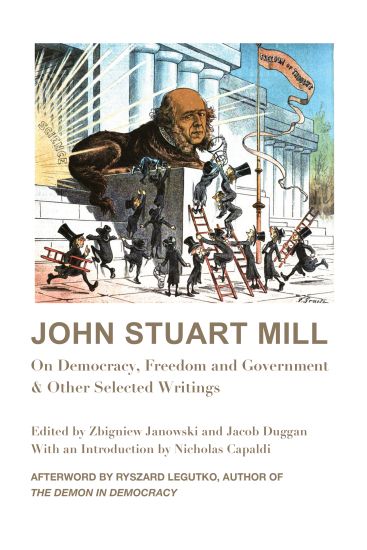
John Stuart Mill – On Democracy, Freedom and Government & Other Selected Writings

John Stuart Mill – On Democracy, Freedom and Government & Other Selected Writings

John Stuart Mill; Zbigniew Janowski; Jacob Duggan; Ryszard Legutko; Nicholas Capaldi

ST AUGUSTINE'S PRESS
2019
sidottu
In addition to “On Liberty” and “On Representative Government,” this new selection of Mill’s writings includes, among others, a number of less known of his writings, such as: “Civilization,” “Perfectibility,” “The Negro Question,” “On Education,” “On Aristocracy,” “On Marriage,” “On Free Press,” “Socialism,” Mill’s review of Tocqueville’s “Democracy in America,” his letters to Tocqueville, and several other writings. If one can use a somewhat exaggerated language, Mill’s writings are to liberal-democracy what Marx and Engels’ writings were to Communism. Both systems gave expression to 19th century man’s longing for equality and justice, both promised to liberate him from the shackles of oppression, authority and tradition. Instead of liberating man, Communism created the most brutal system in human history, and its spectacular fall in 1989 is one of history’s greatest events. Western world today shows that liberal-democracy is no longer a benign doctrine, which advocates free market, minimum state and individual liberties, but, like Communism, is an all-encompassing ideology which forces an individual to abdicate his freedom and soul in favor of a Communist-like collective. As many critics of real Socialism could see the seeds of totalitarianism in the writings of Marx and Engels, so one can see the seeds of liberal totalitarianism in Mill’s writings. This new edition is intended to help readers to understand why democratic-liberalism came so close to its 19th century ideological rival.
John Stuart Mill – On Democracy, Freedom and Government & Other Selected Writings

John Stuart Mill – On Democracy, Freedom and Government & Other Selected Writings

John Stuart Mill; Zbigniew Janowski; Jacob Duggan; Ryszard Legutko; Nicholas Capaldi

ST AUGUSTINE'S PRESS
2019
nidottu
In addition to “On Liberty” and “On Representative Government,” this new selection of Mill’s writings includes, among others, a number of less known of his writings, such as: “Civilization,” “Perfectibility,” “The Negro Question,” “On Education,” “On Aristocracy,” “On Marriage,” “On Free Press,” “Socialism,” Mill’s review of Tocqueville’s “Democracy in America,” his letters to Tocqueville, and several other writings. If one can use a somewhat exaggerated language, Mill’s writings are to liberal-democracy what Marx and Engels’ writings were to Communism. Both systems gave expression to 19th century man’s longing for equality and justice, both promised to liberate him from the shackles of oppression, authority and tradition. Instead of liberating man, Communism created the most brutal system in human history, and its spectacular fall in 1989 is one of history’s greatest events. Western world today shows that liberal-democracy is no longer a benign doctrine, which advocates free market, minimum state and individual liberties, but, like Communism, is an all-encompassing ideology which forces an individual to abdicate his freedom and soul in favor of a Communist-like collective. As many critics of real Socialism could see the seeds of totalitarianism in the writings of Marx and Engels, so one can see the seeds of liberal totalitarianism in Mill’s writings. This new edition is intended to help readers to understand why democratic-liberalism came so close to its 19th century ideological rival.
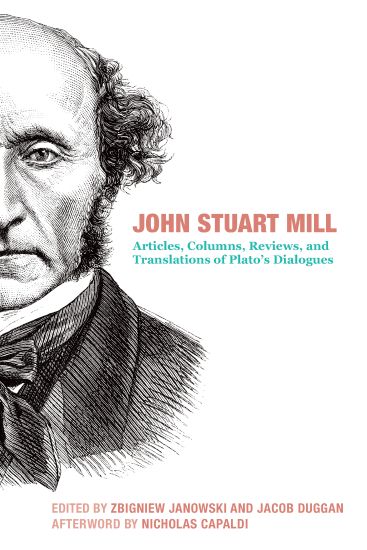
John Stuart Mill – Articles, Columns, Reviews and Translations of Plato`s Dialogues

John Stuart Mill – Articles, Columns, Reviews and Translations of Plato`s Dialogues

John Stuart Mill; Zbigniew Janowski; Jacob Duggan; Nicholas Capaldi

St. Augustine's Press
2022
sidottu
This is the second volume, following the well-received edition of Mill’s writing essential to understanding the liberal tradition. His commentary on a full spectrum of issues gives further insight into the strengths and vulnerabilities of liberal democratic theory in practice. Rare and difficult to locate material is here brought to attention and made available. The contribution of Mill’s most authoritative biographer, Nicholas Capaldi, is a singular and unmatched highlight. The tenor of St. Augustine’s Press volumed on Mill is distinct in its intention to place his work in the framework of political philosophy and the conversation of the viability of liberalism as a tradition of thought.
John Stuart Mill – Articles, Columns, Reviews and Translations of Plato`s Dialogues

John Stuart Mill – Articles, Columns, Reviews and Translations of Plato`s Dialogues

John Stuart Mill; Zbigniew Janowski; Jacob Duggan; Nicholas Capaldi

St. Augustine's Press
2022
nidottu
This is the second volume, following the well-received edition of Mill’s writing essential to understanding the liberal tradition. His commentary on a full spectrum of issues gives further insight into the strengths and vulnerabilities of liberal democratic theory in practice. Rare and difficult to locate material is here brought to attention and made available. The contribution of Mill’s most authoritative biographer, Nicholas Capaldi, is a singular and unmatched highlight. The tenor of St. Augustine’s Press volumed on Mill is distinct in its intention to place his work in the framework of political philosophy and the conversation of the viability of liberalism as a tradition of thought.
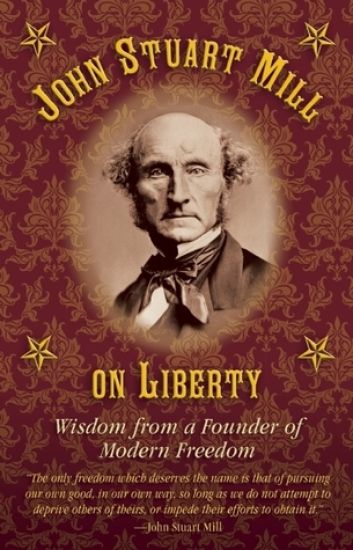
John Stuart Mill on Tyranny and Liberty
The United States was founded on the importance of civil liberties?protections for the individual against the control of others, whether those are other people or the government. Freedom for each person is a cornerstone of Western society. John Stuart Mill’s thoughts on liberty and the concept of freedom are among the most important frameworks on which we’ve built so much of modern society; our very ideas of limited government and personal freedom are rooted in the writings of this great political philosopher.John Stuart Mill on Liberty is a collection of some of the most important of his statements on the ideas of liberty and freedom. This book showcases his firm belief that each person should have the right to live as he or she wants to, so long as it does not harm anyone else. Much of what we now take for granted or still fight to maintain or advance, such as freedom of speech, the abolition of slavery, and the rights of women, are things Mill argued for. As you read his passionate entreaties for liberty, you’ll be amazed at how relevant and important they remain today.?In this age, the mere example of non-conformity, the mere refusal to bend the knee to custom, is itself a service.” ?John Stuart Mill
John Stuart Mill; His Life and Works

John Stuart Mill; His Life and Works

Herbert Spencer

Notion Press
2020
pokkari
Notion Press proudly brings to you timeless classics from ancient texts to popular modern classics. This carefully chosen collection of books is a celebration of literature, our tribute to the pioneers, the legends and the giants of the literary world.Apart from being the voice of indie writers, we also want to introduce every reader to read all kinds of literature.In this series, you will find a wide range of books--from popular classics like the works of Shakespeare and Charlotte Bront to rare gems by the likes of Edith Wharton and James Fenimore Cooper.