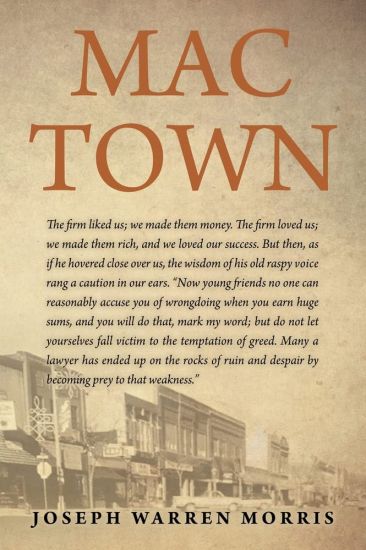
"Better born?" No, they weren't better born. Just born with more advantage. I came from a Christian family abounding in virtue and values and love, and with those qualities serving as a measure, I wagered, I ran near the front of the pack. What more did I need? "Do you know of some bank where I might try my luck?" my father tepidly asked, no alternative forging through for use in negotiating with a man whose wits he knew he couldn't match. "Planting is soon upon us." "Indeed Wow What a situation Two loves on your hands There is no greater predicament than to have a blessing and a curse descending on you at the same time." In him God blessed me with a second father. Everything that I am up to now I owe to my great friend. I tried not to dwell upon the sadness of his passing but instead on the brightness with which his light shone on those in his midst, especially on me. "Please Lord, not her too. See that she heals. Empower the doctors to guide her to wellness." "In every aspect she is a person of goodness; she often likes to say that the highest purpose of living this life is to do good, to be good, that goodness is love and love is goodness."
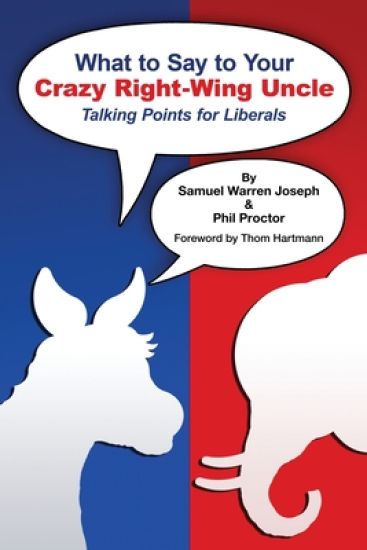
What to Say to Your Crazy Right-Wing Uncle is a fun, informative handbook for progressives to counter conservative talking points and disinformation. Full of funny and clever dialogue and political cartoons, this is a perfect gift for your political allies and the loved ones in your life who you are driving you nuts.Thom Hartmann, the number one progressive radio talk show host in the U.S., writes in the book's foreword: "In 'What to Say, ' Sam and Phil provide both a template for talking back to your Crazy Uncle (who's not really crazy, just misinformed) and a narrative script, both as example and detail. It's a small but important step in reclaiming truth and sanity in the midst of an insane and often nakedly untruthful media landscape."The book addresses such hot topics as Republican scandals, gun control, abortion, the Supreme Court, and income inequality. For instance, in the chapter "Kids in Cages", myths about immigration are debunked. In "Corruption Eruption," the Trump swamp are laid bare. In "Going to Pot," the pros and cons of legalization are examined, as well as many more current topics.
THE MAGIC MAZE TRILOGY includes three books: Tyler and Tess in the Magic Maze; Madness in the Magic Maze; and Escape from the Magic Maze. It is about eleven-year old fraternal twins, Tyler and Tess Porter, who accidentally get sucked up into the bizarre world of the Magic Maze. Geared to appeal to children from seven to thirteen and older fantasy fans as well, the story propels the twins into an "Alice in Wonderland/Wizard of Oz" world. In order to return home, they must get through twelve separate parts of the maze. Each is its own world with strange rules, riddles and puzzles that the twins must solve using their wits, knowledge and athletic prowess. Tyler and Tess learn how much they mean to each other as they evade the evil QUEEN ZEBRA and her ZENTAURIAN GUARD of two-faced POLINERDS, and a duplicitous wizard, SIMON PERCIVAL. They form alliances with the rebel TRIDGETS (tiny trolls with Mohawk hairdos) led by the feisty BELKIN, and an assortment of other bizarre and funny characters. At the end, they must track down and put back together three parts of a MAGIC AMULET before they can be finally transported home, safe and sound.
Contemporaries of the modest and unassuming scientist Joseph Leidy (1823–91) revered him as the supreme consultant in questions relating to human anatomy, paleontology, protozoology, parasitology, anthropology, mineralogy, botany, and numerous other scientific fields. Leidy’s achievements and the breadth of his scientific interests and knowledge were astonishing. He seemed, in short, to be the man who knew everything.This is the first published biography of the remarkable Joseph Leidy—a leading American scientist of the mid-nineteenth century, the foremost human anatomist of his time, the first truly productive microscopist, the author of numerous groundbreaking scientific papers and books, and a devoted professor at the University of Pennsylvania and Swarthmore College. An unflagging pioneer and an exceptional illustrator, Leidy was the first in America to use the microscope as a tool in forensic medicine. He established the concept of parasitism in America. He was also the father of American protozoology and parasitology, describing for the first time Trichina in the pig, the source of the human disease trichinosis. As the founder of American vertebrate paleontology, he was the first to describe a dinosaur and many other extinct animals in America. Leonard Warren provides a full account of Leidy’s life and accomplishments and sets them in the social and historical context of Philadelphia and the United States in Leidy’s day. Warren also explores the reasons for the puzzling disparity between Leidy’s fame and recognition during his life and virtual anonymity a century after his death.
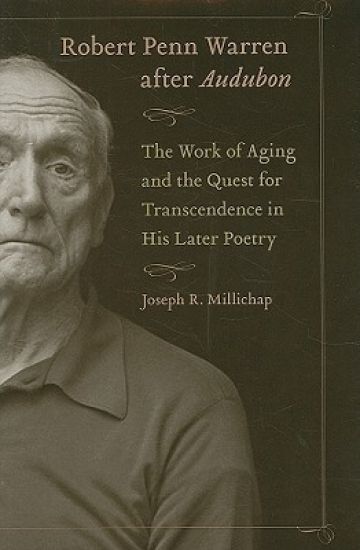
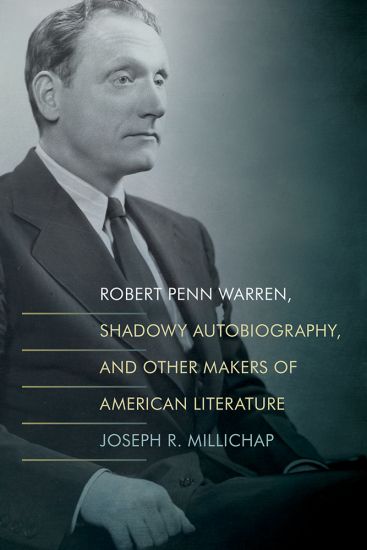
Despite nearly universal critical acclaim for Robert Penn Warren's later poetry, much about this large body of work remains unexplored, especially the psychological sources of these poems' remarkable energy. In this groundbreaking work, Warren scholar Joseph R. Millichap takes advantage of current research on developmental psychology, gerontology, and end-of-life studies to offer provocative new readings of Warren's later poems, which he defines as those published after Audubon: A Vision (1969). In these often intricate poems, Millichap sees something like an autobiographical epic focused on the process of aging, the inevitability of death, and the possibility of transcendence. Thus Warren's later poetry reviews an individual life seen whole, contemplates mortality and dissolution, and aspires to the literary sublime.Millichap locates the beginning of Warren's late period in the extraordinary collection Or Else: Poem/Poems 1968-1974, basing his contention on the book's complex, indeed obsessive sequencing of new, previously published, and previously collected poems unified by themes of time, memory, age, and death. Millichap offers innovative readings of Or Else and Warren's five other late gatherings of poems - Can I See Arcturus from Where I Stand?: Poems 1975; Now and Then: Poems 1976-1978, winner of the Pulitzer Prize; Being Here: Poetry 1977-1980; Rumor Verified: Poems 1979-1980; and Altitudes and Extensions 1980-1984.Among the autobiographical elements Millichap brings into his careful readings are Warren's loneliness in these later years, especially after the deaths of family members and friends; his alternating feelings of personal satisfaction and emptiness toward his literary achievements; and his sense of the power, and at times the impotence, of memory. Millichap's analysis explores how Warren often returned to images and themes of his earlier poems, especially those involving youth and midlife, with the new perspective given by advancing age and time's passage. Millichap also relates Warren's work to that of other poets who have dealt profoundly with memory and age, including Robert Frost, T. S. Eliot, Thomas Hardy, and, at times, John Milton, William Wordsworth, and the whole English and American nineteenth-century Romantic tradition.An epilogue traces Warren's changing reputation as a poet from the publication of his last volume in 1985 through his death in 1989 and the centennial of his birth in 2005, concluding persuasively that the finest of all of Warren's literary efforts can be found in his later poetry, concerned as it is with the work of aging and the quest for transcendence.
Toward the end of his career, Robert Penn Warren wrote, “It may be said that our lives are our own supreme fiction.” Although lauded for his writing in multiple genres, Warren never wrote an autobiography. Instead, he created his own “shadowy autobiography” in his poetry and prose, as well as his fiction and nonfiction. As one of the most thoughtful scholars on Robert Penn Warren and the literature of the South, Joseph Millichap builds on the accepted idea that Warren’s poetry and fiction became more autobiographical in his later years by demonstrating that that same progression is replicated in Warren’s literary criticism. This meticulously researched study reexamines in particular Warren’s later nonfiction in which autobiographical concerns come into play—that is, in those fraught with psychological crisis such as Democracy and Poetry.Millichap reveals the interrelated literary genres of autobiography, criticism, and poetry as psychological modes encompassing the interplay of Warren’s life and work in his later nonfiction. He also shows how Warren’s critical engagement with major American authors often centered on the ways their creative work intersected with their lives, thus generating both autobiographical criticism and the working out of Warren’s own autobiography under these influences. Millichap’s latest book focuses on Warren’s critical responses to William Faulkner, John Crowe Ransom, Herman Melville, Nathaniel Hawthorne, John Greenleaf Whittier, and Theodore Dreiser. In addition, the author carefully considers the black and female writers Warren assessed more briefly in American Literature: The Makers and the Making.Robert Penn Warren, Shadowy Autobiography, and Other Makers of American Literature presents the breadth of Millichap’s scholarship, the depth of his insight, and the maturity of his judgment, by giving us to understand that in his writing, Robert Penn Warren came to know his own vocation as a poet and critic—and as an American.